How I Built a $400K/Month Agency’s First Paid Ads Funnel
I hope you enjoy reading this blog post. If you want my team to just do your marketing for you, click here.
Author: Jeremy Haynes | Published August 13, 2026
Earnings Disclaimer: You have a .1% probability of hitting million-dollar months according to the US Bureau of Labor Statistics. As stated by law, we can not and do not make any guarantees about your own ability to get results or earn any money with our ideas, information, programs, or strategies. We don’t know you, and besides, your results in life are up to you. We’re here to help by giving you our greatest strategies to move you forward, faster. However, nothing on this page or any of our websites or emails is a promise or guarantee of future earnings. Any financial numbers referenced here, or on any of our sites or emails, are simply estimates or projections or past results, and should not be considered exact, actual, or as a promise of potential earnings, all numbers are illustrative only.
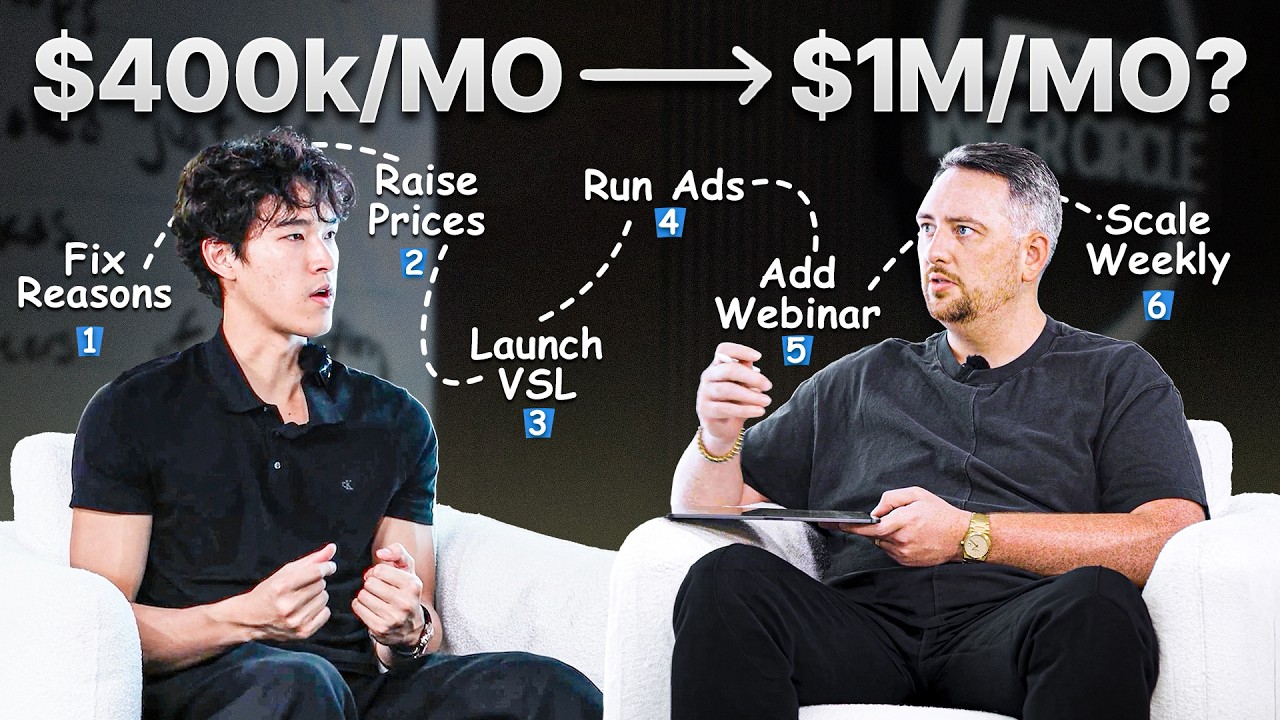
I sat down with a young founder whose organic-content agency had peaked at $400,000 per month and recently settled closer to $330,000. He had a proven offer, a $16,000 average upfront payment, and enough capital to test paid acquisition. The bottleneck was choosing a funnel his sales team could support. He also had to become willing to risk $10,000 on a business customers already backed with five-figure purchases. We left with a practical paid-ads funnel, a starting budget, and a next-day launch commitment.
Already making money? See what it takes to make a lot more.
Why a $400K Agency Still Needed Paid Acquisition
The agency helped established founders build organic-content systems. Its sales mix looked like this:
About 60% came from the $15,000 offer.
The balance was spread across $30,000 and $45,000 tiers.
Roughly three quarters of revenue came from the two lower tiers.
The average buyer paid about $16,000 upfront.
The acquisition engine was almost entirely organic. Two Instagram pages fed attention into two YouTube channels, and the channels reinforced each other. The broader channel created reach. The narrower channel handled specific problems, methods, and proof for people closer to buying.
That system had already generated several hundred thousand dollars per month, so the offer was validated. Revenue contracted when the founder pulled attention away from acquisition to rebuild fulfillment and reposition the business around a more established buyer.
Sales is breathing for a serious business. You can improve fulfillment while acquisition keeps running. Pausing one to repair the other creates the exact contraction this founder experienced, which is why I treat paid and organic growth as connected systems.
How the ICP Shift Changed the Funnel Decision
The original ideal customer was a business owner doing roughly $30,000 to $100,000 per month and trying to reach the next level. The new target was already doing six or seven figures per month, had a working acquisition channel, and wanted organic content to become another predictable channel.
That higher-level buyer has a narrower problem. They already know how to operate a business and make decisions. The missing piece is usually a content system, a capable internal owner, or a repeatable way to turn the founder’s ideas into output.
The offer was also evolving. Instead of training only the founder, the agency wanted to train or place the person responsible for internal content execution. The founder called that role a creative director. I pushed on the language because a market can want an outcome without using the same title you use internally.
Gartner’s B2B buying research says buyers move through problem identification, solution exploration, requirements building, and supplier selection across digital and human interactions. If the market does not already recognize creative director as the solution, the funnel has to connect that term to the outcome before asking for a call.
This is why I tell operators to speak to the highest-level person they want. A message built around the problems of a $100,000-per-month operator can still attract people below that mark. Messaging aimed at the floor makes bigger operators assume the offer was built for someone else.
Why Organic Closers Struggle With Cold Paid Traffic
The founder’s sales team had been closing people who consumed an unknown amount of Instagram and YouTube content before booking. These buyers arrived with context, trust, and a short list of questions. A straight calendar link could work because the content had already done most of the education.
Cold paid traffic changes the job. A prospect may know the problem but lack the vocabulary, proof, or awareness needed to value the mechanism. The closer now has to educate and sell during the same conversation.
That distinction matters more than the B2B label. Every buyer is still a person evaluating information. The right funnel depends on how much education that person needs and whether the sales team can provide it without losing control of the call.
I break down that gap in why cold traffic converts differently from organic leads. A sales team that looks excellent on warm inbound calls can struggle when the funnel stops doing the pre-selling for them.
How Webinar and VSL Funnels Solve Different Problems
A webinar was the higher-probability choice on paper. It could teach the new mechanism, establish why the role mattered, and deliver a more educated lead to a team accustomed to warm conversations. That made it a strong fit for the team’s current skill set.
A VSL call funnel was easier to launch. The page and operational pieces mostly existed, and the founder could script and film the core video quickly. The tradeoff was that the VSL and backend systems would have to shoulder enough education to keep cold prospects from arriving confused.
The offer itself affected the decision. If established operators already wanted someone to run internal content, a direct mechanism-led claim could cut through. If they wanted the result but did not recognize creative director as the solution, a webinar had more room to teach the category.
That is the decision rule. Use the webinar when the mechanism requires education and the sales team has mainly handled pre-sold leads. Use a VSL call funnel when the offer is easy to recognize or when the page and backend assets can close the education gap.
Why Running Both Funnels Would Slow the Learning
The founder had enough cash to test both a webinar and a VSL. Cash was not the limiting resource. Testing bandwidth was.
A call funnel creates a full chain of questions: Are CPMs healthy? Is the link click-through rate acceptable? Is the right person booking? What are the cost per call, show rate, close rate, and average order value? The VSL calculator turns those call-funnel inputs into a financial scenario. A webinar adds opt-in rate, live show rate, retention, booking rate, and the performance of the sales calls that follow.
When both launch at once, every weak metric competes for attention. The founder and team bounce between two pages, two messages, two follow-up systems, and two datasets. The American Psychological Association’s task-switching overview notes that repeated switches create time costs and errors, with some estimates reaching 40% of productive time.
Testing bandwidth is different from financial bandwidth. Pick one funnel, stay close to the data, and fix the most constraining metric before adding a second experiment.
How the Offer Needed to Be Simplified for Cold Buyers
The agency had three tiers, but a cold funnel did not need all three on the front end. The cleanest webinar offer was the $15,000 founder-training tier. Higher levels of access, team training, and placement could be introduced after the sales conversation clarified what the buyer already had.
Bundling founder training with creative-director training created an anchor problem for buyers without that employee. They could assume part of the price covered something they could not use. They might also conclude they needed to hire someone before the offer made sense.
The cleaner promise was an outcome the founder wanted regardless of team structure. If a buyer already had the right employee, the sales conversation could include training for that person. If they needed placement, the agency could introduce that path separately.
Placement offers can be strong when the market has already tried agencies or internal hiring and still lacks the result. The language has to match how buyers describe the gap. That is the same principle behind avoiding generic positioning that says nothing specific.
Why the $10K Ad Test Felt Harder Than It Was
The founder planned to spend $5,000 per webinar and run two webinars per month. His maximum planned exposure was $10,000, even though customers routinely placed five-figure bets on his company and he had spent far more on personal purchases. The webinar calculator makes that exposure easier to compare against the registrations, attendance, calls, and sales required to justify it.
I asked whether he would let me fund the same $10,000 and take 50% of the revenue after getting my money back. He rejected the deal because giving away half the upside made no sense. That exposed the contradiction: he believed the upside was valuable but still hesitated to fund the bet himself.
Organic felt safer because it was familiar. In reality, organic content can require months of production before a buyer converts. Paid traffic creates a shorter feedback loop. You can fund traffic, see calls arrive, and learn whether the message and sales process work within days.
The founder was treating the unknown like a grayed-out video-game map. The way to reveal the map is to move through it. A controlled paid test buys information even when the first version needs work.
Results are not typical. Your results will vary and depend entirely on your individual capacity, business experience, expertise, and level of desire. There are no guarantees concerning the level of success you may experience. The testimonials and examples used are not intended to represent or guarantee that anyone will achieve the same or similar results. We don’t believe in get-rich-quick programs. We believe in hard work, adding value and serving others. As stated by law, we can not and do not make any guarantees about your own ability to get results or earn any money with our information, courses, programs, or strategies.
Why the Final Decision Became a VSL Launch
The webinar still had the stronger theoretical fit. The founder could teach well, and the sales team benefited from pre-educated prospects. Yet the webinar had been two weeks away for more than a month. The date kept moving whenever we made the deadline concrete.
The VSL was the action he would actually take. He already had the offer, page infrastructure, operational support, and the ability to film. Waiting for the theoretically superior funnel would preserve indecision.
So the decision changed. Script and film the VSL that day. Edit it, launch traffic the next day, and use the first week of data to learn whether the market, page, or sales team needed more education.
This was not a permanent rejection of webinars. A live presentation could still become the next test after the founder established paid-acquisition momentum. The immediate job was to enter the market with the funnel he could execute.
What the First VSL Test Needed to Include
The first minute of the VSL needed to summarize the entire argument. The rest of the video could expand each point. This structure helps a cold visitor understand the promise and mechanism early, even if they do not watch every minute.
The team also needed to track play rate and engagement. A weak play rate would signal that the essential sales argument should move into a deck sales letter or additional page sections. My deck sales letter guide explains that alternative when visitors prefer to scan.
Video ads made more sense than static images for this test because the team needed education before the call. A lower click cost would mean little if those clicks created prospects the closers could not convert. A Think with Google case study shows what educational ads can do when buyers need help understanding a complex choice. Its campaign increased leads while lowering acquisition cost.
The $10,000 monthly test translated to a little over $300 per day. At an assumed $100 cost per call, that would produce about three calls daily. A week of data could reveal lead quality, show rate, sales feedback, and possibly an early close depending on the sales cycle.
How Backend Selling Supports the Cold-Traffic Test
The VSL could not carry the entire education burden alone. The team needed at least two pieces of the backend selling system: a proper confirmation page and value-dense emails before the call.
The confirmation page should include short breakout videos that answer the questions prospects repeatedly ask. It can explain the offer, mechanism, expectations, and proof while the buyer is still paying attention after booking.
The email sequence should deliver the key realizations that organic buyers normally collect over weeks of content. The team was aiming for 40% to 60% open rates and needed the messages to cover the beliefs prospects should hold before speaking with a closer. I explain the format in my guide to value-dense email sequences.
If paid leads arrived less educated, the answer would be visible in the call feedback. The team could strengthen the VSL, page, confirmation videos, and emails. If that still failed to close the gap, the evidence would make the webinar decision easier.
7 weeks. Real frameworks. Covering copywriting, funnels, paid ads, and conversion systems.
What This $400K Funnel Build Actually Proved
This founder did not need another month of abstract funnel planning. He needed one paid-acquisition bet that matched the sales team, simplified the offer, and produced data quickly enough to replace fear with evidence.
The plan was specific: a VSL call funnel for the $15,000 offer, video ads, roughly $300 per day, a summary in the first minute, play-rate monitoring, confirmation-page education, and value-dense emails. The webinar remained available once the team had enough paid-traffic experience to earn a second test.
My Inner Circle is where operators work through growth decisions like this with people facing similar constraints. For the full acquisition and funnel infrastructure, Master Internet Marketing, our 7-week live comprehensive training, covers the systems behind paid traffic, sales conversion, and sustainable growth.
Results are not typical. Your results will vary and depend entirely on your individual capacity, business experience, expertise, and level of desire. There are no guarantees concerning the level of success you may experience. The testimonials and examples used are not intended to represent or guarantee that anyone will achieve the same or similar results. We don’t believe in get-rich-quick programs. We believe in hard work, adding value and serving others. As stated by law, we can not and do not make any guarantees about your own ability to get results or earn any money with our information, courses, programs, or strategies.
Get my content first on Google
Add jeremyhaynes.com as a preferred source and Google shows my articles more prominently in your search results, including AI Overviews and AI Mode.

Jeremy Haynes
Owner and CEO of Megalodon Marketing
Jeremy Haynes is the founder of Megalodon Marketing. He is considered one of the top digital marketers and has the results to back it up.