How to Build VSL Call Funnels That Scale to Million Dollar Months Step by Step
I hope you enjoy reading this blog post. If you want my team to just do your marketing for you, click here.
Author: Jeremy Haynes | Published December 16, 2025
Earnings Disclaimer: You have a .1% probability of hitting million-dollar months according to the US Bureau of Labor Statistics. As stated by law, we can not and do not make any guarantees about your own ability to get results or earn any money with our ideas, information, programs, or strategies. We don’t know you, and besides, your results in life are up to you. We’re here to help by giving you our greatest strategies to move you forward, faster. However, nothing on this page or any of our websites or emails is a promise or guarantee of future earnings. Any financial numbers referenced here, or on any of our sites or emails, are simply estimates or projections or past results, and should not be considered exact, actual, or as a promise of potential earnings – all numbers are illustrative only.
Call funnels have been the backbone of scaling businesses to million-dollar months. Embedding video on landing pages can increase conversions by up to 80%, making VSL call funnels one of the highest-converting mechanisms for high-ticket offers.
Out of the 41 different businesses we’ve helped scale to that level, call funnels have been a core conversion mechanism. In some instances, the only funnel used to get there.
I love talking about call funnels. They just make so much money.
So here’s what you need to do with your funnel, ad strategy, follow-up strategy, email marketing, confirmation pages, and sales team practices to maximize ROI and revenue.
If your business is already generating $100k+ per month, My Inner Circle is where you break through to the next level. Inside, I’ll help you identify and solve the bottlenecks holding you back so you can scale faster and with more clarity.
What Ad Strategy and Funnel Tools Work Best for Booking Qualified Sales Calls
Talking head ads work phenomenal at getting people to book calls.
These are just someone sitting down, talking to the camera, walking through a standard set of direct response ads.
The issue? You don’t want the wrong types of people coming through your funnels.
We have an entire resource on pixel conditioning best practices. I’d absolutely encourage you to consume that thoroughly because it talks about the importance of sending back the right people and never allowing the wrong people to come through.
Let’s talk about the funnel itself.
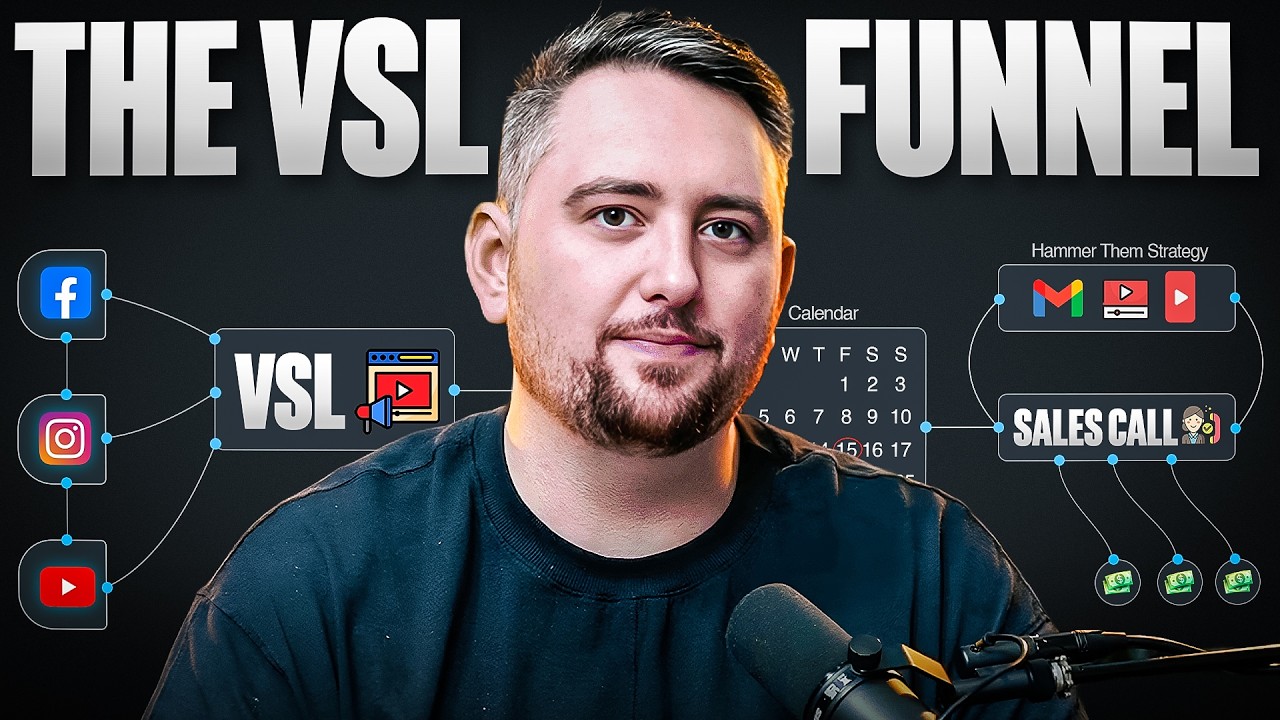
They’re still as simple as what we’ve historically run them. We do a headline, we do a video, and we do an application.
We still today have not found any replacement for the Typeform and Calendly combo.
I know some of you pay an exorbitant amount of money for HubSpot. I know some of you use GoHighLevel and other random platforms.
I don’t care. I will always test it.
I don’t want to be right. I just want to make money.
But the clients that have the lowest cost per qualified call use Typeform and Calendly.
So whenever I get my way in the deal and I can tell them to do this, it’s going to get us the cheapest cost per qualified call.
And obviously when we’re running a call funnel and we’re looking at our financial models, the lower the cost per qualified call, the more profit we make.
Generally from there, we’ll end up having two different outcomes for where people can go. We will have a qualified confirmation page where we send people who are obviously qualified. And then we will have an unqualified page for typically a drop cell.
Most organizations that we work with will have setters that dial the unqualified people. And they’ll have setters or closers that dial the most qualified people that schedule straight into their calendars.
For the qualified standard event that we’ll optimize for, we’ll use schedule or complete registration. Generally at scale we’ll use both.
On the qualified confirmation page, schedule and complete registration will fire off back to the ads manager and signal that somebody was qualified.
However, there are instances where we’ll get unqualified people to hit that pixel. When we get that feedback from the sales team, we’ll use the conversion API instead and link the CRM with different deal stages.
If a salesperson can signal after talking to somebody this individual was actually qualified, that’s the highest qualification metric we can get from salesperson feedback.
So we’ll take this person who is in that qualified bucket and push them back to the ads manager through the conversion API.
It all starts with pixel conditioning. That’s the moral of the story.
Why Your Ad Messaging Determines Whether You Attract Qualified or Unqualified Leads
Now, back to my point.
The direct response ads are pretty standard. We don’t have to do a lot of fancy things to get the calls booked.
This funnel is still very strong as a conversion mechanism.
The thing is,
Most people make pretty terrible direct response ads that have awful messaging inside of it that attract a lower quality person.
So the biggest thing you’re going to consistently see as a theme is dealing with unqualified people. And that obviously holds back the return on ad spend and the potential of scaling up this funnel to the big million-dollar months.
You have to handle quality.
Messaging ends up being one of those massive levers in terms of getting more qualified people through the door if executed successfully.
A great example, there was a guy recently doing around $300K a month that joins my Inner Circle. He has an offer that’s $10,000.
And man, this funnel this guy had was terrible. And the ads were also terrible.
It was all income claims. Audacious income claims at that.
They were like, “Hey, we’ll help you get to $10K a month in 90 days guaranteed or we’ll give you $1,000.”
These are two examples of really low-level sophistication tactics that attract absolute turds into your funnel and onto your calendars.
Rich people know when you’re trying to sell to somebody who’s going to buy a $10,000 offer, a guarantee does not create certainty. A guarantee does not create confidence.
A guarantee essentially signals to the people that are the most skeptical that they can have safety.
So what you’re actually getting as a buyer type is a highly skeptical individual that feels safe in the fact that you have a guarantee.
The people who are actually sophisticated buyers that are typically more financially well off look at guarantees and think, “I’ve been burned by so many people who have offered guarantees before and still haven’t gotten the outcome or my money back.”
They actually look at it as creating an objection.
Income claims are another great example. Super low, sophisticated tactic. No serious person is going to be highly responsive to income claims.
Take this exact site as a perfect example.
I constantly say the US Bureau of Labor Statistics says you have a 0.1% probability of hitting $10 million a year, let alone the even smaller probability to get to $12 million a year.
And I constantly reiterate, I don’t make income claims. I’m just handing down lessons from people who have hit million-dollar months to give you different things you could think with.
I do the exact opposite of income claims.
Why does that attract a higher quality person?
We get people all the time routinely that come through our funnels already at our exact buyer demographic, doing a couple hundred grand a month, meeting our minimum thresholds to buy our different offers.
Why?
Because I’m actually honest with them. I set a realistic expectation. I tell you the truth.
Does that negate the fact that you likely still with the utmost certainty believe it to be possible for you to hit million-dollar months?
You see what I’m saying?
I tell you the realistic expectation. I can’t guarantee the work you need to do with the things I tell you to go do. I can’t guarantee your consumption to go through the significant amount of material that I can provide to you.
But what I can do is provide it to you. That’s what I can guarantee.
That creates an opportunity for a more sophisticated buyer who’s much more financially well off to be responsive to it.
So anyway, the point I’m trying to make, messaging is one of the number one things that creates huge discrepancies right off the bat.
Don’t create objections for people in your messaging.
How Adding Chapters to Your VSL Increases Engagement and Lead Quality by 37 Percent
One thing that we’ve also recently tested is the length of time that we’re actually seeing people consume VSLs has gone up dramatically.
One of my Inner Circle members, Daniel Fazio, had done a speaking gig at one of our recent masterminds. He was awarded a million-dollar a month trophy after hitting it in late Q4.
In that talk, he shared adding chapters to a VSL.
You know how on YouTube you can see all the little chapters? Or if you’re on mobile device, you can see what’s talked about and when?
He implemented that in his VSLs and he saw a huge lift in overall retention and people coming through more qualified as a result.
We’ve since immediately implemented it across everybody that’s running a call funnel.
Typically what you see if you use a platform like Wistia or Vidalytics that gives you insight into user behavior, people typically jump around or watch the first part and then leave.
The chapter titles being implemented obviously caused people to still jump around, but it also enabled them to go back and watch very specific parts or skip parts that they deemed they didn’t need.
Some people like to argue, “Oh, well, I don’t want to have a chapter title on my video because then people are going to jump around.”
That’s just not how humans behave.
When somebody thinks that something’s for them, they’re going to just go apply and go through the funnel. When somebody thinks it’s not for them, they’re going to leave.
When you give them the opportunity to scrub through it with the different chapter titles, you give an opportunity for them to scrub past the things that you think they need to consume that they don’t care about to get them to the point of what they actually think they need to know.
Which ultimately leads them to have a higher probability to take the action, which is applying and then scheduling a call and coming through better framed.
What to Put on Your Confirmation Page to Get Sixty to Seventy Percent Show Rates
The next thing that we found works extremely well is confirmation page best practices.
We’ve called these the due diligence best practices recently where we’ve really stepped up helping people do their research prior to getting onto a call.
Typically on a confirmation page, we’ll have some type of confirmation-based headline demonstrating, hey, your call’s booked.
And once we get past that part, we generally have a few things on the page.
We have a video here with a video thumbnail and those chapter titles. And then from there, there are two main sections that we’re going to create.
One of these sections is what we call breakout videos.
Look at it like this. Everything that happens on your sales call that your salespeople don’t like having to talk about or that they notice is a pattern of people showing up and wanting to talk about and just asking common questions that consistently come up.
Those should be individual breakout videos.
All the things that you want to have made clear in your VSL that you’re consistently frustrated about saying, “Oh, people aren’t watching my VSL, so they don’t show up qualified.”
Great. Take those specific things that you want people to know before a call, make breakout videos for them.
You might end up having anywhere from four to upwards of 12 plus of these types of videos. They end up being anywhere from like 30 seconds to all the way up to maybe 5 minutes long.
These videos help people do their research. That’s the intention of them.
They help people understand the things that your salespeople are otherwise having to talk to them about. They also help improve the show rate dramatically.
Because you’d think that people are booking a call, obviously they want to show up and they want to talk to us.
That couldn’t be further than the truth for most of these people and that’s why your show rate is so bad.
You aren’t actually addressing the things that come up between them booking the call and the actual call time itself.
So that ultimately leads them to have an extremely low priority on showing up.
Instead, we have to after they book the call, sell them on why they need to show up and overcome the questions that they have before they actually show up.
I use this great example of a Dubai company.
I saw an ad that said, “Hey, we can create a corporation for you here in Dubai. You can flow all of your income through that corporation and offshore your profits. So therefore, you’ll zero out your taxes.”
I saw that ad and I was like, “Yeah, that’s for me.”
I booked a call. It was 9 days out from the time I booked the call.
Once I booked a call, it opens a cycle of something I’m now anticipating I have to talk about in the future, which makes me want to do research on it to see if it’s worth my time or not.
The Dubai company didn’t send me a single piece of information. Like nothing in the nine days. Just super basic reminder emails.
So guess what I did?
I did the research and I found that that claim was completely wrong. I’d have to renounce my US citizenship and move somewhere else to avoid the taxes.
Because the company didn’t help me in any way do research, I deemed it as this isn’t worth my time.
They didn’t even try to reach out to me. I didn’t get a single selfie video from the sales rep. I didn’t get any communication from the sales rep. Nothing.
So obviously, I didn’t show up.
So for the people who are going to do research, why not help them do their research?
And that all starts right on the confirmation page with those breakout videos.
The main confirmation page video should be relatively short. Hey, congratulations. You booked your call. Really excited to talk with you.
We view it from here forward between now and your call to help you understand this whole thing as much as we can to get you as much information as we can that’s actually beneficial to your buying process.
By the time you get to the call, we ideally want you to be in or out. That’s our objective.
So from here forward, you’re going to see a bunch of emails from us. You’re going to see some content that answers those types of questions. And right here on this very page below this video, you’ll see a bunch of those.
The other thing that you want to have on this page is testimonials.
Testimonials need to be believable. They need to be the average of your actual result that you’re going to help people get.
And they should ideally be below the breakout videos because the breakout videos have a far greater impact comparatively to just testimonial videos.
How Many Emails Per Day to Send Between Call Booking and Call Time
In addition to the confirmation pages, we have a very aggressive research-oriented email sequence.
This email sequence can be as high, give or take your audience, of about six emails a day. High-growth organizations report an average of 16 touchpoints per prospect within a 2-4 week span, demonstrating that aggressive follow-up sequences are standard for scaling businesses.
Keep in mind that would be 18 total emails assuming that you have a 72-hour duration of time between the person booking and the person showing up.
One current best practice is potentially intentionally spacing out the amount of time between a call booking and the time of the call itself.
Instead of just allowing people to book within a day, sometimes allowing them to book 2 days or 3 days out can be the most ideal booking window.
That way you can get a lot of this information off prior to the call.
I know six emails a day might sound like a ton.
But remember, when people actually want the information, we see open rates on this upwards of 60 to 70% for every single email that goes out.
When you combine that with what we call these research SOPs, these FAQ documents, and these breakout videos that you also work into your email sequences and your content remarketing campaigns, these become incredibly valuable that also ultimately get consumed a lot prior to the call.
How to Use Thirty to Fifty Pieces of Content to Get Leads Ready Before Calls
In addition to all of that, we have the hammer them strategy.
The hammer them strategy is incredible when it comes to helping people show up a lot better framed and further along in the sales process.
We typically do 30 to 50 pieces of short form content.
We try to do about 20 to 30 pieces of long form content.
And we try to retarget people within the key window anywhere as low as about 15 times to as high as about 20 plus times in terms of the ideal frequency.
What I’ve noticed is people try to execute this in a really half-hearted way.
I have not gotten to these numbers by accident or by just making them up.
I’ve tried it with far less content.
I work with busy, rich people for a living. The last thing I ever try to do for that demographic is overwhelm them with a ton of things that I need them to go and film.
So what I’ve noticed is people try to execute this halfway.
They only have short form. They don’t have long form. They’re not hitting the minimum frequency target within that time frame.
So you don’t get the outcome as a result of that.
You get the outcome of people showing up much further along in the sales process with all the common questions answered and being a lot better framed when you actually execute the strategy to the fullest extent.
You have to use content in all of these steps I’ve talked about.
The emails. The research FAQs and the SOPs. The hammer them content. The breakout videos on the confirmation page.
All of these have to be things that people going through your buying process care to know.
If you just use random things that you poorly come up with, you’ll get poor results.
Execute it right. Do all these things.
It’s almost impossible not to have at least 60 to 70% show rates when you do all of it the right way and not just some of it. 80% of successful sales require five or more follow-up touchpoints, proving that comprehensive pre-call nurture sequences are critical for conversion.
Why Sales Reps Texting from iPhones Before Calls Increases Show Rates Dramatically
The other main thing that we’ve seen drive a ton of lift is manual follow-up from the closer.
One of the number one influences of show rate and people being further along in the sales process is a salesperson successfully establishing communication pre-call.
That doesn’t mean an hour before the call.
That means as soon as the call gets assigned to them, ideally within those first few hours max, there’s a real human being texting the lead.
A salesperson from an iPhone texting the lead before the call has the highest delivery rate straight to where the person pays attention to the most, their text message inbox. SMS text messages have a 98% open rate compared to email’s 22% open rate, making text the most effective channel for pre-call communication.
And even greater than that, they send a selfie video.
Huge impacts on show rate and how far along people are in the sales process by a salesperson establishing communication prior to the call.
These people should obviously look trustworthy. They should look good. They should be presentable. They should sound professional.
But more importantly than anything else, they are helpful. They are research-oriented. They’re just trying to solicit communication prior to that call.
Where to Get Complete Call Funnel Training and SOPs to Scale Past Seven Figures
I have entire best practice documentation dedicated exclusively to show rate best practices for sales teams to use.
And I can’t stress it enough.
Check out one of our products.
You have offers like my Inner Circle which are for rich people trying to get a lot richer. And Master Internet Marketing for members who would like to train their staff or themselves on all the best practices from a digital marketing perspective.
Both have extensive libraries, dense amounts of information, access to all the SOPs we’ve created. And in addition to that, access to Jeremy AI.
People have used it for ad ideas, writing ad copy, writing landing page copy, creating webinars, creating VSL scripts.
It is not one of those frivolous surface level AI offers. It is extremely valuable.
It is trained on over 4 million data points just to put it in perspective for how much information and training material exclusively from me we’ve uploaded into it.
And here’s the craziest part. You won’t even understand this until you’re eventually in the paid product of your choice.
I withhold about 90%.
I could talk about this exact same topic in length to the inner circle members and I add 90% more to it with examples and all kinds of additional insight that I’ll never provide for you in free content.
I’m telling you as transparently as I can that this is 10% of the things that I can teach and talk to you about.
Think about that.
We have this combination of all of these things we’ve talked about.
And you must do all of them, not some of them, all of them in order to really maximize show rate and people showing up on the calls much further along.
I look forward to helping you more.
Everything that we talk about here is passing down lessons from the million-dollar a month earners that we’ve worked with and helped get there and just passing them down in bite-sized lessons like this to you.
Most business owners waste years figuring out what actually works. In my Master Internet Marketing program, I compress that learning curve into 7 weeks, covering copywriting, funnels, ads, and more. If you’re ready to invest $5k and get serious about your skills, apply here.
Looking forward to helping you get richer.
Watch the video:
Get my content first on Google
Add jeremyhaynes.com as a preferred source and Google shows my articles more prominently in your search results, including AI Overviews and AI Mode.

Jeremy Haynes
Owner and CEO of Megalodon Marketing
Jeremy Haynes is the founder of Megalodon Marketing. He is considered one of the top digital marketers and has the results to back it up.