
How I Would Scale an AI Agency Without Chasing Every Deal

I hope you enjoy reading this blog post. If you want my team to just do your marketing for you, click here.
Author: Jeremy Haynes | Published November 5, 2026
Earnings Disclaimer: You have a .1% probability of hitting million-dollar months according to the US Bureau of Labor Statistics. As stated by law, we cannot and do not make any guarantees about your own ability to get results or earn any money with our ideas, information, programs, or strategies. We don’t know you, and your results in life are up to you. We’re here to help by giving you our greatest strategies to move you forward, faster. However, nothing on this page or any of our websites or emails is a promise or guarantee of future earnings. Any financial numbers referenced here, or on any of our sites or emails, are simply estimates or projections or past results, and should not be considered exact, actual, or as a promise of potential earnings – all numbers are illustrative only.
An AI agency can have momentum and still make its next growth decision harder than it needs to be. The clients are buying, the content is working, and then a bigger custom project shows up. Now you’re considering a different buyer, a different delivery process, and another product while the business that created the opportunity still needs your attention.
I want to know how much further you can take what is already working before you start rebuilding the company around something else. That means understanding the offer, where demand comes from, what the sales team can close, and what delivery actually requires. More revenue attached to a proposal doesn’t answer those questions.
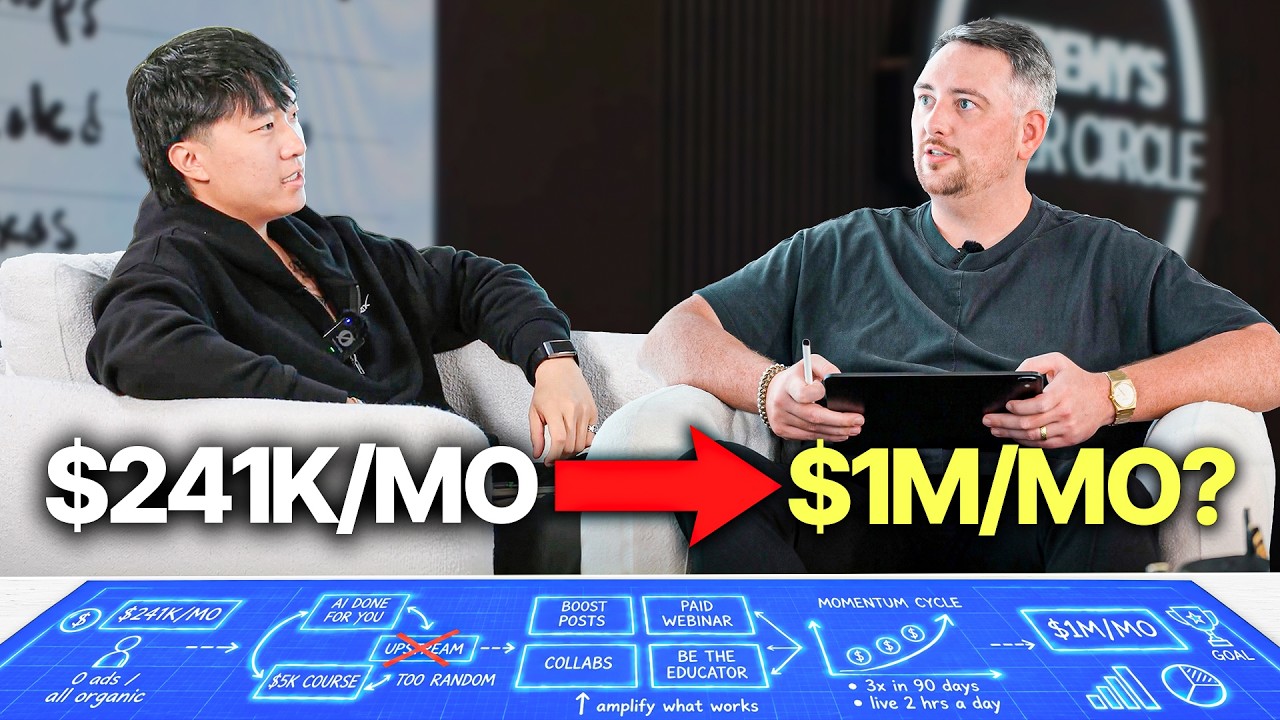
I worked through this with an operator selling AI implementation alongside education about selling AI. He also had a software product. The issue was deciding which opportunities deserved more attention and which would pull resources away from the momentum he already had.
Already making money? See what it takes to make a lot more.
Know Which Part of the AI Business Is Growing
Selling AI implementation, running an education business alongside the agency, and operating software are different commitments. They can serve related customers without requiring the same work.
The operator had demand for implementation and education. Long-form content was becoming a meaningful part of acquisition, and he was considering larger custom engagements. I wanted to understand what had changed before assuming the next move should be a different kind of deal.
Look at where the current demand is coming from and what you did differently while it grew. Did you publish more useful videos? Start going live? Explain the offer more clearly? Build relationships in a market where you already had experience?
Those details tell you what you might be able to amplify. A rising total with no understanding of its parts gives every new idea an equal chance of looking responsible for the growth.
Also recognize what the current money asks of you. Transactional implementation revenue comes with work to deliver. Recurring software revenue comes with a product to maintain and customers who can leave. An education offer has its own delivery and customer experience. Adding those numbers together doesn’t combine the responsibilities.
A Bigger AI Deal Can Require a Different Company
A large custom engagement can look like the obvious next step because the price is bigger. What matters is whether the work fits the company that has to fulfill it.
I have seen an operator add enough different AI services that the team became consumed by fulfillment. Each sale brought a different requirement, another type of client, and more work that didn’t repeat cleanly. He eventually stepped away from that service arrangement and refocused on the offer that had originally gained momentum.
The lesson is to look past the initial sale. If every new customer needs a different solution, you’re selling a collection of custom businesses through the same agency.
A bigger contract can compete with the growth of the business you already have. The same developers and customer-facing people who could improve the working offer may spend their time figuring out an unrelated engagement.
A clear service scope helps you see what you’re agreeing to deliver. The next question is whether that work belongs in the agency at all. Being able to build it is only part of that answer.
The Chocolate Factory Test for a New Service
I use a chocolate factory to explain the difference between a sensible variation and an entirely new undertaking. If the factory makes chocolate bars, another shape of chocolate may fit the equipment and ingredients already there.
A different kind of candy can require another production process. The fact that both products sit in the candy aisle doesn’t mean your factory is set up to make both.
Apply that to an AI agency. The next request might use the same tools, but does it use the same understanding of the customer, the same delivery work, and the same support? Or does the familiar technology hide a completely different engagement?
The answer has to hold during delivery. A project that sounds like a small variation can become a major undertaking once the customer’s material, feedback, and expectations arrive.
You don’t have to refuse every variation. I want you to recognize the difference before you treat a new production process as a harmless addition to the current one. The proposal price should sit beside that reality, rather than distract you from it.
Reusing the Technology Does Not Reuse the Work
I learned this while exploring AI clones for other people. We already had technology behind my own AI product, so making another clone sounded like a nearby opportunity.
Then the actual work arrived. Somebody else’s training material needed to be turned into usable instructions. Their documentation was different from mine. After the prototype, the feedback and requested changes created more work for the team.
The technology was familiar. The undertaking was much larger than that description suggested.
I had also pursued a more general agentic AI platform before reshaping the technology into Jeremy AI. The general platform needed its own marketing attention, sales, and fulfillment. Connecting the product to the work and knowledge people already sought from me made more sense for my business.
That doesn’t make software a bad opportunity. It means a software business deserves to be evaluated as a business. Building it and selling enough access to keep developing, supporting, and promoting it are different jobs.
Before you call a product an easy upsell, ask what your existing team stops doing to maintain it. If the answer is improving something with stronger existing demand, the opportunity has a cost beyond development.
You Can Help the Customer Without Owning Every Service
A customer need doesn’t automatically require another department inside your company. Sometimes the sensible response is connecting the person with somebody who already does the work.
In my Inner Circle, operators ask about people who can help with things such as editing. I could turn that demand into an editing service. But I also have to consider the management, time, and attention it would require compared with the work the team already does.
Results are not typical. Your results will vary and depend entirely on your individual capacity, business experience, expertise, and level of desire. There are no guarantees concerning the level of success you may experience. The testimonials and examples used are not intended to represent or guarantee that anyone will achieve the same or similar results. We don’t believe in get-rich-quick programs. We believe in hard work, adding value and serving others. As stated by law, we can not and do not make any guarantees about your own ability to get results or earn any money with our information, courses, programs, or strategies.
A useful referral can help the member without turning the request into another delivery obligation. Owning the customer relationship doesn’t mean you need to own every service they could purchase.
The same thinking applies to a software addition. If it genuinely supports the existing offer and remains manageable, there may be a reason to maintain it. If it requires a separate operation, compare that commitment with other ways to help the customer.
New opportunities will keep arriving. I’ve had unrelated ideas pitched by someone repairing equipment in my office, by people on my team, and by a business neighbor. The source of the idea doesn’t settle whether it deserves my attention.
Make Growth Decisions From the Business You Have Now
Your thinking can lag behind a business that has grown. You can keep making choices around the resources you used to have even after the situation changes.
I discussed this with another operator who kept prioritizing smaller, quicker deals despite already having experience with a much larger account. The longer sales cycle felt uncomfortable, so the easier sale kept getting the attention. I wanted him to reconsider that choice using his current circumstances.
That is different from taking on every bigger deal. You still need to understand the client, the economics, and what the engagement will require. The question is whether the reason you’re avoiding an opportunity is current or left over from an earlier version of the business.
I’ve made the opposite mistake too, putting money into an unrelated stock opportunity and then looking at the work inside my business that the same capital could have supported. An opportunity can consume money even when it asks for little of your time.
Protect profit while you test growth. Having more resources gives you more choices; it doesn’t make every possible use of those resources worthwhile. I want the next investment compared with the actual alternatives inside the company.
Find Where Content Demand Actually Comes From
Before putting money behind content, establish which content and placement are moving people. Saying “Instagram sends people to YouTube” is a starting point, not enough information to choose what to boost.
Look inside YouTube’s traffic-source reporting. If viewers discover the videos through YouTube itself, that matters. If external links are also contributing, that matters too. You don’t have to choose a story where only one platform deserves credit.
YouTube’s content-performance documentation distinguishes browse features, suggested videos, search, and external sources. External traffic includes websites and apps linking to or embedding the video. Use those distinctions before attributing all the views to promotion elsewhere.
Then look more closely at the promotion. A Story link and a Reel asking someone to request a resource can lead to different paths. If Stories generate the useful clicks, automatically boosting the Reels doesn’t follow from the evidence.
For destinations on a website using Analytics, Google’s campaign URL guidance explains how tagged links identify referring campaigns. Keep that traffic information alongside what buyers tell the sales team. A remembered video is useful context, but it doesn’t establish the whole path someone took.
Amplify the Content That Is Already Building Trust
The operator had increased his long-form publishing and added live content. Prospects were mentioning the live sessions in sales conversations. That was worth understanding before giving him the generic advice to publish more.
At a high publishing volume, more posts can stop being the most useful change. The quality, format, and subject of the next piece deserve attention too. You still need something worth distributing.
I would look at the explanations that make people understand the offer, recognize the problem, or ask a more informed question. A collaboration with someone whose audience already overlaps with yours may also be a useful way to expand something that works.
I’ve expanded into another platform and found it was mainly another place people could see me. By comparison, additional YouTube work and relevant collaborations have deserved more attention in my business. That is a reason to evaluate your next action against what is already contributing.
An organic post still needs a paid-ad test when you change how it reaches people. The point is to test a promising piece with a clear purpose, rather than put equal money behind everything you published.
Follower Growth Needs a Path Beyond the Follow
Paying to distribute content can be part of the plan, but the follow itself doesn’t finish the commercial work. The person needs a reason to keep paying attention and a way to take the next useful step.
I discussed an operator using boosted content to attract followers, then directing people toward further education with automated messages and human follow-up. The useful mechanism was the connection between discovery, continued attention, and a sales conversation.
The tracking was a real limitation. A campaign reporting followers doesn’t automatically tell you which buyers came from it. When several channels contribute, it can become harder to know what a particular spending change caused.
A cheap follow is not enough evidence to justify unlimited distribution. Look at what happens afterward and how confidently you can connect the spending with the business outcome. Keep uncertainty in the decision instead of making the report say more than it knows.
The connection between awareness, nurture, and conversion matters here. Content that attracts attention and content that helps someone choose can do different jobs. Your distribution should support that whole relationship.
Match the Paid Funnel to What Your Sales Team Can Close
Organic buyers may arrive after consuming substantial education. A cold paid prospect can book the same calendar and still arrive with very different understanding.
That changes the sales job. If your team is used to people who already understand the offer and trust the person behind it, handing them cold inquiries creates work the old process may never have required.
I would consider a webinar in that situation because it gives the business room to educate before the call. The funnel needs to match the sales team’s strengths. The right choice depends on what the buyer needs to understand and who is responsible for explaining it.
Different buying paths can also coexist. Some people prefer a message, others a direct booking path, and others a presentation. Let the path serve a real preference without treating every new funnel as another offer you need to invent.
If you are considering a webinar test, the webinar financial model lets you examine how your assumptions interact. Use your own inputs and treat the output as a scenario. It doesn’t establish what the campaign will earn.
Cold Buyers Need the Understanding Organic Built Over Time
Before declaring that the offer won’t work with cold traffic, examine the education around it. A buyer who hasn’t followed you can need the understanding your existing audience accumulated gradually.
In a crowded AI market, the prospect has other people making similar pitches. I think about the feed as a series of attempts to discover what somebody is interested in. Once the person engages with a subject, competing messages can become part of the buying experience.
I experienced that after buying chocolate cake through an ad and then seeing related food advertising. The useful point for an agency owner is to stop assuming your prospect evaluates your message in isolation. It is an observation about the buying environment, not a promise that every feed follows an identical sequence.
Take the educator position. Give somebody a useful explanation of the problem and the approach, with enough substance to compare what you’re offering. A copied pitch leaves very little reason to choose you over the next similar ad.
Be specific about what you can demonstrate. The FTC’s advertising guidance covers both express and implied claims. Showing an AI implementation doesn’t justify attaching an unsupported revenue promise to it.
Put the Buyer Realizations in the Right Order
Useful education changes what the buyer understands. I call those changes aha moments. On the paid side, I want to understand which realizations matter and bring them closer together.
I compare this with concentrated coffee. An organic relationship can spread the explanation over many encounters. A paid funnel needs a more concentrated version of the ideas that help someone understand why the offer matters.
When I started looking into better grass for my home, I discovered specialized equipment and work I hadn’t understood. That changed what I wanted from a landscaper. I wasn’t looking to do the work myself; I wanted somebody who could provide the outcome I had just learned was possible.
My interest in pinball developed through realizations too. First the game had to be interesting to me. Details about the different mechanisms became meaningful after that. Giving a person advanced details before they care about the category can miss the reason they would listen.
For AI services, start with the task the buyer recognizes. Then explain what changes, what is involved, and why your approach deserves consideration. Don’t assume technical features create interest before the person understands the problem.
Keep educating after the opt-in and before the call. The salesperson needs to explain the same ideas because a booking doesn’t mean the prospect consumed every resource you sent.
7 weeks. Real frameworks. Covering copywriting, funnels, paid ads, and conversion systems.
Test the Next Channel Without Abandoning the Working One
I would protect the existing momentum while beginning a manageable paid test. Waiting until organic demand stalls can make the learning period feel more pressured.
That doesn’t mean a new channel deserves most of the resources immediately. It needs room to learn without consuming the people, money, and attention keeping the current business healthy. A test can cost money and still fail to become a useful acquisition asset.
The first moves are connected. Keep making useful, distinctive content. Understand where it reaches buyers. Test further distribution where the evidence supports it, and choose a paid funnel that supplies the education your sales team needs.
At the same time, be more selective about the work you sell. A custom project that requires a new operation can interfere with all of those moves. You can pursue a stronger business without accepting every opportunity that appears beside it.
That connection between message, offer, funnel, and sales is part of Master Internet Marketing, my 7-week live comprehensive training. Before adding another service, ask what would happen if the team put that same effort into making the working business better. Give that option a fair comparison.
Results are not typical. Your results will vary and depend entirely on your individual capacity, business experience, expertise, and level of desire. There are no guarantees concerning the level of success you may experience. The testimonials and examples used are not intended to represent or guarantee that anyone will achieve the same or similar results. We don’t believe in get-rich-quick programs. We believe in hard work, adding value and serving others. As stated by law, we can not and do not make any guarantees about your own ability to get results or earn any money with our information, courses, programs, or strategies.
Get my content first on Google
Add jeremyhaynes.com as a preferred source and Google shows my articles more prominently in your search results, including AI Overviews and AI Mode.


Jeremy Haynes
Owner and CEO of Megalodon Marketing
Jeremy Haynes is the founder of Megalodon Marketing. He is considered one of the top digital marketers and has the results to back it up.