
What I Learned Growing My Education Business From $10M to $25M

I hope you enjoy reading this blog post. If you want my team to just do your marketing for you, click here.
Author: Jeremy Haynes | Published November 3, 2026
Earnings Disclaimer: You have a .1% probability of hitting million-dollar months according to the US Bureau of Labor Statistics. As stated by law, we cannot and do not make any guarantees about your own ability to get results or earn any money with our ideas, information, programs, or strategies. We don’t know you, and your results in life are up to you. We’re here to help by giving you our greatest strategies to move you forward, faster. However, nothing on this page or any of our websites or emails is a promise or guarantee of future earnings. Any financial numbers referenced here, or on any of our sites or emails, are simply estimates or projections or past results, and should not be considered exact, actual, or as a promise of potential earnings – all numbers are illustrative only.
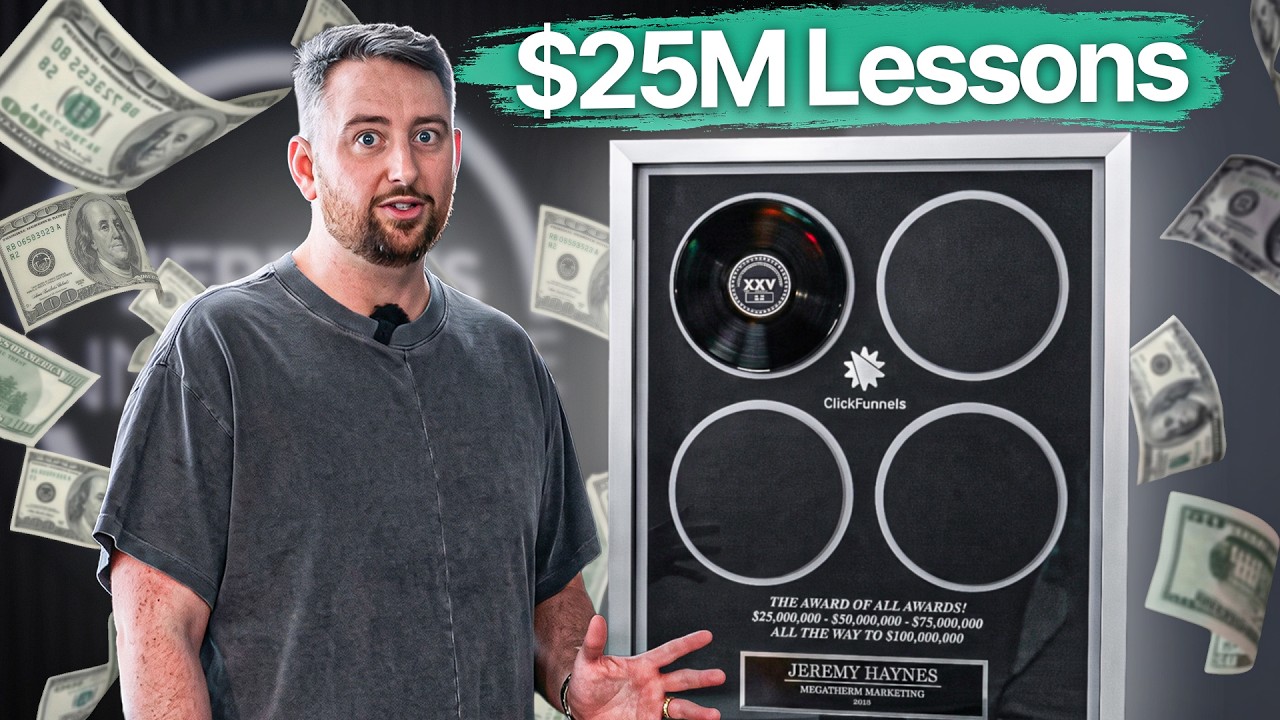
I held my education business back because I thought making more from education than from my agency would make me a fraud. That belief affected how seriously I treated the company and who I spoke to. I had crossed $10M in lifetime education-company cash collected before later passing $25M. Those are cumulative historical collections, not annual revenue or profit, and they do not establish what somebody else can earn.
The change involved more than a new funnel. I changed the buyer I addressed, built offers around what that person wanted, and made delivery worth continuing. I also stayed close enough to the work to recognize where the next offer could come from. The education business needed my full attention as a business in its own right.
Already making money? See what it takes to make a lot more.
The Belief That Kept My Education Business Smaller
I originally sold education to agency owners while running my own marketing agency. I wanted the agency to remain the larger business because I connected that comparison with my credibility.
That became a restriction I had created for myself. The education company’s ability to help someone did not depend on it collecting less money than the agency. Yet I had allowed that belief to influence how much attention I was willing to give it.
I still run the agency. Taking education seriously did not require pretending that implementation no longer mattered. It required recognizing that people could value my experience through a different kind of relationship.
A personal rule can become a business ceiling long before you notice it affecting the numbers. Look at the assumptions behind your own choices. A real delivery constraint needs solving. A belief that one business is allowed to grow only so far needs examining.
The difference between working alongside a client’s team and taking execution off their hands matters here. An established operator can want expertise without wanting another agency to take over the work.
The Buyers Wanted a Different Relationship With Me
I tested long-form YouTube content because I wanted to see whether it could attract the kind of agency client I wanted. My established acquisition approach had involved outbound video pitches and useful follow-up.
The content attracted people whose interests fit the education offers more closely. Some had already had disappointing agency experiences. They wanted to understand the work themselves and make better decisions with their own people.
I had to pay attention to where they were in their buying journey. Offering another agency arrangement to somebody trying to become less dependent on agencies was a difficult place to start.
So I changed who I addressed. Instead of speaking mainly to other agency owners, I spoke to the operators who could have been suitable agency clients. The subjects were still connected to marketing and business growth, but the person receiving the lesson had changed.
Ask what your intended buyer has already tried. A previous disappointment can affect which kind of help they are willing to consider. You still need to deliver something useful; simply repeating that your version is different gives them very little to evaluate.
Real Access Limits Changed My Pricing Decisions
An offer that includes my time has an actual delivery limit. More demand does not create more room in the calendar by itself.
As demand grew, I increased pricing and qualification requirements rather than accepting everybody who wanted access. I also introduced a version with less access, leaving the fuller relationship for the people it could genuinely support.
Those arrangements have to be explained clearly. If one version excludes individual calls or in-person access, somebody considering it should understand that before buying. A similar name does not make the experiences interchangeable.
I want a capacity statement to describe a real constraint. The FTC’s advertising guidance requires truthful, supported claims and warns against material omissions. A claim about remaining places needs to match what you can actually deliver.
I also want the incentive to make sense for the person doing the work. When delivery becomes a commitment you resent, you need to look at what you have agreed to provide and what you are being paid to do. Raising a price does not fix every delivery problem, but ignoring that relationship can make the work harder to sustain.
In my Inner Circle, the value includes operators working through real business decisions together. Protecting the quality of those conversations matters when deciding how much access the room can support.
Results are not typical. Your results will vary and depend entirely on your individual capacity, business experience, expertise, and level of desire. There are no guarantees concerning the level of success you may experience. The testimonials and examples used are not intended to represent or guarantee that anyone will achieve the same or similar results. We don’t believe in get-rich-quick programs. We believe in hard work, adding value and serving others. As stated by law, we can not and do not make any guarantees about your own ability to get results or earn any money with our information, courses, programs, or strategies.
Direct Conversations Keep My Content Useful
My conversations with operators tell me what they need to understand next. That gives the delivery work another purpose beyond the conversation itself.
I hear the questions, see where people get stuck, and recognize patterns across different situations. Those patterns influence what I explain publicly and what needs improving in the offers.
The same connection informs the development of Jeremy AI. The work involves more than collecting public videos. My reasoning in real situations helps identify what the product needs to handle and where a useful answer requires more context.
I do not need to invent a topic because another creator posted it. I can look at the problems appearing in the agency, the questions arriving in messages, and the decisions operators are trying to make.
That keeps organic content tied to genuine buyer questions. If you stop participating in the work, it becomes easier to keep producing explanations for problems your audience has already moved past.
I Want the Business to Last Beyond the Next Sale
I make decisions with longevity in mind. That affects who I accept, how I collect money, and what happens when an offer does not fit somebody’s situation.
I have avoided using third-party financing to bring people into these offers. I want a customer who can participate sensibly, rather than a sale that depends on finding a way for someone to take on debt.
A recent AI customer showed why fit still matters after signup. The person provided very little context, asked the tool to improve a page, and then made changes that reduced the page’s opt-in rate. When the team examined the conversation and the changes, we chose to refund and cancel the relationship.
The useful lesson is that buying access does not make every person a good fit. Onboarding, context, and the ability to use what is provided matter. Keeping the payment can be the wrong decision when the relationship is clearly going in the wrong direction.
I want the business to be valuable enough for people to continue choosing it. That requires paying attention after the sale, including the situations where continuing is not right for the customer.
Recurring Revenue Still Needs Ongoing Value
I prefer building around monthly recurring revenue because I do not want every month to begin with the same dependence on entirely new transactions. The ongoing relationship still has to earn its place.
A subscription creates a reason to keep evaluating the experience. People need to keep finding value in what they can use, access, or work through. Repeating the charge is easier than giving them a worthwhile reason to stay.
Know what the recurring number represents. Stripe’s billing analytics tracks monthly recurring revenue, subscription changes, and churn. Those views help explain a subscription business, but you still need to examine actual collections and what it costs to deliver.
A recurring offer needs continuing value. Think about what changes for the customer after the first useful answer. If the offer has no meaningful role beyond that point, changing the billing arrangement will not supply one.
This is also why I am careful about growth that makes the experience worse. More people entering an offer can create a problem when the work they purchased requires attention that is already committed elsewhere.
Bad Numbers Can Make Good Decisions Impossible
I want to stay in reality, including when the numbers are uncomfortable. A confident explanation built on a miscalculated metric can send the business in the wrong direction.
I have sat with operators whose reported results did not agree with the other figures they supplied. When the numbers were worked through together, the issue could come back to how somebody on the team calculated a statistic.
That creates a difficult situation for the owner. They believe they are responding to what the business is doing, while the report describes something else. Changing the campaign cannot reliably fix a calculation error.
Ask where the number came from. Make the person reporting it explain the calculation and the records behind it. A booking, an attended call, a sale, and collected cash need to remain distinguishable.
I would rather discover an uncomfortable result than preserve a flattering misunderstanding. You can work on a problem you can see. An inaccurate report keeps you arguing with an explanation that was never true.
I Expanded the Content That Actually Worked for Me
Long-form YouTube has been a meaningful part of my education business. I kept making it because the work was useful to the people I wanted to reach.
I expanded into other channel formats, including lessons I wanted to leave for my children and a question-and-answer channel. Those were ways to develop something I already knew I could do well.
That is different from scattering attention across platforms because they are available. My team has posted on LinkedIn, but I have not seen the same direct commercial contribution from it. That is my experience, not a verdict on LinkedIn for every business.
YouTube’s audience reporting distinguishes new, casual, and regular viewers by viewing behavior. Use that information to understand the audience, then connect it with actual inquiries and sales. A loyal-viewer label does not tell you which offer somebody wants.
Paid advertising has also been part of what works for me. The decision is where the next useful effort belongs. A platform that other people enjoy does not automatically deserve the same attention as a channel already bringing suitable buyers.
Keep the Channel and Improve What Makes It Yours
Continuing what works still requires evolution. A channel can remain useful while the way you show up on it needs to improve.
As more people repeat similar topics, I need to demonstrate my thinking in ways that come from the work I actually do. Specific situations, original explanations, and useful formats give someone a reason to keep paying attention.
I cannot preserve that by repeating an old presentation indefinitely. I need to keep noticing what has changed, what buyers now understand, and where the next useful explanation belongs.
Consistency means continuing to serve the audience, not freezing the content at the version that first worked. Keep the underlying contribution and improve how clearly you can demonstrate it.
The same care applies when taking useful organic content into paid distribution. Preserve the reason the idea works while checking whether its new use needs different context.
The Next Offer Has to Solve a Different Capacity Problem
Jeremy AI is part of how I am approaching the next stage because my personal availability cannot expand without limit. I see an opportunity for a product to help with work beyond what I would personally take on.
A webinar review is one example. An operator can need help examining the presentation, revising the slides, and preparing the next version. That is detailed execution work, and it is different from discussing the decision together.
The product still needs useful context and careful evaluation. The customer example above shows why giving a tool a vague instruction can create a poor result. More access to technology does not remove the need to explain the situation and check the work.
I want to think about the next constraint before the current offer reaches it. That includes product development, reinvestment, and the people required to deliver something worthwhile. A future revenue goal is an ambition, not evidence that the next product has already achieved it.
7 weeks. Real frameworks. Covering copywriting, funnels, paid ads, and conversion systems.
Taking the Business Seriously Meant Staying Involved
I became more involved as the education company grew. I stayed close to the questions, kept developing useful explanations, and continued working on the offers.
Passing $25M in cumulative collections did not make the next decision disappear. It made the distinction between maintaining the current business and developing the next stage more obvious.
If you run an agency alongside education, examine the buyer and the work each relationship needs. Do not force education to stay smaller just to satisfy a belief you have never challenged. Equally, do not assume that copying my offer structure will reproduce my history.
Master Internet Marketing, my 7-week live comprehensive training, is one way people can explore the marketing work behind these decisions. Whatever you build, keep listening to the people it serves and stay honest about what is actually working. That gives the next improvement something real to stand on.
Results are not typical. Your results will vary and depend entirely on your individual capacity, business experience, expertise, and level of desire. There are no guarantees concerning the level of success you may experience. The testimonials and examples used are not intended to represent or guarantee that anyone will achieve the same or similar results. We don’t believe in get-rich-quick programs. We believe in hard work, adding value and serving others. As stated by law, we can not and do not make any guarantees about your own ability to get results or earn any money with our information, courses, programs, or strategies.
Get my content first on Google
Add jeremyhaynes.com as a preferred source and Google shows my articles more prominently in your search results, including AI Overviews and AI Mode.


Jeremy Haynes
Owner and CEO of Megalodon Marketing
Jeremy Haynes is the founder of Megalodon Marketing. He is considered one of the top digital marketers and has the results to back it up.