How to Choose the Right Funnel Based on Your Sales Team
I hope you enjoy reading this blog post. If you want my team to just do your marketing for you, click here.
Author: Jeremy Haynes | Published August 25, 2026
Earnings Disclaimer: You have a .1% probability of hitting million-dollar months according to the US Bureau of Labor Statistics. As stated by law, we cannot and do not make any guarantees about your own ability to get results or earn any money with our ideas, information, programs, or strategies. We don’t know you, and your results in life are up to you. We’re here to help by giving you our greatest strategies to move you forward, faster. However, nothing on this page or any of our websites or emails is a promise or guarantee of future earnings. Any financial numbers referenced here, or on any of our sites or emails, are simply estimates or projections or past results, and should not be considered exact, actual, or as a promise of potential earnings – all numbers are illustrative only.
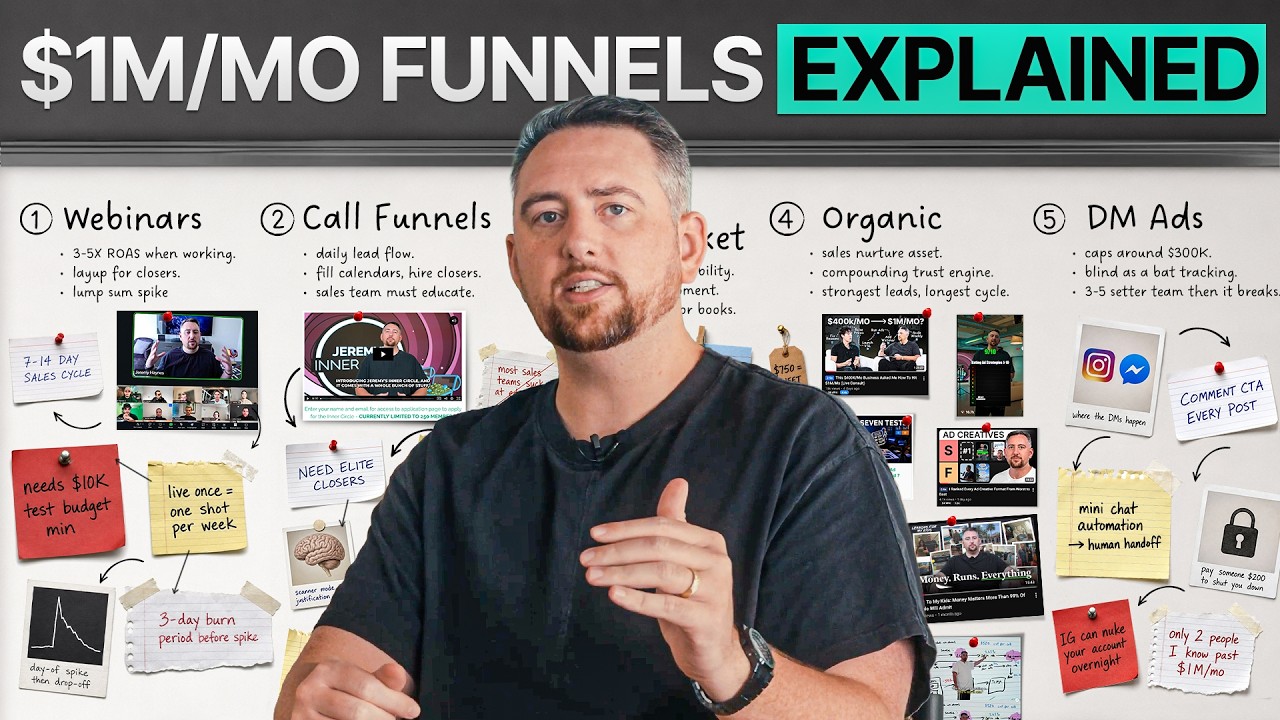
The right funnel strategy depends on what your sales team can actually do after a lead arrives. A webinar can educate and warm the buyer before the call. A paid call funnel asks the salesperson to handle more of that education live. Low-ticket, organic, DM, and challenge funnels each create a different sales cycle, cash requirement, and follow-up burden.
That is why I do not choose a funnel because it is popular or because another business is scaling it. I start with the strengths and weaknesses of the sales team. Then I look at available cash, feedback speed, and whether the company can execute every step well. The funnel has to fit the operator behind it.
7 weeks. Real frameworks. Covering copywriting, funnels, paid ads, and conversion systems.
Start With the Sales Team You Actually Have
An organic audience can make an average salesperson look exceptional. The buyer may have watched dozens of videos, followed the founder for months, read comments, and already decided the company is credible. By the time that person books, the closer is handling a layup.
Move the same sales team onto cold paid traffic and the experience changes fast. The new lead may know almost nothing about the company. They need context, proof, a clear explanation of the problem, and help understanding why the offer fits. If the salesperson has only learned how to process already-convinced buyers, the team may call these leads unqualified when the real issue is that nobody can run an education call.
The funnel did not suddenly stop working. The source of trust changed, and the sales team was not built for the new job.
This is bigger than a landing-page choice. Salesforce has reported that business buyers expect sales representatives to act as trusted advisors. McKinsey’s B2B research found that buyers use an average of ten interaction methods across a purchase journey. Those interactions include websites, video calls, email, and in-person sales. A closer is operating inside that larger journey, not at the end of a single page.
Before choosing the funnel, listen to recorded calls. Can the team create clarity without leaning on a founder’s reputation? Can they explain the problem without dumping information? Can they move from education into a real buying conversation? My breakdown of why sales teams fail to close otherwise workable deals gives you the other places I would inspect.
Why Webinars Make Sales Calls Easier
A webinar works well when the sales team is strongest with buyers who already understand the problem and trust the presenter. The event does a large part of the education in advance. It gives people time to hear the argument, see proof, understand the offer, and decide whether a conversation is worth having.
That can create warmer calls, but the cash pattern is uneven. In the source example, the live webinar produced a sales process of roughly 7 to 14 days. The business spent for two or three days before the event, with buying activity concentrated around the event and the following day. The sales team collected the remaining revenue through follow-up.
In the source example, Jeremy describes a webinar returning 3x to 5x when it worked well. A weaker event landed near break-even or produced a small loss after sales commissions. Those outcomes are illustrative observations, not a promised range for a new campaign.
The follow-up is part of the funnel. Zoom’s guidance on measuring webinar impact recommends separating highly engaged attendees from people who need softer nurturing. Sales then receives a prioritized follow-up list. Registration count alone does not tell you whether the event created pipeline.
Frequency is the tradeoff. A live webinar has to be written, promoted, delivered, and improved before it makes sense to automate it. The test also needs enough spend to create a result worth evaluating, without risking money the business cannot afford to lose. Someone who can only fund a small test once may learn less than an operator who can run the event again after fixing the first obvious problem.
Master Internet Marketing, my 7-week live comprehensive training, covers the full mechanics behind webinars and call funnels. It also covers the systems that support them.
Results are not typical. Your results will vary and depend entirely on your individual capacity, business experience, expertise, and level of desire. There are no guarantees concerning the level of success you may experience. The testimonials and examples used are not intended to represent or guarantee that anyone will achieve the same or similar results. We don’t believe in get-rich-quick programs. We believe in hard work, adding value and serving others. As stated by law, we can not and do not make any guarantees about your own ability to get results or earn any money with our information, courses, programs, or strategies.
When a Paid Call Funnel Becomes a Bad Bet
Call funnels create daily opportunities, which is one reason operators love them. Ads run to a page, the prospect applies, and qualified people book directly onto a closer’s calendar. When the sales team is strong, that daily feedback can make the funnel faster to improve than a weekly event.
The mistake is assuming the video sales letter handled all the education. Play rate and engagement vary dramatically by page and market. Jeremy has seen play rates range from single digits to above 90%. If player data shows 50% engagement on a 10-minute video, roughly five minutes were consumed per viewer. It does not prove that everyone watched the first five minutes in order.
Wistia analyzed more than 100 million uploaded videos. Its report found that play rate, engagement, placement, and video type all change how people consume a video. That is why I want the actual player data. The presence of a VSL is not evidence that the sales team received an educated lead.
Most prospects are scanning before they book. They become more willing to research after they take action because now they are deciding whether to show up and whether the company deserves more attention. That is where the back-end selling system starts.
Use the confirmation page to answer the next real questions. Follow with useful email content. Retarget the person with short- and long-form material that builds context. Have setters begin the education when appropriate. The source material targets 15 to 20 distinct content exposures before the scheduled call. The right volume still depends on the booking window and audience.
Public search and AI results matter too. Buyers are going to look up the founder, company, complaints, proof, and offer. Make sure the public information they find is accurate, useful, and consistent with what the sales team says. That is reputation work, not a shortcut for manipulating an answer.
Low Ticket Works When Value Arrives Fast
A low-ticket-to-high-ticket funnel asks the buyer to experience a smaller piece of the larger offer first. The cleanest version is not a random cheap product. It is a useful component pulled from the high-ticket delivery.
Jeremy’s example comes from weekly group calls inside his high-ticket offer. He selected several detailed webinar lessons, paired them with a narrower SOP, and packaged the material into a $750 master class. The buyer gets three to four hours of training and a substantial written resource. The smaller product proves the type of thinking and support available. That can lead naturally into a conversation about the larger offers.
The problem is time to value. A book funnel may take roughly three months to produce a high-ticket purchase because many buyers want to finish the book before they consider the next step. You can shorten that delay by turning chapters into emails, short explanations, audio, summaries, and retargeting content that helps the buyer reach useful realizations sooner.
Low ticket becomes easier to tolerate when the front end is profitable or near break-even. A long sales cycle hurts more when every new buyer creates an immediate loss.
In one source example, a business lost roughly 20 to 40 cents for every dollar spent acquiring book buyers, then waited about three months for the high-ticket sale. That is a difficult cash position to scale. A front end that produces a modest profit can wait longer because the business is not financing the entire gap. My guide to a low-ticket funnel that liquidates ad spend explains the economics in more detail.
Match the Funnel to Your Testing Capacity
Every funnel has a chain of numbers that can fail. A call funnel has ad costs, clicks, applications, qualified applications, bookings, show rate, close rate, average order value, and collections. A webinar adds registration rate, attendance, retention, and the booking behavior after the presentation. Low ticket adds checkout conversion and each upsell step before the high-ticket ascension begins.
More steps are not automatically worse. They create more places to investigate and more work for the team. A weekly webinar also gives you fewer meaningful attempts than a call funnel producing leads every day. If the company cannot write, build, track, sell, and follow up across the full path, adding another funnel spreads the same weak execution across a larger surface.
A business does not need five funnels at once. It needs one funnel that has reached a stable scaling phase. A second funnel becomes useful when the first is nearing a real ceiling and the team has enough attention to improve another system without neglecting the winner. That is the logic behind using multiple funnels to add separate chunks of revenue.
Organic Is Slow Until It Helps Everything
Organic content is technically a traffic source, but it behaves like its own funnel because it can feed any conversion path below it. A viewer can buy a low-ticket product, register for a webinar, book a call, or start a DM conversation. The content does the trust-building before that next action.
The direct sales cycle may take three to six months in Jeremy’s experience. Early on, the view counts can feel unrewarding. The immediate benefit is that the library gives paid leads something credible to research and gives the sales team useful material for follow-up.
That compounding effect is why I would start organic before it feels urgent. The work done now may not show up as attributable revenue this week, but it can improve the environment around paid traffic immediately and create stronger inbound demand later.
Why DM Funnels Hit a Management Ceiling
DM funnels can work, but the management and tracking limits show up quickly. In the source discussion, Jeremy describes setter teams becoming difficult to manage beyond roughly three to five people and cites working examples between $100,000 and $300,000 per month. Those examples are illustrative, not a benchmark for another business.
The source includes two uncommon exceptions. One operator built more than $1 million per month through organic DM activity. Another generated roughly $1.5 million per month after spending about $500,000 on paid content distribution, using setters to close a $3,000 offer directly in DMs. The second model’s sales cycle lasted around three months and had weak direct attribution, which meant the operator had to keep spending despite limited campaign-level visibility.
Those examples show possibility, not probability. Instagram restrictions, account risk, setter quality, sales management, and incomplete tracking can all cap the model. For many businesses, a DM funnel makes more sense as an additional revenue source than as the only path expected to carry the company.
Challenge Funnels Trade Rhythm for a Large Event
A challenge funnel is a multi-day virtual event. It can create a larger revenue event than a webinar, but it also demands more promotion, more presentation time, more support, and a longer period of financial exposure.
In one large-challenge scenario, Jeremy describes a promotional burn of roughly 60 to 90 days. The operator might spend around $500,000 during that period while pursuing $2 million to $5 million in total revenue. This is an illustrative scenario, not a projected outcome. Some acquisition cost may be offset by ticket sales or upsells before the event, but the business still needs enough cash and patience to carry the promotion.
The event is difficult to repeat monthly. Quarterly is possible for some teams. Many will choose once or twice a year because of the workload. The challenge then becomes a cleanup event for the audience accumulated through daily lead flow, paid traffic, organic content, and prior offers.
One member used a challenge funnel to earn a million-dollar-month recognition and reported more than $800,000 in profit from the event. That result is unusual and depends on the audience, economics, presentation, promotion, sales execution, and follow-up. If you want help deciding whether your team can support that kind of move, I work through capacity and bottlenecks inside my Inner Circle.
Results are not typical. Your results will vary and depend entirely on your individual capacity, business experience, expertise, and level of desire. There are no guarantees concerning the level of success you may experience. The testimonials and examples used are not intended to represent or guarantee that anyone will achieve the same or similar results. We don’t believe in get-rich-quick programs. We believe in hard work, adding value and serving others. As stated by law, we can not and do not make any guarantees about your own ability to get results or earn any money with our information, courses, programs, or strategies.
Already making money? See what it takes to make a lot more.
The Funnel I Would Choose for Each Team
| What the team does well | Funnel to consider | Main risk to check |
|---|---|---|
| Closes warm, educated buyers | Live or scheduled webinar | Promotion cash, event frequency, and follow-up |
| Runs strong education calls | Paid call funnel | Show rate, calendar capacity, and back-end content |
| Delivers a useful result quickly | Low ticket to high ticket | Time to value and front-end cash loss |
| Publishes consistently and builds trust | Organic content into a call or webinar | Three- to six-month direct sales cycle |
| Manages setters tightly | DM funnel as a supporting channel | Tracking, platform restrictions, and team ceiling |
| Can promote and deliver a major event | Challenge funnel | Long burn period and execution load |
Start with the sales calls. If the team needs a buyer to arrive fully convinced, use a funnel that does more education before the conversation. If the team can teach, diagnose, and sell on the call, daily lead flow becomes more attractive. Then check the cash pattern and workload.
Choose the funnel the business can run repeatedly, measure honestly, and improve fast enough. One well-supported funnel can carry a large goal. A collection of half-built funnels usually gives the team more ways to stay confused.
The best funnel is not the one with the strongest reputation. It is the one your sales and operations teams can execute all the way through.
Results are not typical. Your results will vary and depend entirely on your individual capacity, business experience, expertise, and level of desire. There are no guarantees concerning the level of success you may experience. The testimonials and examples used are not intended to represent or guarantee that anyone will achieve the same or similar results. We don’t believe in get-rich-quick programs. We believe in hard work, adding value and serving others. As stated by law, we can not and do not make any guarantees about your own ability to get results or earn any money with our information, courses, programs, or strategies.
Get my content first on Google
Add jeremyhaynes.com as a preferred source and Google shows my articles more prominently in your search results, including AI Overviews and AI Mode.

Jeremy Haynes
Owner and CEO of Megalodon Marketing
Jeremy Haynes is the founder of Megalodon Marketing. He is considered one of the top digital marketers and has the results to back it up.