How to Build a Profitable Low-Ticket to High-Ticket Funnel That Liquidates Your Ad Spend

I hope you enjoy reading this blog post. If you want my team to just do your marketing for you, click here.
Author: Jeremy Haynes | Published November 24, 2025
Earnings Disclaimer: You have a .1% probability of hitting million-dollar months according to the US Bureau of Labor Statistics. As stated by law, we can not and do not make any guarantees about your own ability to get results or earn any money with our ideas, information, programs, or strategies. We don’t know you, and besides, your results in life are up to you. We’re here to help by giving you our greatest strategies to move you forward, faster. However, nothing on this page or any of our websites or emails is a promise or guarantee of future earnings. Any financial numbers referenced here, or on any of our sites or emails, are simply estimates or projections or past results, and should not be considered exact, actual, or as a promise of potential earnings – all numbers are illustrative only.
Low ticket to high ticket is absolutely awesome.
It liquidates a lot of the ad spend – or for those of you who do it completely wrong, a very small percentage of the ad spend.
In a great scenario, you’re profitable before you even make the high ticket sale.
In this blog, we’re going to cover some of the best practices from people who have been there, done that, and liquidate all their ad spend, and are ideally break even or profitable going into the whole process.
We’re also going to be covering some of the best practices to take that high ticket sale that you want to have occur and condense the time frame down to something that’s more ideal than a couple months or even a couple weeks.
There are a specific set of actions and tactics that you must implement in your low ticket to high ticket process. We’re going to cover a majority of them here today.
All we talk about around here is cracking million-dollar months. Whether it’s the first million or next million a month, you’re in the right place because all we do around here is hand down lessons for people who have been there, done that, and cracked these big numbers.
Let me be very direct in saying though – there are no income claims. You are likely part of the 99.99% of people who never stand a chance to hit these kinds of numbers.
The US Bureau of Labor Statistics claims that 0.1% of all business owners on Earth ever crack $10 million a year. That’s an 8 figure run rate. Let alone the even smaller percentage of people that ever crack million-dollar months or the even smaller percentage that ever crack bigger numbers than that.
These are just lessons for entertainment and education purposes exclusively.
How to Price Your Low-Ticket Product So You Actually Liquidate Ad Spend Instead of Burning Money
The first way that you will likely mess up your low ticket to high ticket process is in the pricing decision of the main low ticket product.
You have to understand the very first thing that you want to be thinking about to immediately stack your odds of success in the low ticket portion of this funnel.
The success in the low ticket portion of the funnel would mean you liquidate the ad spend it took to get the buyer in to then start the upsell process to the high ticket product. That’s typically the best scenario.
An even better scenario than that would be getting to the point where you’re profitable from the low ticket sale itself. That way, every dollar that you make past that point is just even more profit that comes in.
A majority of you are likely to lose money and liquidate a small percentage of the total spend in that low ticket process.
And again, pricing is one of the biggest ways. It’s the initial decision that you need to make.
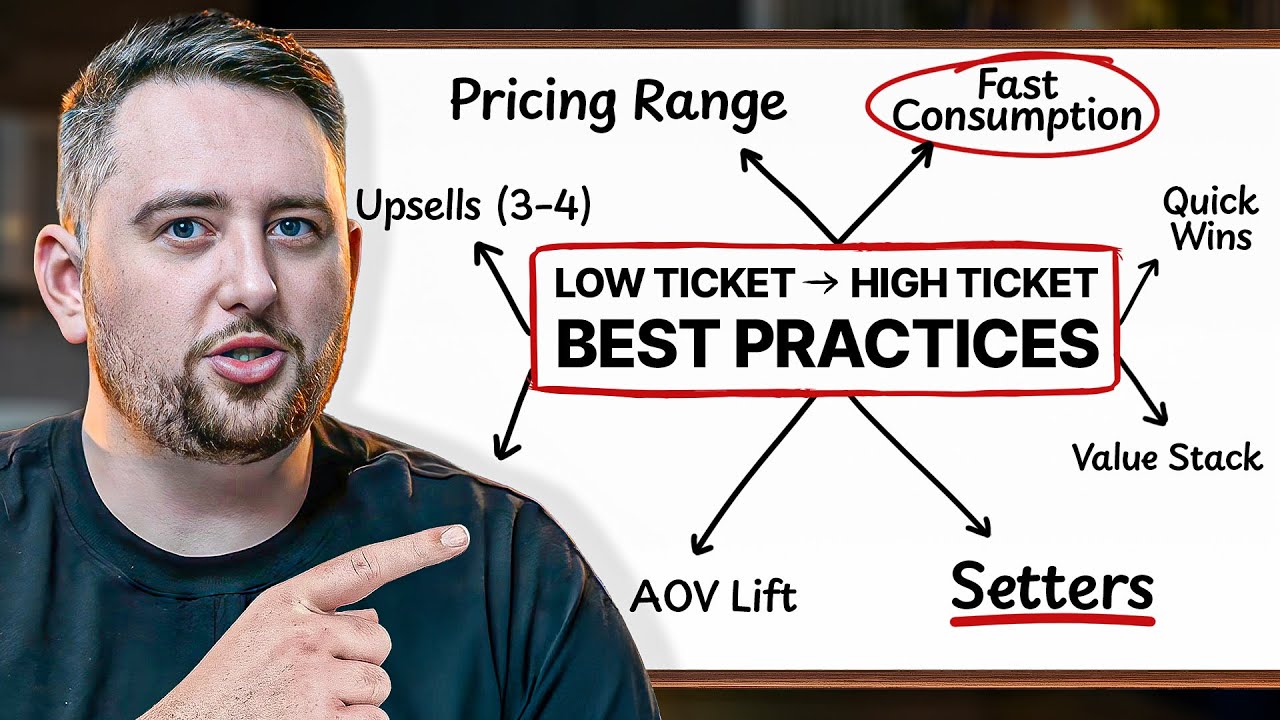
The pricing range that can typically hurt you is somewhere in like a $7 to upwards of $50 range. Most people who really miss the mark, they’re somewhere in like the $7 to $30 range.
This is typically the no-go zone.
The illusion of this specific price is you justify to yourself. You’re like, “Well, I’m going to get a lot more people to buy if whatever the first thing is is really cheap, right?”
And technically, you’re not wrong. You’re going to get a higher percentage of people that’ll purchase.
But the issue is you’re also going to attract somebody who has a lower probability to purchase the next things because they purchased something too cheap initially.
In addition to that, you have to consider that whatever that lowest ticket thing is, like the literal entry point of the funnel in most instances, that specific price – if you acted like nobody else purchased beyond that, that would be what your AOV essentially rounds out to become.
So right away when you consider pricing, the very first step, the very first thing that you’re actually going to charge – if whatever you actually charged for that was the only thing that somebody bought and you thought to yourself, well, could I get purchases below that specific cost, you’re going to be in a much better place.
As an example, if I charged $99 for the first thing, and I could get a cost per purchase below a $99 threshold, I’m in a good spot.
Anything less than $99, I’m break even or profitable.
Now, to be clear, if I had an AOV because the only thing that somebody bought was the first thing and it was like $7 or it was $30 or whatever it is – is my CPA likely, especially this time of year, to be less than that specific price?
Then when you think in terms of probabilities, which one sounds more likely?
I want to give myself the wiggle room because the lower that my cost per purchase has to be for me to be break even, the lower my probability is of actually getting to the point where I’m break even or profitable on the low ticket sale.
You understand?
So why would you set the bar with your AOV to be so low where you’re immediately going to shoot yourself in the foot and hurt yourself with your AOV?
The price can be whatever you want it to be.
People tell me all the time, they’re like, “Oh, I have a book funnel as an example, and the book funnel is my low ticket product. No one’s going to buy a book for more than like $20 with the free plus shipping and handling cost, right?”
Yeah, I mean, again, you’re not wrong. Most people who run book funnels, they are going to be running at a negative burn rate and they’re going to have to sustain until people read the book before they have any probability to get the high ticket sale to occur.
So again, in terms of low ticket funnels, there’s all kinds of lessons we’ll talk about.
Just remember pricing. Ideally, the very first thing that they buy – if your AOV was that – it’s good enough to where you can realistically get cost per purchases with a scaled amount of spend behind it, by the way, to sustain profitability or break even.
Or at the very least, get it to the point where the AOV is high enough to where it liquidates more than 60% of your total ad spend just in the first purchase alone.
Pricing is very important to understand.
If your business is already generating $100k+ per month, My Inner Circle is where you break through to the next level. Inside, I’ll help you identify and solve the bottlenecks holding you back so you can scale faster and with more clarity.
Why You Need Three to Four Upsells to Make Your Low Ticket Funnel Actually Profitable
Most people also really miss the mark on the low ticket to high ticket funnel by not having enough upsells.
When you look at the total amount of upsells that you realistically need, ideally you have three to four altogether.
And these come in strategic forms.
Let me give you a great example of this. If I did run a book funnel as my low ticket product, the book itself can have a little bump sell right there in the actual order form.
I can add something like the audio version of the book. I can add something that complements immediately the actual purchase occurring.
If I go to a nice steakhouse, let’s say I go to Morton’s, I go to Fleming’s, whatever it is that you specifically love, your local steakhouse near you – let’s say we go to Mastro’s together.
One of the first things that they do when you order your steak is say, “What would you like with the steak? Do you want the black truffle butter? Do you want the bone marrow butter? Do you want the red wine butter? Would you prefer us to load it up with crab and lobster? Like, what do you want on top of it?”
That’s immediately their version of a bump sale. It increases their overall AOV.
That’s the first upsell that you’ve got to think about – what’s your version of adding the $17 butter to the steak.
Something that when you look at it, it’s just a little check box right there on the order form itself. It doesn’t need a whole sales page. It’s super obvious that it would make whatever you just bought better.
Without a lot of explanation needed.
That should be the very first upsell – ideally the bump sell. That little check box on the actual order form itself.
Now, the rest of your specific upsells have to be something that complements that low ticket product.
One thing that I talk about inside of my Inner Circle class and that I’ve also covered inside of Master Internet Marketing, which are both paid programs – the high ticket product is what we label the main thing.
In this high ticket product, it’s made up of a bunch of smaller things. When you draw it out like this, you’ll realize that whatever the high ticket thing is, all these little things – like whatever it is that makes up that high ticket thing that you’ve actually got – this is where your low ticket products and your upsells would ideally come from.
You would take realistically like thing number one that makes up your high ticket product and that would become your low ticket product.
Then because somebody purchased that, there’s typically in most instances some specific things that kind of make up that as well. And those can be easy upsells.
How to Break Down Your High Ticket Product into Low Ticket Offers and Strategic Upsells
I’ll give you a perfect example of this.
I historically have had a low ticket product that was called the Perfect Cold Video Pitch Bundle. For over a decade with my marketing agency, we’ve been doing this thing we call the perfect cold video pitch.
I’ll sit down, I’ll make a video. Through time, we started just customizing these without me having to sit down and make them myself. My sales team would sit there and do it all day and just blast out these video pitches.
Everybody’s super lazy that pitches people. As I’m sure you can imagine, looking at your DMs every day, you know exactly what I’m talking about.
Somebody like me comes along and I give you a custom video where you listen to it and you say, “That strategy this guy’s talking about actually makes a whole lot of sense.”
The probability of you responding is far greater than just one of these people that hits you up with these super selfish messages they send. Almost like they’re demanding a response or entitled to a response.
But anyway, I digress.
The perfect cold video pitch is a great way to acquire clients with a marketing agency. For a good few years, I had my entire education company built around helping agencies.
Long story short, the main product that I had was called High Ticket Agency. High Ticket Agency was the main thing. It helped with everything that an agency would need to know to start or scale up aggressively.
One of those things that made up high ticket agency was obviously learning how to acquire clients. That is a branch in this example. It’d be like thing number one – how to acquire clients.
But there’s more than one way to acquire clients. There’s the video pitch strategy, which also incorporates what we call value-driven follow-up. You can run paid ads. You can go to events. You can have referrals. You can post organically. There’s all different kinds of ways.
The way that I specifically chose to teach as my low ticket product was, well, let me show them how to do the perfect cold video pitch and let me teach them how to do value-driven follow-up.
Now, if you cared about that and you chose to buy that low ticket thing, there’s a very high probability that you run a marketing agency and there’s a very high probability that you care about getting clients.
So some of the other things that I could easily upsell that complemented the low ticket product was literal examples and conversations that we’ve had.
What to Sell as Upsells After Your Low Ticket Product to Maximize AOV
I’ll give you a great example of this.
The little bump sell – like the first little checkbox that we talked about – could be something as simple as a swipe file. Here’s scripts for what to say in the DMs, emails, and it could be as simple as that.
Just a little bump sale adding let’s say another $19 to the total AOV of each one of those individuals who chooses to purchase that bump sale.
Now the very first page that comes after they choose to purchase the main perfect cold video pitch bundle is going to be something that further extends value to them related to what they specifically just purchased.
In this example, let’s say that I chose something like actual conversations.
So instead of a swipe file, that next page, I could go grab and export, without exaggeration, hundreds – at a minimum, hundreds of conversations that we’ve had back and forth with people showing the original video pitch and what we said, the back and forth associated with it until we get to the point of the sales call.
That’d be incredibly valuable for that type of person who’s wanting to buy that.
Now, again, outside of the logic of what to actually upsell, you tie back into that concept of, well, what should you charge?
You’ve got to realize that roughly 10 to maybe 30% at best in most instances are going to purchase whatever these upcoming upsells are after that first thing was purchased. E-commerce data shows that order bump conversions typically range from 10-30%, while post-purchase upsells convert at 15-25% when properly matched to customer interest and pricing psychology.
So ideally, they’re high enough that with a low quantity of people buying them, you get your AOV up with a weighted average from having a higher ticket thing on the back end.
By higher ticket, as an example, let’s say the perfect cold video pitch was $100 or $50. That second purchase, not the bump sale, not the little check box, but the second purchase would ideally be like $100 to $300 somewhere in there.
Now, let me be clear in saying this again. You might be like, “Wow, that’s way too high.” And there’s going to be a lower quantity of people that buy it.
But the lower quantity people that buy it, because it’s a higher priced product in the hundred, low couple hundred range – it’s going to weight my AOV up dramatically higher than if I had 50% of people buy at $10.
You understand?
So again, it’s just math, which you think you’re smart enough to be doing when you say, “Well, I should charge less so I get more people to buy, and so therefore, my AOV is actually higher.”
But again, if I had less people than you buy, and they buy at a higher price for $100 minimum, I’m still going to have the higher AOV out of those two examples.
The perspective I’m sharing with you is literally just math. You could do it yourself, and you could find out for you specifically and what pricing you’re considering what would actually make the most sense.
Obviously, you then need to follow through and make sure that whatever you chose to charge less for is actually being purchased at the percentage rate that you factored into your math for why you justified charging so low.
How to Select Upsells That Complement Your Low Ticket Product and Actually Convert
Back to my point. When you’re selecting the upsells themselves, ideally, it complements whatever the original thing was.
Now here’s the second upsell in this example. So again, we had the bump sell, we now had the swipe file, which would be the first official upsell. We’ve got two more that we ideally want to factor in.
The second upsell could be sales call recordings.
What would you care about if you were in the middle of pitching people to become clients of yours for a marketing agency? You’d obviously care about outside of what to say in the messages in the swipe file that I could send to you. You’d clearly also care about what to say on the sales calls.
Again, we have hundreds of sales calls recorded that we could easily bundle together and sell inside of that low ticket product and put inside of a course.
Now, here’s the thing. This is also where most people really mess up.
When you get to the point where you’re considering other upsells, because you may not have a bunch of stuff like that already created for something that just makes clear as day sense to add to your ascension process, you’d likely want to add something that is also branched from the main thing.
Now again, this could be completely different. Back to my original point, the main thing in this example I’m providing to you was again called High Ticket Agency.
In this high ticket agency product, sales and acquiring clients was only one thing. What would somebody else care about after they actually got the client?
All kinds of things. They’d care about staff. They’d care about who to hire and when. Maybe they just want access to a contractor network of people that can help them fulfill. Maybe they’d want contracts, as an example, or agreements that they could send out to people.
Sometimes in an agency, people will ask you for things like a proposal. I could give a bunch of proposal templates as well.
I could also obviously talk about all the specific skills that agencies actually sell. I could pick a completely different upsell that just relates to any one of those particular things.
Again, I’m ideally going to charge in my case a minimum of $100 all the way up to $300 for each one of these upsells individually.
Now, as you can see, when you look at the upsell process, this is where we get a higher AOV that lifts us to the point of profitability.
Why Being Too Afraid to Sell Multiple Upsells Keeps You Unprofitable
Most people when they do low ticket to high ticket, they mess it up right away because they don’t have enough upsells and the upsells that they do have are too low price.
You’ve got to remember the whole point of the low ticket to high ticket process is to be salesy and liquidate your ad spend.
Hey, if you want to be moral in your mind and you want to take the high road – “Oh, I don’t want to have three to four upsells, Jeremy. I don’t want to be too salesy.”
Congratulations. You’re going to be unprofitable.
I am not going to be like you. I’m going to be profitable in my low ticket, high ticket ascension.
You understand? That’s the difference.
Sell people things that’s actually valuable and you won’t have that limiting thought in the first place.
Every single thing that I just gave as an example, if somebody bought it, it would genuinely help them dramatically improve pitching people and getting clients, what to say when pitching people and trying to get clients, what to say on sales calls if they got to the point where they get clients, and whatever else I’d choose for the last step.
Again, it would also be hyper valuable and worth whatever I’m going to charge for it.
That’s the other big way that people really miss the mark on having enough upsells in the first place. They are not valuable people. As a result of that, they’re not creating value for the people that they’re selling to.
So they feel terrible when they try to sell people stuff because again, they’re selling absolute junk.
Pick great things that are actually likely to help people. And guess what? If you don’t have a whole curriculum of content to pull from easily and pick and choose between and you have to create it, no problem.
Just choose things that are actually valuable and it’ll easily help you overcome that little belief you’ve got of, well, I don’t want to have three to four upsells. That seems way too salesy.
What a limiting belief.
But anyway, back to my point. You have to price these things ideally in a $100 to $300 range.
Now let me be clear. If you see that next to nobody’s purchasing your upsells, there’s two things you can adjust. What you chose to sell and the price of what you chose to sell.
The easier thing to pick is the price of what you chose to sell. So don’t be afraid to tinker with it and change the range so you can increase the overall percentage of people that are actually taking your upsells.
Because you need ideally about 5 to 20% of the total quantity of people who hit those pages to ideally say yes.
Why Your Low-Ticket Pricing Determines If Anyone Buys Your Upsells
Which again brings me back to point number one with what you price the first thing at.
If you charge a measly $7 to $30, you’re going to get a bunch of broke people that chargeback. You’re going to get a bunch of people that don’t have a shot of buying something for $100 to $300 right after because again, you charged too little.
If I charge $70 for a New York strip or a filet, whichever one you want, they’re $70. I can charge $19 for butter.
If I have my entry-level product be a $7 hot dog and then I try to upsell a $70 steak and $19 butter, I have the wrong type of customer who’s not likely to buy the higher ticket thing in my upsell process that comes right after it in the funnel itself.
You understand?
I have to have the right type of person there.
If I sell the $70 steak at Mastro’s, the $19 butter is my little checkbox upsell. They’re going to probably buy the $30 to $50 sides and they’re probably not just going to buy one. They don’t just want creamed spinach. They want my white cheddar mac and cheese.
You understand?
They want the butter cake at the end of the meal. They would love the delicious lobster bisque. And guess what? They may also want incredible bottle of wine with the meal.
You get where I’m going with this?
The right types of people that you attract in the first place with the first thing wildly dictate the upsell rate of everything that comes after it in the funnel itself.
So make sure you pick the right stuff and make sure you charge the right amount for it.
Why Fast Consumption of Your Low-Ticket Product Is Critical to Selling High Ticket
Now, when you have whatever it is that you’ve chosen to sell officially in the hands of your customer that just bought it, the biggest thing that inhibits them from buying the high ticket thing, the thing that you’ve actually wanted to sell them this entire time where the true money’s made – the main thing that’s going to inhibit that sell from occurring and delay it from occurring is the low ticket thing or things that they just bought.
Whatever it is that you actually sell has to be consumed and applied easily.
It has to be something that can have immediate effect.
You don’t want to sell somebody a book that’s this thick or even this thick and just wait for the person to read it. A low quantity of people even read books that they buy.
Research shows that 42% of college graduates never read another book after graduation, and of books purchased, only 20-30% are actually completed by buyers, making consumption optimization critical for low-ticket products.
When you sell somebody a book, one of the best things that you could do in this example of using a book to speed up the consumption and the ability to apply the lessons from the book – give them a little video sequence that walks through each chapter and the lessons of the chapter and how to apply the lessons from that chapter.
Write an email sequence that has one email per chapter with the executive summary of what that chapter covers and a specific section in the email that says, “Here’s how you go apply this and get this from reading this specific chapter.”
Make it easy. Encourage the action. Make the consumption simple.
Make it so you have the highest activation rate possible, no matter what the low ticket thing is.
If somebody buys something low ticket, they will not buy anything else until the value of the low ticket thing they bought is extracted successfully.
There has to be usage and there ideally even more than usage has to be a result.
Sometimes the perceived value solely comes from the consumption. Once the consumption occurs, your probability of that high ticket upsell occurring really fast increases dramatically.
If you have a low activation rate, meaning the total quantity of people that buy your thing, they don’t even use it. Whatever it is that you’re selling them, they barely log in, they barely use it, they barely consume it.
Naturally, you’re going to have a lot of objections about spending a few thousand or tens of thousands of dollars with you right after that occurs.
Comparatively, if you get 80% or more of people who buy that low ticket thing within days to consume it, use it, apply it, and get some kind of win – the win has to be fast.
It has to happen quickly.
How to Create Quick Wins in Your Low-Ticket Product So People Buy High-Ticket Fast
You cannot have a slow, long, monotonous, drawn out win. It has to be something where as soon as I apply whatever it is that I’ve just consumed, when I apply it, the speed to getting the result is very quick.
If I have somebody back to my example where I sold them that perfect cold video pitch, the consumption is as simple as like two videos and an SOP that they can read through with video examples of what they look like.
From there, I have to encourage them to go actually make a few. That’s the biggest challenge of that part of the process.
The consumption in that example is rather easy. I then have to encourage somebody to actually sit down, make the videos, and send them out.
Most people who would buy that specific product – and there’s a big reason that we don’t sell that specific product or we don’t even try to sell to that type of demographic anymore because most of them are poor.
When you try to sell to poor people, they don’t understand what it takes to be successful. That’s why they’re poor. That’s why they’re in the position that they’re in. They don’t know all of what it takes.
So what we found, and this is actually really interesting, when we sold somebody that perfect cold video pitch bundle, our biggest issue wasn’t consumption. Our biggest issue was them sitting down, making enough of the videos, and actually sending them out.
Most of them had a lot of apprehension about pitching businesses in the first place. Obviously, that’s a huge limiting variable that we have to address.
So here’s what we started to do. We added a complimentary mindset course.
As you can imagine, I’m extremely direct. I made a series of videos, like three videos that we added in. If you purchased that perfect cold video pitch bundle, we immediately added in three extra videos that addressed the mindset of getting started with a marketing agency.
Which in reality was me sitting there just saying in the simplest way – you have to pitch businesses. You have to pitch way more businesses than what you think you need to pitch. You need to pitch them on all channels, not just some channel that you think.
You need to optimize whatever pages you’re sending from to make it look like you’re a legitimate business person and not some person sitting in their apartment that makes no money and has no idea what they’re doing.
Things like that.
As soon as we added that to it, the success rate of people actually going out and pitching and getting those responses in a tight time frame went up dramatically.
So again, to be very clear with you, whatever you’re actually going to sit there and sell to people, no matter what it is, no matter what that low ticket thing is, you have to optimize around the consumption being quick and more importantly them actually getting a result quickly.
An easy quick result has to happen. And whatever inhibits them naturally, you’d want to just add that to the main product that they bought.
Add that to that low ticket thing. Don’t make it an upsell. Just add it so you increase the speed in which they can get a result.
Because again, that’s what inhibits you from successfully getting that high ticket upsell.
How to Use Setters and Triggers to Convert Low-Ticket Buyers to High-Ticket
Now, to be clear, the whole second half of this equation is you factoring in setters and them strategically knowing when to reach out to these individuals that you’re going to sell to.
Your setter team ideally needs triggers.
This is very simple to create, by the way, with modern-day marketing automation and CRM. If you track the consumption – things as simple as like, did they open the access email, did they download whatever the low ticket thing was? Did they consume whatever the low ticket thing was?
Whatever the low ticket thing is – if it was a physical thing, did they receive it?
Because your setter doesn’t have to reach out and immediately act as a salesperson. They can act as an accountability coach.
Now, there’s a whole set of best practices that I teach to people who actually pay me money. So I’m going to withhold all those specific lessons from you from this point forward.
How to Get More Help Building a Profitable Low-Ticket to High-Ticket Funnel
You can join into one of two things that I’ve got available.
Number one is Jeremy’s Inner Circle. It’s for rich people trying to get way richer. That’s where we include things like one-on-one calls. That’s where we include quarterly in-person masterminds here at our facility in Miami, Florida.
That’s also where we include our weekly group calls, a massive course vault, unlimited access to Jeremy AI, and an extremely active community of all of those rich people trying to get way richer.
It’s an incredibly valuable product, but again, you’ve got to make a certain amount of money and you’ve got to commit for a certain amount of time. We have far too many people that would otherwise buy that product if we didn’t add that friction. We want the right types of people joining into it.
We have my flagship education company product, Master Internet Marketing. You can preview week one of that 7-week live class. It includes lessons extensively on what we just talked about here, taught in a seven-week set of live classes.
There are 3 to 5 hours per class. If you join in between our live cohorts, no problem at all. You get access to the most up-to-date information from our most recent cohorts.
You have homework libraries to consume in between those live classes, those 3 to 5 hour lessons. Each week is, of course, on a different topic. You have dozens of SOPs that you get access to and also Jeremy AI and a very active community.
Whichever one sounds more appropriate for you, be sure to check out the links. Either way, keep following along and check out all the other content. Thank you so much for being here.
Most business owners waste years figuring out what actually works. In my Master Internet Marketing program, I compress that learning curve into 7 weeks, covering copywriting, funnels, ads, and more. If you’re ready to invest $5k and get serious about your skills, apply here.
Go out there and get richer.
Watch the video:
Get my content first on Google
Add jeremyhaynes.com as a preferred source and Google shows my articles more prominently in your search results, including AI Overviews and AI Mode.


Jeremy Haynes
Owner and CEO of Megalodon Marketing
Jeremy Haynes is the founder of Megalodon Marketing. He is considered one of the top digital marketers and has the results to back it up.