
Set Good, Great, and Intolerable Costs Before You Scale

I hope you enjoy reading this blog post. If you want my team to just do your marketing for you, click here.
Author: Jeremy Haynes | Published October 15, 2026
Earnings Disclaimer: You have a .1% probability of hitting million-dollar months according to the US Bureau of Labor Statistics. As stated by law, we cannot and do not make any guarantees about your own ability to get results or earn any money with our ideas, information, programs, or strategies. We don’t know you, and your results in life are up to you. We’re here to help by giving you our greatest strategies to move you forward, faster. However, nothing on this page or any of our websites or emails is a promise or guarantee of future earnings. Any financial numbers referenced here, or on any of our sites or emails, are simply estimates or projections or past results, and should not be considered exact, actual, or as a promise of potential earnings – all numbers are illustrative only.
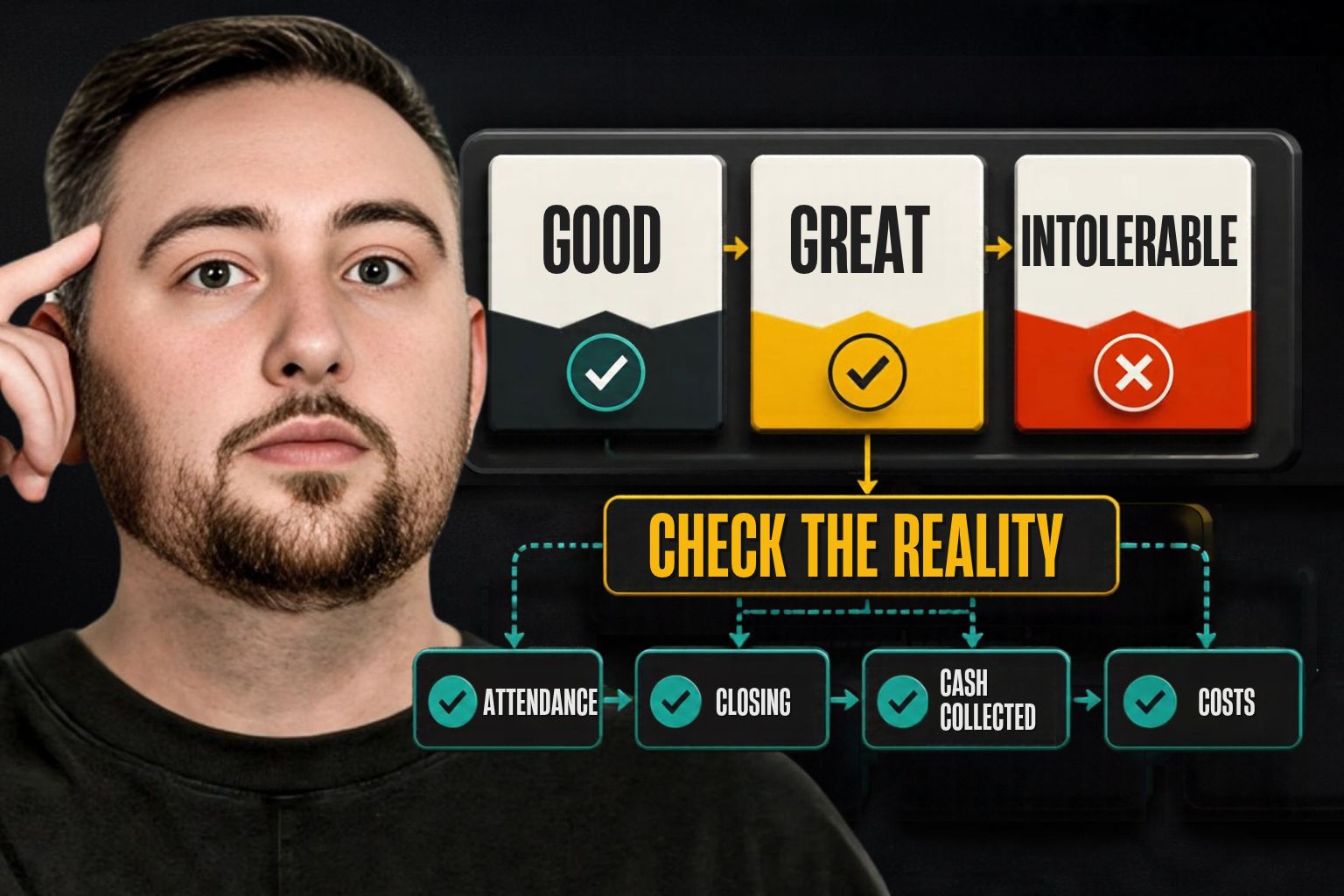
Your target cost per result can be wrong in either direction. You can shut down an ad the business could afford, or keep spending against a number that leaves too little after sales and delivery. I want three ranges in front of me before I make that decision. What looks good, what looks great, and what becomes intolerable.
Start by writing down what you think those ranges should be. Then do the math and see whether your expectations survive it. The difference can be revealing, especially when the number you dislike still supports the business or the number you love depends on sales assumptions that never happened.
The useful outcome is a spending decision you can explain. You know what the result counts, what happens after it, how much cash the buyer pays, and which costs that money has to cover. Then you can decide when to hold, test more spend, or pull back.
7 weeks. Real frameworks. Covering copywriting, funnels, paid ads, and conversion systems.
Why I Write Down My Guesses Before Doing the Math
I start with the ranges you already have in your head because they reveal what you are judging the campaign against. You probably have an opinion about an expensive call even if you have never calculated what the business can afford.
Put that opinion on paper. What would make you happy? What would you accept? Where would you start feeling that the cost was getting out of hand? Give each answer a clear meaning before opening the financial model.
This is an expectation check. You are making the assumption visible so you can compare it with the calculation. If you skip that step, you can keep reacting to an old expectation while telling yourself you are following the numbers.
The number that feels expensive and the number the business cannot afford can be different. That is the reason to do the exercise. A confident opinion about cost still needs to be checked against what happens after the lead comes in.
Someone else’s account can provide context, but it cannot settle your cutoff. Their offer, collection amount, sales process, and delivery costs may differ from yours. I would rather know why your own number works than argue about whether it matches a screenshot.
What Your Cost Per Result Actually Counts
Name the result before assigning it a range. A webinar registration, a booked call, an attended call, and a purchase describe different points in the customer’s journey.
Cost per result divides the relevant advertising cost by the number of those results. If the event is a booked call, keep calling it a booked call. Counting it as a qualified sales conversation before the person attends makes the rest of the calculation harder to trust.
Google Ads defines average cost per action using total conversion cost and the number of conversions. It also distinguishes actual average cost from a target. The number you wanted is separate from the number the account produced.
Your financial threshold is another decision again. It describes what the business can tolerate for the measured event. Setting a target inside an ad platform does not establish that tolerance for you.
For a call funnel, carry the booking through attendance and closing. For a webinar, carry registration through the relevant attendance, engagement, booking, and sales steps. Keep the event labels consistent so you can compare the result with the assumptions that justified paying for it.
This is where marketing math starts earning its place in the conversation. You can see how an inexpensive early event still leaves a lot of work before collected cash.
How Collected Cash Changes the Cost You Can Tolerate
Work backward from the money collected per sale and the rates that connect the advertised result to that sale. The full contract price can give you a misleading starting point when buyers pay only part of it upfront.
For a booked-call campaign, ask how many people attend and how many of those attendees buy. If the process has another sales appointment, include the additional booking and attendance steps. A person completing the first conversation has not yet completed the next one.
Then ask what the business collects from those buyers during the period you are evaluating. Keep the assumptions together. A strong close rate from a different traffic source does not automatically describe the calls this campaign is buying.
You can use the VSL calculator to examine those relationships for a call funnel. The webinar calculator gives you a way to inspect the webinar path. Check the inputs against your own records before treating either output as a spending decision.
A higher collected amount or a stronger sales step can change the acquisition cost the model supports. The calculation also works in the other direction. If fewer people attend or buyers pay less upfront, the old range may no longer fit.
Google’s conversion-value guidance distinguishes counting conversions from assigning value to them. Keep that distinction in mind when reading a dashboard. A recorded action tells you that an event happened; your records need to establish what it was worth.
Why Gross Return Leaves Too Much Out of the Decision
Gross return on ad spend leaves other business costs outside the comparison. Seeing collected revenue exceed advertising spend is a starting point, and you still need to account for selling and delivering what was purchased.
Include the sales compensation associated with the sale. Include the labor, tools, support, and other delivery expenses the customers create. Check how the business has allocated those costs so the calculation stays understandable and avoids counting the same expense twice.
I want to know what remains after those obligations. Otherwise, you can call a campaign tolerable while the money you intended to keep is already committed elsewhere.
Breaking even is a calculation. Deciding whether the remaining return is worth the work is a business choice. You need both answers before setting an intolerable threshold.
The financial model you review with a marketer should make these assumptions visible. Ask what costs were included and which sales figures the plan relies on. An attractive return figure is easier to discuss when you can see what produced it.
If you want to develop your marketing judgment further, explore Master Internet Marketing, my 7-week live comprehensive training. Bring the actual numbers from your business to the work.
Results are not typical. Your results will vary and depend entirely on your individual capacity, business experience, expertise, and level of desire. There are no guarantees concerning the level of success you may experience. The testimonials and examples used are not intended to represent or guarantee that anyone will achieve the same or similar results. We don’t believe in get-rich-quick programs. We believe in hard work, adding value and serving others. As stated by law, we can not and do not make any guarantees about your own ability to get results or earn any money with our information, courses, programs, or strategies.
What Good, Great, and Intolerable Mean After the Math
The finished ranges should describe what you can accept given the sales performance, collections, and costs in the model. Your original guesses may hold up, or you may need to change them.
Great describes a result you would be pleased to see given those conditions. Good describes a result you are willing to keep operating with. Intolerable marks the point where the economics stop meeting the standard you chose.
There is no universal percentage of breakeven that turns those labels into correct answers. The amount you need to retain and the assumptions supporting the calculation belong to your business. Write them beside the ranges so the numbers keep their meaning.
Also keep the other funnel statistics visible. A cost that looks acceptable while attendance and closing hold may become unacceptable after either falls. You cannot keep using the favorable version of the model after the operation changes.
This is different from demanding that every statistic be exceptional. In a funnel bottleneck review, I look at what actually restricts the business outcome. A number can have room to improve without being the next problem worth fixing.
When the Numbers Are Ready for a Spending Decision
Evaluate the ranges against a period that gives the sales process time to produce the result you are measuring. A recent booking and a completed purchase do not arrive at the same moment.
Look at where your buyers came from and how long they took to buy. If you compare fresh advertising spend with sales that came from older leads, you can reach a confident conclusion about the wrong group of people.
Google’s conversion-delay explanation describes how recent performance can look weaker while later conversions have yet to be reported. Review the delay in your own sales process and reporting before treating the latest cost as a settled result.
That does not mean waiting indefinitely while spend continues. Know what you are prepared to spend on the test, what evidence you expect, and when you will review it. A missing outcome needs investigation; it should not quietly become permission to keep paying for it.
The broader scaling process includes periods where performance changes and the business needs to respond. Clear ranges help you judge the change without rewriting your expectations every time the daily dashboard moves.
Already making money? See what it takes to make a lot more.
Give Each Cost Range a Clear Next Action
A cost range becomes useful when you connect it to a decision. Define what conditions justify holding spend, testing an increase, or pulling back before you are in the middle of reacting to performance.
I call that a scale trigger. The range tells you where performance sits; the trigger tells you what you intend to do there. Keep the sales assumptions and the review period beside it so the person managing the account understands the whole decision.
A great-looking acquisition cost still needs the downstream checks. An intolerable result deserves a clear response and a closer look at what changed. Neither label tells you to randomly rebuild every part of the funnel.
Write down your initial expectations, calculate what the business supports, and compare them. Then give the person responsible for spend a decision they can act on and explain. That is much more useful than repeating a target number while everyone interprets it differently.
You can explore my Inner Circle if you want a peer mastermind for conversations about decisions like these. Bring the model, its assumptions, and the point where your judgment is uncertain.
Results are not typical. Your results will vary and depend entirely on your individual capacity, business experience, expertise, and level of desire. There are no guarantees concerning the level of success you may experience. The testimonials and examples used are not intended to represent or guarantee that anyone will achieve the same or similar results. We don’t believe in get-rich-quick programs. We believe in hard work, adding value and serving others. As stated by law, we can not and do not make any guarantees about your own ability to get results or earn any money with our information, courses, programs, or strategies.
Get my content first on Google
Add jeremyhaynes.com as a preferred source and Google shows my articles more prominently in your search results, including AI Overviews and AI Mode.


Jeremy Haynes
Owner and CEO of Megalodon Marketing
Jeremy Haynes is the founder of Megalodon Marketing. He is considered one of the top digital marketers and has the results to back it up.