What Is the Exact Step by Step Process of Scaling to Million Dollar Months

I hope you enjoy reading this blog post. If you want my team to just do your marketing for you, click here.
Author: Jeremy Haynes | Published January 5, 2026
Earnings Disclaimer: You have a .1% probability of hitting million-dollar months according to the US Bureau of Labor Statistics. As stated by law, we can not and do not make any guarantees about your own ability to get results or earn any money with our ideas, information, programs, or strategies. We don’t know you, and besides, your results in life are up to you. We’re here to help by giving you our greatest strategies to move you forward, faster. However, nothing on this page or any of our websites or emails is a promise or guarantee of future earnings. Any financial numbers referenced here, or on any of our sites or emails, are simply estimates or projections or past results, and should not be considered exact, actual, or as a promise of potential earnings – all numbers are illustrative only.
One question that comes up quite frequently is can you explain the scaling process of getting to million-dollar months?
A lot of people find themselves stuck at low couple hundred grand. There’s even people who come through our offers nowadays, we just had a guy just recently come through that was stuck at about $2 million a month and just could not break the ceiling.
You can come across many different ceilings no matter what level you’re at and here I’m going to address how to handle them.
My name is Jeremy Haynes and if you’re unfamiliar with this site or are brand new and this is your first time here, first of all welcome in, smart of you to be here.
All we talk about on this site is hitting million-dollar months. We take all the lessons from the currently 40 different businesses that we’ve helped to get there and just hand them down to you.
We don’t make any income claims, we just simply take the lessons from these different people and hand them down to you.
If your business is already generating $100k+ per month, My Inner Circle is where you break through to the next level. Inside, I’ll help you identify and solve the bottlenecks holding you back so you can scale faster and with more clarity.
If you’re already following along, welcome back. I’ve got another great piece for you here today.
Without further ado, let’s dive in.
Why Scaling to Million Dollar Months Looks Like Going Up Then Contracting Then Up Again
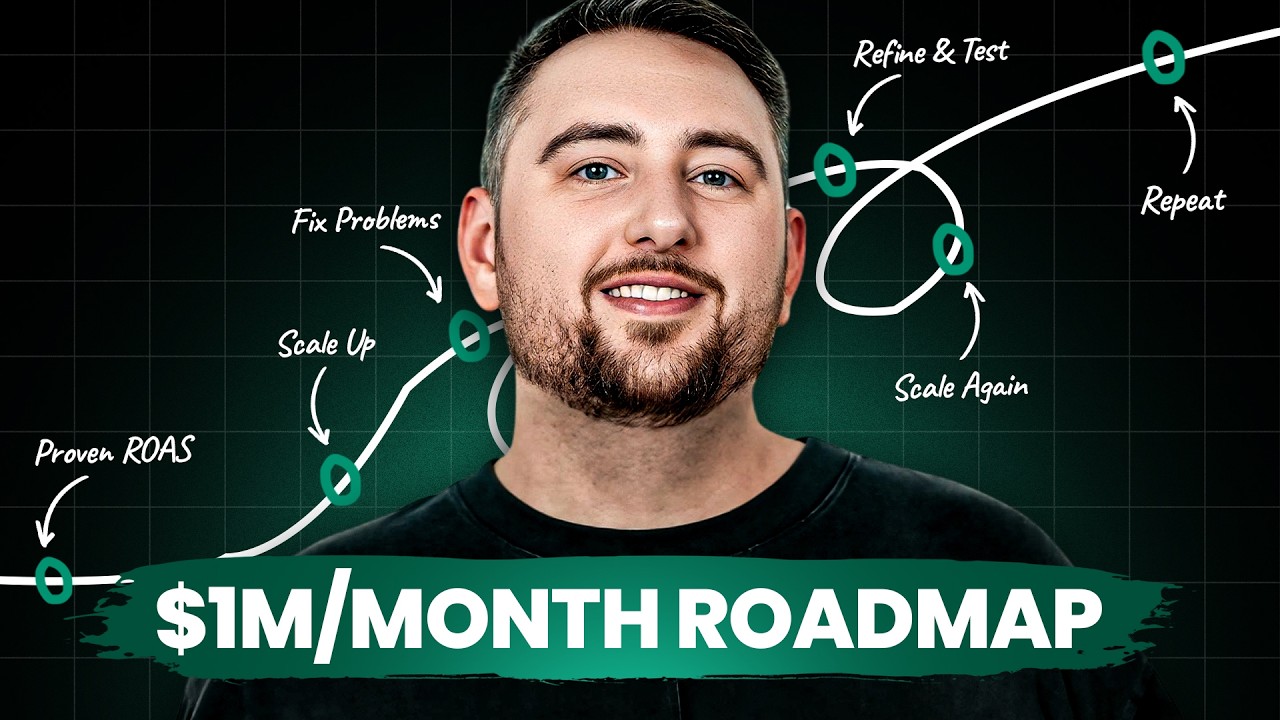
So first of all I pulled some inspiration here visually from Mr. Ray Dalio. Ray Dalio has an incredible book called Principles and one of the visuals that he has, as soon as I saw it, just bingo connected with me mentally and I said if that doesn’t represent how scaling works I don’t know what does.
So I’m going to walk you through this process. This is extremely common.
You can apply to yourself if you’re already doing low couple hundred grand and you’re stuck. You can even apply to yourself if you’re just shy of $100K a month and potentially get to the point where these lessons are something you can implement.
And again even if you are already at the million-dollar plus month benchmark and again you’re stuck, this is likely why.
Why You Need to Get Something ROAS Positive Before You Start Scaling at All
So first things first, you figured out something that works. You got it ROAS positive and it’s time to start the scaling process.
Surprisingly and this happens to be clear and very transparent with you at almost every level of the game, it’s one of the most shocking things to me.
It’s as though either people who are at the bottom specifically and have not started scaling yet, they get caught in this, I call it tinkering your way to poverty.
You can split test your way into mediocre stagnant positions in business, because over-reliance on split testing without strategic direction can limit meaningful innovation and lead to diminishing returns.
A lot of people will get attached to some grand ROAS that they have. In some instances it’s the opposite, they’re ROAS positive but they’re not as ROAS positive as they think they should be.
Simply put these people at this lower level that don’t even start the scaling process typically get attached to what a ROAS expectation should be.
And rather than just being profitable and starting the process and making a whole lot more money, they instead split test their way to poverty. And they stay stuck as a result of that.
There’s nothing wrong with fixing things as you scale but don’t let split testing be something that prevents you from scaling in the first place at all.
As soon as you get something that’s ROAS positive that’s efficient to be able to deliver on and is scalable, you start spending more money.
A very tactical way to go about doing this is to make sure you actually set aside a set percentage of your total profit to reinvest back into ad spend, since reinvesting profit into marketing is a proven strategy for sustainable business growth.
That’s one of the first booby traps that happens at this specific level of the game before you even technically take off. You don’t even focus on reinvestment.
You’re making the profit and just pulling it out and doing who knows what with it, anything other than scaling with it that’s for sure.
And in another instances it’s not that you’re not willing to spend more money, again you just get attached to what some specific ROAS should be.
We’ve had guys that have like 25x ROAS when they’re at this specific level and every time they start the scaling process their ROAS slips to only like a 15 or an 18x ROAS and they start flipping out thinking oh I need to make sure that it goes back up to 25 before I start spending more money and only turning a dollar into 15 or 18 instead of a dollar into 25.
That’s how ridiculous that sounds. Spend more money.
We get other people as an example where they’ll be at like a 3x ROAS, something more conservative, and again they start pressing the gas, they stay at a 3x but they’re like man I’d rather this be at like a 5x or a 6x so again they end up scaling it back down.
And even worse and this is kind of crazy to be fair but you’ll find people that like barely press the gas and then they just kind of get scared.
I don’t generally find that those people consume my content but hey if that’s you it’s time to step up here and there and spend some more money when it’s appropriate to do so.
But I digress, let’s move on to what happens next after you get something that’s ROAS positive and working and you start to press the gas a little bit.
How to Start Spending More Money Without Killing Your ROAS When Scaling
Simple enough, you start spending more money.
You start spending more money in scaling and again I can’t stress this enough, one of the easiest ways to go about doing this is obviously doing financial modeling.
Being aware of what we consider, and I want to give some cliff notes on this, a good, great and intolerable KPI benchmark for each statistic in your model.
As an example of this let’s say I’m running a call funnel. I can be very clear on what my cost per call can go up to that’s considered good, really good like great, and then if it goes above this it’s intolerable.
I can’t tolerate anything above that. I won’t be profitable as long as all my other statistics hold.
Being aware of these three KPIs makes a tremendous difference for the certainty and confidence that you’ll have as you start scaling.
Same thing with things like show rate in a call funnel example, close rate, average order value, the cash you’re actually collecting per sale on average.
Payment plan funding partners can also help give or take what you’re selling.
Any funnel to be clear can be modeled out. If it’s a webinar as an example you’ve got your click-through rate, your CPMs, your opt-in rate, your show rate, your conversion rate, cash collected obviously.
It’s all kinds of statistics that you need to be aware of for those three different categories of good, great and intolerable benchmarks for each one of those specific KPIs.
If you go into it blind and you are oblivious to what you can actually spend up to or what that KPI can fluctuate up to, then you’re going to lose a lot of certainty real quick when you start to spend more money.
There’s going to be days that are really good, there’s going to be days that are terrible.
The terrible days are like booby traps. If you judge on extremely short-term time frames you have a much higher probability to pull back the spend. It’s not good.
You don’t want to be that kind of person. You want to be able to judge things on a broader duration of time.
The contextual broader duration of time that’s generally most appropriate to judge things by is your sales cycle.
So if I have an average sales cycle timeline of let’s say 7 days, I have to endure roughly 10 to 14 days because if I only endure 7 days that means I’m technically only accounting for day one’s spend out of the 7-day window.
If I have a full seven days of spend I can technically start to judge it at the end of the 14th day. You see what I’m saying?
You have to have a time frame that you’re also aware of and tapped into in addition to the good, great and intolerable KPIs so you know over a broader window whether you’re still profitable or not.
Can’t tell you the countless amount of times we’re working with businesses at every level of the game that just start freaking out. The biggest guys do it and the smallest guys do it.
You have to know your certainty KPI and you have to know the duration and time that you can actually look.
If you are in doubt just look up the last 30 days worth of buyers and look at their origination dates. That’ll give you the true average of your sales cycle.
You’d be impressed of how few businesses actually dig into these statistics and have accuracy on them.
Most people are inherently extremely lazy and even though they don’t want to identify as lazy they are and they don’t actually look at these statistics for what they can truly be.
They barely build any financial models if any. You have to do these things when you’re scaling.
I promise it’ll make things so much easier and just give you a lot more certainty and confidence that’s required when you’re scaling and reinvesting dollars.
What Goes Wrong When You Start Scaling and How to Diagnose the Problem
Here’s the third thing that kind of starts to occur. Something along the way just kind of comes up and there’s all kinds of different things that come up obviously relative to what specific funnels you have.
All these different problems I’m about to describe are obviously inherent to specific businesses that we’ve worked with. Your specific problems might be similar, you might have completely different problems but something generally pops up.
Some very simple examples, let’s use a call funnel or a webinar that pushes people to book calls as examples.
So you start the process of scaling up and you might be poor at recruiting good closers into the business or the closers that you’ve recruited have been terrible.
AKA you might be poor at training, development and sales management but let’s use the example that the people you hired did actually not perform well.
Obviously you have to go through the process of hiring new batches of people and if you just focus on that one problem in itself that can be a very time-consuming issue that can drag on for upwards of 3 to 4 weeks.
To get a closer recruited, to get a closer trained and onboarded, to get a closer officially tag teaming with another closer or yourself to officially get them confident and then to get the closer on the phone, that’s generally a good 3 to 4 week process.
That’s one of the most common things that can typically hold a business back.
That’s why I use this visual here. You start here towards the bottom where things you’re in the figure it out phase, then you move into the window of okay I’m starting to scale and then you hit this phase right here where something becomes wrong.
And you’ve specifically got to start paying attention to what is holding it back.
I’ll give you another good one as an example. One of my Inner Circle members, he had paired up with another Inner Circle member to do his marketing, good for him.
And this guy specifically started scaling and it did really really good for the guy. He went from about $100K a month to a little over $200K a month within the first 30 days working with the guy.
But as they started their scaling process one thing in particular popped up.
The guy who is scaling instead of following the scaling principles that I teach and like to talk about, which are also some of the best practices out there, such as only scaling about 10% to 30% a day, sometimes multiple times a day.
The cost per result holds within that same period of time while you’re scaling up. If you do it too aggressively your cost per result can kind of start to spin the wheels. You don’t get as good of a cost, starts to get out of reach really quickly.
Which again if you’re oblivious to your good, great and intolerable KPIs you’ll just continue scaling anyway which is what this specific business did.
So they were scaling about 50% a day for many days in a row trying to milk existing creatives that were really good in the words of the marketer but they didn’t overcome ad fatigue.
We have a whole piece on this site, it’s one of the first pieces that I posted here that you can go check out on what to do to overcome ad fatigue protocol.
And of course if you’re an existing student of mine in something like my Master Internet Marketing group or my Inner Circle program we have an entire PDF SOP guide on overcoming ad fatigue titled What Is Ad Fatigue.
DM me in the instance that you don’t have it or tag me in one of the group chats and I’ll happily get it to you.
To be clear, ad fatigue is a huge problem and it’s one of the most common instances, because continued exposure to the same ads can reduce engagement and effectiveness unless creatives are regularly refreshed.
This specific example of them scaling up and then having the problem that they had to deal with, it was just ad fatigue.
All they had to do is just relaunch their creatives with some fresh campaigns, some fresh creatives within those campaigns, everything would have been all good again and that’s a very fast and easy problem to solve.
What Is the Difference Between Marketing Knobs and People Problems When Scaling
There’s generally two types of problems that occur at these different levels. One of them is what we call marketing knobs coined by my buddy Josh Troy and another one is the people problems.
People problems are far longer to solve, typically weeks at a time at a minimum.
Marketing knobs are generally things that can be done almost instantaneously. As an example, overcoming ad fatigue just requires some fresh creatives that at most, as long as the person can film or maybe you have somebody that can just make your ads for you, can be extremely fast problem to solve typically within the day.
In other instances again if it’s a people problem like the closer example, it can drag on for quite a bit of time.
But what you’ll notice is you eventually, although yes you deal with a minor contraction in that phase specifically, start the process of swinging back up again.
And when you start the process of scaling back up that’s the period of time that we consider the make sure it works again phase.
Why You Need to Make Sure It Works Again Before Scaling Further After a Problem
The make sure it works again phase is generally where you want to regain some certainty.
We had a client just recently, it was one of our Inner Circle members who had done a webinar. Their last month’s webinar had done phenomenal. They flipped about $43K in a test budget to a little over $248,000. Really good for them especially for a test.
They did a second webinar and they changed in their own words over 80% of what was done in the first webinar.
They changed the ads, they changed the copy in the ads, they changed the messaging of the page, they changed the webinar content itself and they didn’t do so good the second webinar.
So they started the process of scaling up, they got to the point where they executed the second webinar and it just did not go well at all. As a matter of fact I’m pretty sure they lost money on the second webinar.
They get on a call with me to do a debrief and again we dig into it, we find out it was very evident why it didn’t work. It changed nearly everything instead of just repeating successful actions and scaling it.
But then they go on to do a third webinar. The third webinar is where you’re in the phase of make sure it works again.
You don’t necessarily have to contract back down. That’s the one thing I want to make extremely clear about scaling.
You might think in that example that they scaled up and it failed technically so then they got to repeat the process all over again but that’s not necessarily how it works in reality.
You might just stay stuck at a specific level for a longer duration of time and then you start the process of scaling back up again until you reach the next new level.
This can represent the stagnancy that can happen at almost any level of the game.
This is what I was inferring at the beginning of this piece. We’ve seen people stuck at low couple hundred grand a month. We’ve seen people stuck like the guy who recently came through our funnel that was at about $2 to $3 million a month.
There’s plateaus at all levels of the game. It doesn’t mean that you contract aggressively back down to the previous levels you were once at. It just means you kind of stay stuck.
So like in that webinar example I just provided, they didn’t contract back down, they just have to stay stuck at that level until they get the confidence again.
That’s what’s very key about this next phase, the make sure it works again phase.
They’re going to spend about the same $45-ish K that they spent the first webinar. They’re going to return about the same amount they did the first webinar, priced somewhere in that $250K range.
Once they make sure it works again, press the gas and start scaling. That’s as simple as it is.
How to Scale Again After You Fix the Problem and Regain Certainty
So again once they get through that part of the phase it’s pretty simple. You start scaling again. You start pressing the gas and then the cycle repeats itself.
All of a sudden you got new issues that popped up and you’re just repeating the same thing again and again and again.
It’s never from my experience, from what I’ve seen anyway, just a smooth sailing ride all the way up. There’s always something.
And usually the something that it is are generally from three main areas and those three main areas are pretty simple and common in almost all businesses.
It’s either a sales problem, a marketing problem or some kind of operations issue.
There are instances where it can be something else but these are the big three when it comes to problems that can arise along the way.
Why Contraction Phases Are Normal When Scaling and How to Get Through Them
When you look at these windows specifically during these minor contraction phases, that’s what’s key.
You have to be aware of this specific cycle because if you lack the self-awareness on the fact that this is happening you end up getting distraught and have a much higher probability to contract or just stay stuck.
There’s a specific protocol that you have to do at each level of the game. It’s generally that simple.
If you’re oblivious to the protocol of what to do, like imagine you’re driving down the road, you pop a tire, your little notification pops up on your dashboard that says hey you’ve got a flat and you don’t know what to do so you just keep on driving.
You damage the vehicle exponentially more if you just keep driving the vehicle and don’t know what to do.
In that example it’s the same thing. If you have a check engine light, some check engine lights are minor like a sensor going out. Other check engine lights are pretty major.
And the whole point is you have some type of signal that you become self-aware of that helps you diagnose the severity of the issue and that can determine literally the need to pull the vehicle over or that you can keep driving, take it back home and just service it at a later time.
Every problem that has little indication lights in your business you have to be aware of the severity of them and what to do as a result.
Again imagine if you’re just oblivious to what those signals are, how they work, what they mean. You’re going to have a really bad time when you’re trying to scale up to million-dollar a months if that’s the case because you’re not going to know what to do.
What to Do When You’re Stuck at Your Current Revenue Level and Can’t Break Through
So if that’s you or if you are stuck, one thing I’d really encourage you to do is consider joining into my Inner Circle offer. There’s a link for it available.
You and I will jump on to twice a month one-on-one calls. We do weekly group calls that are about an hour sometimes upwards of an hour and a half long that you can request the topics for.
We also do quarterly in-person masterminds right here in the penthouse in Miami, Florida. We have an incredible movie theater room that we do the presentations in and then we bring it up here for the networking time on Saturday night and all day Sunday to hang out and just network.
We have a big 2,500 square foot balcony up here where we hang out in addition to just being right here where you see me now in the unit itself.
Lastly we have a group chat full of rich people trying to get a lot richer than they are right now that are all extremely transparent with one another and actually care about each other because it’s a give and take relationship that you develop with the other people in the group.
You get some great friends, great relationships and some great value outside of just myself because all the other people in there are just like you. They want to get a lot richer than they are right now and they’re fed up with being stuck.
We also have my Master Internet Marketing program, perfect to train your staff or perfect to train yourself if you’re an individual.
Seven full weeks of 3 to 5 hour live classes, worksheets to help with retention from each one of the topics that are covered in the content.
In addition to that we have a tremendous volume of content to consume in between each one of the live classes for your homework.
It is designed in a way that has such an extreme intensity to help with the information being retained at its highest possible levels but to also not talk to you like you’re a beginner.
It’s a lot of intermediate and advanced information that we’re going to put you on game to inside of that offer as well.
The Inner Circle is an ongoing recurring price point that we generally want people to commit to for a year.
The Master Internet Marketing program is a transactional price, one-time access for the lifetime of the offer which you are obviously welcome to also check out.
Either way I genuinely appreciate you consuming this content.
Go ahead and check out some of the other pieces on the site that you may have missed in between this one and some of the last few great ones.
Most business owners waste years figuring out what actually works. In my Master Internet Marketing program, I compress that learning curve into 7 weeks, covering copywriting, funnels, ads, and more. If you’re ready to invest $5k and get serious about your skills, apply here.
I appreciate you being here. Go get richer.
Watch the video:

Jeremy Haynes
Owner and CEO of Megalodon Marketing
Jeremy Haynes is the founder of Megalodon Marketing. He is considered one of the top digital marketers and has the results to back it up.