
Adding a Challenge Funnel Without Losing a Working Webinar

I hope you enjoy reading this blog post. If you want my team to just do your marketing for you, click here.
Author: Jeremy Haynes | Published November 3, 2026
Earnings Disclaimer: You have a .1% probability of hitting million-dollar months according to the US Bureau of Labor Statistics. As stated by law, we cannot and do not make any guarantees about your own ability to get results or earn any money with our ideas, information, programs, or strategies. We don’t know you, and your results in life are up to you. We’re here to help by giving you our greatest strategies to move you forward, faster. However, nothing on this page or any of our websites or emails is a promise or guarantee of future earnings. Any financial numbers referenced here, or on any of our sites or emails, are simply estimates or projections or past results, and should not be considered exact, actual, or as a promise of potential earnings – all numbers are illustrative only.
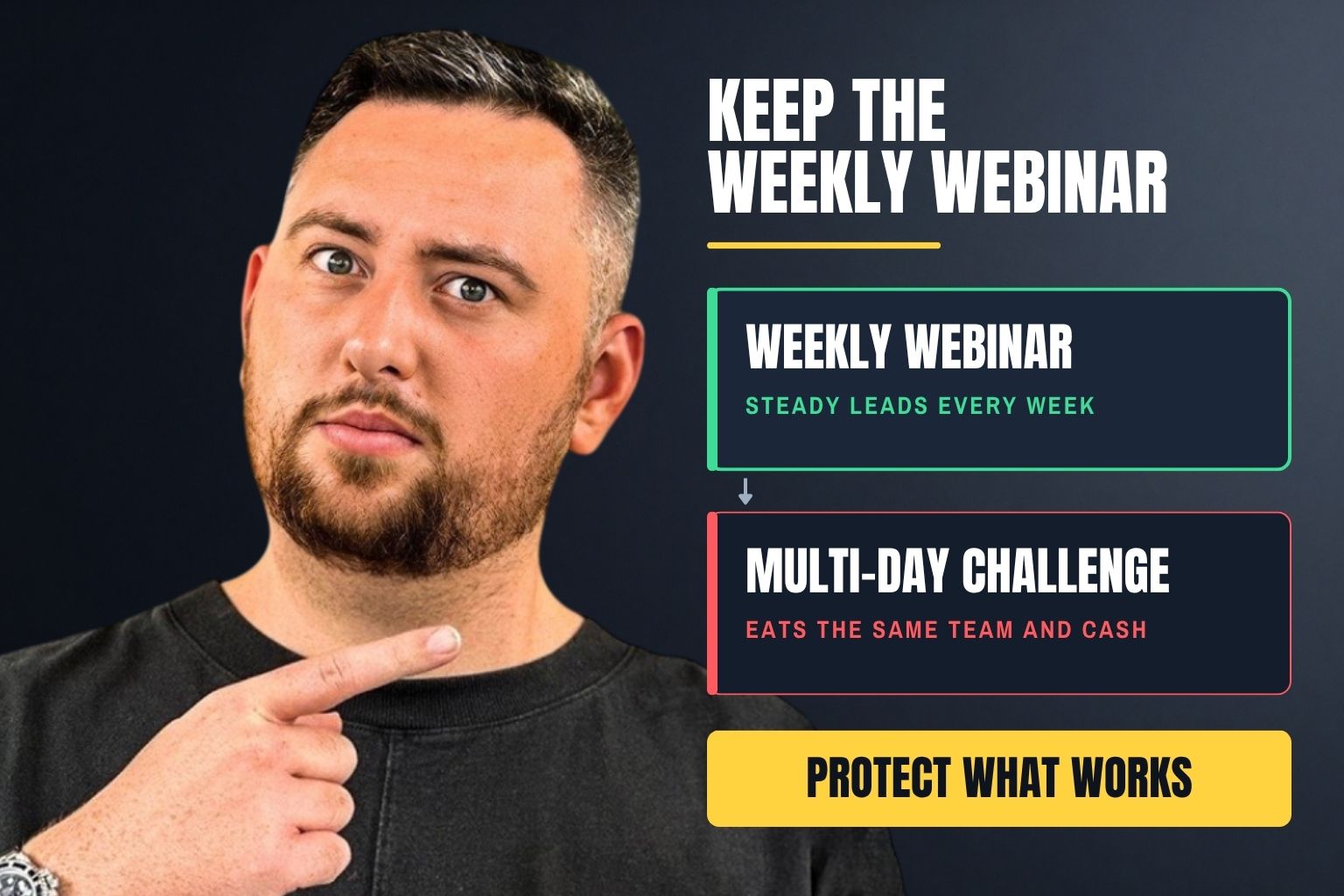
A challenge funnel versus a webinar is a different decision when your agency already has a webinar that works. You are choosing what the next event adds and what running it takes away from the existing business. A multi-day launch can absorb the same presenter, salespeople, and advertising cash that keep the weekly funnel moving. I want that tradeoff understood before the launch becomes everybody’s priority.
I think of a challenge as a concentrated event that can reconnect with people already familiar with the business. A recurring webinar gives you another chance to educate buyers and improve the presentation. Those jobs can support each other, provided the agency can deliver both without quietly abandoning the one already doing useful work.
Already making money? See what it takes to make a lot more.
A Bigger Event Changes the Rhythm of the Business
A challenge concentrates promotion, presentation, and selling around an event. That makes its workload and cash pattern different from a webinar you are already repeating.
The event needs material, promotion, technical delivery, sales coordination, and follow-up. Adding days increases the amount the presenter and team have to support. Guest speakers can share some of the presentation work, but somebody still has to organize the whole experience.
With a weekly webinar, a weak part of the presentation can be improved for the next run. A larger challenge may give you fewer opportunities to repeat the whole event. You need to be comfortable with that difference before treating the launch as the better learning environment.
A large collection day can also change how the team talks about the business. Everybody remembers the event, while the ordinary acquisition work becomes less exciting. The recurring work still matters after the launch ends.
Your sales team’s ability to handle the resulting leads remains part of the decision. The event format cannot compensate for a team that has no room to work the opportunities it creates.
The Challenge Needs a Job Your Webinar Is Missing
I want a reason to add the challenge beyond having seen somebody else’s launch result. Identify the people it could help you reach or re-engage and why the existing webinar has not moved them further.
You may have people who have followed the business for a while, registered for previous material, or stayed interested without purchasing. A larger event can give them a different way to engage with the subject.
That is the cleanup role I describe for challenge funnels. You have already put effort into creating awareness. The event gives some of those people another reason to come back and consider the offer.
It still has to offer something they want. More sessions are not a reason by themselves. The material, presenter, and eventual offer need to make sense for that audience.
Look at what the challenge format asks the team and buyer to do. Extensive education can help prepare a conversation, but it takes real time to create and consume. Keep that commitment connected to an actual buying question.
Account for the Webinar Work the Launch Displaces
The challenge’s cost includes the useful work your team stops doing to build it. The same person cannot give their full attention to the weekly presentation and the launch at the same time.
Look at who improves the webinar, who produces the ads, and who follows up after it. If those people move into the challenge, determine what happens to their existing work.
An agency can make this harder by treating client delivery, its own marketing, and the event as though each has a separate team. Follow the actual people through the calendar. That is where the conflict becomes visible.
Protect the part that already works. If someone else will run the webinar or follow-up, make sure they can do the job before relying on the handoff. If the launch requires reducing the weekly activity, recognize that reduction as part of the test.
A launch has to justify the attention it takes from an existing winner. The follow-up supporting booked sales calls still needs attention while the event is being prepared. A shared calendar does not tell you whether anybody has enough time to complete the work.
The relationship between the offer, funnel, and sales process belongs in Master Internet Marketing, my 7-week live comprehensive training. Decide what the event contributes before committing the people who keep the current funnel running.
Results are not typical. Your results will vary and depend entirely on your individual capacity, business experience, expertise, and level of desire. There are no guarantees concerning the level of success you may experience. The testimonials and examples used are not intended to represent or guarantee that anyone will achieve the same or similar results. We don’t believe in get-rich-quick programs. We believe in hard work, adding value and serving others. As stated by law, we can not and do not make any guarantees about your own ability to get results or earn any money with our information, courses, programs, or strategies.
Ticket Sales May Leave Cash Committed Until the Pitch
Ticket revenue can offset some promotion costs, but you still need to know how much cash remains committed before the main offer is sold. A busy registration report cannot answer that question.
I describe challenge funnels as having a promotional burn period because money can go out before the larger sales event occurs. The business needs to support that period without assuming the eventual pitch will repay everything.
Keep the working webinar in the same cash conversation. If money that normally funds it moves into challenge promotion, the change affects more than the event’s advertising account. You may be reducing the acquisition activity that helps support the business while waiting for the launch.
Use your actual costs and collections. Include the work needed to produce and deliver the event. Ticket sales, accepted payment plans, and cash already received need to remain distinguishable.
Stripe’s billing analytics separates recurring-revenue reporting from views of unpaid invoice balances. Look through to the money available rather than treating every sale or scheduled payment as spendable cash.
Do not finance a launch with money already needed for delivery. If the plan only works when the new event delivers its best outcome immediately, the business is carrying more risk than the promotional excitement suggests.
Registration and Attendance Answer Different Questions
Registration tells you who signed up. Attendance tells you who came. A comparison between the challenge and the webinar needs to follow suitable prospects further than either of those actions.
Zoom provides registration and post-event attendee reports as separate reporting options. Use the appropriate records when examining where people stopped participating.
A multi-day event introduces more points where somebody can leave before hearing the offer. That makes the journey through the event part of what you are testing, alongside whether the right people registered in the first place.
Keep the sales records connected to the event they came through. You want to know who asked for a conversation, who attended it, who fit the service, and what was actually collected afterward.
A challenge that produces many unsuitable conversations creates a different workload from a webinar producing fewer relevant ones. The larger headline count can hide the work the sales team now has to do.
Allow for Follow-Up Before Judging the Added Event
The event does not finish its commercial work when the presentation ends. Your team still has conversations to conduct and people to follow up with.
Plan for that workload while the weekly webinar continues. Otherwise, the team can move straight from presenting the challenge into processing new webinar leads and leave earlier interest untouched.
Give each follow-up a useful reason to exist. Answer the question the person still has, clarify the offer where appropriate, and respect their decision if it does not fit. Another invitation is weak help when the person needs an explanation.
Recent advertising numbers may also be incomplete. Google Ads documents conversion lag, including how delayed conversions can temporarily affect reported acquisition costs and returns. That reporting issue is separate from waiting for an agreed payment to arrive.
Use an observation period that makes sense for your actual sales process. Keep the same definitions when comparing the event with the webinar, and investigate missing records instead of filling the gaps with optimistic assumptions.
7 weeks. Real frameworks. Covering copywriting, funnels, paid ads, and conversion systems.
The Business Still Needs Lead Flow After the Launch
The final decision is whether the challenge added something useful while leaving the business able to keep acquiring and serving clients afterward. The event’s busiest day is only part of that answer.
Look at the webinar after the launch. Is the presentation still being improved? Are relevant buyers still coming through? Has follow-up recovered, or is the team carrying unfinished work from both events?
You may decide to repeat the challenge, change its role, or keep attention on the weekly webinar. Let the actual contribution and workload inform that choice. One successful event does not establish that the agency should replace its ordinary acquisition rhythm.
For a webinar scenario, the webinar calculator lets you work through different inputs. Treat the output as a scenario to examine against your own records, rather than a prediction of what the next event will collect.
Operators in my Inner Circle can discuss these funnel decisions with peers. Bring the current webinar’s contribution, the challenge’s intended job, and the people and cash required to support both. A challenge should expand the opportunities you can serve without quietly taking apart the system already helping you serve them.
Results are not typical. Your results will vary and depend entirely on your individual capacity, business experience, expertise, and level of desire. There are no guarantees concerning the level of success you may experience. The testimonials and examples used are not intended to represent or guarantee that anyone will achieve the same or similar results. We don’t believe in get-rich-quick programs. We believe in hard work, adding value and serving others. As stated by law, we can not and do not make any guarantees about your own ability to get results or earn any money with our information, courses, programs, or strategies.
Get my content first on Google
Add jeremyhaynes.com as a preferred source and Google shows my articles more prominently in your search results, including AI Overviews and AI Mode.


Jeremy Haynes
Owner and CEO of Megalodon Marketing
Jeremy Haynes is the founder of Megalodon Marketing. He is considered one of the top digital marketers and has the results to back it up.