How to Fix Your Sales Call Show Rate Problem Using Follow-Up Systems

I hope you enjoy reading this blog post. If you want my team to just do your marketing for you, click here.
Author: Jeremy Haynes | Published May 7, 2026
Earnings Disclaimer: You have a .1% probability of hitting million-dollar months according to the US Bureau of Labor Statistics. As stated by law, we can not and do not make any guarantees about your own ability to get results or earn any money with our ideas, information, programs, or strategies. We don’t know you, and besides, your results in life are up to you. We’re here to help by giving you our greatest strategies to move you forward, faster. However, nothing on this page or any of our websites or emails is a promise or guarantee of future earnings. Any financial numbers referenced here, or on any of our sites or emails, are simply estimates or projections or past results, and should not be considered exact, actual, or as a promise of potential earnings – all numbers are illustrative only.
Most businesses are sitting on a gold mine they don’t even know exists. I’m talking about dead leads and no-shows. You’re spending money to get people booked on your calendar, and then half of them just ghost. That’s not a lead quality problem. That’s a systems problem.
Let me break down what’s actually happening here. Your show rate is the percentage of booked calls that actually show up. If you book 100 calls and 60 people show up, you’ve got a 60% show rate. Most businesses I’ve worked with operate without proper systems in place. The ones running tight SOPs have structured processes for every touchpoint. If you want a deeper breakdown of the exact confirmation-page and email tactics that move this number, I’ve laid out four backend systems that push show rates toward 80% in a separate piece.
Here’s what the operational framework looks like. Let’s say you’re booking 100 calls a month. If you’re running a systematic follow-up process versus a manual one-off reminder approach, you’re working with completely different conversion mechanics. Same ad spend. Same offers. Same everything. Just different execution on the follow-up layer.
The problem is that most people treat follow-up like an afterthought. They send one reminder text and call it a day. That’s not a system. That’s barely trying.
In my experience working with operators through our 7-week live comprehensive training, the gap between businesses that have documented follow-up processes and those that don’t is massive.
Results are not typical. Your results will vary and depend entirely on your individual capacity, business experience, expertise, and level of desire. There are no guarantees concerning the level of success you may experience. The testimonials and examples used are not intended to represent or guarantee that anyone will achieve the same or similar results. We don’t believe in get-rich-quick programs. We believe in hard work, adding value and serving others. As stated by law, we can not and do not make any guarantees about your own ability to get results or earn any money with our information, courses, programs, or strategies.
7 weeks. Real frameworks. Covering copywriting, funnels, paid ads, and conversion systems.
Why Booked Calls Go Cold Before They Happen
Before we get into the SOPs, you need to understand why leads go cold in the first place. It’s not because they’re tire-kickers or they weren’t serious. Most of the time, it’s way simpler than that.
Time decay is the biggest factor. The longer the gap between when someone books and when the actual call happens, the colder they get. They booked in a moment of motivation, maybe late at night after watching your VSL or reading your sales page. By the next morning, real life kicks back in. They start second-guessing. They forget why they were even excited.
Then you’ve got competing priorities. People are busy. They book multiple calls with multiple people. If you’re not staying top of mind, they’re going with whoever follows up better. It’s not personal. It’s just that the other person reminded them five times and you reminded them once.
Lack of perceived value is another big one. They don’t actually understand what they’re getting on the call. They think it’s going to be a pitch fest, so they bail. Or they don’t see the urgency. There’s no real reason they need to show up today versus next week versus never.
The research on this backs up what we see in the field: one widely cited Harvard Business Review study tracked how fast companies contacted online sales leads and found that firms that made contact within an hour were dramatically more likely to qualify the lead than those who waited even a day. Speed and consistency of follow-up directly impact whether someone shows up to a scheduled commitment. And then sometimes it’s just that your front-end targeting was off and you booked someone who was never going to be a fit anyway. But that’s a different problem. For now, we’re focused on the people who should be showing up and aren’t.
How SMS and Email Function in a Multi-Channel Follow-Up System
Here’s what you need to understand about these two channels: they’re not interchangeable. They serve completely different purposes, and you need both.
- SMS has higher open rates and faster response times.
- Email is where you deliver value, build authority, and handle objections.
You can’t deliver a case study or a testimonial video effectively over a text message. A text is for quick hits: confirmations, reminders, and getting a reply. Email is where you send the case study, the testimonial video, or a breakdown of what to expect on the call.
When you use both together, you’re creating omnichannel pressure without being annoying on any single channel. You’re strategically hitting them on SMS for accountability and urgency, and on email for education and proof.
The data on this is consistent: coordinated, multi-channel outreach sequences significantly outperform single-channel efforts, with sales teams running combined touchpoints across channels seeing meaningfully higher conversion than teams relying on one method alone. Combining multiple touchpoints in a coordinated sequence creates higher engagement than relying on a single communication method.
What a Pre-Call Confirmation Sequence Actually Looks Like
This is where most of the operational leverage is. The sequence between when someone books and when the call actually happens is your window to turn a cold booking into a warm, engaged lead who actually shows up.
- Immediately after booking (within 1–5 minutes): Send an SMS that feels personal and conversational. Example: “Hey [Name], it’s [Your Name/Brand]. Got you locked in for [Day] at [Time]. Quick question, what’s the number one thing you’re hoping to solve on this call?” That question gets them to engage and commit mentally.
- At the same time: Send a confirmation email with calendar details, what to expect on the call, a quick testimonial or case study link, and Zoom or phone info.
- If the call is more than two days out: Send another email ~24 hours after booking with pure value — a short case study or a video from you explaining what you’ll cover.
- 24 hours before the call: Send an SMS: “Hey [Name], just a heads up, your call is tomorrow at [Time]. Still good?” Aim for a reply as another micro-commitment. Send an email at this point with 2–3 questions to think about before the call to prime them.
- Morning of / Evening before: Send another SMS: “Looking forward to chatting today at [Time]. Here’s your Zoom link: [link].”
- 15–30 minutes before: Send a final text: “Jumping on in 15, see you there! [link].” This is the last nudge to pull them back if they were distracted.
The goal isn’t only to remind them — it’s to get replies. Every reply is a re-commitment.
How to Build a No-Show Recovery Process That Actually Runs
When someone doesn’t show, most people give up after one message. That’s leaving opportunity on the table. Here is a practical recovery sequence:
- 5 minutes after a missed call: Send a neutral SMS: “Hey [Name], I was just on the line waiting for you, everything okay?” Keep it human and non-accusatory.
- 30–60 minutes later: Another SMS: “No worries if something came up. Want to reschedule? Here’s my calendar: [link].”
- Same day, evening: Send an empathetic email with value and social proof — a testimonial or a short story of someone who almost didn’t show and then benefited.
- 24 hours later: SMS: “Still want to chat? I’ve got a couple spots open this week: [link].”
- 48 hours later: Email with objection-handling content or a relevant case study tied to what they said they wanted to solve.
- Day 3–5: Send a break-up text: “Hey [Name], I haven’t heard back so I’ll assume the timing isn’t right. If things change, you know where to find me.” This creates scarcity and often elicits replies.
The tone should be consistent: persistent but not pushy. Automation can send many of these touches, but human follow-up is essential when they reply.
What Dead Lead Reactivation Campaigns Look Like in Practice
Leads that went cold 30, 60, or 90+ days ago are low-hanging fruit. You already paid to acquire them.
- Run a batch SMS blast with a fresh hook: “Hey [Name], we just opened up [X], thought of you. Still looking to [solve problem]?”
- Use checking-in messages that feel human: “Hey, been a minute, how’s everything going with [their problem]?”
- Offer a new lead magnet or free training as a re-entry point: a case study, workshop, or low-commitment resource.
- Segment carefully. A no-show is different from a lead who showed but didn’t close, and different from someone who never booked. Tailor messaging accordingly.
- Sometimes a different number or sender name helps when past outreach has been ignored.
Reactivation campaigns can recover a meaningful percentage of dead leads into booked calls at minimal additional spend. If a batch reactivation still isn’t converting, the leads that raise their hand are often better served by getting them in front of you directly — I break down how group closing calls turn reactivated dead leads into closed high-ticket sales in a separate piece, since a second, higher-authority touchpoint closes a chunk of these that a text sequence alone never will.
Why Automation and Human Touch Need to Work Together
Most people either automate everything (which feels robotic) or do everything manually (which is inconsistent). You need both:
- Automate the first 2–3 touchpoints (confirmation texts/emails and the first reminders). These should fire immediately.
- Human intervention should occur when someone replies or no-shows. If a lead gets only canned responses, you lose trust. A real person replying within minutes changes engagement dramatically.
Common tools: GoHighLevel (GHL), HubSpot, Salesforce + Twilio, Close CRM, Keap. The principle is speed to human — automation starts the sequence and keeps it consistent; humans handle nuance and conversion. If your CRM already lets you tag why a lead didn’t close, you can go a layer deeper than generic reminders — I cover how top businesses build contextual follow-up based on exactly where a lead is in the sales process in a separate piece, which pairs well with the sequences above once you have volume.
This is the operational framework we teach in the Inner Circle, where operators build out their entire client acquisition and fulfillment stack.
Results are not typical. Your results will vary and depend entirely on your individual capacity, business experience, expertise, and level of desire. There are no guarantees concerning the level of success you may experience. The testimonials and examples used are not intended to represent or guarantee that anyone will achieve the same or similar results. We don’t believe in get-rich-quick programs. We believe in hard work, adding value and serving others. As stated by law, we can not and do not make any guarantees about your own ability to get results or earn any money with our information, courses, programs, or strategies.
How the Operational Framework Impacts Your Business Model
Concrete scenarios to illustrate impact:
- Coaching business booking 200 calls/month with a manual reminder process might see ~110 people show up. Implement a standardized seven-touchpoint SMS + email SOP and your show rate improves — same close rate, same offer, more show-ups.
- An agency with 2,000 dead leads can run a three-day SMS reactivation campaign and generate new appointments from an ignored database.
- A high-ticket service provider who manually texts inconsistently can standardize messaging in the CRM and lift show rates through consistency alone.
This is not theoretical — businesses that implement systems instead of winging it see measurable operational shifts.
What Not to Do When Building Your Follow-Up System
Common mistakes:
- Assuming a no-show isn’t a real lead. Life happens — follow up.
- Thinking more messages always annoy people. Under-communication is a bigger problem when your messages are valuable and conversational.
- Believing automation replaces humans. Automation maintains consistency; humans handle conversion.
- Treating dead leads as worthless. Often your most cost-effective source of new appointments.
- Sending only one reminder. Industry research consistently shows multiple touchpoints are needed — the businesses that respond fastest and follow up most consistently connect with leads at dramatically higher rates than those that give up after one attempt.
- Assuming email is dead. Email educates and builds authority — don’t skip it.
- Copy-pasting templates without adapting them to your voice, offer, and audience.
Already making money? See what it takes to make a lot more.
Where to Start Building This System Right Now
Priority order:
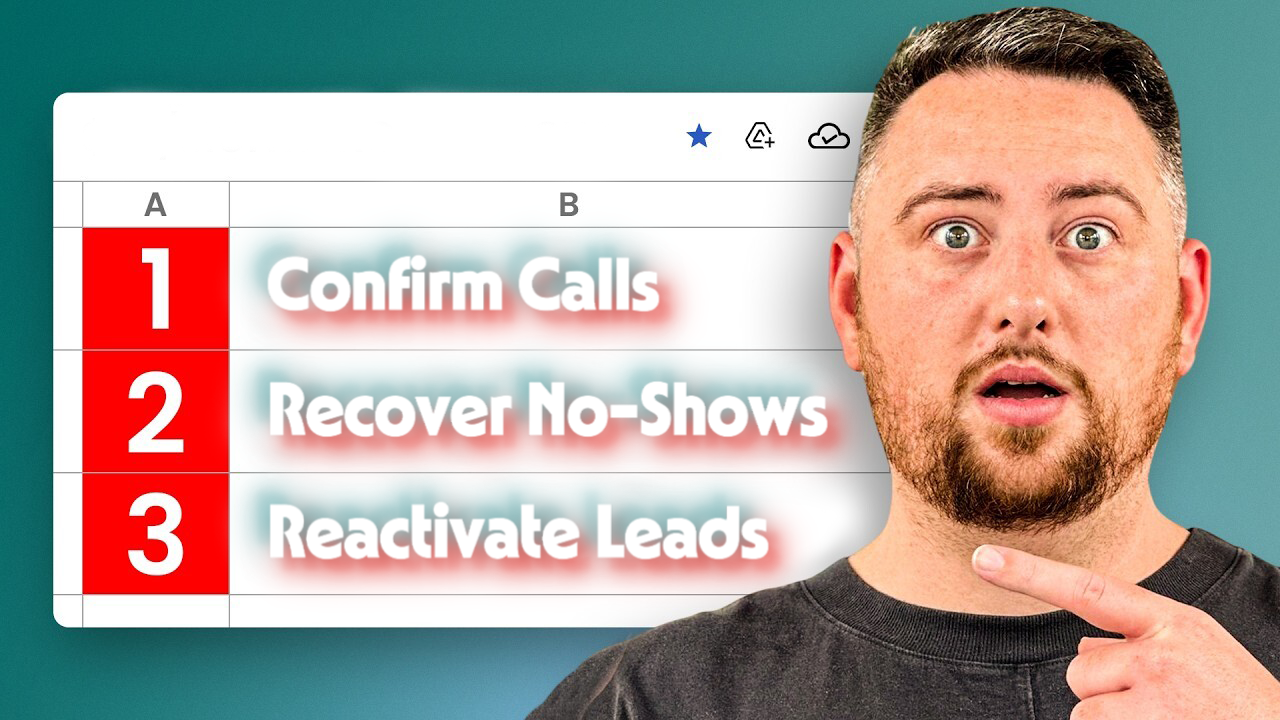
- Pre-call confirmation SOP. This is the highest-leverage area. Ensure every person who books gets the full booking-to-call sequence. Nail timing and messaging and get people replying.
- No-show recovery sequence. This is your safety net to bring people back when they miss a call.
- Dead lead reactivation. Segment your CRM (last 90 days, 60 days, 30 days) and hit them with fresh angles.
Don’t try to do everything at once. Pick one, build it, and make it consistent. Then add the next layer.
Your show rate is one of the highest-leverage metrics in your business. You’re already paying for traffic, ads, and calls. A lift in show rate with the same inputs changes your operational model. It’s not sexy — it’s execution on fundamentals.
If you’re ready to build the full operational stack, from lead acquisition to client fulfillment, the 7-week live comprehensive training walks through exactly how to document and deploy these systems in your business.
Results are not typical. Your results will vary and depend entirely on your individual capacity, business experience, expertise, and level of desire. There are no guarantees concerning the level of success you may experience. The testimonials and examples used are not intended to represent or guarantee that anyone will achieve the same or similar results. We don’t believe in get-rich-quick programs. We believe in hard work, adding value and serving others. As stated by law, we can not and do not make any guarantees about your own ability to get results or earn any money with our information, courses, programs, or strategies.
Get my content first on Google
Add jeremyhaynes.com as a preferred source and Google shows my articles more prominently in your search results, including AI Overviews and AI Mode.

Jeremy Haynes
Owner and CEO of Megalodon Marketing
Jeremy Haynes is the founder of Megalodon Marketing. He is considered one of the top digital marketers and has the results to back it up.