
Before You Broaden Your Niche, Test a New Buying Reason

I hope you enjoy reading this blog post. If you want my team to just do your marketing for you, click here.
Author: Jeremy Haynes | Published October 15, 2026
Earnings Disclaimer: You have a .1% probability of hitting million-dollar months according to the US Bureau of Labor Statistics. As stated by law, we cannot and do not make any guarantees about your own ability to get results or earn any money with our ideas, information, programs, or strategies. We don’t know you, and your results in life are up to you. We’re here to help by giving you our greatest strategies to move you forward, faster. However, nothing on this page or any of our websites or emails is a promise or guarantee of future earnings. Any financial numbers referenced here, or on any of our sites or emails, are simply estimates or projections or past results, and should not be considered exact, actual, or as a promise of potential earnings – all numbers are illustrative only.
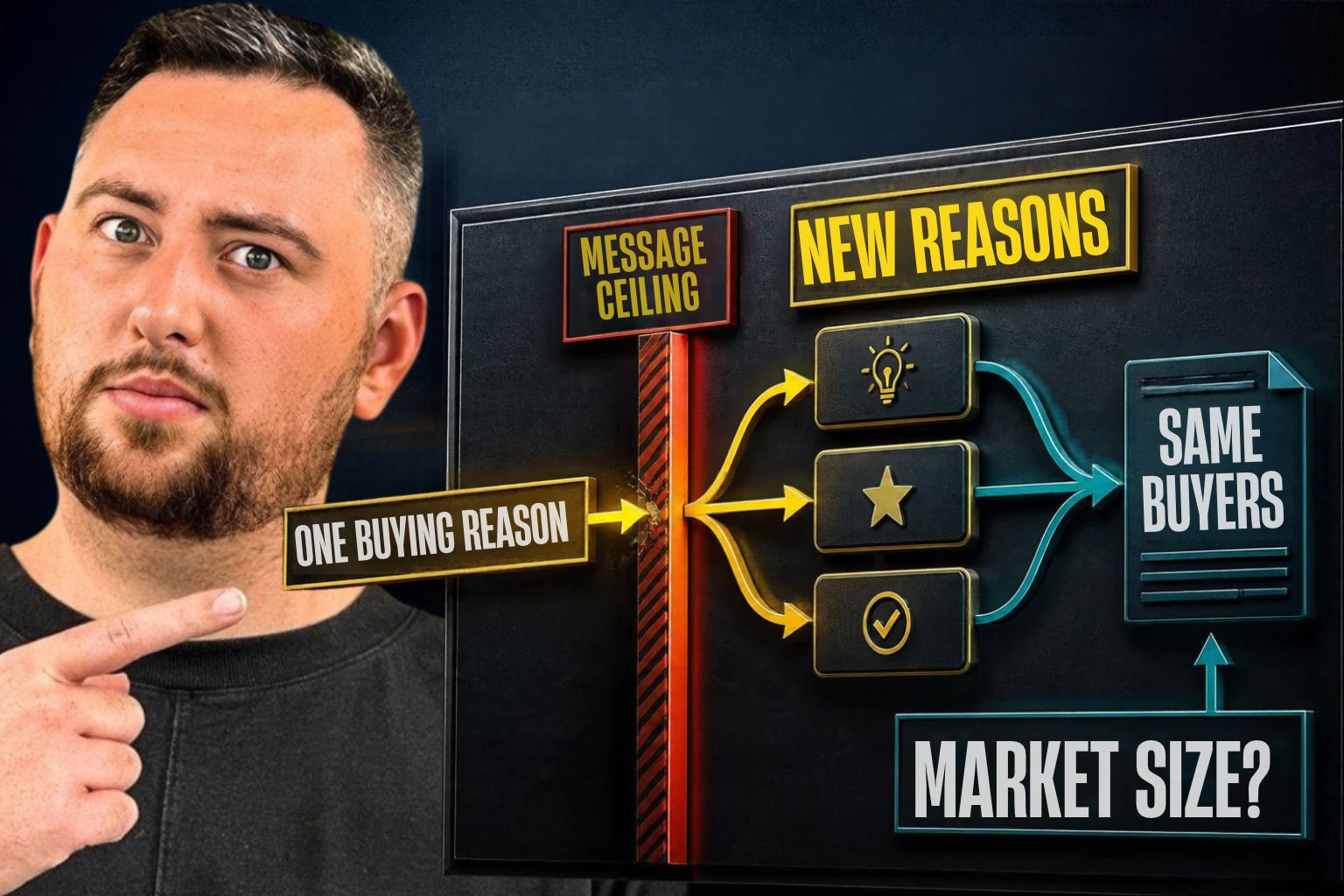
Before broadening your niche, check whether your message has reached its limit. An ad can work with a narrow group of buyers and become too expensive when you try to push it further. That tells you something about the current message and funnel. You still need evidence before concluding that the whole market is too small.
I would start with the reason people respond to your offer. Have you found an argument that matters to a broad part of the market, or one that fits a very specific situation? And when you say you tested other angles, did you give another buyer a genuinely different reason to care?
Changing the kind of customer you serve is a bigger decision than changing how you explain the offer. Keep that distinction clear while you investigate the ceiling. You may have more to test with the market you already understand.
7 weeks. Real frameworks. Covering copywriting, funnels, paid ads, and conversion systems.
What a Campaign Ceiling Actually Tells You
A campaign ceiling tells you that the current message and funnel combination has stopped supporting additional scale at an acceptable return. It does not tell you how every possible buyer would respond to a different reason to buy.
When increasing spend pushes the economics beyond what you will accept, bring the campaign back to a level where it still works. I call a campaign kept at that useful level a foundational campaign. Its job becomes maintaining the contribution it has earned.
You can preserve that working campaign while looking for additional opportunities. A winner with a ceiling still has value. Asking it to carry the whole business can make you overlook that contribution.
A limit on the message is incomplete evidence for a limit on the market. Before changing your positioning, identify which of those things you actually tested.
The relationship between messaging pockets and campaign ceilings matters here. That relationship explains why an ad can perform well within its range and struggle above it. The niche-expansion decision starts by asking how much of the market that message was capable of reaching.
Why a Minority Hook Can Still Be a Useful Winner
A minority hook speaks to a reason that matters to a narrower part of your market. It can be highly relevant to the people experiencing that problem without having broad appeal across everyone you could serve.
I use the question about broadening a niche as an example. It matters to an operator who is trying to scale and wondering whether the market is the problem. Other operators may care much more about a different issue right now.
That specific answer can still help somebody who searches for it. It does not need to attract the entire audience to deserve a place in your content. Its purpose and its reach should make sense together.
The mistake comes when you expect a narrow reason to carry unlimited distribution. Finding people who care about a specific issue does not establish how many additional people share that issue at the time you are advertising.
Look at the reason in the opening of the ad. What must already be happening in the buyer’s business for that line to matter? If it depends on a very particular circumstance, acknowledge that when evaluating how much room the angle has left.
Useful specificity stays useful. You are checking its role in the acquisition mix before deciding that its reach describes the size of the business opportunity.
What the Majority of Your Market Already Cares About
A majority hook addresses a reason that matters to a broader share of the market you intend to serve. The customer definition can stay the same while the reason for responding becomes more widely relevant.
Start with what those buyers care about most. What are they trying to accomplish? What problem brings them into the category? Which reasons for taking action recur when you listen to them?
The distinction is between different concerns inside the same market. You do not have to erase who the offer is for to investigate a more broadly relevant argument.
A broad promise also needs to remain accurate. Do not make the outcome larger or more certain to make the hook sound bigger. Find a real buying reason that the offer can address and explain it clearly.
The U.S. Small Business Administration points businesses toward customer research and competitive analysis when evaluating a market. Use that work to understand who needs the offer and the alternatives they consider. A feeling that your advertising has stalled leaves those questions unanswered.
Your offer’s market size and positioning still matter. I am asking you to investigate them with evidence while giving the messaging explanation a fair test.
Why Your New Angles May Reach the Same Buyers
New wording can repeat the same buying reason. If your supposedly different messages appeal to almost the same people for almost the same reason, you may have tested less of the market than you think.
Changing the opening sentence, the recording location, or the headline can create a different ad. Ask whether it changes who recognizes a reason to buy. That is the question behind the test.
I explain this with different views of the same object. Someone looking at the front sees details the person looking at the back cannot see. Both are describing the same thing, but the information available from each perspective differs.
Bring that thinking to the offer. Explain what a buyer gains from another part of it, which problem that part addresses, and why somebody would care. If you end up making the original argument again, keep looking.
Keep the offer recognizable while changing the reason someone responds. You are looking for a useful perspective you have left out, with claims the business can support.
For broader marketing education, explore Master Internet Marketing, my 7-week live comprehensive training. The work starts with being honest about what your current message says and who it actually attracts.
Results are not typical. Your results will vary and depend entirely on your individual capacity, business experience, expertise, and level of desire. There are no guarantees concerning the level of success you may experience. The testimonials and examples used are not intended to represent or guarantee that anyone will achieve the same or similar results. We don’t believe in get-rich-quick programs. We believe in hard work, adding value and serving others. As stated by law, we can not and do not make any guarantees about your own ability to get results or earn any money with our information, courses, programs, or strategies.
How I Would Test a Different Buying Reason
Give the next test a clear question about the message. You want to learn whether another reason for choosing the offer attracts suitable prospects, rather than changing the customer definition and every part of the funnel together.
Keep the existing winner doing the work it can support. Then make the difference in the new argument clear enough that you can explain it without pointing at the ad’s appearance.
Write down the reason each angle gives someone to act. Read those reasons beside each other. If they are interchangeable, your variations may be closer than their scripts make them seem.
Track the response through the sales process. Did the people understand what was being offered? Were they relevant buyers? What happened after they expressed interest? Extra attention from unsuitable prospects leaves the original problem unresolved.
Google’s experiment guidance warns that changes during an experiment can make the results harder to interpret. Keep that discipline in your own comparison so you can explain what changed and what the test taught you.
Give the content and direct-response parts of acquisition clear jobs too. A useful answer for a specific buyer and an ad intended for wider distribution can belong in the same business without carrying identical expectations.
When a Different Funnel Deserves a Test
After genuinely different messaging angles have been explored, a proven message in a different funnel is another option to consider before changing the niche. The way a prospect receives the explanation can change the work required to reach a buying decision.
Keep the argument you know people respond to and examine the path around it. Are you asking for a conversation before they understand the offer? Does the sales team need more of the education to happen before the call? Where does the current path lose relevant people?
That is a separate question from whether the market contains enough buyers. Changing the path gives you a way to investigate it without assuming you must serve a new type of business.
Be clear about the outcome you will measure. A registration, a booking, and a sale show different levels of progress. Google’s conversion-value guidance distinguishes conversion counts from the value assigned to them. Apply that care when comparing what the funnels actually produced.
Use your own economics when deciding whether the test is worth doing. The VSL calculator and webinar calculator can help you inspect the assumptions for those paths. A favorable model still needs to be checked against real performance.
Already making money? See what it takes to make a lot more.
What I Need to See Before Changing the Niche
I want evidence about the market as well as evidence about the messages and funnels already tested. More expensive advertising alone leaves too much unresolved to justify changing who the business serves.
Look at the buyers coming through consistently. If they keep being the wrong fit, inspect what the messaging invites them to expect and what the conversion signals are telling the ad system. Make the cause clearer before changing the audience definition again.
Also take a genuinely narrow market seriously. A limited number of plausible buyers affects the business you can build around them. In that situation, the price and the availability of additional relevant offers belong in the conversation.
There is room for expansion when the evidence supports it. The point is to stop using expansion as the automatic answer to a campaign reaching its ceiling. Preserve the useful message, test a different buying reason, and consider whether the funnel is doing enough before making the larger change.
You can explore my Inner Circle if a peer mastermind fits your stage. Bring the actual angles you tested and what happened afterward. That gives the conversation something more useful to work with than the conclusion that the niche must be too narrow.
Results are not typical. Your results will vary and depend entirely on your individual capacity, business experience, expertise, and level of desire. There are no guarantees concerning the level of success you may experience. The testimonials and examples used are not intended to represent or guarantee that anyone will achieve the same or similar results. We don’t believe in get-rich-quick programs. We believe in hard work, adding value and serving others. As stated by law, we can not and do not make any guarantees about your own ability to get results or earn any money with our information, courses, programs, or strategies.
Get my content first on Google
Add jeremyhaynes.com as a preferred source and Google shows my articles more prominently in your search results, including AI Overviews and AI Mode.


Jeremy Haynes
Owner and CEO of Megalodon Marketing
Jeremy Haynes is the founder of Megalodon Marketing. He is considered one of the top digital marketers and has the results to back it up.