
How I’d Scale a Stalled Business With Paid Ads and Upsells

I hope you enjoy reading this blog post. If you want my team to just do your marketing for you, click here.
Author: Jeremy Haynes | Published October 16, 2026
Earnings Disclaimer: You have a .1% probability of hitting million-dollar months according to the US Bureau of Labor Statistics. As stated by law, we cannot and do not make any guarantees about your own ability to get results or earn any money with our ideas, information, programs, or strategies. We don’t know you, and your results in life are up to you. We’re here to help by giving you our greatest strategies to move you forward, faster. However, nothing on this page or any of our websites or emails is a promise or guarantee of future earnings. Any financial numbers referenced here, or on any of our sites or emails, are simply estimates or projections or past results, and should not be considered exact, actual, or as a promise of potential earnings – all numbers are illustrative only.
A revenue plateau gets expensive when you keep buying more traffic without knowing why the extra money stopped producing growth. Before I push a business toward a bigger monthly target, I want its profit, call volume, acquisition costs, and cash collected in front of me. Then I can decide whether we need fresh creative, another buying reason, more sales capacity, or a better offer after the first purchase.
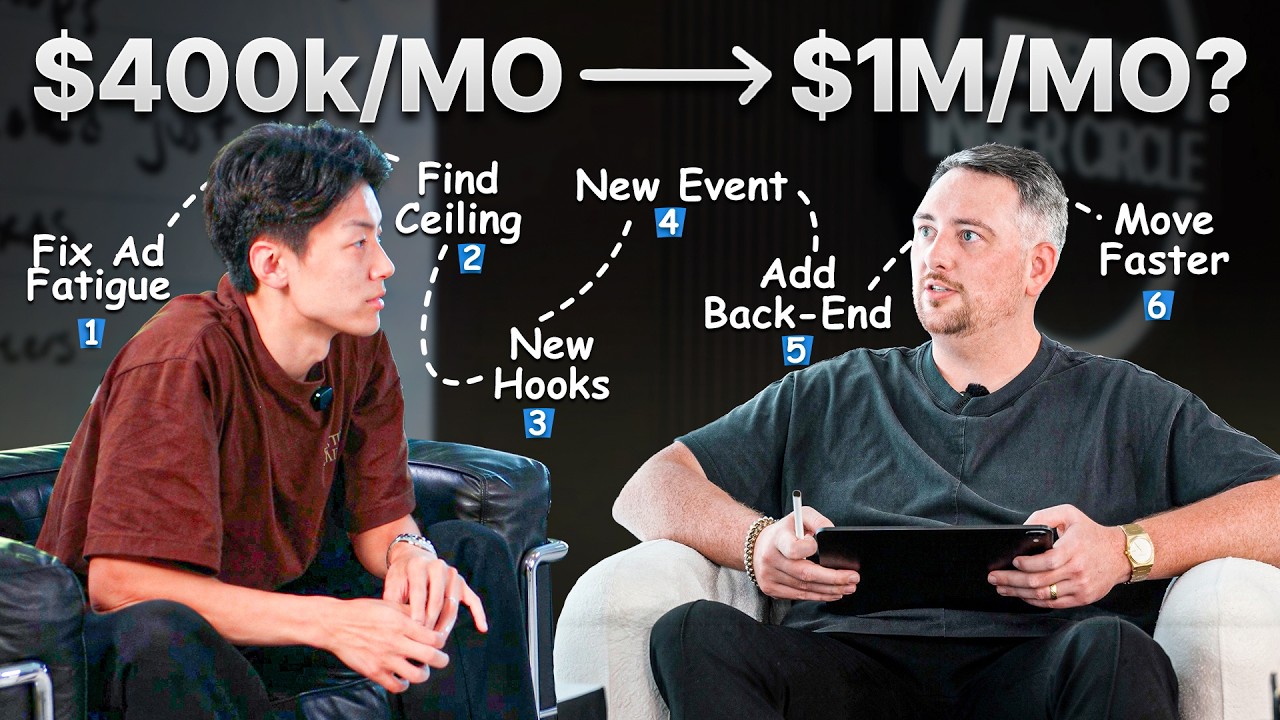
I reviewed a content-education business whose owners wanted to move toward a million-dollar month. They had spent more on advertising, collected roughly the same monthly revenue, and assumed the closers might be the problem. Once we checked the booked calls, the explanation changed. They had paid more and received fewer calls.
That was the starting point. The work ahead also included understanding what the business actually kept, protecting a useful campaign, testing additional ways to acquire buyers, and giving those buyers something relevant to purchase next. I would make those decisions together, because a cheaper call means very little if the rest of the business cannot support the sale.
7 weeks. Real frameworks. Covering copywriting, funnels, paid ads, and conversion systems.
Why I Ask About Net Profit Before More Ad Spend
I want an actual profit number before discussing how much more money to risk. An estimate leaves too much room for the owner and the media buyer to imagine different spending limits.
Start with the revenue and the expenses attached to running the business. Include advertising, payroll, selling costs, and delivery. Have the person responsible for the accounts explain the treatment of taxes and other obligations, rather than calling everything left in the bank free money.
The owners could describe their sales, but they were unsure of the exact profit calculation. I recommended getting proper financial help, including considering a fractional chief financial officer. They needed clear financial numbers before committing more money.
I also asked about review frequency. A monthly view of the whole business can be useful while the advertising decisions need attention sooner. If the account has been losing efficiency, waiting for another completed month can leave the team reacting late.
Your growth budget starts with money the business can actually commit. From there, decide what belongs in a test, what must cover existing obligations, and whether the next useful investment is advertising or a person who can resolve a missing capability.
What the Price Leaves Out of the Sales Picture
The advertised price and cash collected per sale can be different. I asked about both because the business accepted financing, in-house payment plans, and pay-in-full purchases.
A price on a sales page does not answer how much the business receives from the average buyer during the period being reviewed. You need the payment mix and the actual collection records. You also need to know how much revenue comes from the first offer and how much comes from later purchases.
The owners reported a strong close rate and were considering a price increase. I agreed that a higher price deserved attention. That did not remove the need to understand collections or to check whether the conversion rate would hold as acquisition expanded.
I would keep a price test on fresh sales opportunities distinct from changing terms for people already buying. A new price is something to evaluate against actual sales and collections. It should not quietly become an assumption that every future customer pays more while every other number stays unchanged.
The owners also gave different estimates of how much demand came from paid and organic traffic. That deserves a look at the underlying records. An estimate remembered from an earlier week and a current dashboard may be describing different periods or different events.
Why the Closers Were the Wrong First Explanation
Fewer calls after more advertising spend pointed us toward acquisition before blaming the sales team. The owners initially thought call volume had increased. Checking the calendar showed otherwise.
That distinction matters. If more qualified conversations arrive and sales stay flat, attendance, closing, or capacity deserves attention. If fewer conversations arrive while spend rises, first investigate what happened to the cost of creating those opportunities.
The closers had recently become fully booked. That still belonged in the growth plan, because another increase in call volume would need somewhere to go. It did not explain the entire period we were reviewing.
Follow the numbers far enough to tell those explanations apart. Booked calls, attended calls, and purchases are separate events. A team can be busy while the business has several different problems, and the calendar alone will not identify which one caused the plateau.
Recent sales data also needs enough time to develop. Google’s conversion-delay guidance explains why outcomes can arrive after the original ad interaction. Account for that delay when comparing periods instead of treating every fresh lead as a finished sales opportunity.
Why I Would Refresh the Ads Receiving Most of the Spend
I would investigate ad fatigue first in the situation these owners described. The account was spending more for fewer calls, and a few creatives carried much of the delivery.
The signs I discussed included rising cost with declining result volume and a different pattern where cost appears acceptable while the quality of the people coming through deteriorates. Either observation needs a closer look at the actual ads and downstream response.
My proposed test kept the successful buying reason recognizable while replacing tired executions. If the ad had been attracting suitable buyers, a fresh recording could preserve the argument while changing its presentation. That is a different test from changing the promise, audience, and funnel together.
I described relaunching a duplicated campaign with replacement creative and retiring the fatigued original once the replacement was approved. That recommendation applied to the account we were discussing. Check what is actually deteriorating before replacing a campaign that still earns its place.
The practical challenge is having the replacement ready. Preparing replacement ads before a winner fades gives the buyer more options than waiting for a new shoot while costs rise.
Then watch what happens. A useful recovery supports the fatigue explanation; continued weakness sends you back to the other possibilities. Recreating an ad does not guarantee lower costs or establish that every revenue plateau is caused by fatigue.
When a Campaign Becomes Part of the Foundation
A campaign that works at a lower spending level may deserve to stay there. I call that a foundational campaign when further increases have stopped producing an acceptable return.
For these owners, the next question after the creative test was whether pulling spend back restored efficiency. That would add evidence that the current message had reached a practical ceiling. The test was meant to clarify the limit of this campaign, rather than declare the whole market exhausted.
Keep that useful contribution while looking for additional capacity elsewhere. You can maintain a proven campaign and test another path at the same time. There is no requirement for the original winner to carry every future increase in revenue.
I explained a ceiling as the point where the extra money stops buying enough additional results. Pushing harder can resemble a vehicle spinning its tires in mud. More force goes in while movement gets worse.
That is why message quality and conversion signals belong in the scaling conversation. A useful message can have limits while another reason to buy remains largely unexplored.
Which Campaign Changes Can Open Another Path
I gave the owners three options to consider after establishing a messaging ceiling. Each changes a different part of how the business reaches buyers.
Keep the message and funnel while testing a different optimization event. I refer to this approach as a cyclic campaign.
Keep the funnel and optimization event while testing a genuinely different buying reason.
Keep the message while testing a different funnel through which the prospect receives it.
The easiest choice depends on what the account can support. Changing the event can be a practical test, but the selected action still needs to mean something useful for the business. More inexpensive events do not automatically mean more suitable buyers.
I use roughly 50 optimization events per ad set per week as a starting guideline for learning. Check the delivery status in your account and whether the selected event happens often enough to evaluate. Reaching that volume still leaves the question of whether the campaign brings suitable buyers.
Keep a record of what changed. Google’s experiment guidance warns that changes during a running comparison can make results harder to interpret. The same discipline is useful when deciding which question your next campaign is meant to answer.
For broader marketing education, explore Master Internet Marketing, my 7-week live comprehensive training. The useful habit here is being able to explain what you tested and what the response tells you.
Results are not typical. Your results will vary and depend entirely on your individual capacity, business experience, expertise, and level of desire. There are no guarantees concerning the level of success you may experience. The testimonials and examples used are not intended to represent or guarantee that anyone will achieve the same or similar results. We don’t believe in get-rich-quick programs. We believe in hard work, adding value and serving others. As stated by law, we can not and do not make any guarantees about your own ability to get results or earn any money with our information, courses, programs, or strategies.
Why a New Hook Needs a Different Buying Reason
A different buying reason gives another part of the market a reason to respond. A cosmetic variation can preserve the same appeal to the same people.
I described majority hooks as reasons relevant to a broader share of a market and minority hooks as reasons relevant to a narrower share. Neither label makes the offer bigger than it is. You still need an accurate promise for the buyer you intend to reach.
Think about a restaurant appealing to someone who does not want to cook for the family tonight. That reason is more specific than hunger. It can be useful, but it depends on a narrower circumstance.
The education business had potential appeals around personal branding and creating user-generated content. I asked which appeal appeared in the ads that actually received spend. Having both ideas somewhere in a large creative folder does not prove both received a meaningful test.
The ads receiving the money tell you which argument the account is really testing. Start there before concluding that the alternative angle has failed.
This is also why testing another buying reason before broadening your niche can be useful. Preserve a message that still works while finding out whether another concern inside the same market deserves its own campaign.
How Minimum Viable ROAS Sets the Spending Limit
Your minimum viable return on ad spend depends on the economics of your business. A gross return figure leaves expenses outside the advertising comparison.
Return on ad spend, or ROAS, compares attributed conversion value with advertising cost. Google’s Target ROAS documentation uses conversion value and cost for that measurement. The ratio still needs the right value inputs and a separate review of what the business spends to sell and deliver.
Ask how far the return can contract before the account no longer meets your requirements. That answer affects what you can spend on a new test, when an increase should stop, and how much room remains when acquisition becomes more expensive.
I raised heavier advertising competition during holiday and election periods as another reason to know the limit. You cannot choose what every other advertiser spends. You can decide whether your own economics still support the next commitment.
For a webinar path, the webinar calculator can help you inspect the relationship between registration, attendance, sales, and collections. Use your actual figures and check the model against the results that arrive. For a VSL-led sales-call path, use the VSL calculator for the relevant chain.
A clear spending limit lets you write useful if-then rules. If the return and downstream sales hold at the level you require, consider the next increase. If cost rises without useful volume, investigate the change before continuing the same ramp.
What a Useful Upsell Adds to the Growth Plan
A relevant later purchase can change how much value a customer brings to the business. That gives you another way to improve the economics while working on acquisition.
The owners had made some later sales, but the first purchase still carried most of the business. I asked what else the existing customer would sensibly want and when the business could deliver it.
The fit matters. Fries are an obvious addition to a burger for many diners. A specialist mastermind suits a much narrower group of people than the original education offer. Those purchases should not share an assumed acceptance rate.
A specialist peer group may suit customers who have already put the earlier education to use and now want perspective from others at a similar stage. That next need belongs to a subset of the original audience. Start with when customers become ready for it and whether you can deliver it well.
The work on a relevant upsell and ascension path starts with that customer need. A bigger price alone does not establish that the next offer belongs there.
Then compare the whole sales outcome. A higher amount collected per buyer may leave room for a lower close rate, but you need the actual combination to decide. Future upsell revenue should earn its place in the plan before you use it to justify today’s advertising loss. I did not encourage these owners to acquire customers at a loss on faith.
Why the Growth Target Needs Another Pass Through the Math
A larger target needs a workable chain from advertising through collected cash. The owners wanted a million-dollar month. Before committing to the spending needed for that goal, I wanted the full calculation checked.
Work backward through cash collected per sale, purchases, attended calls, booked calls, and acquisition cost. Check the multiplication and the definitions at every step. A booked appointment cannot count as an attended sales conversation.
Then challenge the assumptions. A close rate from the current volume may change when the account reaches more people. A new closer needs room to become effective. The next campaign still has to prove that its leads belong in the funnel.
I pushed the owners on how quickly they were moving through those questions. They had a short timeline in mind while creative replacement and other improvements were taking too long. That gap belongs in the plan as much as the ad budget does.
There is also a useful limit to forecasting. A model can tell you what would need to hold. It cannot tell you that every statistic will hold because you want the target badly enough. Keep the next test specific and update the plan with what it teaches you.
Already making money? See what it takes to make a lot more.
What I Would Fix Before Calling the Business Capped
I would get the profit number clear, verify what happened to call volume, and run the relevant creative test. If the evidence points to a messaging ceiling, I would preserve the campaign at its useful level and test another event, message, or funnel. I would also give a suitable upsell real attention instead of leaving the idea as a permanent side project.
Speed matters because each unanswered question delays the next decision. A creative-production delay, an unclear sales number, or a missing collection figure can keep the business waiting while money continues to leave the account.
When fear points to a specific weakness, investigate that weakness. If you are uncomfortable relying entirely on first purchases, work on the later customer need. If you do not know how much loss a test can absorb, get the costs and collections clear before committing more.
You can explore my Inner Circle if a peer mastermind fits your stage. Bring the actual account changes, customer response, and numbers behind the next decision. The useful goal is to leave with something to test and a clear way to judge it, then return with what actually happened.
Results are not typical. Your results will vary and depend entirely on your individual capacity, business experience, expertise, and level of desire. There are no guarantees concerning the level of success you may experience. The testimonials and examples used are not intended to represent or guarantee that anyone will achieve the same or similar results. We don’t believe in get-rich-quick programs. We believe in hard work, adding value and serving others. As stated by law, we can not and do not make any guarantees about your own ability to get results or earn any money with our information, courses, programs, or strategies.
Get my content first on Google
Add jeremyhaynes.com as a preferred source and Google shows my articles more prominently in your search results, including AI Overviews and AI Mode.


Jeremy Haynes
Owner and CEO of Megalodon Marketing
Jeremy Haynes is the founder of Megalodon Marketing. He is considered one of the top digital marketers and has the results to back it up.