How to Keep Replacement Ads Ready Before Your Winner Fades
I hope you enjoy reading this blog post. If you want my team to just do your marketing for you, click here.
Author: Jeremy Haynes | Published September 29, 2026
Earnings Disclaimer: You have a .1% probability of hitting million-dollar months according to the US Bureau of Labor Statistics. As stated by law, we cannot and do not make any guarantees about your own ability to get results or earn any money with our ideas, information, programs, or strategies. We don’t know you, and your results in life are up to you. We’re here to help by giving you our greatest strategies to move you forward, faster. However, nothing on this page or any of our websites or emails is a promise or guarantee of future earnings. Any financial numbers referenced here, or on any of our sites or emails, are simply estimates or projections or past results, and should not be considered exact, actual, or as a promise of potential earnings – all numbers are illustrative only.
Your best ad starts slipping, and the team says new creative is coming. The script still needs approval, the footage is with the editor, and nobody has tested the replacement. A creative testing cadence helps with ad fatigue only when it produces alternatives before you need them. A folder full of ideas cannot take over from a tired ad.
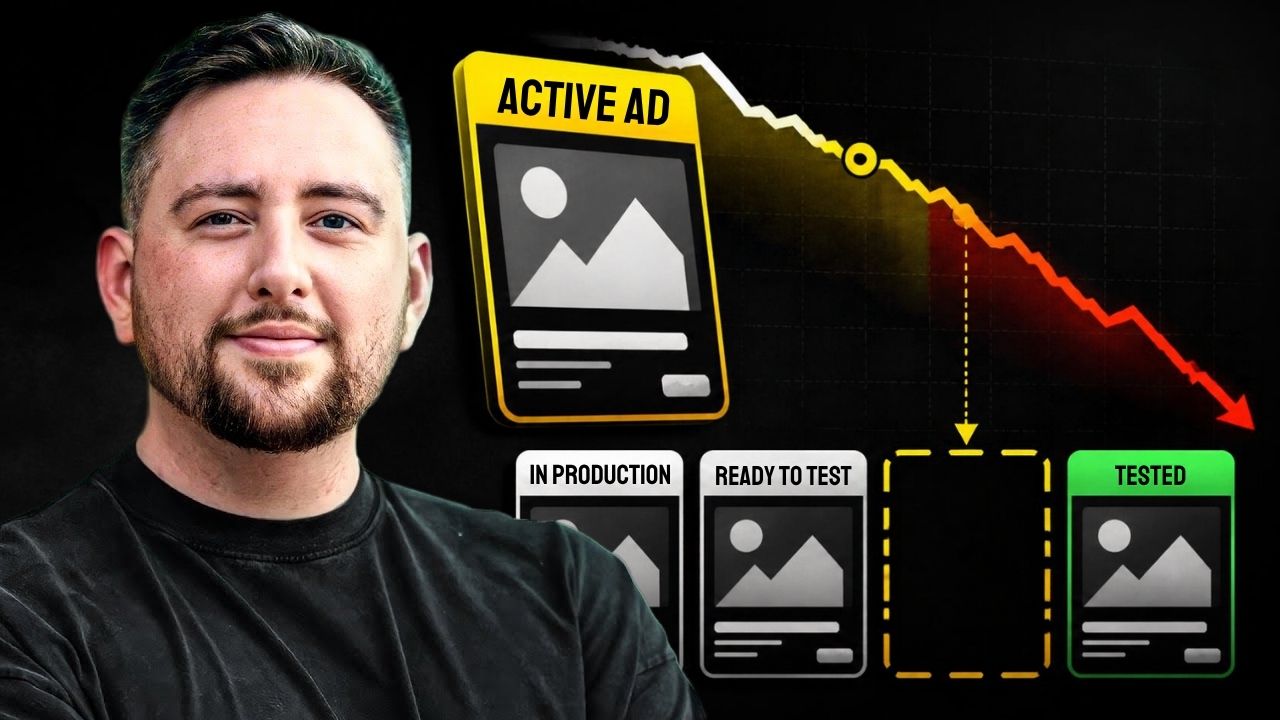
I want the team to know what can actually run next. That includes work still in production, ads already being tested, and the evidence behind any proposed replacement. Those are different stages. Calling all of them “new creative” hides how exposed the account is.
Already making money? See what it takes to make a lot more.
Why a Full Creative Calendar Can Still Leave You Stuck
A production calendar tells you what the team plans to make. It does not tell you whether an ad is ready to carry spend. An approved concept still needs a finished asset, and a finished asset still needs a market test.
That difference matters when a current winner weakens. You cannot move straight from a promising script to a reliable replacement. There is work between those points, and the account still has to operate while the team completes it.
Look at the next creative review. If everyone talks about how many pieces are being made, ask which ones the buyer can launch. Then ask which launched ads have enough evidence to support a decision. You may discover that the busy production schedule has produced very little choice.
Finished footage and a tested replacement are different things. An editor can deliver exactly what was requested without producing an ad that earns useful inquiries. The review needs to recognize both the production accomplishment and the commercial question still open.
A consistent campaign testing cadence creates opportunities to answer that question. This article focuses on what happens when the next batch has not supplied a replacement yet. That gap deserves attention while the current ad is still working.
Check the Performance Drop Before Calling It Fatigue
A weaker result deserves investigation before the team orders a new shoot. Repeated exposure can make creative less effective, but a performance drop alone does not identify the cause. The page, tracking, traffic mix, or sales process may also have changed.
Start with what actually moved. Are fewer people clicking? Are the clicks still arriving while completed applications fall? Are applications coming through but the sales team reporting a different kind of prospect?
Those observations point to different questions. If an application form has stopped working, another hook leaves the broken form in place. If the opening attracts people who want something the offer does not provide, a cleaner edit may preserve the wrong promise.
Frequency belongs in that review, but it cannot make the decision by itself. Read it alongside response and business outcomes. The same number means little without knowing the audience, reporting period, and what happened to the results you care about.
Recent results may also be incomplete. Google Ads explains conversion lag as a reporting issue that can make recent acquisition costs appear higher before later conversions arrive. That is a reason to account for delay, not a reason to dismiss a genuine decline.
The point is to avoid sending creative off to solve a problem you have not located. My approach to developing media-buying skills connects creative decisions with measurement and the rest of the funnel. Keep those connections in the review instead of giving every disappointing result the same label.
Count the Ads That Are Ready for the Next Decision
When the account depends heavily on a current winner, check the status of its alternatives. A simple distinction helps. Is the next ad still being made, ready to launch, or already producing evidence?
Work in production needs a clear next action. Perhaps the claim needs approval or the creator has not supplied the demonstration. Name the missing piece. “Almost done” is a poor answer when the media buyer is trying to decide what can run.
Launch-ready work should have the actual file, matching copy, destination, and intended test identified. The media buyer should not have to reconstruct the assignment from a chat thread. If the destination changed while the video was being edited, resolve that before treating the asset as ready.
Tested work needs a record of what happened. A video that has been switched on has not automatically had a fair chance to answer the question. Check delivery and relevant outcomes before describing it as the successor to the current winner.
This is where the pre-launch preparation pays off. The file and the campaign need to tell the same story. An available asset becomes useful when the person launching it knows what it is meant to test.
There is no universal stock level that makes an account safe. The team needs enough viable work to keep testing within its available budget and production capacity. Counting unfinished ideas as backup creates confidence without creating an alternative.
How a Winning Ad Can Supply the Next Brief
A current winner gives the next brief a place to start. Look at the buyer problem, argument, or demonstration that deserves another execution. Preserve enough of it to learn whether the new version improves anything.
A different opening can put the same argument in front of the viewer sooner. A new demonstration can make the offer easier to understand. A format change can suit a placement where the earlier execution feels awkward.
Be clear about which of those you are testing. If the hook, offer, destination, and audience all change together, you have a broader comparison. You cannot confidently assign the difference to the opening alone.
That is why Google’s experiments guidance starts with a hypothesis and recommends keeping test records. Decide what question you need answered before spending on the comparison. The platform cannot supply the missing question afterward.
My creative-family approach develops related executions around an idea worth testing further. That can give the team usable directions without demanding a completely different concept every time. It also keeps the next brief connected to something the account has already learned.
Keep room for genuinely different arguments too. A library made entirely of cosmetic edits can leave the business dependent on the same message. The next buyer may need a different explanation, and changing a background color will not provide it.
In Master Internet Marketing, my 7-week live comprehensive training, I connect creative choices to the offer, funnel, and paid traffic. That connection matters here because the next asset needs a commercial reason to exist before anyone films it.
Results are not typical. Your results will vary and depend entirely on your individual capacity, business experience, expertise, and level of desire. There are no guarantees concerning the level of success you may experience. The testimonials and examples used are not intended to represent or guarantee that anyone will achieve the same or similar results. We don’t believe in get-rich-quick programs. We believe in hard work, adding value and serving others. As stated by law, we can not and do not make any guarantees about your own ability to get results or earn any money with our information, courses, programs, or strategies.
Why Replacement Production Has to Start Earlier
If production begins only after the winner declines, the team has to create and test under pressure. You are waiting for footage at the same time you want a decision about whether it can replace the current ad. Starting earlier gives those jobs room to happen separately.
The useful production lead time is the one your team actually experiences. Include the wait for approval, filming, editing, and corrections. A fast editor cannot finish a clip the founder has not recorded.
Look at where work sat during the last batch. Was the brief ready while the proof was still being approved? Did the creator deliver on time while feedback waited in someone’s inbox? The next production request should account for that delay instead of assuming the calendar will behave differently.
TikTok’s creative guidance recommends maintaining a supply of fresh creative to address fatigue. The useful part is continuity. You need material available for testing while the existing campaign is running.
That does not require replacing an effective ad because it has reached an arbitrary age. Production timing and retirement timing are separate decisions. You can prepare new assets without declaring the current winner finished.
Making the next ad early gives you a choice; switching it on does not make it a winner. Keep that distinction visible when the team reports progress. An early delivery is valuable because it allows a test, not because it guarantees what that test will show.
Keep a Good Ad Running While Alternatives Earn Spend
An existing ad should not lose its place simply because a newer asset looks better in the review meeting. Compare the evidence relevant to the account. Production quality, novelty, and enthusiasm are reasons to investigate an idea, not substitutes for campaign results.
A replacement can attract attention without attracting the right prospect. Check what happens beyond the click. For a call-based offer, qualified conversations and sales feedback may expose a mismatch that a strong click-through rate hides.
Use the testing approach that fits the available budget. Spreading the test budget over more assets than it can meaningfully support may leave every comparison unclear. More uploads do not necessarily give you more decisions.
There will be cases where the current ad is no longer acceptable and the replacement is still unproven. Acknowledge that honestly. Replacing the asset may be necessary, but the team should not report the problem solved before it has evidence.
The account can also retain a working ad while the creative team explores a different angle. A production deadline is not a command to retire it. Let the review answer what to keep, what to test further, and what to stop.
Keep the record close to the asset. If the replacement disappointed, note whether it received enough delivery and what happened after people responded. That prevents the next review from turning an unclear test into a permanent rule about what your buyers dislike.
7 weeks. Real frameworks. Covering copywriting, funnels, paid ads, and conversion systems.
What to Ask Before the Next Winning Ad Starts Slipping
Open the account and the production queue together. Identify the ad you would be most uncomfortable losing. Then find the work that could give you another option.
The conversation should get specific quickly. Which file can launch? What is the test meant to show? If the asset is stuck, who can resolve the missing approval or footage?
If the team already has tests running, ask what remains unknown. A question about delivery needs a different response from a question about lead quality. Keep those unresolved questions attached to the assets so the next meeting starts where the last one ended.
The aim is to reduce the scramble around a weakening ad. You cannot promise that a schedule will prevent fatigue, and you cannot make every new concept work. You can make sure the team keeps preparing, testing, and learning before the account needs an emergency replacement.
In my closed-door mastermind, Inner Circle, operators work through acquisition and team constraints like these. If the next ad is always coming but never ready, inspect where it gets stuck. Fixing that delay gives the media buyer something more useful than another promise from production.
Results are not typical. Your results will vary and depend entirely on your individual capacity, business experience, expertise, and level of desire. There are no guarantees concerning the level of success you may experience. The testimonials and examples used are not intended to represent or guarantee that anyone will achieve the same or similar results. We don’t believe in get-rich-quick programs. We believe in hard work, adding value and serving others. As stated by law, we can not and do not make any guarantees about your own ability to get results or earn any money with our information, courses, programs, or strategies.
Get my content first on Google
Add jeremyhaynes.com as a preferred source and Google shows my articles more prominently in your search results, including AI Overviews and AI Mode.


Jeremy Haynes
Owner and CEO of Megalodon Marketing
Jeremy Haynes is the founder of Megalodon Marketing. He is considered one of the top digital marketers and has the results to back it up.