The VSL Problem Behind This $1.8M/Month Funnel

I hope you enjoy reading this blog post. If you want my team to just do your marketing for you, click here.
Author: Jeremy Haynes | Published August 3, 2026
Earnings Disclaimer: You have a .1% probability of hitting million-dollar months according to the US Bureau of Labor Statistics. As stated by law, we can not and do not make any guarantees about your own ability to get results or earn any money with our ideas, information, programs, or strategies. We don’t know you, and besides, your results in life are up to you. We’re here to help by giving you our greatest strategies to move you forward, faster. However, nothing on this page or any of our websites or emails is a promise or guarantee of future earnings. Any financial numbers referenced here, or on any of our sites or emails, are simply estimates or projections or past results, and should not be considered exact, actual, or as a promise of potential earnings, all numbers are illustrative only.
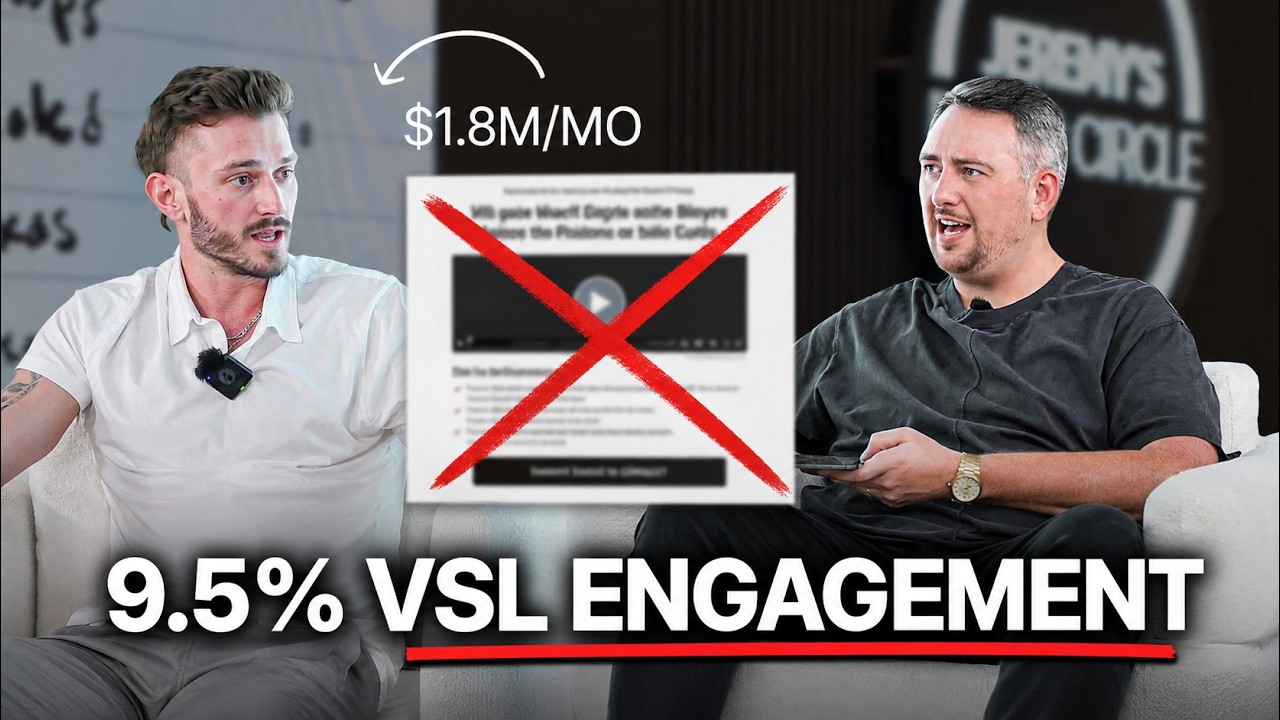
A men’s fitness offer climbed from $250K to $1.8 million a month in 90 days, yet its funnel still had an obvious leak. About 80% of landing-page visitors started the video sales letter, while only 0.8% booked a call. Traffic was arriving and the ad was earning attention. The breakdown happened after the click, within the opening seconds of the video.
7 weeks. Real frameworks. Covering copywriting, funnels, paid ads, and conversion systems.
Why New Strategies Were No Longer the Answer
The operator had enough information. What the company lacked was clear ownership at the leadership level.
His original head of sales had helped build the business from zero to $250K a month while working part-time. He needed that seat occupied full-time, knew it, and delayed the conversation. They finally addressed it in mid-February. She chose to leave on good terms, which opened the role for someone who could give it full attention.
The first full-time closer collected $475K the following month. That result made the broader organizational problem impossible to ignore. The operator dismissed his marketing team, took control of paid advertising, and gave his new heads of sales and client success genuine authority over their areas.
He described the company as three businesses operating under one roof. Each leader received the keys to their part instead of waiting for every decision to travel through the founder. McKinsey’s work on agile organizations supports the value of clear ownership and empowered teams. The company reached $875K the next month.
What $1.2 Million in Ad Spend Exposed
Rapid growth puts pressure on parts of a business that can look healthy at a smaller scale. A funnel may perform adequately at $50K a month and develop expensive leaks when the same system handles $50K a day.
By April, a contract team had built eight custom AI agents around the company’s actual workflows. These were purpose-built operating tools rather than generic software subscriptions. Revenue reached $1.4 million that month.
In May, the operator deliberately pushed the system harder. Approximately $1.2 million in advertising produced 17 million impressions through one call funnel. Return on ad spend weakened, but the month gave him something useful: a clear view of what failed under load.
He compared the decision to testing a bullet train at 300 miles per hour. If the wheels begin to wobble, slowing down hides the defect. The high-speed run reveals where the engineering needs work.
How the Business Rebuilt Without Turning Off Spend
June became an infrastructure month. The team migrated its CRM, rebuilt the call funnel, and changed booking software while keeping roughly $500K to $600K in advertising active.
A migration under that kind of traffic rarely moves in a straight line. Previously reliable systems fail, data lands in the wrong place, and small integration problems become urgent because leads are arriving every hour. The company still closed around $1.2 million during the rebuild.
Once the new setup stabilized, cost per call fell 45%. The messy month had produced a measurable improvement rather than a cleaner-looking collection of software.
What the $1.8 Million Funnel Looked Like
The offer serves men between roughly 40 and 65. Its pricing and transaction structure looked like this:
- Core offer: $9,000 for the main 12-month program
- Down-sell: $6,000 for a six-month version
- Executive tier: $30,000 with medical support such as hormone therapy and blood work
- Payment mix: 50% paid in full and 50% financed through Affirm
- Financed cash collection: approximately 80% to 90%
- Sales cycle: two to three days from application to close in this example
The company used a single call funnel and a one-call-close sales process. It had no webinar or direct-message funnel running beside it. More strikingly, 98% of revenue came from new front-end sales. A 12-month service with virtually no upsell or recurring revenue had built an enormous acquisition engine and barely touched the buyer base it already owned.
Where the VSL Lost an Interested Buyer
The advertising numbers gave little reason to blame the ads. CPMs ranged from $70 to $76, link click-through rate sat at 2.15%, and approximately eight out of ten page visitors pressed play. Pain-focused messaging was finding the right people and creating enough curiosity to earn the next action.
The video analytics told a different story. Retention dropped sharply within the first few seconds and then stayed low. Average viewing time on an eight-minute VSL was 9.5%, which meant the average visitor watched less than one minute.
The opening began with the operator introducing himself. That is a costly choice with cold traffic. The visitor clicked because the ad named a problem in his life, then the video changed the subject to the person selling the solution.
HubSpot’s video marketing research emphasizes the importance of holding attention early. In this funnel, the ad had already earned interest, so the first lines of the VSL needed to continue the same problem, promise, and emotional thread. The introduction interrupted that continuity.
The rest of the VSL had survived earlier rounds of improvement because it once performed well. Meanwhile, the company had changed its messaging everywhere else. Our guide to building a VSL for high-ticket buyers explains how to align the opener, pacing, and promise with the ad that brought the viewer there.
Why the 0.8% Conversion Rate Was Fixable
For this audit, I used a 3% to 5% click-to-qualified-call conversion range as the comparison point. This page converted at 0.8%.
The combination matters more than the low number alone. An 80% play rate says the ad-to-page transition works. The 0.8% booking rate points toward a narrower failure after playback begins. That gives the operator a specific area to repair instead of a reason to replace the whole acquisition system.
Two doublings would move the page from 0.8% to 1.6%, then from 1.6% to 3.2%. That reaches the target range without increasing traffic. With return on ad spend near 2.8, closing that gap could move the same budget toward a return around 6, although the actual result would depend on lead quality, show rate, and sales performance.
The next step is identifying the sub-metric responsible for the loss. VSL retention, application completion, qualification, and scheduling each require a different fix. This guide to reducing cost per call through bottleneck analysis shows how to find the weak step before changing the funnel.
The application-to-booking stage already performed better than the common baseline discussed during the review. About 35% of qualified applicants failed to schedule, compared with approximately 50% when separate application and calendar tools create extra friction. The explanation of how an application gate improves sales-call attendance covers why that stage deserves its own measurement.
How a Cleaner Team Recovers Abandoned Revenue
Closers handled eight to ten calls a day and arrived each morning with another full calendar. That volume created a buy-or-die culture. A prospect who declined today received little attention tomorrow because the closer had fresh calls waiting.
One week produced 676 bookings, a 42% show rate, and a 23% close rate. The VSL calculator makes it easier to model how changes in those three rates affect the same traffic volume. Hundreds of leads entered conversations, failed to buy, and then received little meaningful follow-up. Some were poor fits, while others needed more time, another conversation, or a better answer to a legitimate concern.
A cleaner team would own leads at least 72 hours removed from the original call. Those closers would follow up, work through unresolved issues, and reschedule qualified prospects onto their own calendars. A split commission would credit both the first closer and the person who recovered the deal.
This is a dedicated closing function rather than an entry-level follow-up role. At the company’s volume, it also needs more than one person. Our guide to improving show rates at scale covers the reminder and follow-up systems that support a team like this.
Why the CRM Needed an AI Follow-Up Agent
The next automation did not require a large software project. The proposed CRM agent could be built in roughly nine focused hours. Its job was to read call transcripts, update pipeline stages, send contextual follow-up, and route unresolved opportunities to the cleaner team.
The build order matters. Start with dependable routing rules, then add transcript-aware messaging. Keep human judgment involved when a conversation falls outside a predictable pattern. That is the same sequence covered in our article on automation systems that scale without extra headcount.
Operators compare practical builds like this inside my private mastermind, Inner Circle. The useful question is whether the automation shipped and improved the operation, rather than how impressive it sounded during planning.
Results are not typical. Your results will vary and depend entirely on your individual capacity, business experience, expertise, and level of desire. There are no guarantees concerning the level of success you may experience. The testimonials and examples used are not intended to represent or guarantee that anyone will achieve the same or similar results. We don’t believe in get-rich-quick programs. We believe in hard work, adding value and serving others. As stated by law, we can not and do not make any guarantees about your own ability to get results or earn any money with our information, courses, programs, or strategies.
Where the Untouched Back-End Revenue Was Hiding
A 12-month offer producing 98% of its revenue from first-time sales has considerable room behind the initial transaction. The company had already paid to acquire each buyer, earned trust, and spent months delivering a result. It had almost no structured next purchase.
Bain & Company’s research on customer retention has long documented the profit leverage associated with keeping and expanding customer relationships. For this company, the practical opportunity was an offer designed for people who had already completed or progressed through the fitness program.
An in-person event could serve the same 45-to-60 buyer group with a premium weekend centered on health, community, and accountability. Running it once or twice a year would use the existing customer base instead of requiring another acquisition campaign. Smaller events devoted to mobility or longevity could create additional paths beyond the $9,000 core offer.
The team should survey buyers before deciding what to build. Existing customers can reveal which outcomes they still want, what type of access they value, and which delivery format fits their lives. Our breakdown of upsells and ascension paths explains how to add that next offer without distracting the front-end funnel.
Already making money? See what it takes to make a lot more.
The Four Moves Assigned for the Next 30 Days
The company did not need to wait for one project to finish before beginning the next. Separate leaders owned the four priorities:
- Rewrite the VSL opening so it continues the ad’s pain-focused message.
- Build a cleaner team with the head of sales.
- Deploy the CRM agent for pipeline logging and contextual follow-up.
- Survey current buyers before choosing a back-end offer.
These projects follow the same principle that drove the 90-day run. Internal constraints produced more useful work than another hunt for a new traffic source. Three other operators reached million-dollar months through different strategies during the same period, and each had to solve the bottleneck inside its own operation.
When people click an ad but fail to become customers, the answer often sits inside the conversion path already receiving traffic. In this case, the ad earned the click and the landing page earned the play. A weak VSL opening, incomplete follow-up, and an undeveloped back end left the clearest opportunities.
Master Internet Marketing, my 7-week live comprehensive training, teaches operators how to read this funnel math and diagnose the next constraint without replacing an entire system on instinct.
Results are not typical. Your results will vary and depend entirely on your individual capacity, business experience, expertise, and level of desire. There are no guarantees concerning the level of success you may experience. The testimonials and examples used are not intended to represent or guarantee that anyone will achieve the same or similar results. We don’t believe in get-rich-quick programs. We believe in hard work, adding value and serving others. As stated by law, we can not and do not make any guarantees about your own ability to get results or earn any money with our information, courses, programs, or strategies.
Get my content first on Google
Add jeremyhaynes.com as a preferred source and Google shows my articles more prominently in your search results, including AI Overviews and AI Mode.


Jeremy Haynes
Owner and CEO of Megalodon Marketing
Jeremy Haynes is the founder of Megalodon Marketing. He is considered one of the top digital marketers and has the results to back it up.