How to Optimize Your Show Rates to Reach Million-Dollar Months
I hope you enjoy reading this blog post. If you want my team to just do your marketing for you, click here.
Author: Jeremy Haynes | Published September 17, 2025
Earnings Disclaimer: You have a .1% probability of hitting million-dollar months according to the US Bureau of Labor Statistics. As stated by law, we can not and do not make any guarantees about your own ability to get results or earn any money with our ideas, information, programs, or strategies. We don’t know you, and besides, your results in life are up to you. We’re here to help by giving you our greatest strategies to move you forward, faster. However, nothing on this page or any of our websites or emails is a promise or guarantee of future earnings. Any financial numbers referenced here, or on any of our sites or emails, are simply estimates or projections or past results, and should not be considered exact, actual, or as a promise of potential earnings – all numbers are illustrative only.
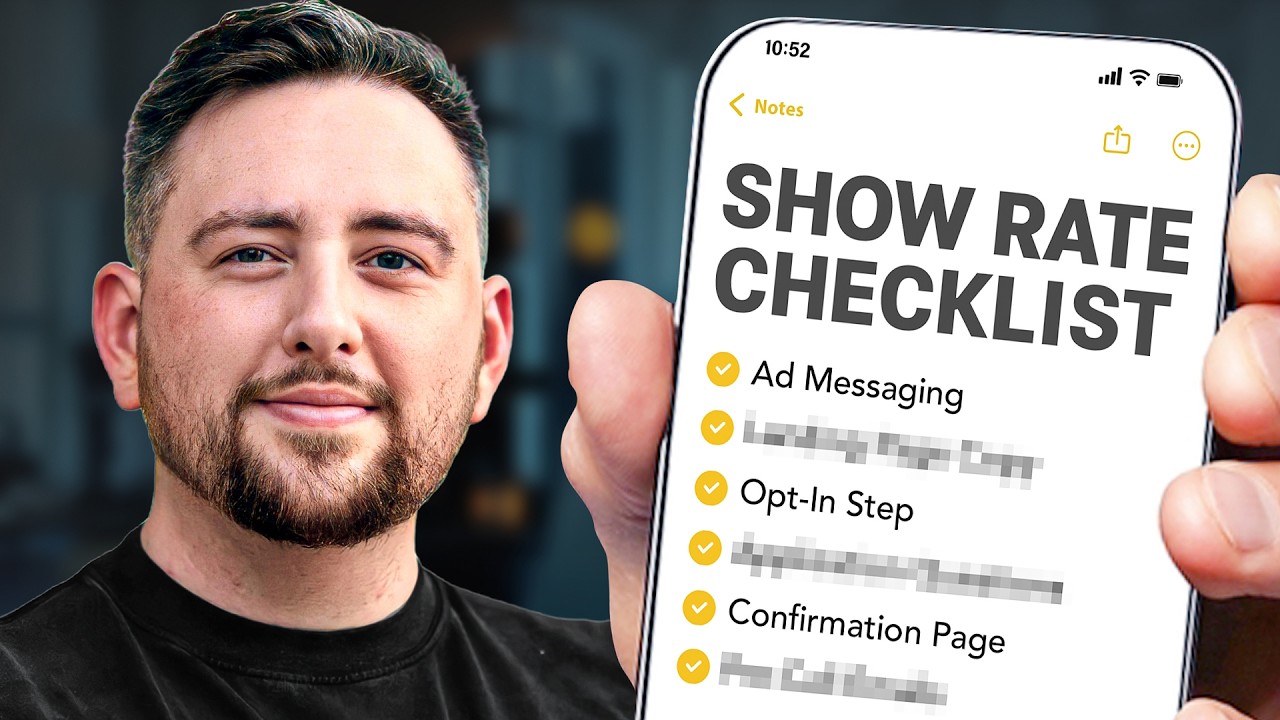
When you’re scaling up to million-dollar months, one of the biggest KPIs that matters most is your show rate. We’re going through a two-for-one here – your call funnel show rate best practice checklist AND a webinar best practice show rate checklist.
You need to know step by step what to pay attention to, what you might need to check, and what you might need to improve to maintain the highest show rate possible.
Let’s be frank here. The difference between a 50% show rate and a 70% show rate on a call funnel is realistically a couple of hundred thousand dollars for most of you. For the smaller people reading this, tens of thousands of dollars in difference, which still has substantial meaning to both parties.
For webinars, the difference between a 10 to 15% show rate and upwards of a 30% show rate? Same scenario, same dollars on the line.
These are all lessons from clients who have been there, done that. Lessons that are proven to work out there in the field.
If your business is already doing $100k+ per month, My Inner Circle is where you break through to the next level. I’ll show you exactly how to solve the bottlenecks holding you back and scale faster than you thought possible.
But I can’t stress this enough, your probability of doing $10 million a year, according to the U.S. Bureau of Labor Statistics, is 0.1%. So the probability for you personally to ever hit million-dollar months is even smaller than 0.1% (Bureau of Labor Statistics).
There’s no income claims here. No earning potential. Absolutely no guarantees you’re going to make any money after reading this article. These are just lessons we’re handing down from people who have been there, done that.
Keep that in mind.
Show Rate Improvement Strategy Step-by-Step
For your call funnel specifically, there’s a few things that matter the most when you’re looking at what you need to focus on step by step.
What I like to do with any good checklist is go through the sequential order of what happens from a lead’s perspective that could impact their probability to show up or not.
That obviously starts with the ads.
Facebook Ad Optimization for Better Show Rates
There’s a few things we have to keep in mind. Number one is the messaging of the ads.
There’s a lot of people recently who have been leveraging AI tools recently, and rightfully so. A few of them can absolutely lead to higher click-through rates, higher quantities of people booking calls, lower cost per calls, and there’s no issue with lead quality when done right.
But some of you are very low-skilled, or you’ve hired low-skilled people. So you see the vanity metric of a higher click-through rate, and you see a cheaper cost per call, but in reality, it’s shooting you straight in the foot.
You’re bringing in a bunch of junker leads that are coming through as a result of having a high level of curiosity and then a complete disconnect on who you are, what your brand is, what you’re there to help people with.
You’ve got to have a fine balance to this.
We want to have the right people in the first place coming through and booking. We have to therefore, be extremely intentional about who we are attempting to communicate to and what we are attempting to communicate to them.
Sometimes your messaging can have incongruencies that lead to a lot of problems that you don’t necessarily correlate on the backend to the messaging issues that you have on the front end.
How to Fix Ad Message Congruency Problems
A great example of this – if I tell somebody that I can do X and then as soon as they actually book the call and I implement some back-end selling systems, confirmation page videos, value dense email sequences, my hammer them strategy, salespeople manually reaching out, tailoring very specific helpful things for the lead to consume prior to the call…
And those things talk about I can do Y and Z and they fail to reiterate that I can accomplish X?
The person might think, “I booked a call for somebody who can’t help me.”
That’s incongruency. Incongruency can mess up your show rate.
Sometimes I get people who I work with bringing up these situations. They’ll have a really good cost per call, but half their leads are junker leads. And as a result, their cost per call is technically not what they view it as in the ads manager.
So it’s artificially low. It’s not actually low.
The difference between what an actual cost per qualified call is currently coming through and what a junker lead cost per call is comparatively – when they implement some of the best practices we’re talking about now, they look at it like, “Oh, I’m getting a higher cost per call now.”
But in reality, they’re dramatically increasing the quality of the calls that they’re producing, and they technically have a lower cost per qualified call than whatever the cost per qualified call was prior.
You understand?
Sometimes you’ll do things that improve stuff and then it artificially inflates one of your numbers to the real number that it should be the entire time. You’ll still view it as higher because you’re comparing it to a previously made-up number that didn’t make sense to track in the first place.
Moral of the story – messaging can bring in the wrong people or it can bring in a lot of the right people. And messaging is everywhere. It’s on the ads, it’s on the funnels, it’s in what you say in the videos, it’s in what you say in the images.
Video Ads vs Image Ads for Higher Show Rates
Messaging can also be how we communicate what we can do. Image ads are very easy to quickly interpret. However, they typically bring a lower interest level and therefore a lower intent lead into the booking call process.
Comparatively, if I have a video ad that does a great job with awesome messaging congruent to whatever it is I can actually do on the back end once somebody books a call, brings in the right caliber of lead, the right quality individual through the process, that matters a lot.
That’s going to help the process of our show rate naturally being higher because of that.
Just to be clear, messaging happens everywhere. It happens in the video ads. They typically are higher intent, a little higher quality, generally not coming through just curious. They’re a little more sold or at least a little more closer to being sold.
Image ads can bring a naturally lower intent lead. They technically can both communicate similar things, but image ads obviously have far less to communicate.
When I talk about messaging, it’s a very all-encompassing initial thing on the checklist. There’s a bunch of sub-things like the body copy, the headline, the actual ad video or the ad image.
If you want to take an actual checklist, just make sure you note those things down. The body copy, the congruency aspects of this whole thing, what you say inside of the videos, what you say inside of the images.
And by the way, you should never use just one or the other in terms of videos or images. We typically like to use about 80% of our total assets to be videos. We like to have 20% be images. We find the balance is healthy.
Facebook Ad Targeting and Pixel Conditioning Strategy
Also on the ad level, we have our targeting. Most of the time, for a lot of you reading this, you’re going to be leveraging Facebook and Instagram as your main traffic channel.
Obviously, if you’re doing paid ads, it’s a very big difference between channels. Every channel allows you to target different subsets of people, but most businesses that we’ve seen spend the majority of their budgets on Meta.
Long story short, targeting on Meta specifically is broad targeting. If you do interest stacks, even if you do lookalike audiences, it’s pretty much still broad targeting nowadays.
As a result of that, two things matter the most. One of which we’ve already talked about – messaging – and the second of which is what we call pixel conditioning.
How does this all relate specifically to your show rates?
Pixel conditioning. The people that you allow to come back and hit that results column, that’s who the ads manager is probably going to go after next.
Just to reiterate, you have a bunch of junker leads coming through your process, you’re going to go after a bunch more turds.
If you have essentially factored in how broad targeting actually works nowadays and you’ve watched my most recent video on the Meta Andromeda update and how that requires a ton more well-diversified creative than what we’ve previously had to accomplish as advertisers, you’ll understand right away that the combination of these three things wildly impacts show rate.
Messaging, targeting, and the pixel conditioning.
Keep in mind pixel conditioning and messaging – that’s really what targeting is nowadays, since everything’s broad.
Proven Facebook Campaign Structure for High Show Rates
Generally, when we set up our campaigns, we’ll do a very simple structure. We’ll have a cold audience. We’ll have a warm audience campaign. So two campaigns total.
The cold audience campaign specifically will typically have three ad sets. We’ll do a broad, we’ll do an interest stack, and we’ll do lookalike audiences.
Of course, if we’re in a special ad category, two out of three of those can be disabled for us. Technically, in almost all special ad categories, you have some interests that are available to you. So you can technically do two out of three of those.
In the warm audience campaign, we typically have that one ad set as a warm audience stack full of every warm audience that we can put inside of it.
And then if we have an account that doesn’t have all the stupid stuff turned on with it on the dynamic ad level – stupid stuff being things like site links, some of the advantage creative toggles being turned on by default on the dynamic creative level – in some instances, we’ll use dynamic. In other instances, we’ll set it up with a bunch of individual ads.
If we do individual ads, the benefit of that is we get to have far more creatives than just the 10 videos or images that we’d otherwise upload into a dynamic ad.
When I’m looking at what can impact my show rate, I do pay attention to these things a lot because they are the leading front-end side of the spectrum here.
Landing Page Optimization for Better Call Bookings
The next step is obviously our landing page. A landing page has a tremendous amount of influence as well on who’s probable to come through and whether they’re probable to show up or not.
When you look at landing pages specifically, there’s generally three main components that we like to look at. The headline, the VSSL, and then all the sections that we have on the page.
A little other subset statistic just to pepper in here is whether we directly embed the application or whether we have a button.
Something else to consider in terms of whether people are probable to show up or not.
Inside of these variables specifically, this is a big component of messaging for how this is going to influence who comes through or not. But I also want to be very fair in saying some people at this step specifically will have something like an opt-in.
Should You Use Opt-In Pages for Sales Calls?
If you’ve watched a lot of my videos, you’ve heard me talk time and time again about demonizing opt-in pages. It’s generally because it lowers the quantity of people who are going to book calls. It artificially inflates your cost per call as a result.
And it typically also is optimized around the general public. Whereas rich people, they generally don’t ever opt in, especially when they’re just there to watch and consume a pitch that you have and see if it’s right for them in the first place.
You’re therefore going to allow more people to book. You’re going to have a lower cost per call. And also, you’re going to have in this case, believe it or not, have more people probable to show up.
Time and time again, we’ve seen that opt-in rates can either wildly influence in a positive direction or negative direction what the show rate ends up as.
Believe it or not, as a split test, we have different accounts where they justify wholeheartedly that the opt-in is necessary, that people who opt in show up at a higher rate, and they buy at a higher rate, yet their show rates are in the 40s to even as high as the 60th percentile range.
And we tell them, “Look, let’s just try it for 2 weeks. Let’s remove the opt-in for a two-week duration of time. Let’s see if we can get any positive impact on the other side of that split test.”
A majority of the time, when we remove an opt-in through that two-week test, just that in itself improves the show rate. A minority of the time, and I’d say sub 10% removing an opt-in actually keeps the show rate the same or negatively impacts it, and therefore justifies the point of the client.
I go by a great golden rule that I’ve talked about time and time again – I don’t want to be right. I just want to make money.
Here’s what I found out with opt-ins specifically. Whenever we have somebody actually just go into their CRM and run the numbers, nobody ever buys who opts in and does not book the call or apply.
And that’s the specific CRM test that you want to run. Go and look and just run the numbers. If I have this many people who opted in and they did not apply, they did not schedule, whatever that time frame is, did the people who opted in buy?
The minority of examples where it’s totally justifiable to still have an opt-in is if you have a baller setter team. If you’ve got an absolute set of killers on your setter team that are reaching out proactively to all these people that are opting in and not applying, that’s your highest probability to obviously make money with those folks.
If you’ve got a killer email sequence that’s laying up people onto your schedule, therefore lowering your cost per call and justifying the opt-in because those people do buy, again, totally makes sense to have an opt-in.
But let me be clear when I say this. When it comes to show rate, a good 90% of the time when we remove an opt-in, it improves the show rate.
So it’s something to consider when you’re looking at your show rate checklist. Do you at least want to justify running the test to find out for yourself what your organization’s statistics are going to look like on the other side of that?
It’s justified every time in my world when somebody has an opt-in, especially for a good two weeks.
Opt-ins can absolutely and wildly affect show rate.
Call Application Design Best Practices for Quality Leads
Outside of that, the application itself. When you look at application question counts, this can also dictate show rate positively or negatively.
We have a consulting client literally right now that just in the most recent month ran this test. We had an application that was 18 questions long. Every single time we looked at CRO, everybody would point their finger at that application and be like that’s got to be messing us up. Like, there’s so many drop-off points throughout the application. So much friction.
So we did a shorter application. It had seven questions. It was called super short.
And the super short application test dropped the show rate by 20%. The closers and setters immediately started to communicate a substantially lower qualified lead who was showing up as well.
All because we removed friction.
So when you look at application questions specifically and how the application’s designed, what questions are being asked, how many questions are being asked, this absolutely impacts show rate.
Look at the question-by-question drop off. But just remember, you have to remember this. If you remove some questions, you might lower the show rate.
Sometimes, as a result, you actually need to increase the quantity of application questions, as silly as that might sound, in order to increase friction so you get higher intent leads on the other side of it.
The right questions signal that you get it and that you understand what you are doing for the other party. The information gathering process can signal to the other party that you’re an idiot or that you actually know what you’re talking about.
Let me just break it down like this. If I ask multiple-choice questions that are the super dumb questions, like, “Did you watch the entire video before you started filling out this application?” That’s a dumb question.
If you ask them, “Hey, you’re about to book a call. Are you actually going to show up to the call that you booked?” That is a ridiculous question.
Again, these are questions that are unnecessary. Add irrelevant levels of friction that are going to mess you up in terms of your show rate process. It can also signal to the right people that you’re the wrong person.
You don’t need to do those kinds of things.
Just on a total side note, on the front-end people are generally in a scanner mode. They’re not necessarily there to consume everything that there is to consume. They’re generally going through it in a very efficient process, a very energy-conservative, oriented mode.
And all they’re trying to conclude is, is this right for me? Is this not right for me?
As soon as that conclusion is made, an action gets taken. They either leave or they start to fill out the application.
Once they’re on the back end and they’ve actually taken the action, that’s where everything starts to improve a lot. That’s where the amount of information they’re willing to consume actually occurs. That’s where the commitment is to go out of their way and educate themselves and your ability to get them that information and how you get them that information.
The application questions that you ask, they need to indicate to somebody that you’re the right person and that you actually understand their circumstances while you’re going through the information gathering process.
You also must understand the distinction between conditional logic multiple choice questions that are necessary to be there for the conditional logic and lead scoring, and comparatively questions that are from the application that are more long-form or short-form oriented, that are going to get higher intent people through.
These things all matter a lot.
In addition to the landing page stuff, when I talk about sections on the page, these are like well do you want to include testimonials on the front of the page or not? Do you want to include testimonial sections, about us sections, or sections that are from the VSSL that you build out on the page because your play rate or your engagement rate on the VSSL is low?
All those sections can also wildly dictate show rates, believe it or not.
Also, how framed people are and the need for the call. Sometimes, your demographic, as silly as this sounds, they’re going to prefer to actually communicate with you as soon as they come through the application, and they’re not really going to want to wait until the scheduled call.
We’ve seen that with a handful of offers that we’ve worked on over the years where people are less probable to show up on a Zoom call and they’re much more probable to just answer their phone in real time as soon as you get the lead that comes in.
So speed to lead matters a lot more. Blue-collar niches, especially when you get them at the right time, they’re yours (Source: Mixmax, citing HBR). If you wait too long, they’re gone.
Comparatively the younger demographic, they’re very used to booking Zoom calls, showing up on Zoom calls. Builds a lot more trust when it’s done that way. It’s very demographic-centric.
Point I’m trying to make is very simple. You have to understand the front end matters a lot. Everything above this when you look at it, this all wildly impacts show rate.
But a lot of people don’t put any attention onto the front end when they’re trying to solve their show rate. They only put attention on the back end. And there’s nothing wrong with that. The back end can absolutely improve it, which you’re about to see here.
But the front end matters a lot, too. Don’t discount that.
Confirmation Page Optimization for Higher Show Rates
On the backend side of things, right after somebody books, we got the very first thing that they’re going to interact with, and that’s the confirmation page.
Typically on our confirmation pages, we have the initial at the top headline that we want to make sure we optimize for. Sometimes people put stupid stuff there. They’re like, “Stop. Don’t leave. Watch the video below.”
Terrible.
Confirm what they just did and let them know you’re excited to help them with whatever the outcome is.
From there, you want an urgency video. This urgency video gives believable reasons that somebody needs to show up, why they need to do it now, why they need to create a priority out of whatever you want them to do.
Below that, we typically put what we call breakout videos. And these breakout videos go through all kinds of great questions, information that you’re going to present.
The breakout videos are very simple. They’re typically questions that people have prior to the calls. In some cases, like I give this one out very frequently – do a video where you showcase your refund rate, your dispute rate, and just show the overall quantity of people within your payment processor that have transacted with your business.
How much more believable can it possibly get when you make a video like that? And you make a bunch of other videos that are similar with the impact and level of trust that they’re going to immediately create.
That urgency video, by the way, is not to be undermined. It does a tremendous job at setting the initial tone. And a lot of people undermine the need to have reasons to do things.
You don’t just want to have a confirmation page that gives information. You want to also give reasons, emotional reasons at that to actually do stuff. But they have to be very believable.
You have a testimonial section in most instances. And then from there, you can even have just some written out FAQs that are a little more easy to consume.
In some instances, you have something that you might have there that’s like a downloadable piece of material or a list to certain sales assets or trust assets that you might have put in a well organized place.
The confirmation page matters a lot. We typically see about a 17% average improvement in show rates just from a well optimized confirmation page. It is huge in terms of what it does.
High-Value Email Sequences to Increase Call Attendance
From there we have the emails that they typically interact with next. In my world we have these things we call value dense emails.
The value dense emails are really easy to understand. It is actually valuable high frequency emails that get sent. We have some accounts that send up to six a day. As crazy as that sounds, usually we don’t start at six a day. Usually we start at about three a day.
And if the open rate does not diminish when we add a fourth, we’ll add a fourth. If we add a fifth and that open rate doesn’t diminish, we have a fifth. And if we add a sixth, and again the open rate in the sequence doesn’t diminish, we’ll add a sixth per day.
But I can’t stress this enough. If you send junk emails that are not valuable and things that the other person doesn’t give a darn to know about, you’re going to have a bad time. You’re going to have a terrible time.
You’re going to get a lot of people that say, “Hey, why are you spamming me?” You’re actually going to negatively impact your show rate from taking this action if the emails suck.
Can’t stress that enough.
The value dense email sequences are one of those strategies that either works really well for you because you actually executed it successfully or it runs you into the ground.
I want to be very fair in saying make sure you execute it successfully because if you do not, it’s not worth taking.
But I want to be clear when I say this. The reminder-based email sequences on their own, they’re very problematic because all they do is just remind people. They don’t actually provide any value.
A lot of people also think that when you create the value-dense email sequences, you can just lead them to things that they need to click to go consume. You’re going to have really low click-through rates in most instances when you run emails period.
The main thing you have to understand is the consumption occurs in the email itself. So whatever you were going to have them click through to go consume, I would have rather you just put it straight into the email itself.
That would have made a much bigger difference to the probability of you actually getting that consumption.
Content Marketing Strategy for Booked Leads
From there, we have what’s called the hammer them strategy. The hammer them strategy, this is one of those content ad strategies. This stuff works super hard. It’s so awesome.
Content ad strategies are very simple. I’ve pioneered these strategies over the last decade. Whether it’s leading with content and then following with direct response, having direct response and then content, having direct response, a key action taken, and then content like what the hammer them does, and many more instances, content strategies are amazing at what they can do.
All you’re doing is in extremely cost-effective ways paying to distribute content that you want to have reach a specific target demographic.
So in this case, after somebody books a call, I want that person to go and consume a lot of content.
We typically have 30 to 50 short-form pieces of content and we generally have about 15 to 30 long-form pieces of content.
Picture a video just like this one that you’re reading right now being distributed to you after you’ve booked a call with my team about learning marketing from us. And imagine it’s not just this one, but it’s upwards of 30 long-form videos like this and 30 to 50 short-form pieces of content that help establish expertise, trust, answer questions, frame properly, handle objections before they ever come up, and more.
The hammer them strategy is highly effective, but it requires you to really understand it to be able to use it successfully. You have to understand the content that’s needed for it, and you also have to understand the technical side of things.
How many people need to be a part of that specific audience you’re targeting? The frequency, goals, and objectives of it.
Sales Development Rep Best Practices for Call Show Rates
And the last thing are your SDR best practices, which are your setters. Your setters or your closers, whichever one you want to have specifically execute this, this matters a lot as well.
The pre-call communication from a real person makes a significant difference to show rates.
Here’s the good news. Over the years, I’m going to give you an example of a strategy that’s worked really well, but has never really been mass adopted due to the effort that’s required.
Every person typically biases towards energy conservation. From an evolutionary perspective, we all had limited calories in the past. We had to go out of our way and hunt and gather to get the calories that we were going to consume, to then go expense.
Therefore, we all defaulted to a state of energy conservation. And over the years, obviously, in modern times, we have unlimited calories. Therefore, we have unlimited energy.
Humans have not yet adapted to this idea and as a result most still bias towards extreme energy conservation.
The moral of the story is when I give this specific tip to sales teams to go do they generally never execute it. They never execute it because it takes that little bit of extra manual effort and instead, what they try to do is automate it and it has such a low impact as a result.
Which is a huge advantage for those who are actually going to go the extra mile that have great sales people that have the willingness to go do these kinds of things because again each one of these by itself whether it’s the confirmation page whether it’s the value dense email sequences the hammer them strategy or in this case the SDR best practices they all have such huge double-digit impact each.
When you do all four of them, you’re just increasing your probability that much more that you get that double-digit impact on show rates in a positive direction.
Selfie videos. Lead comes in, you have a presentable-looking setter or closer that represents the company well, takes out their phone, shoots that lead that just booked a call onto their calendars, a quick video.
This is their first real human interaction with your organization. You want to be well represented here, and you just want to have that person express some enthusiasm, excitement, and tailor some resources for that other individual to consume prior to the call.
That’s the thing that the setters get the opportunity to do. They get the opportunity to look at the application data, say this specific set of resources would make the most sense to give to this individual prior to the call.
And instead of this individual having to go and consume all the hammer them content, all the email sequences, every video that’s on the confirmation page, they have a human that looked at their current situation and just said, “I know what this person needs. You need this, this, and this. Bang. Here you go.”
That makes the most sense.
Find a testimonial that’s strikingly similar to the current person’s circumstances. They can do that. All the marketing automation typically can’t do that.
I want to be very fair in saying there are some advanced strategies with these back-end selling systems that incorporate AI into it to help with application analysis and being able to add marketing automation that can contextually do this as well without having a setter do it.
But I can’t stress it enough. It’s so easy to just have the person do this stuff too. And it creates a more positive impact because we all appreciate when somebody goes out of their way to personalize an experience for us in a world that we’re all just treated like a number for the most part.
Very important to distinctly have that mindset in the closers or setters that take this action because it makes a big difference.
Best Times to Schedule Sales Calls for Maximum Attendance
From a back-end selling perspective, this is everything that happens prior to the call and obviously, you have the call itself.
When you look at the call and you officially have the time of the conversation itself, you have to understand there’s a few things that matter here, too. The time and the date.
A lot of the time what people will do is they’ll book calls during the workday. It’s kind of like if you were working a nine-to-five and every business that you needed to go interact with was also a nine-to-five business.
How are you ever going to get anything done? You have a job during those hours. How are you going to go to the bank during those hours? How are you going to go grocery shop? Let’s say every mechanic that could work on cars was only open from 9:00 to 5:00. Let’s say every business was just open between 9:00 and 5:00 and you also had to work between 9:00 and 5:00.
There’s a much higher probability you’re not going to be able to accomplish things that you need to get done in that example. Those are need to get done things, let alone the auxiliary things like whatever you’re trying to sell to people that you also want to have worked into that type of schedule.
Your closers are typically going to want to bias towards like standard working hours. In reality, and this is very interesting to point out, we typically see much higher show rates during off business hour times, whether that be later into the evening or earlier in the day.
There are substantially higher show rates that occur during those specific times.
The off-time hours make a substantial difference to positive impacts on the show. So when you look at those mid times of day, it’s not like we don’t want to load up the calendars during those times, but that’s where we really have to make sure that we’ve made a priority out of this compared to everything else they can go do.
That’s why the urgency matters. That’s why the real highly believable reasons to do this now instead of just being able to chalk it up as something I could do anytime later. That’s why that kind of stuff matters to get established prior to the call time itself.
Because the majority of your calls happen during those peak times where everybody’s got a bunch of other stuff to go do like work and accomplish actual high priority things.
You get what I’m saying?
That also wildly affects show rate. You can do everything above the exact way I just articulated. And if you schedule everybody on specific days and times that just aren’t good days and times to talk, you’re going to have a bad time.
That’s going to be a huge bias. It’s going to be something that wildly impacts how many people are probable to show up.
How These Strategies Apply to Webinar Show Rates
And by the way, need I not stress at this point that every single thing I’ve just said, I framed it around the call funnels itself. This is all wildly applicable for webinar show rates as well.
Whether it be the ads and all those lessons of the ads, the landing pages, and the front-end side of things, every single back-end sales system that we just talked about applies to webinar show rates as well.
And the actual call or the webinar start date and time again also coincide directly with each other and all these best practices.
Can’t stress enough if you’re currently struggling with your show rate, this is essentially the ultimate checklist to go through. You do each one of these things and you ensure that you’re following the best practices of them.
Troubleshooting Persistent Low Show Rate Problems
The only real thing that you’d have to look at besides that is whether you executed it successfully and the right way, which could take a second opinion, a second set of eyes to look at it and help be the judge as to whether you’re doing stuff in a super dumb way and you executed it, but you didn’t do it right, or whether you technically executed it right, and you might have more of an offer problem.
If you do all these things right and you get a bunch of people that also agree like, “Yeah, I mean, no, this looks like it moved me into a state of priority,” you might just have a crappy offer, which is also something to consider.
You could do all the right things, but if you’ve just got something that people don’t really actually want, they’re also going to have a bad time.
Action Steps to Implement Show Rate Improvements
This article is meant to be more of a mastery piece on what show rate improvement checklist should look like and what you need to go through step by step just from the very beginning when you’re already trying to set yourself up for a great show rate.
But if you’re struggling with show rate, walk through these steps, see what you come up with.
There’s plenty of other resources on this topic whether it be landing page best practices, ad and messaging best practices. All the backend selling systems have their own dedicated content independently and generalized larger pieces where I go through the entire system as a whole.
What I can teach you isn’t theory, it’s the exact playbook we’ve used to build multi-million-dollar businesses. My Master Internet Marketing course gives you lifetime access to live cohorts, dozens of SOPs, and an 80+ question certification exam to prove you know your stuff. If you’re ready to invest $5k into yourself, you know where to go.
There’s a tremendous amount of resources made available to you. So enjoy them and go get rich.
Watch the video:
Get my content first on Google
Add jeremyhaynes.com as a preferred source and Google shows my articles more prominently in your search results, including AI Overviews and AI Mode.


Jeremy Haynes
Owner and CEO of Megalodon Marketing
Jeremy Haynes is the founder of Megalodon Marketing. He is considered one of the top digital marketers and has the results to back it up.