
Why Slow Landing Pages Can Raise Your Cost Per Booked Call

I hope you enjoy reading this blog post. If you want my team to just do your marketing for you, click here.
Author: Jeremy Haynes | Published October 20, 2026
Earnings Disclaimer: You have a .1% probability of hitting million-dollar months according to the US Bureau of Labor Statistics. As stated by law, we cannot and do not make any guarantees about your own ability to get results or earn any money with our ideas, information, programs, or strategies. We don’t know you, and your results in life are up to you. We’re here to help by giving you our greatest strategies to move you forward, faster. However, nothing on this page or any of our websites or emails is a promise or guarantee of future earnings. Any financial numbers referenced here, or on any of our sites or emails, are simply estimates or projections or past results, and should not be considered exact, actual, or as a promise of potential earnings – all numbers are illustrative only.
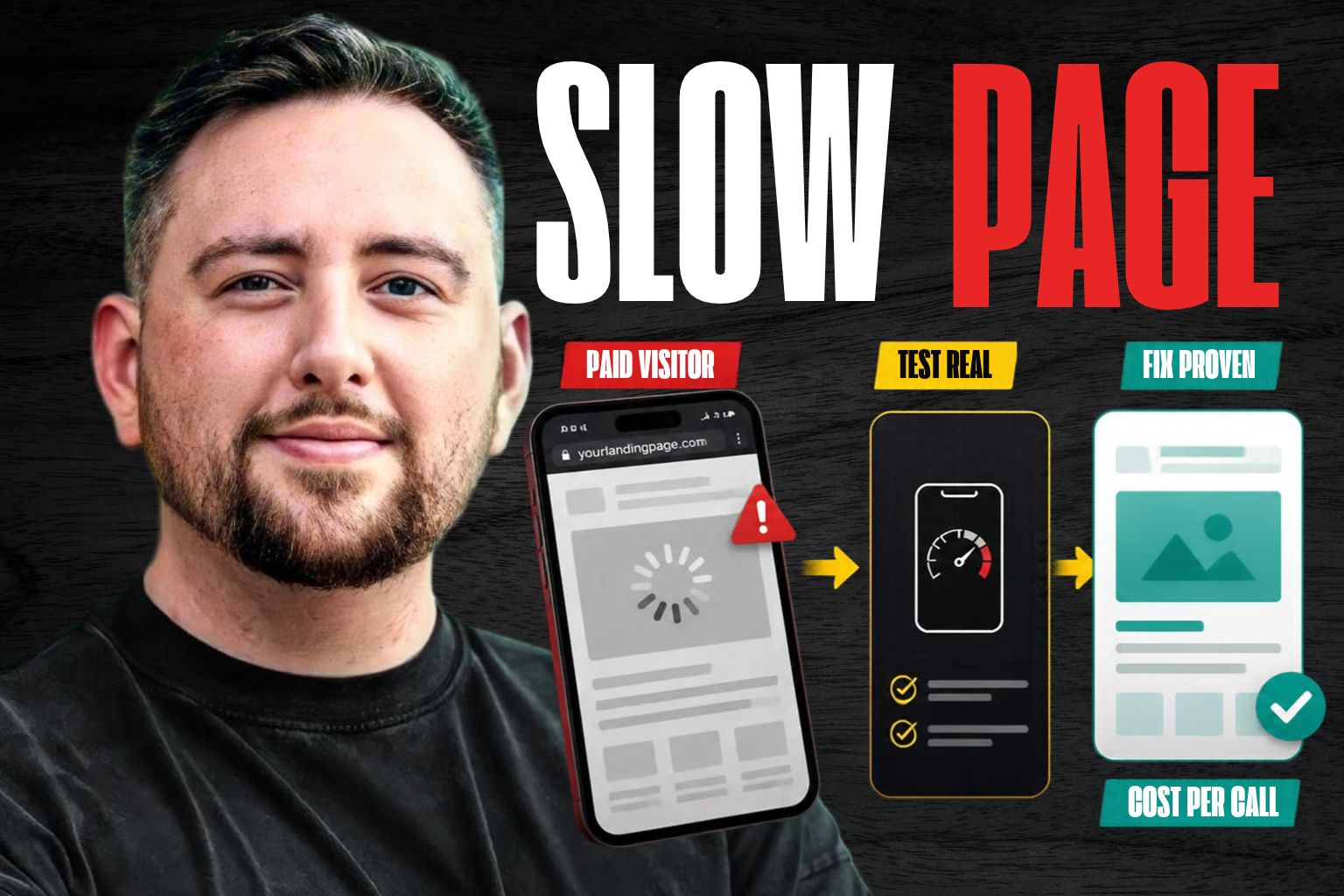
Before you buy another batch of clicks, open the landing page on a phone and use it like a new prospect. Slow landing pages can raise your cost per booked call because you paid for the visit before the person had a usable page in front of them. Your office browser may hide the problem. It has seen the page before, it is on your connection, and you already know where everything is.
I want to see the experience a stranger gets after the ad. Can they read the message, use the application, and reach the scheduler without waiting on a page that keeps assembling itself? Check that before deciding the traffic is the whole problem.
Already making money? See what it takes to make a lot more.
Why a Paid Click Is Only the Start of the Visit
A paid click is the start of the visit because the prospect still has to reach and use the destination. Interest in an ad does not establish that the page loaded correctly or that the person is a qualified buyer.
The campaign can produce clicks while the next step loses people. A blank opening screen, a form that takes time to appear, or a button that moves as the page loads can create friction before the offer has had a fair chance.
That can affect the economics of the call funnel. Cost per booked call is ad spend divided by the booked calls attributed to that spend. If fewer visitors complete the path while the spend stays the same, the cost rises. Keep the booking definition and attribution method consistent while comparing results.
You paid to get someone to the page. The page still has to do its part. That does not mean every missing booking is a speed problem. It means you should inspect the handoff before blaming the people who clicked.
The rest of the cold-traffic call funnel still matters. A fast page with an unclear promise can struggle, just as a clear promise can struggle when the visitor cannot use the page properly.
How I Check the Page a New Buyer Actually Sees
I check the page in circumstances that differ from the browser and connection I use every day. Open it in a browser you do not normally use and try it on a phone using mobile data. Check it on another connection as well.
The reason is straightforward. A page you have already visited can have resources stored in the browser. That familiar visit can feel different from the first visit somebody makes after seeing an ad.
During an info-business review, I asked the operator to open the page in an unfamiliar browser and try different connections. The purpose was to see what was happening outside the comfortable version of the experience they were used to.
Do that while safely stationary, with time to pay attention. Watch the first screen appear, then read the headline. Try the form and the next step. You are checking the whole path a buyer needs, including whether the page is usable after something first becomes visible.
Write down what you actually observe. Maybe the headline appears late or the form does not respond. The scheduler might open but fail to finish loading. Specific observations give the person fixing the page something more useful than a complaint that the website feels slow.
What PageSpeed Can Tell You About a Slow Page
PageSpeed Insights can help identify performance issues, but its score is only part of the check. Use its mobile report alongside what you observe on the actual page.
Google’s PageSpeed Insights documentation distinguishes controlled lab measurements from real-user field data. The lab view helps investigate a page under test conditions. Field data describes observed experiences where that data is available.
Do not treat those views as interchangeable. A lab result cannot show you every connection and device a prospect might use. A real-user summary also needs enough data and the right page or origin context to answer the question you are asking.
The current Core Web Vitals are Largest Contentful Paint, Interaction to Next Paint, and Cumulative Layout Shift. In ordinary language, those concern how the main content appears, how the page responds to interaction, and whether the layout shifts unexpectedly.
Google’s Web Vitals documentation explains those measures. Use them to make the problem more specific. A page that looks ready but ignores a tap needs a different investigation from a page that keeps moving the application button.
You do not have to become the developer to describe the problem accurately. Give the technical person the page URL, the device and connection you used, what happened, and the report. That makes the conversation about a reproducible experience.
Why a Better Score Does Not Prove Calls Will Improve
A better performance score does not prove calls will improve because loading is only one part of the buyer’s decision. The page still needs a clear message and a working path to the appointment.
Keep the question narrow. Did the work make the page more usable for the people arriving from the ad? Then check whether more of the right people completed the application and booked.
Do not attach a guaranteed reduction in call cost to a faster page. The result also depends on the traffic, the offer, the booking process, and what changed during the comparison. Speed removes a possible obstruction. It does not decide whether somebody wants the offer.
Be equally careful with advertising scores. Google Ads describes Quality Score as a diagnostic tool and explicitly says the displayed score is not an input in the ad auction. It cannot tell you exactly how much a faster page will save.
Your cost-per-call analysis should keep the page experience connected to the rest of the path. A score is useful when it helps locate a problem. A booked call is a different event and needs its own record.
Which Parts of the Page Need Attention First
The parts that deserve attention first are the ones delaying or disrupting what the visitor needs to understand and do. That may be an image, a video component, a script, the form, or the way several pieces load together.
Have the person responsible for the site inspect the actual cause before choosing the fix. A heavy first-screen asset and a slow server response are different problems. Changing the page builder without knowing what caused the delay can move the work without resolving it.
Protect the useful content while you do this. Removing a video that explains the offer may make a test score look better while leaving the buyer less informed. Keep the sales job of each element visible while finding a lighter or better-loading version.
The same goes for tracking and consent tools. Do not casually delete them to improve a score. Confirm which functions the business needs, which rules apply, and how the page can keep working without making the visitor wait unnecessarily.
If you bring this kind of issue into my Inner Circle, bring the observed problem and the relevant funnel numbers together. A useful discussion starts with where the person gets stuck, rather than which technology somebody happens to prefer.
Results are not typical. Your results will vary and depend entirely on your individual capacity, business experience, expertise, and level of desire. There are no guarantees concerning the level of success you may experience. The testimonials and examples used are not intended to represent or guarantee that anyone will achieve the same or similar results. We don’t believe in get-rich-quick programs. We believe in hard work, adding value and serving others. As stated by law, we can not and do not make any guarantees about your own ability to get results or earn any money with our information, courses, programs, or strategies.
How to Check That a Faster Page Still Books Calls
Check the booking journey again after the performance work. A faster first screen is incomplete progress if the application, qualification rules, or scheduler stopped working.
Go through the same route a new prospect would follow. Use the campaign’s destination URL, including the parts needed for attribution. Complete a test application through the appropriate test process and confirm the next step works.
Make sure the team can still connect a booked call to the source. If a tracking event disappears during the cleanup, the dashboard can make a working page look worse or an incomplete booking look like a success.
For the comparison, keep the page message and other meaningful conditions stable where possible. If you replace the headline, traffic, form, and page layout together, a different call cost will not isolate the effect of speed.
A VSL funnel scenario can help you see how a changed booking rate affects the arithmetic. Use observed inputs and keep the output hypothetical. The calculator cannot tell you that a particular technical fix will produce that rate.
Keep checking the quality of the resulting appointments, too. More bookings only help the sales process when the people meet the standard the business set. Faster access to the page does not replace qualification.
7 weeks. Real frameworks. Covering copywriting, funnels, paid ads, and conversion systems.
What I Would Fix Before Buying More Traffic
I would fix a demonstrated loading or usability problem before paying to send more people through that same problem. The important word is demonstrated. Open the page, reproduce the issue, and identify what needs attention.
If the page loads and works well under realistic conditions, move on to the next plausible cause. Inspect the message, the application, or the traffic against the evidence you have. Do not keep chasing a perfect score while the real obstruction sits elsewhere.
The broader funnel bottleneck check keeps those decisions connected. The speed check earns its place because it can reveal a problem before you spend more money trying to solve something different.
Repeat the usability check after changes that could affect the page. New assets, forms, or scripts create another reason to look at what the visitor now experiences. Do not assume that a page checked once stays unchanged.
Master Internet Marketing, my 7-week live comprehensive training, covers copywriting, funnels, paid ads, and conversion systems. Keep those pieces connected when you evaluate performance. A buyer needs a page they can use and a reason to take the next step once they get there.
Results are not typical. Your results will vary and depend entirely on your individual capacity, business experience, expertise, and level of desire. There are no guarantees concerning the level of success you may experience. The testimonials and examples used are not intended to represent or guarantee that anyone will achieve the same or similar results. We don’t believe in get-rich-quick programs. We believe in hard work, adding value and serving others. As stated by law, we can not and do not make any guarantees about your own ability to get results or earn any money with our information, courses, programs, or strategies.
Get my content first on Google
Add jeremyhaynes.com as a preferred source and Google shows my articles more prominently in your search results, including AI Overviews and AI Mode.


Jeremy Haynes
Owner and CEO of Megalodon Marketing
Jeremy Haynes is the founder of Megalodon Marketing. He is considered one of the top digital marketers and has the results to back it up.