Google Ads Keyword Mistakes That Waste High-Ticket Budget

I hope you enjoy reading this blog post. If you want my team to just do your marketing for you, click here.
Author: Jeremy Haynes | Published September 14, 2026
Earnings Disclaimer: You have a .1% probability of hitting million-dollar months according to the US Bureau of Labor Statistics. As stated by law, we cannot and do not make any guarantees about your own ability to get results or earn any money with our ideas, information, programs, or strategies. We don’t know you, and your results in life are up to you. We’re here to help by giving you our greatest strategies to move you forward, faster. However, nothing on this page or any of our websites or emails is a promise or guarantee of future earnings. Any financial numbers referenced here, or on any of our sites or emails, are simply estimates or projections or past results, and should not be considered exact, actual, or as a promise of potential earnings – all numbers are illustrative only.
Google Ads keyword mistakes become expensive on high-ticket offers because the click is only the beginning of the sale. A search can look relevant, produce a lead, and still come from somebody who wanted education, employment, or a cheap alternative. If the campaign optimizes around that shallow action, more volume can create more waste.
The fix starts with intent. Build keyword groups around the problem the offer solves and the buying action the searcher appears ready to take. Then use match types, negative keywords, search-term reviews, and qualified-conversion data to keep that intent visible as Google expands reach.
Already making money? See what it takes to make a lot more.
A Keyword and a Search Term Are Different
The keyword is the targeting input you add to the account. The search term is what a person actually typed. Those two can differ, even when the keyword uses phrase or exact match.
Google’s current keyword-matching documentation explains that match types consider meaning as well as syntax. Broad match reaches more related queries than phrase match, and phrase match reaches more than exact match. Exact match can also cover close variants with the same meaning.
That makes the search terms report the reality check. Do not assume the keyword label tells you every query receiving spend. Review what people searched, which keyword matched it, and what happened after the click.
This distinction connects to my article on how buyer intent affects funnel scale. Search traffic arrives with different levels of awareness and urgency. The account structure needs to preserve those differences.
Put Educational Searches in Their Own Budget Lane
A person asking what a service means is not in the same position as somebody looking to hire a provider. Both searches can contain the core service phrase. Only one clearly signals an immediate commercial action.
Read the full query. Look for the problem, the desired solution, the buyer context, and the action implied by the wording. Terms involving providers, services, pricing, consultation, or a specific business use case often deserve a different group from definitions, tutorials, certifications, careers, and free resources.
Do not declare every informational query worthless. Some businesses can educate early-stage buyers and nurture them over time. The mistake is paying for that traffic inside a campaign expected to produce near-term high-ticket opportunities, then judging every lead as if it entered with the same intent.
My guide to building a buyer-ready funnel explains why qualification should begin in the message. In Search, the keyword and query are part of that message.
Do Not Treat Broad Match as a Shortcut
Broad match can find demand beyond a narrow keyword list, but it also gives the system more freedom. Whether that freedom helps depends on the account’s conversion signals, bidding strategy, landing pages, existing keywords, and negative coverage.
Start with the amount of uncertainty the budget can support. When the offer has limited conversion history and every click is expensive, tighter match types can make the first learning period easier to interpret. Broader reach can be tested later in its own controlled campaign or budget lane.
Avoid universal rules such as never use broad match or always use exact match. Match type is a control, not a verdict. The real question is whether the query mix and downstream outcomes justify the reach.
Build Negative Keywords Around Wrong Intent
Negative keywords should reflect the searches the offer does not serve. Start with obvious categories such as employment, certification, free resources, definitions, do-it-yourself help, login pages, support requests, and unrelated uses of the same word.
Then make the list specific to the business. A word that signals poor intent for one offer may describe an ideal buyer for another. Review negatives carefully so a broad exclusion does not block a qualified search containing the same term in a different context.
Google recommends using the search terms report to identify negative-keyword ideas. Its guidance also notes that negative match types work differently from positive keyword match types, so each exclusion needs the right scope.
Negative coverage is not a one-time launch task. The market changes its language, Google finds new relationships, and new irrelevant patterns appear. The list should improve as evidence accumulates.
Group Keywords by the Decision They Signal
An ad group should make one coherent promise to one recognizable search intent. When broad research queries, comparison searches, provider searches, and brand searches sit together, the ad and landing page have to speak vaguely enough to fit all of them.
Group keywords by the decision the searcher appears to be making. A buyer comparing providers may need proof and differentiation. A buyer searching for a specific service may need direct confirmation of fit. A brand search may need a clean path to the correct offer.
This structure makes the account easier to read. You can see which intent group consumes budget, which message earns qualified actions, and where the landing page does not match the query.
My breakdown of building a high-ticket sales funnel explains why the message, qualification step, and sales process need to agree. Keyword grouping should support that same path.
Review Search Terms Against Qualified Outcomes
A search terms report becomes more useful when it includes what happened after the form fill. Mark queries that produced qualified conversations, reached the correct pipeline stage, or became customers. Separate them from searches that generated volume but repeatedly failed qualification.
Google’s search terms guidance explains that the report shows which searches triggered ads and how those searches performed. It also notes that some low-volume queries may be grouped or omitted for privacy, so the report is useful without being a complete transcript of every search.
Review the evidence on a sensible cadence. New campaigns may need closer attention because the query mix is still developing. Mature campaigns can use a weekly review with alerts for unusual spend or sudden intent shifts.
Do not pause a query from one weak interaction or promote it from one fortunate sale. Use enough context to make a reasonable decision for the account’s volume and sales cycle.
Send Qualified Lead Data Back to Google
If every form submission counts equally, the bidding system receives no distinction between a qualified buyer and an irrelevant inquiry. High-ticket campaigns often need a deeper event from the CRM to show which leads created real sales value.
Google describes enhanced conversions for leads as a way to connect offline lead outcomes with the ad interactions that produced them. Its current documentation recommends Data Manager for advertisers moving from legacy offline conversion imports.
The exact setup depends on the website, consent model, CRM, data policy, and technical stack. Treat it as a measurement project, verify that values and stages map correctly, and protect customer data throughout the process.
My article on teaching an ad platform what a qualified lead looks like covers the broader principle. The system can only optimize around signals it receives and trusts.
Inside Master Internet Marketing, my 7-week live comprehensive training, I teach operators to connect the traffic source with the downstream sales outcome instead of grading campaigns on lead volume alone.
Results are not typical. Your results will vary and depend entirely on your individual capacity, business experience, expertise, and level of desire. There are no guarantees concerning the level of success you may experience. The testimonials and examples used are not intended to represent or guarantee that anyone will achieve the same or similar results. We don’t believe in get-rich-quick programs. We believe in hard work, adding value and serving others. As stated by law, we can not and do not make any guarantees about your own ability to get results or earn any money with our information, courses, programs, or strategies.
Match the Landing Page to Search Intent
Tight keyword control cannot rescue a landing page that answers a different question. The ad should acknowledge the searcher’s intent, and the page should continue the same promise with the right offer, proof, qualification, and next step.
Do not send every search to a general homepage because it is convenient. A focused intent group often deserves a focused page or a clearly relevant section. The closer the page matches the problem and decision behind the query, the easier it becomes to evaluate whether traffic quality or page experience needs work.
This is another reason to keep intent groups separate. If every query lands on the same page, poor conversion tells you very little. When the query, ad, and page match, the result becomes easier to diagnose.
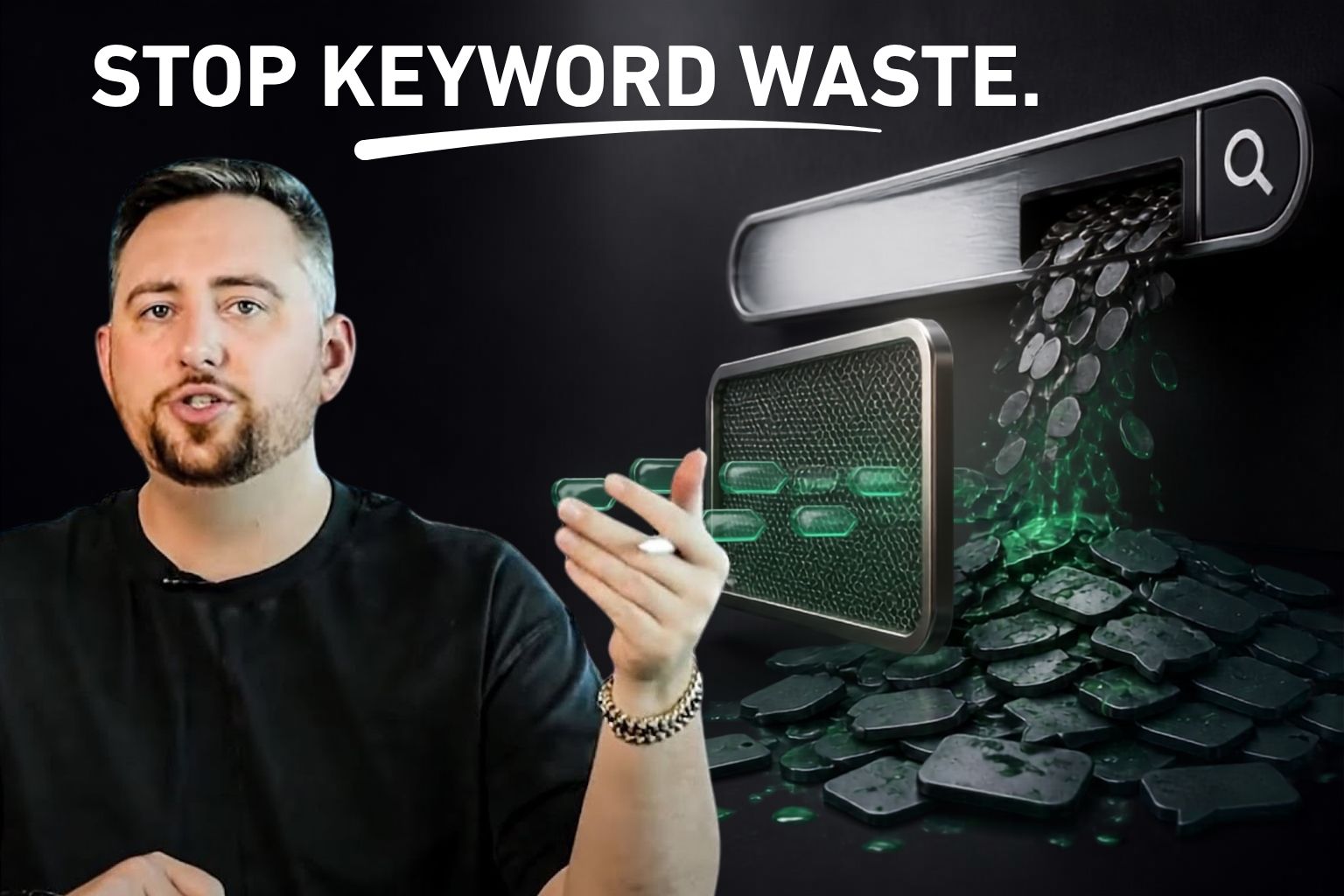
Use a Weekly Keyword Waste Review
A useful review starts with the queries that consumed meaningful spend, then follows them into qualification and sales. Add negatives where the intent is clearly wrong. Tighten or separate keywords that repeatedly reach too broadly. Promote strong queries into controlled groups when enough evidence supports the move.
Keep a record of the change and the reason. If performance moves, you should know whether the team changed a negative list, match type, landing page, conversion goal, or bid strategy. That discipline keeps account learning separate from random cleanup.
Experienced operators can bring this account evidence into my Inner Circle and pressure-test whether the problem sits in query intent, qualification, sales follow-up, or the economics behind the offer.
Results are not typical. Your results will vary and depend entirely on your individual capacity, business experience, expertise, and level of desire. There are no guarantees concerning the level of success you may experience. The testimonials and examples used are not intended to represent or guarantee that anyone will achieve the same or similar results. We don’t believe in get-rich-quick programs. We believe in hard work, adding value and serving others. As stated by law, we can not and do not make any guarantees about your own ability to get results or earn any money with our information, courses, programs, or strategies.
7 weeks. Real frameworks. Covering copywriting, funnels, paid ads, and conversion systems.
Make Every Keyword Earn Its Budget
High-ticket Google Ads keyword strategy is not about finding the largest possible list. It is about preserving commercial intent from the search through the sale.
Understand the query behind the keyword. Control reach with match types and negatives. Group searches by the decision they signal. Review them against qualified outcomes, and send deeper sales evidence back to the platform when the setup supports it.
If you want to build this kind of disciplined acquisition system, Master Internet Marketing, my 7-week live comprehensive training covers the frameworks I use to connect advertising, funnels, and sales.
Results are not typical. Your results will vary and depend entirely on your individual capacity, business experience, expertise, and level of desire. There are no guarantees concerning the level of success you may experience. The testimonials and examples used are not intended to represent or guarantee that anyone will achieve the same or similar results. We don’t believe in get-rich-quick programs. We believe in hard work, adding value and serving others. As stated by law, we can not and do not make any guarantees about your own ability to get results or earn any money with our information, courses, programs, or strategies.
Get my content first on Google
Add jeremyhaynes.com as a preferred source and Google shows my articles more prominently in your search results, including AI Overviews and AI Mode.


Jeremy Haynes
Owner and CEO of Megalodon Marketing
Jeremy Haynes is the founder of Megalodon Marketing. He is considered one of the top digital marketers and has the results to back it up.