
This Agency Made $300K/Month and Was Still Broke, Here’s Why

I hope you enjoy reading this blog post. If you want my team to just do your marketing for you, click here.
Author: Jeremy Haynes | Published July 10, 2026
Earnings Disclaimer: You have a .1% probability of hitting million-dollar months according to the US Bureau of Labor Statistics. As stated by law, we can not and do not make any guarantees about your own ability to get results or earn any money with our ideas, information, programs, or strategies. We don’t know you, and besides, your results in life are up to you. We’re here to help by giving you our greatest strategies to move you forward, faster. However, nothing on this page or any of our websites or emails is a promise or guarantee of future earnings. Any financial numbers referenced here, or on any of our sites or emails, are simply estimates or projections or past results, and should not be considered exact, actual, or as a promise of potential earnings, all numbers are illustrative only.
I recently sat down with two agency operators who built a roofing marketing business at 18 and 19 years old. They had serious scale. They were also barely keeping their heads above water: operational chaos, cash flow problems, and a bloated team of 46 people.
Their biggest problem wasn’t marketing. It was everything else.
In my experience working with operators through my Inner Circle, this pattern shows up constantly. You can have the revenue on paper and still be broke. The difference comes down to systems, profit margins, and how you structure delivery.
Results are not typical. Your results will vary and depend entirely on your individual capacity, business experience, expertise, and level of desire. There are no guarantees concerning the level of success you may experience. The testimonials and examples used are not intended to represent or guarantee that anyone will achieve the same or similar results. We don’t believe in get-rich-quick programs. We believe in hard work, adding value and serving others. As stated by law, we can not and do not make any guarantees about your own ability to get results or earn any money with our information, courses, programs, or strategies.
7 weeks. Real frameworks. Covering copywriting, funnels, paid ads, and conversion systems.
How This Roofing Marketing Agency Actually Worked, and Why It Was Bleeding Cash
They run a roofing marketing agency targeting businesses in a specific revenue range. Their offer includes Meta ads under the client’s branding, lead generation, and an in-house call team to book sales appointments. The pricing model charges an upfront setup fee, then several weeks after service delivery begins, clients pay a monthly retainer plus a percentage of their ad spend.
The messy part: they were spending roughly what they collected upfront on customer acquisition. They had over 100 active clients and dozens more pending launch. But a significant portion of clients who paid the setup fee never made it to the monthly billing cycle.
The real problem was timing. It was taking an average of 72 days to get a client from setup fee to their first monthly payment. It should have been closer to 40 to 45 days.
Think about that timeline. They’d spend money on ads to generate a lead, wait for that lead to close into a paying client, collect a setup fee that barely covered acquisition cost, then wait another 70 days on average before collecting the first monthly payment. That’s nearly three months from initial ad spend to seeing any margin. During that entire window, they were funding ad budgets, paying 46 staff members, and covering every operational cost.
Ramp’s research on cash flow management puts a number on exactly this dynamic: the average business now waits nearly two months to collect cash from the moment a sale closes once you combine typical payment delays with days sales outstanding, and that gap is where otherwise profitable companies quietly run out of working capital. The longer that gap, the more capital you need just to stay operational. They had no backend offers, no upsells, no ascension model. Just the recurring monthly charge and a rarely purchased hiring service.
Why 46 People on Payroll Wasn’t a Sign of Scale
They went from a handful of customer success managers to 10 in just a couple months. Each CSM was handling roughly 30 clients while also being responsible for technical account management. They didn’t track how their team actually spent time. They had no clear training systems. And the timeline to get clients launched kept getting longer.
When I asked what they did all day, the answers were vague. One operator reviewed ad spend and created action-step videos. The other managed salespeople. Neither was deeply involved in the client success process that was clearly failing.
This shocked me. I run a larger operation and only have nine people actively working with me. They had 46. When I asked about it, the answer became clear: they didn’t have a constraint in their decision-making around hiring. Anytime something needed to get done, they’d just hire someone to do it. No consideration for whether the role would produce a measurable return. No thought about whether existing staff could handle it with better systems or incentives.
I operate differently. Before I hire anyone, I first ask how I can accomplish this without hiring someone new. Can I incentivize current staff? Can I automate it? Can I systematize it so it takes less time? When I finally do hire, I make sure the contribution is obvious and measurable. I recently hired someone whose only job is building one lead magnet per day from our content, and I structured it as a 45-day contract first to test the hypothesis before committing long-term.
When you scale a system that doesn’t work, you just get more bad outcomes at a larger scale. Hiring more people into a broken system doesn’t fix the system. They needed to audit every single role and ask what revenue each position directly generates or protects. If the answer isn’t clear, that’s a problem.
Why You Can’t Just Blame the Client When You Already Knew They’d Struggle
A significant portion of their clients made it past the first two billing cycles. But there was a clear pattern in who succeeded and who failed.
The best clients tracked their numbers, were strong at sales (specifically at the door when meeting homeowners), could film the creative assets needed for ads quickly, had strong branding and omnichannel presence, and communicated feedback rapidly and clearly. The worst clients were the opposite: slow, emotional instead of data-driven, weak at sales, unable or unwilling to film content, weak branding, and using call centers that killed conversion rates.
They kept closing the bad-fit clients anyway. They’d set verbal expectations, hand them a couple PDFs, and hope for the best.
When most of your struggling clients can be identified before you close them, and you close them anyway, you’re choosing to take their money knowing they’ll probably struggle. At that point, it becomes your responsibility to build systems that help those clients succeed despite their weaknesses.
They weren’t doing that. They built their entire delivery system around the clients who were already great, the ones who’d succeed with almost any system. The others were left to struggle with a delivery model that required skills and habits they didn’t have. Most agencies make this mistake. They point at the client and say “you’re bad at sales” or “you won’t film content.” That might be true. But if you took their money knowing that, it’s on you to build a system that works anyway.
How to Collapse the Cash Collection Timeline From 72 Days to 40
Every extra day of cash flow delay was limiting their ability to operate, so the first fix was rebuilding onboarding around a day-by-day playbook instead of a vague window where they waited on clients to provide assets.
Day one: onboarding call and asset collection. Day two: backup creative generation if client content isn’t ready. Day three: ad account setup and initial campaign structure. And so on, with no ambiguous gaps where the timeline just drifts.
They also needed to stop relying on clients to do things clients are bad at. Roofers don’t want to fill out spreadsheets. They want to talk on the phone. So instead of sending tracking sheets, have a CSM call them and document lead outcomes in real time during the conversation.
For creative assets, they’d already started using AI image generation when clients were slow, but they needed to systematize that further. Build templates that automatically localize details like municipality names, regional roof styles, local tree types, and neighborhood architecture. Make it so easy that a client just needs to send a couple photos and read a short script, then AI handles the rest. If your onboarding is still running on a loose timeline instead of a locked playbook, building a 30-day first-win timeline covers how to structure that day-by-day sequence properly.
What to Do When Your Clients Have Weak Sales Processes
Most of their struggling clients had sales teams that weren’t converting. The best salespeople in roofing do in-person presentations that last 90 minutes to two hours. They have a process. They build pain. They close on the spot. The worst ones show up, check the roof, email an estimate 24 hours later, and do some light follow-up.
Instead of just pointing at that gap, they needed systems to address it. That could mean building email automation sequences that do the follow-up work automatically. It could mean AI phone systems that pre-educate leads before the sales rep ever shows up. It could mean recorded sales training that shows the exact process their best clients use.
The key was making it so low-friction that even unmotivated clients would plug into it. Not a 47-page manual. Not a three-hour training call. A simple system they could copy and paste into their business with minimal effort. This is the same underlying pattern covered in the five client red flags that kill agency margin, spotting the weak-fit clients early is only half the fix; building delivery that compensates for their weaknesses is the other half.
Why Your Clients Need More Than Your Core Service
Most agencies miss this. Your clients need way more than just your core service. They need education, resources, and support systems.
Think about what I provide in my Inner Circle: quarterly events where members network with others at their level, weekly group calls, strategy sessions, an AI that answers questions in real time, a library of SOPs and training modules, and an active group chat. People consume those resources in different ways based on their preferences. Some only come to events. Some watch every weekly call live. Some binge the recordings later. Some only use the AI. Some read the written SOPs instead of watching videos. I give them multiple ways to get the information and support they need.
These guys were giving clients two PDFs. When your clients are struggling and you only have two PDFs to help them, that’s not a client problem. That’s a delivery problem.
Results are not typical. Your results will vary and depend entirely on your individual capacity, business experience, expertise, and level of desire. There are no guarantees concerning the level of success you may experience. The testimonials and examples used are not intended to represent or guarantee that anyone will achieve the same or similar results. We don’t believe in get-rich-quick programs. We believe in hard work, adding value and serving others. As stated by law, we can not and do not make any guarantees about your own ability to get results or earn any money with our information, courses, programs, or strategies.
They needed video libraries showing best practices, scripts and templates, recorded examples of top performers in action, weekly check-in systems, accountability frameworks, and automated nurture sequences that kept clients engaged and executing. This isn’t unique to roofing or even to agencies. SundaySky’s research across customer onboarding programs found that poor onboarding ranks as one of the top drivers of early churn, and companies using structured, multi-format onboarding (video, written SOPs, live calls, and self-serve tools together) consistently retain more customers than those relying on a single format. Two PDFs is a single format. It was never going to work for the clients who needed the most help.
Ringly’s compiled research on churn puts a number on what structured onboarding actually buys you: reducing early-stage churn by roughly 50%, largely because customers who hit a real “win” in their first week or two stay engaged twice as long as those left to figure things out on their own. That’s the same dynamic playing out with this agency’s clients. The ones who got fast, clear wins stuck around. The ones handed two PDFs and left to sink or swim mostly sank.
Why Premature Travel Can Cost You Years of Growth
At one point in the conversation, I asked if they’d ever been to Italy. They had. I haven’t.
Not because I don’t want to go. I’d love to tour Europe. But I haven’t built my business to the point where I can truly step away for a nine-hour international flight without it costing me operationally. When I do travel, I take private jets, I have drivers, I ship my cars to where I’m going. I’ve built the systems and the resources to make travel seamless and enjoyable. I didn’t do that prematurely.
They went to Italy at 18 and 19 while their business was dealing with cash flow issues, breaking systems, and collapsing margins. They came back to anxiety and stress because they left too early.
Every dollar you invest in your late teens and early twenties has more time to compound than dollars you invest in your thirties. Compound interest over time makes early capital the most valuable capital you’ll ever deploy. If they allocate cash into index funds and real estate now, those investments will grow for 30-plus years. The same dollars invested ten years from now will have significantly less time to compound. The math is simple but most young operators ignore it. This is the time to go all in, not when you have kids and a mortgage and responsibilities. Right now, when you have the least to lose and the most energy and time to give.
Already making money? See what it takes to make a lot more.
What the Rebuild Actually Looks Like
They need to get focused on the highest-impact activities, not busy work, not vanity metrics, the things that directly generate or protect revenue.
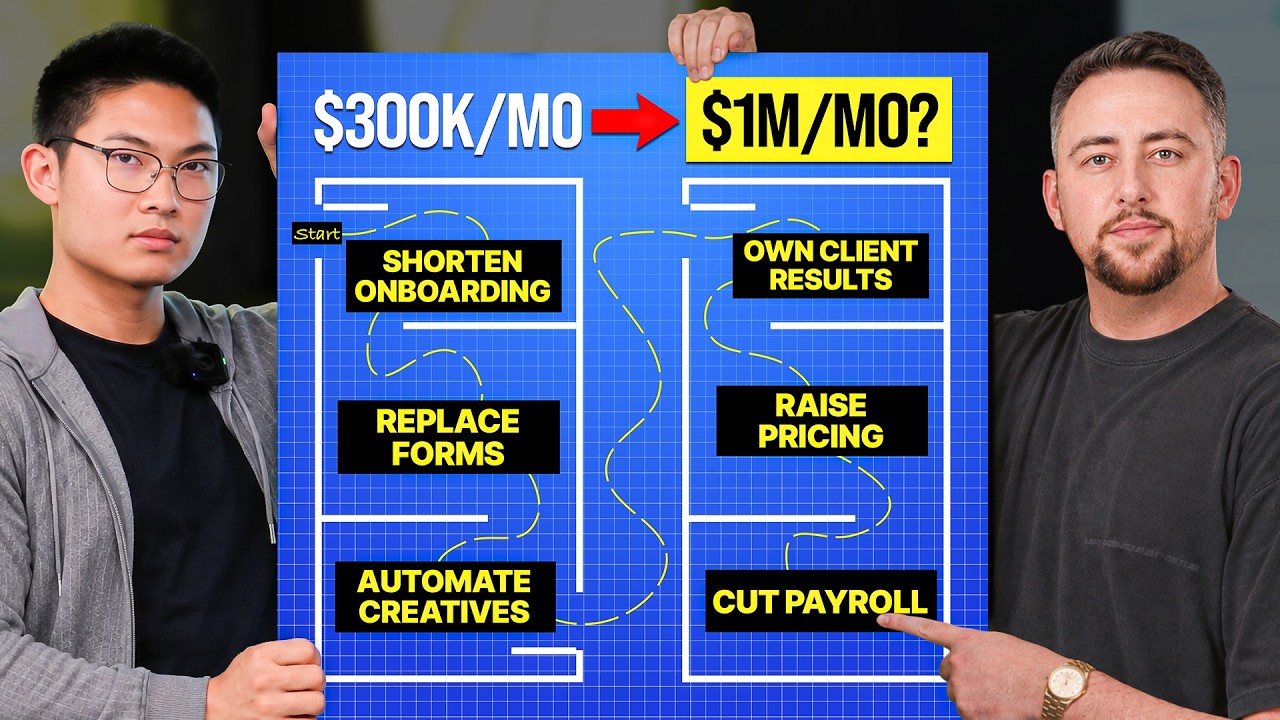
That means rebuilding onboarding to collapse the cash collection timeline from 72 days back to 40. It means creating a full library of client-facing resources that make execution easier. It means training their CSMs to actually move clients forward instead of just managing accounts. It means auditing every staff role and cutting or restructuring anything without clear contribution. It also means adding constraints to their thinking: how can we do this without hiring more people, how can we make this so simple a client can’t mess it up, how can we automate or systematize this instead of manually doing it every time.
Most importantly, it means taking full responsibility for client outcomes instead of pointing fingers at clients who are bad at sales or slow with content. Building systems that work even when clients have those weaknesses. If this pattern of hidden operational gaps sounds familiar, this breakdown of a 287-client agency’s five operational gaps walks through a different agency with a similar problem: revenue that looked fine on paper while the actual operations were quietly broken underneath it. And if the home-service niche specifically is where you’re building, scaling a home service marketing agency past seven figures covers the industry-specific playbook in more depth than fits here.
In my experience teaching operators through Master Internet Marketing, the biggest breakthroughs come when you stop blaming external factors and start building systems that account for reality.
Results are not typical. Your results will vary and depend entirely on your individual capacity, business experience, expertise, and level of desire. There are no guarantees concerning the level of success you may experience. The testimonials and examples used are not intended to represent or guarantee that anyone will achieve the same or similar results. We don’t believe in get-rich-quick programs. We believe in hard work, adding value and serving others. As stated by law, we can not and do not make any guarantees about your own ability to get results or earn any money with our information, courses, programs, or strategies.
What This Means for Your Agency
You can have a massive business on paper and still be broke. You can do high revenue and net less than what some employees make. The difference between a real business and a glorified job comes down to systems, profit margins, and cash flow. If you’re working 80 hours a week, managing dozens of people, and taking home modest pay, you’re not winning. You’re just busy.
The goal isn’t to look successful. It’s to be profitable, scalable, and eventually optional in your own business. That only happens when you build systems that work without you, when you hire strategically instead of reactively, and when you take responsibility for outcomes instead of pointing at external factors.
These operators have the revenue. They have the clients. They have the opportunity. What they need now is focus, constraints, and a willingness to do the hard work of rebuilding their systems from the ground up. The question is whether they’ll actually do it or keep taking premature vacations while their business slowly falls apart.
If you’re running an agency or service business and dealing with similar issues around client success, cash flow, or scaling, the problems are almost always systemic. You don’t need more clients, you need better systems to serve the ones you have. You don’t need more staff, you need the right staff doing high-impact work. And you definitely don’t need to work harder, you need to work on the right things.
Take the time to audit your business with brutal honesty. Look at your actual profit margins, not just revenue. Measure how long it takes to collect cash. Identify which clients succeed and why. Then build your entire delivery system around making your worst clients successful, because that’s the system that will make everyone successful.
And if you’re young and just getting started: the time to go all in is now, not later when it’s more comfortable. Now, when you have the energy, the time, and the compounding power of early capital on your side.
If you want to learn how I structure my agency operations, client delivery systems, and team management, you can apply to work with me directly through my Inner Circle or join my 7-week live comprehensive training at Master Internet Marketing.
Results are not typical. Your results will vary and depend entirely on your individual capacity, business experience, expertise, and level of desire. There are no guarantees concerning the level of success you may experience. The testimonials and examples used are not intended to represent or guarantee that anyone will achieve the same or similar results. We don’t believe in get-rich-quick programs. We believe in hard work, adding value and serving others. As stated by law, we can not and do not make any guarantees about your own ability to get results or earn any money with our information, courses, programs, or strategies.
Get my content first on Google
Add jeremyhaynes.com as a preferred source and Google shows my articles more prominently in your search results, including AI Overviews and AI Mode.


Jeremy Haynes
Owner and CEO of Megalodon Marketing
Jeremy Haynes is the founder of Megalodon Marketing. He is considered one of the top digital marketers and has the results to back it up.