The Agency Scaling Mistakes That Cost Millions in Revenue

I hope you enjoy reading this blog post. If you want my team to just do your marketing for you, click here.
Author: Jeremy Haynes | Published June 25, 2026
Earnings Disclaimer: You have a .1% probability of hitting million-dollar months according to the US Bureau of Labor Statistics. As stated by law, we can not and do not make any guarantees about your own ability to get results or earn any money with our ideas, information, programs, or strategies. We don’t know you, and besides, your results in life are up to you. We’re here to help by giving you our greatest strategies to move you forward, faster. However, nothing on this page or any of our websites or emails is a promise or guarantee of future earnings. Any financial numbers referenced here, or on any of our sites or emails, are simply estimates or projections or past results, and should not be considered exact, actual, or as a promise of potential earnings – all numbers are illustrative only.
Most marketing agencies hit a ceiling and never break through. What separates the ones doing seven figures monthly from those stuck below it isn’t more leads or better ads. It’s recognizing the specific things that are actually holding you back.
I recently sat down with one of our Inner Circle members running a marketing agency exclusively for home service businesses. He’s crossed the million-dollar-a-month mark. And he’s stuck.
Results are not typical. Your results will vary and depend entirely on your individual capacity, business experience, expertise, and level of desire. There are no guarantees concerning the level of success you may experience. The testimonials and examples used are not intended to represent or guarantee that anyone will achieve the same or similar results. We don’t believe in get-rich-quick programs. We believe in hard work, adding value and serving others. As stated by law, we can not and do not make any guarantees about your own ability to get results or earn any money with our information, courses, programs, or strategies.
Not stuck in the early-stage way where you’re still figuring out what you’re selling. Stuck at the harder part, where the things that built the business are now the things capping it. Here’s the full breakdown of where the ceiling actually is and what needs to change to get through it.
7 weeks. Real frameworks. Covering copywriting, funnels, paid ads, and conversion systems.
The Foundation: Offer Structure and Traffic Mix at Seven Figures
This agency runs a tight, focused model: local SEO, Google Ads, and website design exclusively for plumbers, HVAC companies, bathroom remodelers, and similar home service businesses. The front-end offer is direct: rank number one on Google Maps for a specific price the first month, then a recurring monthly fee after that.
The onboarding fee wasn’t arbitrary. It turned their Facebook ads from cash-flow negative to cash-flow positive on the front end. Before that fee existed, they were losing money on every new client they acquired through paid ads. At this revenue level with hundreds of active clients on a recurring monthly fee, this is not a lifestyle business. It’s an operation that needs real systems to hold together.
For the first time in this agency’s history, they’ve hit 50/50 between organic and paid traffic. Twitter used to drive a significant chunk of their monthly revenue. Now Facebook ads are scaling with substantial monthly spend. The front-end ROAS sits at break-even to slightly positive, basically breaking even in the first 30 days, then profiting from month two onward. Retention sits above 90%. That’s a solid position to scale from.
Most people miss this about paid acquisition in this space. Home and Home Improvement averages $8.33 per click on Google Ads in 2026, one of the highest CPCs across all industries. When you’re breaking even on paid acquisition at those costs, your pricing becomes the limiting variable on how hard you can push spend. Every dollar you add to the front-end price directly changes how aggressively you can scale without bleeding cash.
Why Sales Team Capacity Is the Real Primary Bottleneck
The clearest ceiling right now is sales capacity. Three salespeople, all maxed out. Two months ago there were five. Two got cut for underperforming.
Most agency owners misread this situation. If someone doesn’t immediately impress you in their first week, they rarely turn it around. One operator I’ve worked with hired someone who closed a deal on day one. That’s the signal you’re looking for: someone who memorizes your script in 48 hours and starts closing before you’ve finished onboarding them.
The agencies doing multiple millions monthly stopped training people from zero a long time ago. They hire from other organizations already selling similar services. It’s faster, it’s more predictable, and ramp time collapses because these people already know how to sell. They just need to learn your offer.
This agency has closed deals with a former teacher who picks things up fast, a pressure washing business owner who sold his company, and someone in their fifties who worked in sales decades ago. What they all had in common: proven closing ability before they ever applied. Background doesn’t matter. Demonstrated sales instinct does.
The Unique Psychology of Blue Collar Business Owners
Home service business owners are a specific type. They’ve been burned by agencies over and over. They’re skeptical of anything that feels like internet marketing. And they can smell a pitch from a mile away because they’ve sat through hundreds of bad ones.
A few things that actually matter when you’re selling to this demographic:
- They don’t watch VSLs or confirmation page videos. They skip them. Email, though, works exceptionally well, well above average open rates for the industry when you write like a human being and skip the marketing language.
- They don’t trust testimonials. They’ve seen too many fake ones. Proof needs to be specific: a named business, a named city, a named result they can verify.
- They prefer Google Meets over Zoom because they associate Google with the actual service being sold. Small thing, but it matters.
- They use Slack at higher rates than you’d expect when you frame it as “texting us through an app.”
One key operational insight here: below a certain revenue threshold, a smaller percentage of home service business owners are actually good operators. That ratio flips significantly when you move upstream to larger clients. This agency is now deliberately moving toward larger, more sophisticated clients because the retention data and unit economics make the case clearly. Better clients, better margins, better business.
How 90-Day Thinking and Slow Upsell Timelines Are Killing Growth
This agency thinks in 90-day windows. The core offer takes about three months to show results. The upsell conversation happens around month three. Everything runs on quarterly timelines.
That’s the problem.
Clients pay monthly. Clients make their decision about whether to stay in the first 30 days based on what happens in that window. If your fulfillment thinking runs on 90-day cycles but billing runs on 30-day cycles, you’ve built in a structural mismatch that churn will eventually exploit.
The agencies that scale fastest figure out how to deliver a real win in 14 days, not 90. The core service doesn’t change. You add something alongside it that produces a fast, visible outcome. Think about how tech companies work. Engineering says a product takes two years. Leadership says they have six months. The physics of the product doesn’t change. The constraint of time forces completely different thinking, and that thinking usually finds a faster path that was there the whole time. The question for this agency isn’t whether SEO takes time. The question is what can be delivered in 14 days that builds enough trust to protect the long-term retainer.
The upsell problem runs parallel. Three client touchpoints right now: onboarding call, 14-day check-in, 31-day review. Upsell conversation starts at 14 days, but actual conversion typically doesn’t happen until month three. That’s too slow. Clients who have a great onboarding experience often go into a buying phase where they’ll purchase everything you offer immediately, if the early experience exceeds what they expected. With the right signals, you can catch that window in week two, not month three.
Multiple Entry Points, the Entrepreneur Strategy, and Where to Deploy Capital
Right now there is one way to become a client. One price, one offer, one front door. For an agency trying to get to multiple millions monthly, that’s a real problem.
The first instinct is to add a lower-priced down-sell. That’s backwards. Why build a front door that makes your paid acquisition math worse? Front doors get built based on profitability, not on what sounds like an accessible price point. If you’re breaking even at the current price on the front end, the better second offer is something priced higher that’s cash-flow positive in the first 30 days, a three-month SEO sprint paid upfront, for example. Better cash flow, lower payment risk, and a natural 90-day window where clients either commit or churn on results.
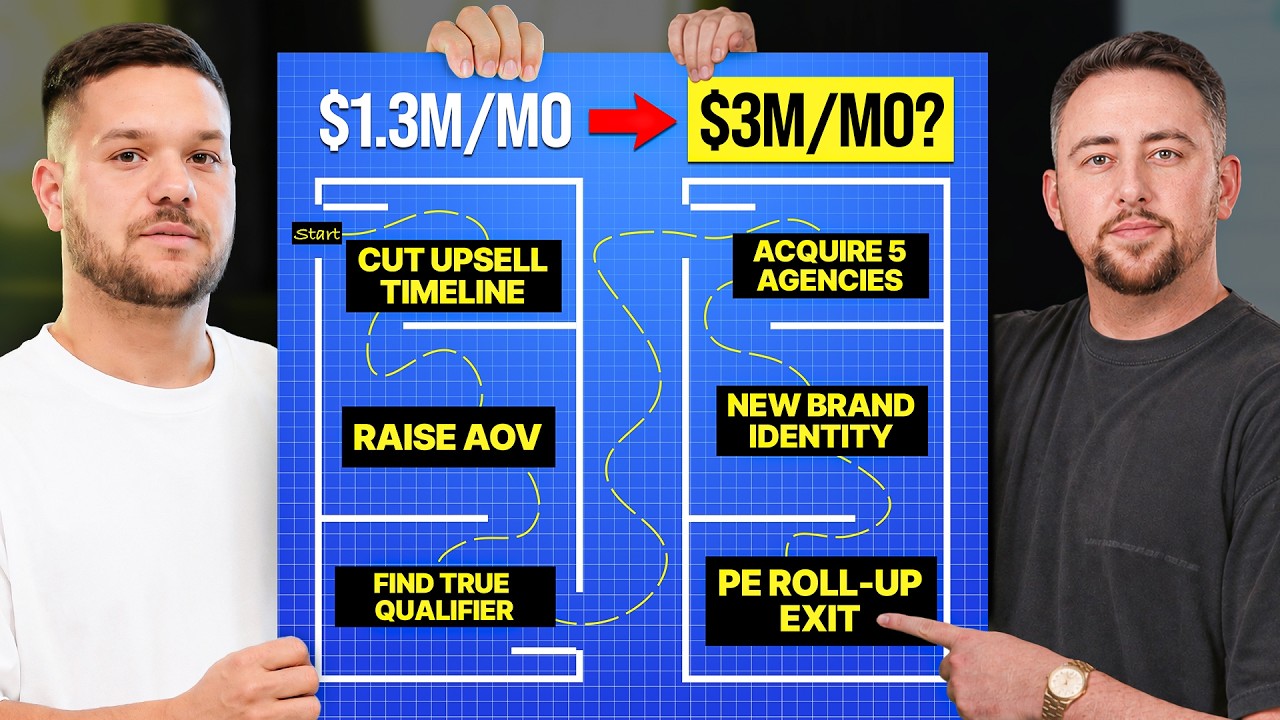
The real move is structural. There’s a massive market of smaller home service businesses this agency currently turns away because the economics don’t work at that tier. Instead of leaving that revenue on the table, the approach is to acquire small agencies already serving that demographic or bring in entrepreneurs to run a separate brand targeting that segment. Separate brand name to protect the main agency’s reputation. Separate fulfillment systems built for lower-touch clients. Backend infrastructure and support from the main agency. The entrepreneur running it gets meaningful upside and ownership. The main agency captures a market segment it currently ignores.
The idea of launching a high-ticket consulting offer sold at live events sounds attractive and could generate significant short-term revenue. It’s still a mistake for an agency trying to build real enterprise value. Consulting doesn’t scale. It’s founder-dependent, can’t be systematized cleanly, and buyers actively discount it when evaluating acquisitions because the revenue doesn’t transfer without the founder. Productized services that deliver the same value through systems and team members are worth far more at exit.
On capital deployment: every month, this agency sets aside funds for growth initiatives. Recently that’s gone into Facebook ads, a content studio, and office space. The approach has been conservative. That conservatism is holding things back. The businesses that move from one level to the next get there by deploying capital aggressively into proven channels and new bets with real upside, not by managing growth capital like it’s something to protect.
Results are not typical. Your results will vary and depend entirely on your individual capacity, business experience, expertise, and level of desire. There are no guarantees concerning the level of success you may experience. The testimonials and examples used are not intended to represent or guarantee that anyone will achieve the same or similar results. We don’t believe in get-rich-quick programs. We believe in hard work, adding value and serving others. As stated by law, we can not and do not make any guarantees about your own ability to get results or earn any money with our information, courses, programs, or strategies.
Already making money? See what it takes to make a lot more.
Regional Personalization, Exit Positioning, and the Shift to Eight Figures
There’s a competitive advantage sitting right in front of this agency that’s being completely underused: regional personalization. Home service business owners in different parts of the country have completely different problems. A roofer in Florida cares about hurricane damage and tile roofs. A roofer in the Midwest cares about ice dams and shingle replacement. Generic national marketing works. Regional marketing that speaks directly to local conditions works significantly better.
BrightLocal’s research on local consumer behavior consistently shows that people respond more strongly to messaging that’s specific to their geography and their situation. For an agency already spending substantially on Facebook ads, building regional campaigns is incremental effort with a meaningful return on acquisition efficiency. Most competitors won’t bother. The ones who do will pull ahead.
On the exit side: when private equity eventually looks at this business, a roll-up of multiple brands serving different market segments commands higher multiples than a single brand doing a single thing. Every move made now toward a second brand, a second entry point, and a regional marketing advantage also improves the eventual valuation, not just the near-term revenue number.
Getting from mid-seven figures to multiple millions monthly is not about doing more of what already works. To hit your first million monthly, you need one great offer and one primary channel. You ride that as far as it’ll go. To get to multiple millions monthly, you need multiple offers, multiple channels, multiple front doors, and multiple people running different parts of the business. It’s a completely different operating model, not just a bigger version of the old one.
For this agency specifically: compress result timelines from 90 days to 30, add a second entry point that’s profitable on the front end, execute on the entrepreneur strategy to capture the smaller-client market, and build regional campaigns to improve acquisition efficiency. The market is there. The infrastructure exists. What changes now is how the business is structured to serve it.
If you’re running an agency and any of this sounds familiar, we cover these exact frameworks in Master Internet Marketing, our 7-week live comprehensive training.
Results are not typical. Your results will vary and depend entirely on your individual capacity, business experience, expertise, and level of desire. There are no guarantees concerning the level of success you may experience. The testimonials and examples used are not intended to represent or guarantee that anyone will achieve the same or similar results. We don’t believe in get-rich-quick programs. We believe in hard work, adding value and serving others. As stated by law, we can not and do not make any guarantees about your own ability to get results or earn any money with our information, courses, programs, or strategies.
Get my content first on Google
Add jeremyhaynes.com as a preferred source and Google shows my articles more prominently in your search results, including AI Overviews and AI Mode.


Jeremy Haynes
Owner and CEO of Megalodon Marketing
Jeremy Haynes is the founder of Megalodon Marketing. He is considered one of the top digital marketers and has the results to back it up.