Best Sales Funnels for High Ticket Offers: Ranked S-Tier to D-Tier

I hope you enjoy reading this blog post. If you want my team to just do your marketing for you, click here.
Author: Jeremy Haynes | Published November 11, 2025
Earnings Disclaimer: You have a .1% probability of hitting million-dollar months according to the US Bureau of Labor Statistics. As stated by law, we can not and do not make any guarantees about your own ability to get results or earn any money with our ideas, information, programs, or strategies. We don’t know you, and besides, your results in life are up to you. We’re here to help by giving you our greatest strategies to move you forward, faster. However, nothing on this page or any of our websites or emails is a promise or guarantee of future earnings. Any financial numbers referenced here, or on any of our sites or emails, are simply estimates or projections or past results, and should not be considered exact, actual, or as a promise of potential earnings – all numbers are illustrative only.
Ladies and gentlemen, we have an updated S tier list for funnels and conversion mechanisms that we’re going to be going through today that are working for the businesses generating million dollar months.
If you’re new here, it’s all we talk about are been there, done that lessons of the million dollar month earners that we’ve worked with over the years.
We’ve currently helped forty one different businesses hit these million dollar months. We don’t make any income claims. We just pass down the lessons from these businesses to you.
We’re not saying you’re going to read this and make million dollar months possible. Hell, the US Bureau of Labor Statistics says that point one percent of all businesses ever achieve ten million dollars a year, let alone the even smaller quantity than that that hit twelve million a year, the big million dollar months.
All we do, just be clear, is hand down lessons to you. So if you’re here for that, welcome in. It’s a pleasure to have you.
And of course, if you’re already following along, welcome back. This one’s going to be a banger.
So this is an updated piece. I’ve made one of these in the past, but I like to keep you on current game, not just past game. And some things have changed from the last time that I made this.
If your business is already generating $100k+ per month, My Inner Circle is where you break through to the next level. Inside, I’ll help you identify and solve the bottlenecks holding you back so you can scale faster and with more clarity.
So without further ado, we’re going to jump in funnel by funnel and rank it.
How S-Tier A-Tier B-Tier Funnel Ranking System Works
If you are new to how these list ranking pieces work, let me put you on game. We rank the highest tiered, highest working, highest probable to hit funnels in the S tier and then we work our way down.
A, B, C, and D tier are below that. D tier in this case would represent funnels that we would arguably never try. Things that we have tried that just fail to work. Things that work with a very low probability.
And I want to be clear when I say this. Some of these still crush. They just don’t crush at a high rate for every business that we try them with.
So I just want to be really clear on some disclaimers. I might rank something that you might absolutely sweep with and just milk profits with, but a majority of the time it doesn’t hit for everybody else. So therefore, I rank it lower is what it is.
Let’s get started with the first one.
S-Tier: Call Funnels Are Best Funnel for High Ticket Sales
Call funnels. I want to be super clear when I say this. I absolutely love call funnels. Call funnels are so good.
Just so we’re all on the same page. You drive traffic from a direct response ad over to a page that has a VSL on it and encourages somebody to book a call typically after filling out an application expressing the fact that they’re qualified and then being able to book.
The VSL calculator lets you test whether the traffic, booked-call, show-rate, and sales assumptions behind that structure work financially.
If that is what you define a call funnel to be, I rank that in the highest possible tier of S.
Call funnels are incredible. If you fail to make call funnels work, it’s typically because you have an awful show rate and you are failing to implement all the modern best practices. Industry benchmarks show that average appointment show rates hover between 35-45%, with the higher the show rate directly correlating to higher sales conversion rates across most industries.
And in addition to all that, having all the best practices in place with trust assets and sales assets for your salespeople to be able to use to be able to retarget those people with and text them manually as well, along with a whole slew of other best practices.
Call funnels are incredible. They work a majority of the time. When we initially come into a business, it’s a go-to strategy. It’s a go-to funnel for us.
And when we implement our stack of what increases the probability for it to work more than half of the time by far is it absolutely crushing for us especially especially with anything that’s high ticket.
We love call funnels but I do want to give a sad set of condolences to those that have not updated their best practices to the modern set of standards that you have to implement across these funnels in order to actually milk them and get them extremely profitable and working for you.
So if you have inconsistency on it, I have a whole bunch of content dedicated to call funnels and those current best practices. I also have content dedicated to some of those topics independently on their own so we can expand on those topics from how much I believe in them.
S-Tier: Live Webinars Convert Cold Traffic to High Ticket Buyers
Next one. Live webinars. Absolute S tier.
Before funding one, the webinar calculator shows how registration cost, attendance, conversion, and sales assumptions affect the model.
Industry data confirms that live webinars typically achieve conversion rates around 33%, significantly outperforming on-demand webinars which average only 25%, validating why live formats continue to dominate high-ticket sales strategies.
I want to be fair in saying live webinars in my previous ranking they were ranked at an A tier because they just weren’t working that well at that time. Time can change everything, can’t it?
In this case, live webinars were resurrected. It’s not that they completely died. We still had a bunch of people that were crushing it with live webinars during the dark ages over the last several years where they weren’t ripping a majority of the time.
And that’s when we ranked them lower. They were still working, but they weren’t working a majority of the time.
Now, I mean, if you’re a good one to many presenter and you have the skill sets that webinars require you to have, live webinars work incredibly hard. They’re awesome.
And it’s very important to note that when executed at a high frequency, specifically to cold audiences, they work even harder.
Research shows that 73% of B2B marketers identify webinars as the best way to generate high-quality leads, with conversion rates for webinars often reaching between 5% and 20% of viewers into buyers.
I am in love with clients and my inner circle members that can take cold traffic seriously with live webinar strategies. It is such an effective way to convert people who have no idea who you are into buyers at a high rate.
Because it is a value dense presentation that gives people a lot of information, increases their awareness, increases their interest levels, and gives them an opportunity to buy typically through salespeople rather than direct to checkout.
That’s what all our high ticket product and service based businesses are doing nowadays with live webinars.
B-Tier: Automated Webinars Fail When Buyers Watch Multiple Times
And I want to be really clear when I say this is a great transition and bridge. Auto webinars, I’m actually going to rank at a B tier.
Now this might sound a little crazy because we do have a handful of clients where what they’ll do is they’ll make the front part live and then they’ll switch to an auto webinar for like the remaining ninety percent of the presentation and then they’ll sit there and they’ll be their own moderator in their chats and answer questions and it’s an interesting strategy but it’s not technically automated in itself.
It’s a majority automated but not the entirety of it.
Automated webinars used to be awesome. Like there was a period of time where we could just run an on demand webinar. Not even just like a standard auto webinar where you fake it being live at a certain date and time.
Like a literal on demand webinar where somebody could just opt in and immediately watch it within a few minutes. Those were awesome.
But unfortunately like they’re just not working that well right now. Same thing with auto webinars. Even if you stage it to be live, what we’re noticing, and this is why I don’t think that they’re ranked higher on my list here, is we’re seeing up to one third.
Think about this. One third of the people who buy a high ticket product or service watching more than one webinar to buy.
So the issue becomes when they go back and they opt in for the same webinar again as that one third of total buyers and they realize, oh this is just the same stuff, they don’t buy. And they don’t get the additional information that they need.
What they look for and this is very interesting. I think short form content really changed the game with how the live webinars were resurrected and like brought back to life.
It’s not just like the same live webinars that they used to be either. They are different. They require a whole different set of best practices to actually work well at scale for our million dollar month clients.
They are all doing them live and they’re doing them differently than they used to. And what we’re seeing as a big part of what’s making people show up and actually enjoy these things and buy from them as a result is the fact that it’s live.
And like I said, when you get a majority of people that end up buying that are recurring webinar viewers, it lowers trust for some reason. It’s turning people off. That’s the best way to put it.
As a result of that, we are not endorsing auto webinars nearly as much as what we used to.
I just want to be fair and saying like, look, I’m a marketer where I don’t want to be right. I just want to make money.
If a client comes to me and they’re already doing incredible numbers with an auto webinar and they just want to scale it up, I am totally okay with that and obviously happy to do it.
But I’m just simply telling you a majority of the time that’s not the case. It’s a minority of the time that that’s happening. And it’s not even like a big minority. It’s a very small minority of the time that we see that kind of thing.
And I assure you, we got visibility on it.
S-Tier: Challenge Funnels Generate $3M Plus from Single Event
One of the newest S tier list members is the challenge funnel. My goodness, I could borderline rank this in A. I’m very close to ranking it in A, but I’ll tell you why I ranked it an S.
The lump sums that a challenge funnel generates are generational.
It is insane what challenge funnels can do when you put your commitment on the table. It is wild the results that they can produce.
We had a challenge funnel case study that we published with a client that spent two hundred ninety two thousand dollars in ad spend. They on the front end with ticket sales were one point nine X profitable going into the challenge making just shy of six hundred thousand dollars from just ticket sales and the little upsells on the back end of the ticket purchases.
And then made three point four million dollars in the actual challenge itself selling a ten thousand dollar offer.
That’s a total of almost four million dollars in that single challenge.
Since then, as you can imagine, we’ve had plenty of other clients take advantage and risk some cash on challenges and have gone big that have seen awesome results.
I want to be clear when I say this though, the reason it’s like borderline an A tier. Two things.
Number one, it takes an incredible amount of work. It is exhausting. It is not light work at all. It is tremendous in terms of the workload that it takes.
And a lot of our bigger deals, especially like the ones that take it real serious, they’re spending like ninety to one hundred twenty thousand dollars just on the cost of like a really really good virtual studio to shoot it in with paid MCs, guest speakers coming in.
And it’s more like a virtual event is what it feels like rather than just like a traditional challenge funnel.
My inner circle members who typically don’t risk as much in this case, some of them do to be fair, but most of them start at like a smaller level.
Like we had one I had to press him. I won’t say his name because I got a lot of respect for the guy. But to be clear, I had to press him to go big after he got a phenomenal return on his first challenge.
Guy spent like seven grand and he made two hundred thousand dollars on a challenge funnel. A lot of that in terms of the total buyers came from his organic following. He pushed it pretty hard organically.
But in that following challenge that he wanted to do, he didn’t want to risk nearly as much.
So just to show and demonstrate not everybody is risking three hundred thousand dollars on a challenge and still seeing awesome returns with it. There’s people that are risking smaller amounts and still seeing really good ROI.
This is just again a resurrected strategy that for a long period of time wasn’t really worth the risk and wasn’t necessarily worth the time, but now it’s paying dividends. It is awesome.
So big fan of challenges. The reason that I’m borderline putting it on an A tier, and this is the other reason, is it is outside of the fact it’s so challenging to get a challenge funnel, just so much work.
We’re just seeing that it can’t be executed at a really consistent pace. Like our biggest biggest client that’s risking the most on this is spending a million dollars in a month. That’s the plan. A million dollars in a month on a challenge.
And the goal is to do a challenge every single month with six of those challenges in the year being the same topic and the other six challenges in the year being an alternative topic.
And I just want to be clear, like a million dollars in a month on a challenge is insane. That’s the only person that we’ve seen commit to the idea. And again, it’s just an idea. This has not been executed at this point.
This is just an idea that this person’s willing to commit to of doing a monthly. Everybody else that we’ve seen that’s done a challenge or considering doing a challenge due to the exhaustive level of work that it takes is more so doing it like twice a year or quarterly if that.
We feel like if we push people to do it quarterly that’s a huge win. However, a lot of our bigger clients like they’re just not making the time for it to do it at a higher frequency.
It’s being done at most typically twice a year or some of them even worse than that once a year. So that’s what makes it borderline A tier for me.
It’s a relatively big risk just due to the exhaustive labor behind getting it done. And then two, it puts you in a position where you just realize like right after you do it, you’re like, there’s no way I’m going to be able to do that again in that short of a duration of time.
It also takes a little bit longer of a promotional cycle to truly get enough people into it. If you don’t give yourself enough time, there’s going to be things that mess up.
Like you might launch a challenge and your paid funnel just doesn’t work well. We’ve had people in our inner circle, they’ve tested launching a paid challenge, and they had to pivot to a free challenge in order to get it to work.
We’ve had other people where they’ve launched a paid challenge, had a under one point zero return on ad spend, and then they had to make a giant change to the page, and then they were at a three X return on ad spend on the front end of their ticket sales with their AOV being lifted a little bit from the backend upsells.
It’s like, simply put, if you only gave yourself thirty days and you actually tried to run it monthly, you probably wouldn’t have enough time to fix what’s not working anymore. And then two, you’d probably fatigue it. And then three, you would just be exhausted because this takes a ton of work.
So again, I’m ranking it S tier just due to the lump that it produces. But I got to be honest, I kind of want to rank it an A instead of an S.
A-Tier: Book Funnels Work for Free, Book to $12K Upsell Strategy
Book funnels. Book funnels are a variation of low ticket to high ticket. I’m teetering here. I got to be honest, I’m teetering. I’m between an A and a B.
I’m not that certain as to whether I can rank it an A just due to the fact that it works when it works and it typically works for my larger deals.
Like people that are extremely well known, people that are big personal brands or big businesses that have big dollars.
Like we had a client, as an example, they spent forty three thousand dollars in the month of May. They generated three hundred twenty two thousand dollars from the upsells in the month of May.
They converted seven percent of their total buyers into a twelve thousand dollar AOV upsell. And these people just started with a free book and maybe a higher AOV. So like again, that’s super scalable. That’s awesome. That works hard.
But at the same time, it’s also limiting because I don’t see a lot of people willing to take big risks on book funnels and even start it. It’s a minority of the time that people run it period.
A majority of the time that it’s run, it works and it becomes like a cornerstone funnel. And that makes me want to put it at an A just based on the fact that again a majority of the time when tested it works.
So that’s what’s going to make me place it there. But I just want to be really clear. This can be a borderline B tier argument because it’s like just you don’t have a lot of willingness to execute it and not every business is technically applicable to have the ability to execute it.
There’s some service businesses where I can see it makes no sense to have a book. Like in one of our recent pieces that we’ve posted, I went through some content and there was a gentleman who has a thirty five thousand to two hundred fifty thousand dollar a year service.
It’s like a wardrobe service. Come to your house, obviously do your measurements as a custom tailor, build you out an entire wardrobe full of sports jackets and suits and really nice stuff.
But at the end of the day, does that make sense for that person to have a book funnel? Probably not. You get what I mean?
So again, it’s a funnel that works a majority of the time when it’s applicable to run. Does that make sense? But a minority of the time is it necessary or makes sense to run.
So rank it where you rank it in your list. But my list, that thing’s awesome. I love it.
A-Tier: Live In Person Events Are Exhausting But Generate Massive Lump Sums
Live events. First of all, again, we kind of have an argumentative point here as to whether this goes in the S tier list or the A tier list.
Live events are even more exhausting than challenge funnels. And I got to keep it real. Even just based from that, I think I’m going to put it in the A tier.
But talk about lumps. I’m going to give you a story that I just want to add an income disclaimer to, an earnings disclaimer prior to even saying it.
This level of result is so uncommon. This has literally been the only instance in my entire career of being a marketer in my life that I’ve ever heard of this level of result and had a client that produced this level of result at that.
And it’s again extremely uncommon. This is not the norm. I’ll talk more about the norm here in a minute, but wow does this arguably make me really want to put it in an S tier.
I had a client that did a joint live event with one of his longtime business partners and they did nineteen million dollars off this live event.
Nineteen million dollars. That’s insane for the level of lump sum that a live event can produce.
I’ve had million dollar a month trophy earners that have been in my inner circle program in Australia that traveled around to different parts of the United States, Canada, Europe, but mainly the United States was where it typically worked best for him.
And he’s since been able to replicate it and make it work well in Australia. And he just did live events and once a month he’d have a live event.
Sometimes when he was traveling he would do smaller live events and he was clearing million dollar months and he was doing phenomenal.
He would typically get a big guest speaker, somebody he would pay like fifty to one hundred thousand dollars to come and speak, promote heavily and try to be profitable going into the event and then obviously have an upsell after presenting great information and charging the environment with a strong positive emotion.
It’s incredible what you can do with live events.
However, I rank it as an A tier for two reasons. Number one, again, it’s so exhausting. If you’ve ever coordinated a live event, even if it’s small, like we do quarterly masterminds for our inner circle program along with one on one weekly group calls, our access, unlimited access at that to Jeremy AI, which is trained on literally four point two million data points.
It’s updated on every single thing that I know today and record today and document today, the following morning. It’s as real time as it gets.
But for that offer, for our inner circle offer where we do our quarterly masterminds, I have to do masterminds four times a year, once every quarter. And those are all in person. They’re streamed virtually. They’re recorded. Then they’re uploaded into our training libraries for all of our inner circle members to view ongoing.
Those even just those have like at most maybe a hundred people that come out of everybody that’s in the group. We usually get like maybe two thirds of the total people that are going to join in and arrive give or take which one of the year which one of those four it is throughout the year.
Those even those are exhausting. I’ve had clients that have thrown two thousand to five thousand person. The largest one being like ten thousand people in-person events.
It is insane how long it takes. It takes like six months, three months if you want to really run it tight to coordinate all these vendors and contractors and the speakers and sell out the event.
Depending on how big you go, the more time you need. And there is just especially given the time of year, a lot of fluctuations you can experience from an advertising perspective in the ability to sell it out.
But boy oh boy do they rip if you do it right. However, you got to do it right.
So if you don’t do it right, you’re not going to get nearly that level of result of going even just a few million dollars at one time.
It is a skill to be able to present successfully and strategically know when to do what to be able to convert a large quantity or even a small quantity of people into buyers at that event.
It is not for the weak, it’s not for the newbies, it’s not for the novices. It is again a very skilled funnel and that’s why it just unfortunately it just doesn’t fall into the ranks of the S tier as a result of that.
Phenomenal, but a minority of the time does it absolutely crank. And just due to its infrequency and severity of workloads, it’s just not something I can choose to rank in the S tier.
A-Tier: Low Ticket to High Ticket Funnels Work When Done Right
Low ticket to high ticket. This one’s easy for me. This feels like a teeter totter between the A and B.
Mainly because a majority of the time we’re seeing that yes, it works. But a minority of the time is it run and I don’t know, man. It just makes me want to put it in the A tier due to its consistency and how well it performs.
So I think I’m going to place it there. But I’ll tell you, you got to do it right. Most people really mess this up.
When they sell something low ticket and then they try to ascend people to high ticket, the issue becomes that they are not taking something from the main product, breaking it off, and selling it low ticket.
Instead, what they’re doing is they’re just making up some random thing to sell low ticket that has no congruency to the high ticket thing that they want to upsell the person.
Even worse than that, they’ll pick something that sabotages the high ticket sale by selling something low ticket that takes far too long to get a result with.
The key with the low ticket products is to pick something that has an immediate high impact result that aligns to the main thing that you want to upsell the person.
The faster they get the result with the low ticket thing, the faster the sales cycle is going to be for the high ticket thing.
The more people that you sell the low ticket thing to that get a result period, the higher the probability is that you’re going to get people to buy the high ticket thing.
So again, not S tier as a result of people having a high rate of messing it up if they do it wrong. But for the people who do it right, a majority of the time it absolutely rips.
However, just a minority of the time are people doing it period. Most people will do things like call funnels, webinars, challenge funnels. Those are the core funnels that people are going to run most often. And rightfully so. I mean, they’re S tier funnels.
But low ticket can be great for liquidating some of the ad spend. Let’s use the example you’re operating at scale where you’re already spending a couple hundred grand a month on ads or even if you’re just spending tens of thousands a month on ads and you want to start increasing your return on ad spend and driving more profitability.
A great conversion mechanism and funnel strategy to do that is something that would liquidate some of the front end ad spend and therefore increase your profitability because all the sales that happen on the back end are just pure profit or pretty close to pure profit.
So any kind of funnel that’s higher return on ad spend blended together at a high rate of spend with all of your other cash burning kind of fronting cash funnels like call funnels, live webinars or free challenge funnels, free events.
These types of low ticket to high ticket funnels become accelerants for profitability. That’s why we love them. That’s why I believe it belongs in the A tier list.
However, again, just not a lot of people are executing it with ease. So not an S tier funnel by any means.
B-Tier: Quiz Funnels Work for Self Qualification with Multiple Offers
Quiz funnels. I’m going to argue on this one. This one can belong really in almost any one of these tiers because it’s essentially like a lead magnet to a degree where what you’re doing is you’re trying to give people an opportunity to self qualify what product might be best.
So as an example, if you have a few different offers and you want people to come through framed that the offer you’re going to sell them on makes sense as a result of the answers and questions you asked them and what answers they provided that led them to that product being for them or that service being for them.
Sure, that framing can help a lot to convert traffic, but at the same time, you can really mess that up, especially if you don’t have a wide range of offers or a suite of offers or the questions don’t come through and give people that frame.
It just feels more like an application funnel. You can really mess up a quiz funnel, but at the same time, give or take the specific product or service that you’re running for, quiz funnels can be awesome, but I just, I got to be honest, I don’t think they belong in an S by any means, nor do I think they even belong in an A.
I believe they’re more like an auto webinar in the B category. You’re fronting cash. You’re pushing people through something that can make sense for the right types of high ticket product and service based businesses, but it’s not a majority of high ticket product and service businesses that really this type of conversion mechanism makes sense for.
For the right ones, awesome, rips, great. But again, for a majority, and that’s a minority of people, it’s going to be the right one for, for a majority of folks, it’s just not really going to do what it’s supposed to do for the most part.
However, whether you know or don’t know if it’s right or wrong for you, it can still be worth a test. But I also want to disclose it’s just not high on the list of things to test.
That’s also why it’s in the B tier. It’s not like you go from, okay, call funnel, live webinar, challenge funnel, live events, low ticket to high ticket, and then you’re like, “Oh, let’s do a book funnel.”
There’s other funnels that you’re much more probable to run before you ever just say out loud, “All right. Let’s go run a quiz funnel.”
If and when that does happen and again you’re the right type of high ticket product and service business for it, yes, it makes sense and it absolutely works hard but not a majority of the time and it’s not even applicable a majority of the time to run.
It’s also just low on the list of things that you’re going to have a lot of willingness to try and test in the first place.
A-Tier: Why DM Ads Hit Hard Ceiling at $200K to $300K Monthly
This one is a little controversial because we have several million-dollar-a-month businesses. We have a lot of inner circle members as an example that use DM ads. And DM ads are awesome. They are.
But there are a lot of limitations to DM ads. It is the number one funnel type that I see have a hard ceiling right around two to three hundred thousand a month. That’s the most common ceiling that I see.
Are there people that make more money with DM ads than that? Yes, absolutely. But it is also one of the most volatile and vulnerable strategies that I’ve seen.
Meaning once you get up to that ceiling, it’s typically a ceiling that is imposed in a very weird way. You might start dealing with some inconsistency with the platform.
So as an example, let’s say you’re running DM ads on Facebook and Instagram, which the most common placements to run these DM ads on. You’re going to potentially come across some, as an example, messaging violations from your setters following up too aggressively and breaking the rules that exist, like the seven day non-response rule as an example, or the twenty four hour non-response example.
Those rules are hard rules, and they’ll restrict you. We have a person that was at two hundred thousand a month with DM ads. He got restricted out of nowhere for three months.
Three months, he’s not going to be able to run that strategy that was making him two hundred thousand a month.
Vulnerability just doesn’t really happen in a lot of these other funnels. It’s more so happened in the DM ads than anywhere else.
In addition to that, we’ve noticed that there’s a lot of inconsistencies in either the setters or the AI technology that’s available to use.
So as an example, there’s a software that’s been used by a handful of our inner circle members. It’s called BB Nine. And BB Nine is essentially like an AI software that replicates what setters would otherwise do inside of your DMs.
And there’s, I’m sure, dozens of other softwares that are the exact same as that. But again, that’s what we’ve seen some of our inner circle members use more than almost all the other softwares that are available.
And I just want to be clear when I say this, that has been able to replicate what setters do quite well with a lot more consistency than what having human setters does.
Human setters, we’ve noticed a lot of inconsistencies where you’ll have like, let’s say, two out of your five setters that are all stars and three out of five that are pretty mediocre and that weights down your total statistics and it causes a lot of inconsistency as a result in the strategy.
It’s pretty exhausting to a degree as well to have to manage dozens of setters if you actually did take this thing up to a million plus a month.
You have to leverage the tech, but from what we’ve seen, I mean, right around that two to three hundred thousand level is just a monthly revenue ceiling for this strategy.
So as a result, honestly, arguably, I think it’s a B. But when you just argue it from a perspective of the chunk method and how it helps to hit million dollar months, and it does have a lot of consistency up to those hard ceilings that a lot of people run smack into.
So I still believe that it’s an A tier strategy. Although, I got to be honest, I really do think this belongs in a B. However, there’s just so many people that I know it’s one of those things that a majority of the time when it’s run, it’s working really well.
So from that perspective, we’re going to place it in the A, but that was a challenging one.
B-Tier: Instagram Shoutout Strategy Has Limited Success Rate
IG shoutouts. There is literally one person that I know that operates this strategy successfully. He’s been a longtime inner circle member of mine many years over. His name’s Jeremy Moser.
And Jeremy Moser and his business partner Jan, upstanding people, do a phenomenal job with this and it’s actually quite comical.
They have such a dominance over this specific service and they’re arguably the absolute best at it. And that’s not even from a biased perspective of them being in my inner circle program.
Just to be clear, it’s actually very non-biased. I would be quite direct in the instance and probably not even say their names in this blog if I didn’t genuinely believe in how great they are.
I’ve done million dollar month deals with these people. They’re phenomenal and they execute really well.
And the other thing that’s really funny is they have a handful, like a literal handful of other people that are competitors of theirs that have learned directly from these people and then attempted to replicate what they do.
And these competitors that they have, they’re all, oddly enough, like really weird people that generally don’t have, I don’t know, ethics, I guess, would be the right word.
They essentially just follow all of Jeremy’s clients and just try to copy and replicate everything that Jeremy and his team do, which is interesting in itself.
But I digress. I just want to be clear when I say this. This specific strategy entails you having really good content that through a shout out network of pages that have followers that are ideal customers of yours.
And that’s another really key skill here that you really have to put some attention on is do they have the network and the ability to actually put these pieces of content in front of the right people?
And in addition to that, can they just make great content in general that has virality potential that’s going to algorithmically get pushed in front of the right people without having to use the shout out network?
That’s something also to consider. However, it is a minority of the time that I see this strategy work and it’s really something that has a strong limitation kind of like DM ads.
However, I will say again, Jeremy Moser and his business partner Jan and their whole team over there, they are phenomenal and they specifically execute it really well.
But a lot of the other people that ever try it, I rarely ever hear anybody saying they hit million dollar months doing it. It’s more so something that chunks like maybe a couple hundred grand onto what you do.
And when some of these people out here, especially the ones that are using competitors or learning from Jeremy and then unfortunately not actually using Jeremy, just not experiencing the gigantic result that Jeremy and his organization are able to produce comparatively.
So although revenue wise with what Jeremy does specifically, if it was just judged on Jeremy, I would definitely rank it an S tier funnel for sure, but it’s not.
It’s based on does a majority of the time this specific funnel work, unfortunately, the answer is no. Does it work a minority of the time and can it work really well? Yes.
But a majority of the time when it does work a minority of the time, is it producing big results or just a couple hundred grand? Couple hundred grand.
As a result, I’m putting it B tier. However, I mean, God bless you if you get the opportunity to work with Jeremy Moser. That belongs in a higher tier in the instance you use them.
C-Tier: Lead Magnet Funnels Are Mostly Dead for High Ticket
All right, lead magnets. So I feel like over the years lead magnets have really died. Give or take the niche.
A lot of high ticket product and service businesses, this is really just a point of friction now. Why have an opt-in? Especially if you’re selling to richer demographics for something that you’re going to quote unquote give away for free, try to earn some trust and some reciprocity and warm people up.
Why do that in the instance that you’re going to have people opt into it? It’s arguably because you’re going to build a big list, you’re going to have a lot of people you can retarget and email and they’re eventually going to buy.
And again, for the right types of lead magnets, absolutely. You’re one hundred percent right in that regard. There is a high probability it can work for you if you have the right lead magnet.
If it doesn’t sabotage the high ticket result of getting them to the point where they’re willing to buy the high ticket, the lead magnet has to be good, has to get a result, has to be implemented and activated at a high rate.
And if not, it’s just a point of friction.
And there are also by far like a very small minority of the time does this funnel come up as something to do or to make sense of or to test and deploy.
It is kind of a funnel that’s died. It’s died and it’s not been nearly as used or as effective as what it once was. So as a result of that, I’m going to rank it relatively low.
But I do just want to give a fair shout out. I know with certainty that there are people out there who have lead magnet funnels and offers that are doing tremendously well and that do hit big numbers.
But again, it’s just not something that we’re seeing in my world right now. And as a result of that, I’m going to rank it a C. It’s our first C in the list today.
Which is unfortunate because again, I’ve had periods in my career where lead magnets might be one of the very first things that can be executed, but it’s just not even in the big five nowadays, let alone the top five or ten. You know what I mean?
B-Tier: Hydra Lead Form Strategy Requires Aggressive Sales Team
I have an ad strategy called the Hydra. It leverages lead forms. Lead forms leverage conditional logic right inside of the ad platform itself.
Facebook, Instagram, LinkedIn, TikTok. You can run these on a lot of these different social platforms and it is an in-platform lead application.
You are giving people the opportunity to at the bare minimum collect first, last, email, phone, any other combination of personal identifiers and demographic traits and characteristics.
You can also ask questions that leverage conditional logic, which is what makes it awesome. Just like an application funnel, you get the opportunity to ask questions and then based on people’s answers, you’re going to route them to either, hey, you’re getting dropped out of the form completely because you answered it wrong or the next set of questions relative to how they answered.
Phenomenal funnel, one of my favorites. But again, a minority of the time do we get the opportunity to run this nowadays.
The qualifier to be able to use this funnel is you have to have a killer sales team of real salespeople. It does not work nearly that well when it is ran with people who only want to take qualified scheduled calls, nothing else.
They barely follow up. They have not a lot of willingness to chase leads.
Real salespeople in this case is just a term that I use to identify a salesperson that has extreme willingness to go out there, chase leads who had any level of interest, work them, dial them, text them, follow up with them relentlessly for eternity, leveraging both tech and automation and manual follow up in order to do so.
The Hydra is so good when the right variables and conditions exist. However, it is not something that we get to commonly use.
It is, as a matter of fact, a very uncommon strategy as a result of a majority of sales teams just not having the right types of salespeople.
Very unfortunate because it is a strong funnel that’s worked really well for us. I’m going to rank it a B.
Although I would love to as a creator of the Hydra specifically and how we leverage lead forms, I would obviously love to rank it higher than that just as a personal bias.
But again a minority of the time are we able to deploy it? It has to circumstantially be the right set of variables and conditions to get it to work otherwise just not worth it.
C-Tier: Mini Course Funnels Have High Attrition Rate Between Videos
And the last one we’re going to close it out with. Mini courses. So mini courses are arguably just a lead magnet but they are a little different.
Sometimes we’ve called this in the past trust funnels. And other times we just call it mini courses.
This is essentially where you get somebody to opt in for a sequential series of content that you label as a mini course.
Sometimes people host this nowadays in School. Circle has been another place that people are hosting these things nowadays.
Sometimes people host them on traditional platforms like ClickFunnels, GoHighLevel, Kajabi. You could host it wherever you’d like.
Long story short, it’s essentially just a sequence of videos that are unlocked as the person consumes the one prior to that, if actually consumed.
There is a tremendous benefit to the framing that results just like a webinar funnel or a challenge funnel or any other content based ad funnel that you would run.
However, the downside to mini courses and trust funnels in general is the attrition. You get whatever quantity of people you get to opt in and you just get this waterfall effect where you lose people at each additional step.
On top of that, even worse, give or take how long each one of the individual videos are within it, you are not getting a high retention rate or consumption rate for every piece of content consumed.
So again, a minority of the time are we running this. It is something that doesn’t even come up inside of the businesses that we work with that do million dollar months.
It is so infrequently run. It is so infrequently tested.
I want to be fair in saying though, we do still have both inner circle members, occasionally master internet marketing members as well, along with an occasional, very small minority of the time client that is running something like this.
And if it works, it works so unbelievably well. But it’s not working a majority of the time.
That attrition rate and having the willingness to tweak the videos and change different components of the content when that retention curve in the content is extremely low.
There’s just rarely ever a client that’s like, “Oh that piece is messed up the entire chain of people getting to the other side. Let me go refilm that whole thing.” Or, “Oh, that opening hook is bad. Let me go change it.”
Just not a lot of willingness to do that.
There are a handful of marketers, really good marketers at that I want to give a shout out to that do a phenomenal job at leveraging AI to be able to use tools like Descript as an example or all the other plethora of the ones that exist nowadays that you can go and plug the content into, retype some of the words that were said.
It generates that person saying those words so the client doesn’t actually have to go refilm stuff to overcome some of those retention curve challenges.
But again, it’s not a majority of the time are people running that specific offer. As a result, I’m unfortunately going to rank it right where the lead magnets are in the C category.
Final Rankings Summary
So in this updated S tier list, nothing made it into the D category. Surprisingly, I can’t even necessarily think of one that might rank in there because I don’t do things that are D tier.
And I hope I don’t get exposure to the D tier list, and I hope you don’t either.
But I’ll tell you where I do bias. That S tier, that S tier and that A tier. These are some of the most common funnels that we run that have the most impact, have the most leverage in getting our clients to the big dog numbers.
And hey, maybe we can help you learn a lot about these individual funnels too in two different ways.
First of all, my whole content library is dedicated to million dollar months and the lessons that have helped get our clients and inner circle members there.
There is a tremendous amount of lessons, a lot on each one of these individual funnels. We have content, mastery content at that on challenge funnels, webinars, call funnels, selling to wealthy people, advertising to wealthy people, book funnels, low ticket to high ticket, and a lot of these other ones that have worked.
And I would love for you to take the opportunity to go and check some of those out.
And of course, if you want the real stuff, the real juice, I do not hold back anything inside of my paid offers. I put you on game and give you extensive SOPs on funnels just like this, an extensive training library, and of course, you get access to AI Jeremy in real time.
And give or take which offer you get, of course, you get access to real Jeremy too, to give you all the help that you need in order to go out there and get richer.
So go ahead and check out the information available if you’re interested in any kind of paid support. And of course, go check out more content if you are not already following so you can get put on game to all these things in a lot more detail than what we just covered here today.
Go get richer.
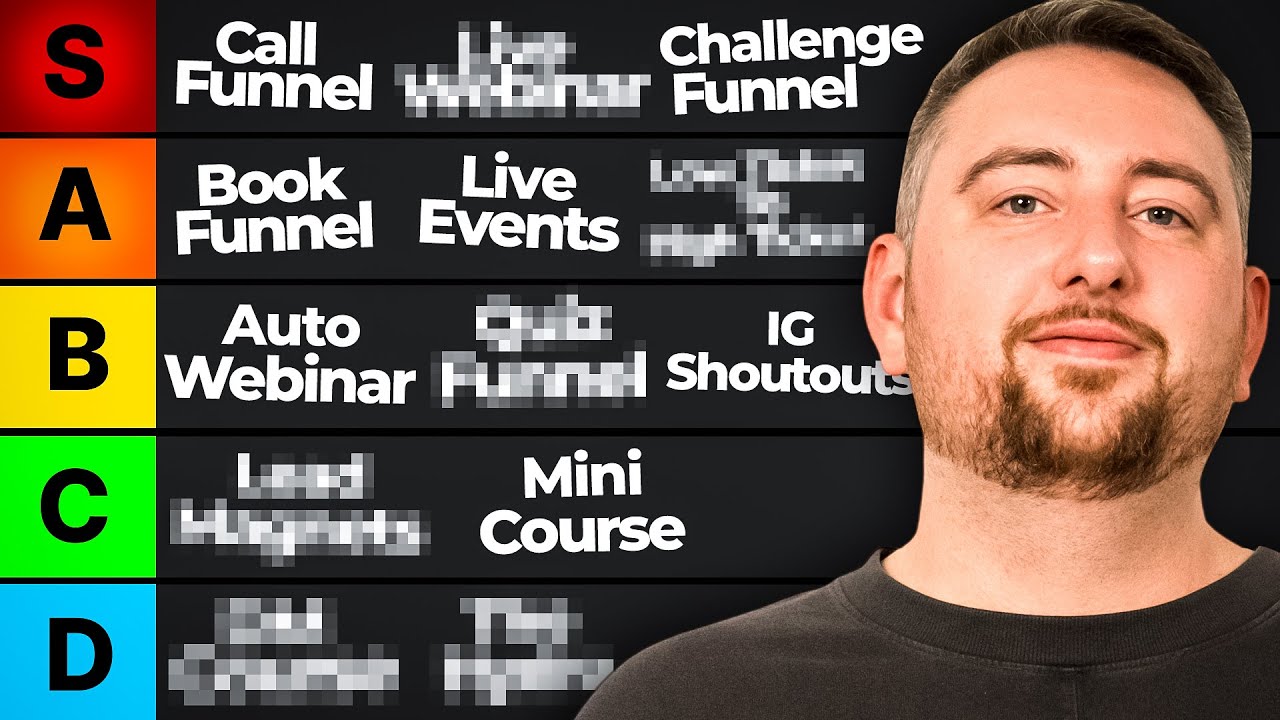
The S tier funnels are call funnels, live webinars, and challenge funnels. These three dominate million dollar months.
A tier includes book funnels, live events, low ticket to high ticket, and DM ads. Strong performers with specific limitations.
B tier covers auto webinars, quiz funnels, IG shoutouts, and the Hydra. They work but for fewer businesses or have hard ceilings.
C tier is lead magnets and mini courses. Mostly dead strategies that rarely work in high ticket anymore.
Focus on S tier first. Then A tier. Everything else is situational at best.
What I can teach you isn’t theory. It’s the exact playbook my team has used to build multi-million-dollar businesses. With Master Internet Marketing, you get lifetime access to live cohorts, dozens of SOPs, and an 80+ question certification exam to prove you know your stuff.
Watch the video:
Get my content first on Google
Add jeremyhaynes.com as a preferred source and Google shows my articles more prominently in your search results, including AI Overviews and AI Mode.


Jeremy Haynes
Owner and CEO of Megalodon Marketing
Jeremy Haynes is the founder of Megalodon Marketing. He is considered one of the top digital marketers and has the results to back it up.