Value Based Pricing Strategy and Proof Framework for Premium Offers

I hope you enjoy reading this blog post. If you want my team to just do your marketing for you, click here.
Author: Jeremy Haynes | Published October 17, 2025
Earnings Disclaimer: You have a .1% probability of hitting million-dollar months according to the US Bureau of Labor Statistics. As stated by law, we can not and do not make any guarantees about your own ability to get results or earn any money with our ideas, information, programs, or strategies. We don’t know you, and besides, your results in life are up to you. We’re here to help by giving you our greatest strategies to move you forward, faster. However, nothing on this page or any of our websites or emails is a promise or guarantee of future earnings. Any financial numbers referenced here, or on any of our sites or emails, are simply estimates or projections or past results, and should not be considered exact, actual, or as a promise of potential earnings – all numbers are illustrative only.
Most people price their offers wrong from the start.
They look at what everyone else is charging. They pick a number that feels “reasonable.” They worry about being too expensive. They convince themselves that a lower price will get them more customers.
And then they wonder why they’re working harder than ever but barely staying profitable.
What nobody tells you about pricing: the number you choose matters way less than how you defend that number.
You can charge $500, $5,000, or $50,000 for essentially the same transformation. And all three price points can work. The difference isn’t the number itself.
It’s whether you can back up that number with proof.
I’ve worked with clients who’ve 10x’d their prices and actually increased their conversion rates. Not because they changed their offer. But because they finally started pricing for profit and defending that price with undeniable proof.
If your business is already generating $100k+ per month, My Inner Circle is where you break through to the next level. Inside, I’ll help you identify and solve the bottlenecks holding you back so you can scale faster and with more clarity.
Now, let me show you how this works.
Common Pricing Mistakes and Why Cost Plus Pricing Fails
Start with why most people get this wrong.
They start with the cost of delivering the thing. They add up their time, their expenses, maybe a little margin. And that’s their price.
Or they look at competitors. “Oh, everyone else is charging $2,000. I should probably charge $1,800 to be competitive.”
Both of these approaches are backwards.
Cost-plus pricing doesn’t account for the value you’re creating. It doesn’t account for the transformation you’re delivering. It just accounts for what it costs you to show up.
And competitor-based pricing is even worse because you’re letting other people’s pricing decisions dictate your business model. You have no idea if they’re profitable. You have no idea if they’re struggling. You’re just following them off a cliff.
The right way to price is to start with profit.
What do you need to make per customer to hit your revenue goals? What margin do you need to reinvest in growth? What do you need to pay yourself and your team?
Work backwards from there.
If you need to make $100K a month and you can serve 20 clients, you need $5K per client. That’s your starting point.
Not what it costs you. Not what others charge. What you need to make.
Then the question becomes: can you defend that price?
Four Levels of Proof Required for High Ticket Pricing
High prices require high proof.
If you’re charging $500, people don’t need much convincing. It’s an impulse buy. It’s low risk. They’ll take a chance.
If you’re charging $5,000, you need proof. Real proof. Not testimonials from your cousin. Not vague promises. Actual documented results from real people who’ve paid you money and gotten outcomes.
If you’re charging $50,000, you need bulletproof proof. Case studies. Data. Before-and-afters that are so undeniable that the buying decision becomes obvious.
The higher the price, the higher the burden of proof.
Most people try to increase their prices without increasing their proof. And then they wonder why conversion rates tank.
You can’t do that.
You have to build the proof infrastructure that supports your price. And that infrastructure has four levels.
Level 1: Social Proof
This is testimonials. Reviews. “Hey, this person worked with us and they loved it.”
It’s the baseline. Everyone should have this. But it’s also the weakest form of proof because it’s entirely subjective.
“Jeremy’s great!” Cool. But what does that actually mean? What result did you get?
Social proof is necessary but not sufficient for high prices.
Level 2: Result Proof
This is where you start showing actual outcomes. Numbers. Metrics. Before-and-afters.
“We took this client from $10K a month to $100K a month in 90 days.”
“We helped this company cut their CAC by 60%.”
“This person lost 40 pounds in 12 weeks.”
Result proof is way more powerful than social proof because it’s specific. It’s measurable. It’s real.
This is the minimum you need to charge premium prices.
Level 3: Process Proof
This is where you show how you get those results. The methodology. The system. The framework.
“Our exact 8-week process for scaling Facebook ads from $1K/day to $50K/day.”
“The nutrition protocol that got these results.”
“The team structure we implement that lets businesses scale past seven figures.”
Process proof does two things. It makes the results feel more believable because you’re showing the mechanism. And it makes you seem more credible because you have a system, not just random tactics.
This is what separates you from everyone else at your price point.
Level 4: Prediction Proof
This is the highest level. This is where you can accurately predict outcomes before they happen.
“Based on your current numbers, here’s exactly what you’ll do in 90 days if you work with us.”
“Your month-by-month growth trajectory.”
“How long it will take you to hit your goal.”
When you can do this accurately, price becomes almost irrelevant. Because you’re not asking people to take a risk. You’re showing them exactly what they’re buying.
Very few people operate at this level. But when you do, you can charge literally whatever you want.
Step by Step Process to Document and Build Proof Infrastructure
So how do you actually build this proof infrastructure?
You can’t fake it. You can’t manufacture it out of thin air. You have to earn it.
The path:
Step 1: Start documenting everything
Right now, today, start tracking results for every single customer.
What were their metrics when they started? What are their metrics now? What specific outcomes have they achieved?
Don’t rely on memory. Don’t rely on testimonials. Track the actual numbers.
If you’re running a service business, this might be their revenue, their traffic, their conversion rates, their cost per acquisition.
If you’re in health and fitness, it’s their weight, their body fat percentage, their strength metrics, their blood work.
If you’re in relationships or personal development, it’s harder to quantify, but you can still track tangible outcomes. Number of dates, quality of communication scores, self-reported happiness on a scale.
The point is to have data. Real data.
Most people don’t do this. They deliver great results but they never document them. So when it’s time to sell, they have nothing to show.
Don’t be that person.
Step 2: Build case studies systematically
Once you have data, turn it into case studies.
A good case study has a simple structure:
- Where the client was before (with specific numbers)
- What you did together (your process)
- Where they are now (with specific numbers)
- What made the difference (key insights or turning points)
You should be creating at least one detailed case study per month. More if you can.
These become your sales ammunition. You use them in your ads. You use them on sales calls. You use them in your content.
Every case study you create increases the defensibility of your price.
Step 3: Systematize your process
Once you’ve delivered results multiple times, you should start to see patterns.
What steps do you always take? What sequence works best? What elements are non-negotiable?
Document this. Turn it into a framework. Give it a name.
This is your intellectual property. This is what makes you different from everyone else doing something similar.
When someone asks “Why should I pay you $10K instead of the other guy charging $2K?” you can point to your framework. Your system. Your methodology that has a proven track record.
This isn’t about being better than everyone else. It’s about being specific. It’s about having a defined process that you can point to and say “This is how we get results.”
Step 4: Build your prediction model
This is advanced. Most people never get here. But if you want to charge top-tier prices, this is the move.
Once you’ve worked with enough clients and tracked enough data, you start to see predictive patterns.
“Okay, when someone comes in at X revenue with Y% margins and Z cost per acquisition, if we implement our process, here’s where they’ll be in 90 days.”
You won’t be perfect. But you can get pretty close.
I have clients where I can look at their ad account, their funnel metrics, and their current spend levels, and I can tell them within about 10% accuracy what they’ll do in revenue over the next 60 days if they follow my strategy.
That level of predictability is incredibly powerful. Because now I’m not selling hope. I’m selling a forecast.
And people will pay a premium for certainty.
Pricing Psychology Principles That Increase Perceived Value
Let me hit you with some pricing psychology that actually matters.
Higher prices increase perceived value. Research shows that consumers often perceive higher-priced products as better quality, even when products are identical.
This is real. It’s been studied to death. People literally assume that higher-priced things are better quality, even when they’re identical to lower-priced alternatives.
If you have two identical programs and one costs $1,000 and the other costs $10,000, people will assume the $10,000 one is better. They’ll invent reasons why it’s better. They’ll look for justifications.
This works in your favor if you have the proof to back it up.
But it works against you if you’re overpriced relative to your proof. Then people feel scammed.
Price anchoring is everything. Research demonstrates that presenting a higher-priced option first significantly influences how consumers perceive subsequent pricing options.
The way you present your price matters as much as the price itself.
If you say “This program is $5,000,” that’s one thing.
If you say “This program is $5,000, which is less than what you’ll make back in the first month based on our average client results,” that’s completely different.
If you say “This program is normally $10,000, but for this cohort it’s $5,000,” that’s different again.
You’re anchoring their perception of value. You’re giving them context for the number.
Never present a price in isolation. Always anchor it to something.
Payment terms affect conversion more than price. Studies show that offering payment plans can dramatically increase conversion rates even when the total price is higher.
This is huge and most people miss it.
Someone who won’t pay $6,000 upfront will often pay $500/month for 12 months. That’s the same money. Actually, it’s more money. But it converts better.
Why? Because the friction point isn’t the total price. It’s the immediate financial impact.
If someone has $10K in their bank account and you’re asking for $6K, that feels risky. They’re giving you more than half their cash on hand.
But $500 a month? That’s probably less than their car payment. It feels manageable.
I’ve seen conversion rates double just by offering payment plans, even when the total price goes up by 20-30% to account for the payment plan.
Don’t leave money on the table by only offering pay-in-full.
How to Handle Price Objections Using Proof and Case Studies
Let me walk you through what happens on an actual sales call when price comes up.
Most people get scared when they say the number. They rush through it. They apologize for it. They immediately start offering discounts before the person even objects.
That’s the fastest way to destroy your price integrity.
Here’s how you should handle it.
You present the investment. You say the number clearly and confidently. Then you shut up.
Whoever speaks first loses.
Let them sit with it. Let them think about it. Don’t fill the silence.
If they immediately say yes, great. Close the deal.
If they hesitate or object, that’s when you deploy your proof.
“I get it. It’s a significant investment. Let me show you why this makes sense.”
Then you walk them through a case study. You show them the numbers. You show them someone who was in their exact position, paid this price, and got this result.
“Sarah was doing $15K a month when she started, just like you. She invested $10K to work with us. Within 90 days, she was at $75K a month. Within six months, she crossed $150K. The ROI on that investment was over 10x.”
You’re not arguing. You’re not defending. You’re just showing proof.
If you have enough proof, the price objection dissolves. Because now it’s not about whether they can afford it. It’s about whether they can afford not to do it.
If they still push back, you can ask: “What would need to be true for this to be an obvious yes for you?”
Let them tell you. Then show them proof of exactly that thing happening for someone else.
Most price objections aren’t real price objections. They’re confidence objections. They’re “I’m not sure this will work for me” objections.
Proof solves that.
Strategic Pricing Increases Based on Growing Proof Stack
You should be increasing your prices regularly.
Not arbitrarily. Not just because you feel like it. But systematically, as your proof stack grows.
Every time you get a significant result, that’s an opportunity to increase your prices.
Every time you add a new case study, you can charge more.
Every time you refine your process and improve your outcomes, you can charge more.
I have clients who’ve gone from charging $2K to charging $25K for essentially the same offer. Not because they changed what they deliver. But because they built such an overwhelming proof stack that the higher price became defensible.
The progression usually looks like this:
You start at whatever price you can sell. Maybe that’s $500, maybe it’s $2K. You’re building proof at this stage.
Once you have 10 solid results, you increase by 50-100%. Now you’re at $1K-$4K. You’re still building proof, but you’re also starting to filter for better clients.
Once you have 20-30 results and a few exceptional case studies, you increase again. Now you’re at $5K-$10K. You’re in premium territory. Your proof needs to be tight.
Once you have 50+ results, a systematic process, and predictable outcomes, you can charge whatever the market will bear. $20K, $50K, $100K+.
At that point, it’s not about the price. It’s about whether you’re the right fit and whether they trust you.
The key is to increase prices as your proof grows, not before. If you try to charge premium prices with weak proof, you’ll struggle. But if you have overwhelming proof and you’re still charging entry-level prices, you’re leaving massive amounts of money on the table.
Why Discounting Destroys Business and How to Handle Requests
Let me be clear about something. Discounting destroys your business.
Not just because you make less money per customer. But because of what it signals.
When you discount, you’re telling the customer that your price wasn’t real. You’re telling them that you don’t believe in your own value. You’re training them to always ask for discounts.
And worse, you’re attracting the wrong customers. The ones who only care about price. The ones who will be the most difficult to work with. The ones who won’t get results because they’re not invested.
I have a hard rule: I don’t discount. Ever.
If someone can’t afford the investment, that’s fine. We’re not a good fit right now. Maybe we will be in the future when they’re in a better financial position.
But I’m not going to undermine my pricing structure and my proof by offering discounts.
The exception is payment plans. I’ll offer flexible payment terms. I’ll make it easier to say yes. But the total investment stays the same or goes up.
If you have enough proof, you don’t need to discount. The value is obvious. The ROI is clear. The price is justified.
If you don’t have enough proof, discounting won’t help. Because the problem isn’t the price. It’s that they don’t believe it will work.
Build more proof. Don’t lower your price.
Creating Positive Pricing Cycles Through Better Client Results
What’s beautiful about this approach:
When you price for profit and defend it with proof, you enter a positive feedback loop.
Higher prices mean you need fewer clients to hit your revenue goals. Fewer clients means you can deliver better results. Better results means better proof. Better proof means you can charge even higher prices.
It’s a virtuous cycle.
Most people are stuck in the opposite cycle. Low prices mean they need tons of clients. Tons of clients means diluted attention. Diluted attention means worse results. Worse results means weak proof. Weak proof means they can’t raise prices.
It’s a race to the bottom.
The only way out is to break the cycle. Price higher. Serve fewer people. Deliver exceptional results. Document everything. Build overwhelming proof.
Then do it again at an even higher price point.
Four Week Action Plan to Implement Profit Based Pricing
If you’re reading this and realizing you’ve been underpricing, do this:
This week, calculate your profit-based price. What do you actually need to charge per customer to hit your goals? Be honest. Don’t lowball it.
Next week, audit your proof. What results have you delivered? What documentation do you have? What case studies can you build?
If your proof is weak, don’t increase prices yet. Focus on documenting the results you’re getting with current clients. Build case studies. Create your process framework.
Once you have at least 5-10 solid results documented, increase your price by 50% for all new clients.
Yes, 50%. Not 10%. Not 20%. Fifty percent minimum.
Use your new proof to defend that price. Show the results. Show the process. Show the ROI.
Some people won’t buy. That’s fine. The ones who do will be better clients, and you’ll make more money with less work.
Then rinse and repeat every quarter. More results. More proof. Higher prices.
Within a year, you can easily 5-10x your prices if you’re systematic about building proof.
But you have to start. You have to make the decision to price for profit and commit to building the proof that defends it.
Because at the end of the day, you’re not doing anyone favors by undercharging. You’re just making it harder to deliver great results and stay in business.
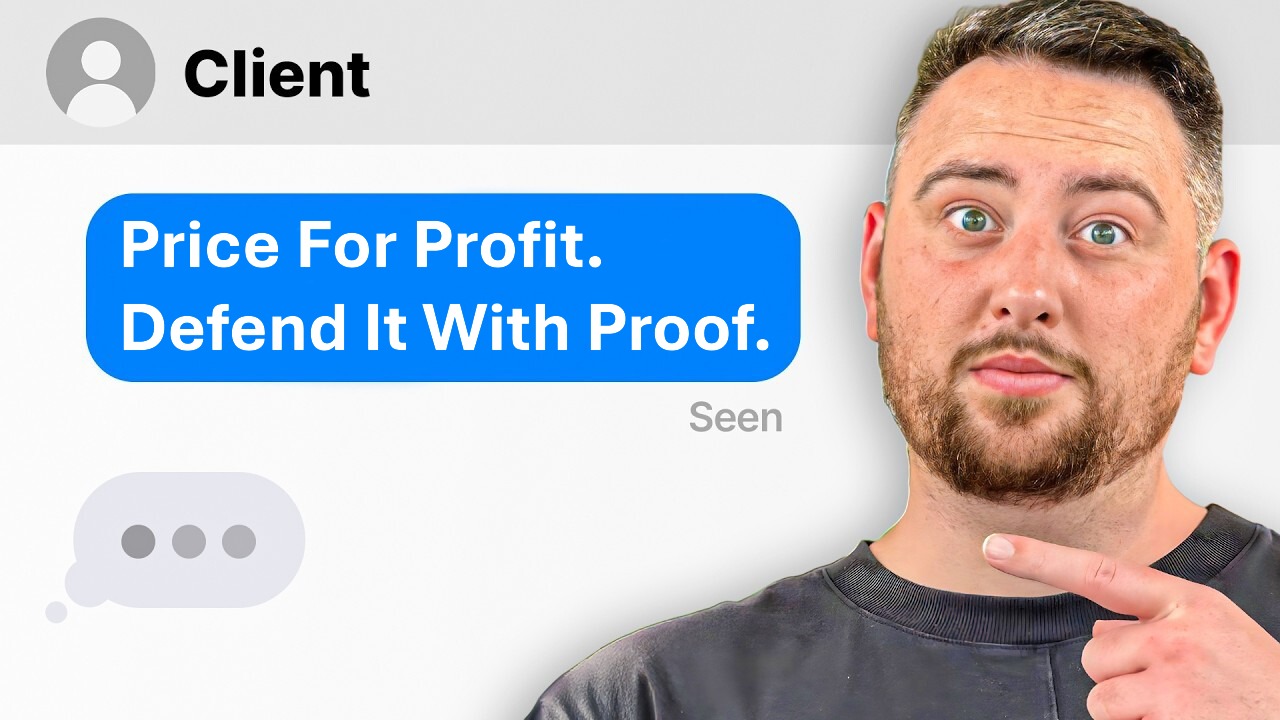
Price for profit. Build undeniable proof. Then charge what you’re worth.
But before I let you go, most business owners waste years figuring out what actually works. In my Master Internet Marketing program, I compress that learning curve into 7 weeks, covering copywriting, funnels, ads, and more. If you’re ready to invest $5k and get serious about your skills, apply here.
Now go audit your pricing and proof stack. You’ve got work to do.
Get my content first on Google
Add jeremyhaynes.com as a preferred source and Google shows my articles more prominently in your search results, including AI Overviews and AI Mode.


Jeremy Haynes
Owner and CEO of Megalodon Marketing
Jeremy Haynes is the founder of Megalodon Marketing. He is considered one of the top digital marketers and has the results to back it up.