How to Batch Film Ad Creative Without Leaving Gaps in the Edit

I hope you enjoy reading this blog post. If you want my team to just do your marketing for you, click here.
Author: Jeremy Haynes | Published September 30, 2026
Earnings Disclaimer: You have a .1% probability of hitting million-dollar months according to the US Bureau of Labor Statistics. As stated by law, we cannot and do not make any guarantees about your own ability to get results or earn any money with our ideas, information, programs, or strategies. We don’t know you, and your results in life are up to you. We’re here to help by giving you our greatest strategies to move you forward, faster. However, nothing on this page or any of our websites or emails is a promise or guarantee of future earnings. Any financial numbers referenced here, or on any of our sites or emails, are simply estimates or projections or past results, and should not be considered exact, actual, or as a promise of potential earnings – all numbers are illustrative only.
Batch filming ad creative should give your editor enough material to build the ads you actually need. Filling a drive with footage is easy to count, but it tells you very little about what can run. Before you book a shoot day, decide which buyer questions the ads must answer and which shots those answers need. Then organize the filming around those requirements, rather than hoping a long recording session will somehow cover the month.
I care more about whether an ad makes sense than whether the production calendar looks full. A clear opening needs an explanation that follows it. A demonstration needs the footage that makes it believable. If the editor has to invent the connection, the shoot left something out.
A single day can be a useful production window. It isn’t a promise of a month’s worth of effective advertising. Your offer, the ideas ready to film, and what you learn after launch should decide how long that material stays useful.
Already making money? See what it takes to make a lot more.
Plan the Ads Before You Plan the Shoot
Start with the message you want a buyer to understand. Leave the camera choice until later.
Take an objection your sales team already hears. Work out what the ad would need to explain for that objection to make sense to someone new. Then identify what the viewer should see while you explain it. That gives the production team something specific to prepare.
A line about how your service works might need a demonstration. A line about who the offer suits might work better as a direct explanation. Those are different filming needs, even when both ads lead to the same page.
My article on writing marketing messages around the buyer covers that message-first decision. Don’t substitute whatever sounds impressive in a script for the concern the buyer actually has.
Before adding an idea to the shoot, explain how it differs from the others. A different opening sentence may be a useful variation. It doesn’t automatically make the underlying argument different.
Keep ideas that still need research out of the committed shot list. You can save them for later without forcing the presenter to improvise an answer on camera. Filming a confident explanation of something the business hasn’t decided creates work for everyone afterward.
This is also where you check the offer itself. The person speaking, the script, and the destination page should describe the same scope. If the offer changes before launch, some footage may need another pass. Recording it in a batch doesn’t protect it from becoming outdated.
Build the Shot List Around Complete Ads
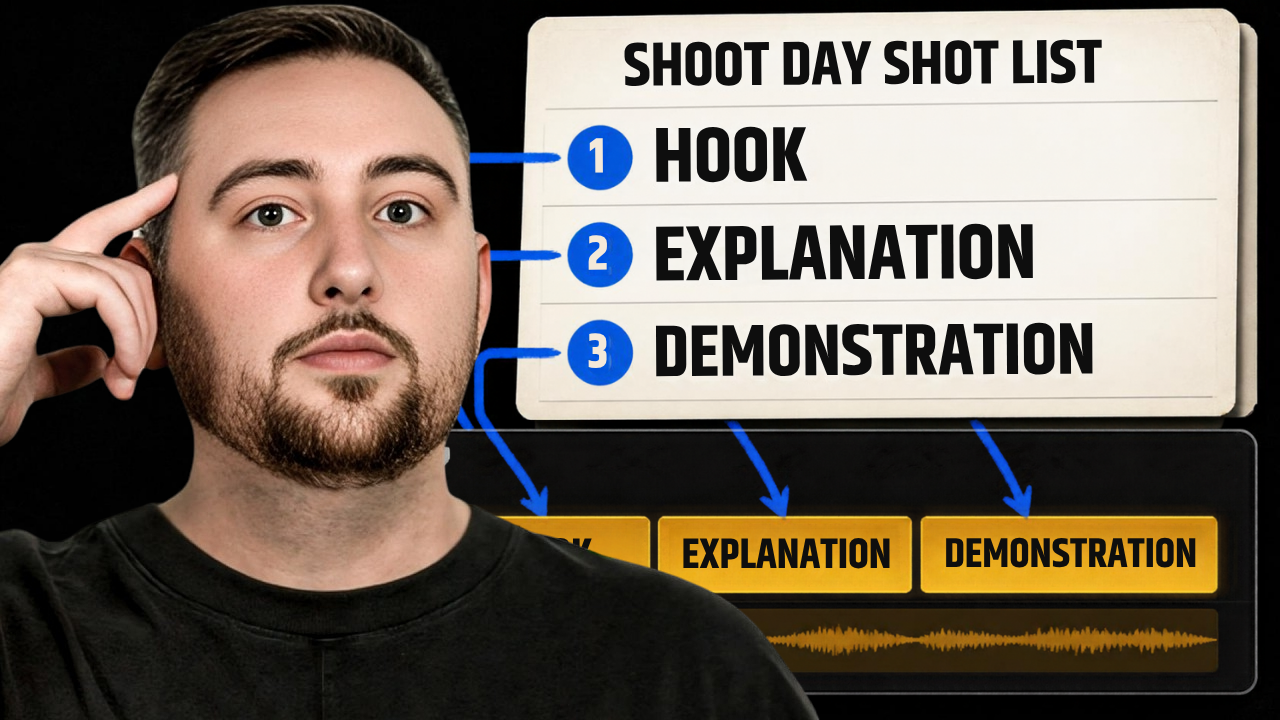
A hook list isn’t a shot list. The opener may earn attention, but the rest of the footage has to carry the argument.
Read an intended ad from beginning to end. Mark where the viewer needs to see something other than the presenter talking. If the script refers to a document, a process, or a product feature, decide whether that material needs to appear on screen.
Don’t assume the editor can find a suitable substitute later. A generic laptop clip doesn’t show how your service works. It might cover an edit, but it won’t supply an explanation you never recorded.
Adobe’s shot-list guide distinguishes coverage from simply recording the scene. Use that distinction when you prepare an ad shoot. The question is whether you captured the pieces needed to assemble the message.
Keep the list readable on set. Separate what must be captured from an optional visual idea. Otherwise, a complicated extra shot can absorb the attention that belongs to the main explanation.
Send the planned material to the editor before filming. Ask where the intended edit would need another angle, a clearer demonstration, or a clean transition. That conversation belongs before the location is packed away.
Don’t turn this into a massive production document for a simple talking-head ad. The level of planning should match the job. A clear explanation with a short list of supporting shots can be enough. What matters is that somebody has thought through the finished ad.
A Shared Setup Can Still Serve Different Ad Ideas
Once you know what the ads need, group the footage by setup. Capture the material that belongs at the desk while the desk is ready. Handle the demonstration when its equipment and screen are available.
The filming order doesn’t need to match the order in which the viewer sees the clips. Keep a clear reference to the intended ad so changing the schedule doesn’t scramble the message.
There is a useful distinction between reusing a setup and repeating an idea. You can explain different buyer concerns from the same chair. Changing shirts while repeating the same argument does not create a new concept.
My breakdown of creative families and ad variations separates the main concept from the elements you change within it. Use that distinction to label what you’re filming. The person reviewing results should know whether an asset tests a new argument or another execution of an existing one.
Don’t add location changes just to make the session feel more ambitious. A location should help communicate something or give you a useful visual treatment. Otherwise, you’re spending shoot time on variety you haven’t connected to a test.
The same goes for polish. My article on raw and polished ad creative addresses the choice of presentation. An expensive-looking production is not the objective of this shoot. Make the message easy to understand, and choose a treatment that suits it.
Modular Hooks Need a Matching Explanation
Modular footage gives the editor options, provided those options belong together. Don’t record unrelated opening lines and assume they can all sit in front of the same body.
If the hook raises a concern about implementation, the next line needs to address implementation. Jumping straight into a price argument leaves the opening unanswered. Both clips might sound good by themselves and still make a confusing ad together.
Read the opening and the beginning of the body aloud as a pair. Listen for repeated words, unexplained references, and sudden changes in subject. Fix the connection while the presenter is there.
Record a complete version of the argument before treating it as interchangeable parts. That gives the editor a clear reference for the intended flow. Additional hooks should remain attached to the explanations they actually introduce.
TikTok’s creative guidance treats the opening, selling points, and call to action as parts of the ad’s structure. Apply that at the script stage. It isn’t enough to make the beginning attention-grabbing if the rest of the ad doesn’t follow through.
The ending needs the same attention. Tell viewers what happens next using the actual destination. An invitation to watch a training and an invitation to apply are different actions. Don’t leave the editor choosing between them without knowing where the ad will send people.
For broader marketing education, explore Master Internet Marketing, my 7-week live comprehensive training.
Results are not typical. Your results will vary and depend entirely on your individual capacity, business experience, expertise, and level of desire. There are no guarantees concerning the level of success you may experience. The testimonials and examples used are not intended to represent or guarantee that anyone will achieve the same or similar results. We don’t believe in get-rich-quick programs. We believe in hard work, adding value and serving others. As stated by law, we can not and do not make any guarantees about your own ability to get results or earn any money with our information, courses, programs, or strategies.
Get the Supporting Footage While You Are There
The missing clip often sounds small when somebody asks for it afterward. A closer view of the screen. The presenter holding the material they mentioned. The action before the result.
Those details deserve a place on the shoot list, especially when recording them later would require rebuilding the setup. Keep checking the script against what the camera has actually captured.
Adobe describes B-roll as footage that supplements the main material, including shots that help explain a scene or smooth a transition. For an ad, use supporting footage to clarify the point being made. It shouldn’t be a collection of attractive images that have nothing to do with the message.
When filming a screen, check what the audience will be able to read in the intended format. When filming a demonstration, make sure the action you are explaining is visible. Review the captured clip rather than assuming the camera saw what you saw in person.
Also check permission to use what appears in the frame. Keep private client details and unapproved results out of the footage. Don’t ask the editor to turn a screen recording into proof of a claim the business cannot substantiate.
Sound deserves a check before you repeat the entire script. Listen to a recorded sample, not just the presenter in the room. Look at framing and the space needed for captions too. A good performance shouldn’t reach the edit with an avoidable recording problem.
Capture another take when something important is unclear. There is no reason to record every line repeatedly once you have what you need. Spend that attention on the missing explanation or supporting shot instead.
Hand Off the Message Along With the Files
The editor shouldn’t have to guess which footage belongs together. Keep the clips tied to the concept, the intended opening, and the action at the end.
Include the approved wording where a claim needs to stay precise. Identify anything still awaiting approval so it cannot quietly become a finished ad. If a take contains a mistake, mark it instead of relying on somebody to notice.
You don’t need an elaborate naming system to make that handoff useful. You need a system the person doing the work understands. A file name that points to the right concept is more helpful than a clever abbreviation nobody remembers.
Keep unused takes available, but distinguish them from the preferred material. An alternate delivery can help during the edit. It shouldn’t force the editor to watch every clip just to discover which version the team selected.
Tell the editor where each ad is intended to run. My article on connecting TikTok creative to the next step covers why the ad and its destination need to work together. Production handoff should preserve that connection.
Ask to see an assembled cut before the whole batch moves through finishing. You’re looking for missing context and awkward joins, not just colors and captions. If the complete ad exposes a gap, deal with that before reproducing the same gap across the rest of the footage.
7 weeks. Real frameworks. Covering copywriting, funnels, paid ads, and conversion systems.
The Next Batch Should Reflect What You Learn
Finishing the shoot doesn’t tell you how the ads will perform. It tells you the material is available for editing and testing.
Don’t turn the calendar into a commitment to run everything you filmed. Some ideas may need another edit. Others may become less relevant as you learn more about the buyer or change the offer.
Keep a record of what the editor had to request afterward. Missing demonstrations, unclear endings, and disconnected hooks are useful feedback for the next shoot. They tell you where preparation fell short without turning the review into a debate about who worked hardest.
Separate that production feedback from advertising results. A clean handoff can produce an ad that doesn’t persuade. A promising message can arrive in footage that still needs work. Those situations call for different changes.
For business discussions with other operators, explore my closed-door mastermind, Inner Circle.
Results are not typical. Your results will vary and depend entirely on your individual capacity, business experience, expertise, and level of desire. There are no guarantees concerning the level of success you may experience. The testimonials and examples used are not intended to represent or guarantee that anyone will achieve the same or similar results. We don’t believe in get-rich-quick programs. We believe in hard work, adding value and serving others. As stated by law, we can not and do not make any guarantees about your own ability to get results or earn any money with our information, courses, programs, or strategies.
Before booking another filming day, look at the next ads you need to make and the material you already have. You might need a new argument, a better demonstration, or a short pickup rather than another large shoot.
The useful measure of a batch is what your team can build from it. Plan for complete messages, capture the footage those messages need, and leave yourself room to respond to what you learn.
Get my content first on Google
Add jeremyhaynes.com as a preferred source and Google shows my articles more prominently in your search results, including AI Overviews and AI Mode.

Jeremy Haynes
Owner and CEO of Megalodon Marketing
Jeremy Haynes is the founder of Megalodon Marketing. He is considered one of the top digital marketers and has the results to back it up.