Why Raw Ads Consistently Beat Polished Video for High-Ticket Offers
I hope you enjoy reading this blog post. If you want my team to just do your marketing for you, click here.
Author: Jeremy Haynes | Published July 1, 2026
Earnings Disclaimer: You have a .1% probability of hitting million-dollar months according to the US Bureau of Labor Statistics. As stated by law, we can not and do not make any guarantees about your own ability to get results or earn any money with our ideas, information, programs, or strategies. We don’t know you, and besides, your results in life are up to you. We’re here to help by giving you our greatest strategies to move you forward, faster. However, nothing on this page or any of our websites or emails is a promise or guarantee of future earnings. Any financial numbers referenced here, or on any of our sites or emails, are simply estimates or projections or past results, and should not be considered exact, actual, or as a promise of potential earnings – all numbers are illustrative only.
Most people selling high-ticket offers have this completely backwards.
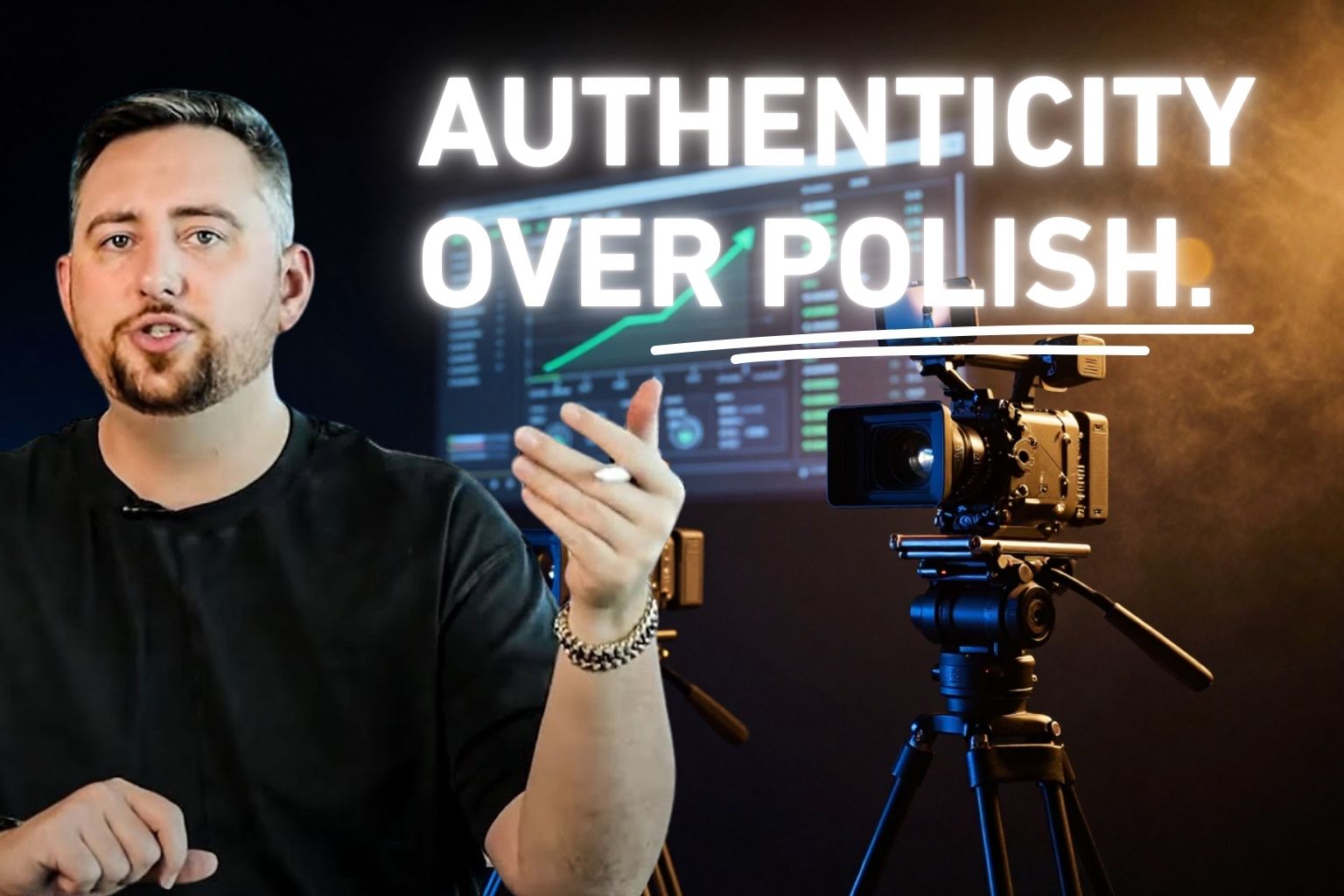
They think their ads need to look expensive because their offer is expensive. So they drop thousands on a polished video production, wait weeks for the final cut, launch it with a prayer, and watch it underperform against some scrappy iPhone selfie video someone threw together in ten minutes.
The more sophisticated your buyer, the less they trust a polished ad. That’s the part most people never work out. A high-ticket buyer has sat through more sales pitches than you have. They’ve been burned by slick marketing before. When something looks like a commercial, their guard goes up before you’ve said a word.
I’ve watched this pattern play out dozens of times with businesses I’ve worked with. The instinct is always to spend more to look more credible. The data says the opposite works better.
If you want to go deeper on building systematic approaches to client acquisition, Master Internet Marketing, our 7-week live comprehensive training, covers the foundational frameworks for this type of testing infrastructure.
Results are not typical. Your results will vary and depend entirely on your individual capacity, business experience, expertise, and level of desire. There are no guarantees concerning the level of success you may experience. The testimonials and examples used are not intended to represent or guarantee that anyone will achieve the same or similar results. We don’t believe in get-rich-quick programs. We believe in hard work, adding value, and serving others. As stated by law, we can not and do not make any guarantees about your own ability to get results or earn any money with our information, courses, programs, or strategies.
7 weeks. Real frameworks. Covering copywriting, funnels, paid ads, and conversion systems.
Why Sophistication Works Against Polish, Not For It
The psychology most media buyers get backwards is this: they assume a bigger purchase decision means the buyer needs more reassurance through production value. It’s the opposite. A bigger purchase decision means the buyer needs more reassurance through trust. Trust does not come from a slicker edit.
Nielsen’s research on high-consideration purchases found that in categories where the buying decision takes longer than a week, most consumers are still hesitant to try something new, even when the offer looks credible. Trying something new is a risk, and buyers actively look for signals that reduce that risk. A polished, corporate-feeling ad reads as a company trying to look good. A raw, direct-to-camera ad reads as a person willing to be seen without the armor. One of those signals is far more disarming to someone who’s used to being sold to.
Pattern interrupt matters too. Polished ads look like ads. Your brain has been trained to scroll past them without registering the content. Raw creatives look like organic content someone just posted, which means they don’t trigger the same instant ad-blindness.
Speed is the other half of the equation nobody talks about. You can produce twenty to fifty tiny creatives in the time it takes to produce one polished video. That’s exponentially more data, more tests, and faster learning. Lower production costs also mean more of your budget goes to actual media spend instead of production overhead, and platforms like Meta, YouTube, and TikTok all favor fresh creative. The algorithm wants new content constantly, and raw formats let you feed that without burning out your team.
Where Creative Actually Sits in a High-Ticket Funnel
Before the testing framework, you need to understand what job the creative is actually doing.
The typical flow is cold traffic ad, then a landing page, VSL, webinar, or application page, then a call booking, then the sales conversation, then the close. Your creative’s job is not to sell the offer. Its job is to sell the click. Get the right person to take the next step.
This is fundamentally different from ecommerce, where you’re driving impulse purchases. In high ticket, you’re starting a conversation with someone who has the capacity and intent to invest significantly. That means qualification matters more than volume. Your creative should actively repel unqualified prospects while attracting qualified ones. A creative that generates leads of people who can’t afford your offer is worse than a creative that generates fewer leads of people who can.
The Two-Campaign Structure That Separates Testing From Scaling
You need two separate campaign structures: one for testing, one for scaling.
The testing campaign is where new creatives prove themselves. I typically recommend an ABO structure so each creative gets equal spend and you’re isolating the variable to just the creative itself. Small daily budgets, broad or proven audiences, because you’re not testing audiences here: you’re testing creative. Each ad set should contain one creative for true isolation. Some people run three to five creatives per ad set to move faster, but you lose precision doing it that way.
The scaling campaign is CBO with higher budgets. Only creatives that pass your testing thresholds get moved here.
Most people mess this up because they don’t have clear kill criteria. They let ads run too long hoping they’ll improve, or they kill winners too early because they don’t understand the metrics that actually matter.
For high-ticket offers specifically, monitor hook rate on video (three-second views divided by impressions), click-through rate on the link, cost per click, cost per lead, and cost per booked call. If you’re getting leads that don’t book calls, or your cost per booked call runs well above target after enough spend, either kill the creative or iterate on the landing page and follow-up sequence instead. Spend enough to get statistically meaningful data, but not so much that you’re burning money on an obvious loser. The specific budget thresholds shift depending on your daily spend, but the principle doesn’t: make decisions fast.
Turning One Raw Winner Into a Family of Ten
When you find a winner, don’t just scale it. Dissect it.
Ask what specific element is winning. The hook? The body copy? The CTA? The visual style? The angle? Then create five to ten variations changing one thing at a time: same hook with a different body, same body with a different hook, same script delivered by a different person, same concept in a different format, same ad with a different thumbnail.
This is how one winning raw ad becomes a family of ten to twenty winning variations, the multiplication system that actually sustains scale. Most people find one winner and try to scale it until it dies, then scramble for the next one. That is not a system. That is gambling.
Formats that consistently work for high ticket, ranked roughly by ease of production: screenshot or DM-style ads, text-on-image static ads, meme-style ads adapted to your niche, selfie-style talking head filmed on iPhone with no editing, screen recordings with voiceover, client testimonial clips pulled from Zoom calls, carousel ads, and intentionally “ugly” formats (rough text, hand-drawn elements, anti-design as a pattern interrupt). For a serious operation, that’s a minimum of five to ten new creatives per week, with twenty to thirty-plus per week for an aggressive pace. That sounds like a lot until you realize a single person can produce ten or more raw creatives in a day.
The hook is the highest-leverage element in any of these formats: the first one to three seconds of video or the headline of a static ad. Build a running hook bank organized by angle: contrarian, result and proof, question, pain agitation, curiosity gap, identity. Test five to ten hooks on the same body content. Often the hook alone is the difference between dramatically different cost-per-lead numbers.
Where to Pull Endless Raw Ad Ideas From
You do not invent these from scratch. You extract them from reality.
Sales call recordings tell you which objections come up repeatedly and what language prospects actually use. That’s your ad copy, verbatim. Client testimonials and case studies tell you which specific results resonate and what transformation language people reach for. Competitor ads in the Meta Ad Library or TikTok Creative Center show you which angles are being tested in your space, not to copy, but to study. Reddit, YouTube comments, and community forums surface the exact questions people are asking. And your own high-engagement content (a LinkedIn post or email that got a big response) can be turned into five ad variations on its own.
Organize everything into angle categories: pain-based, aspiration-based, logic-based, fear-based, curiosity-based, proof-based. Each angle can spawn five to ten creatives across different formats. You will never run out.
Scaling Winners Without Killing Them
Two approaches to scaling a proven winner. Vertical scaling increases budget on the winning ad set or campaign gradually (do not double budget overnight, since that resets the algorithm’s learning phase and usually tanks performance). Horizontal scaling duplicates the winning creative into new contexts: new ad sets with different audiences, a fresh campaign ID (which can get better delivery), new placements moving from Feed to Reels or Stories, and new platforms moving from Meta to YouTube Shorts or TikTok.
Every creative has a lifespan. Data from AdEspresso shows ad fatigue produces a 35% decrease in click-through rate and a 20% increase in cost per click once frequency climbs too high. On cold traffic specifically, watch frequency closely. Once it exceeds a certain threshold, performance usually starts to decline. This is exactly why you need a constant pipeline of new raw creative. You’re always replacing fatigued winners with fresh ones. It is a system, not a one-time effort.
Already making money? See what it takes to make a lot more.
Leading indicators (hook rate, CTR, CPC, CPM) tell you fast. Lagging indicators (cost per lead, cost per booked call, ROAS) tell you the truth. A creative can post a great CTR and still attract completely unqualified leads. Always validate with downstream metrics. For high ticket, the feedback loop is slower since sales cycles can run seven to thirty-plus days, so make early decisions on leading indicators while tracking lagging indicators over time. Use UTM parameters, CRM tracking, “how did you hear about us” fields, and call tracking to connect creative to closed revenue. Attribution is messy in high ticket, but close the loop as much as you can.
The most common mistakes: testing too few creatives (three is rarely enough), killing losers too slowly, scaling winners too fast, ignoring downstream metrics because the CPL looked good, over-iterating on losers instead of multiplying winners, and searching for one perfect ad that doesn’t exist. Winners fatigue. They have to be replaced, not preserved.
Speed of learning compounds. The faster you test, the faster you learn what resonates in your specific niche. After three to six months of ruthless raw-creative testing, you develop real pattern recognition. You start to know intuitively which hooks will land, which angles will resonate, and which raw formats will outperform. Every subsequent creative you produce carries a higher probability of winning because you’ve built that database of knowledge. That is the difference between businesses that scale predictably and businesses that are always hunting for the next thing that works.
For operators ready to build this level of systematic infrastructure, my Inner Circle is where we work directly with agency operators on implementing frameworks like this.
Results are not typical. Your results will vary and depend entirely on your individual capacity, business experience, expertise, and level of desire. There are no guarantees concerning the level of success you may experience. The testimonials and examples used are not intended to represent or guarantee that anyone will achieve the same or similar results. We don’t believe in get-rich-quick programs. We believe in hard work, adding value, and serving others. As stated by law, we can not and do not make any guarantees about your own ability to get results or earn any money with our information, courses, programs, or strategies.
Get my content first on Google
Add jeremyhaynes.com as a preferred source and Google shows my articles more prominently in your search results, including AI Overviews and AI Mode.


Jeremy Haynes
Owner and CEO of Megalodon Marketing
Jeremy Haynes is the founder of Megalodon Marketing. He is considered one of the top digital marketers and has the results to back it up.