TikTok Creative to High-Ticket Calls: The Workflow That Works
I hope you enjoy reading this blog post. If you want my team to just do your marketing for you, click here.
Author: Jeremy Haynes | Published July 22, 2026
Earnings Disclaimer: You have a .1% probability of hitting million-dollar months according to the US Bureau of Labor Statistics. As stated by law, we can not and do not make any guarantees about your own ability to get results or earn any money with our ideas, information, programs, or strategies. We don’t know you, and besides, your results in life are up to you. We’re here to help by giving you our greatest strategies to move you forward, faster. However, nothing on this page or any of our websites or emails is a promise or guarantee of future earnings. Any financial numbers referenced here, or on any of our sites or emails, are simply estimates or projections or past results, and should not be considered exact, actual, or as a promise of potential earnings, all numbers are illustrative only.
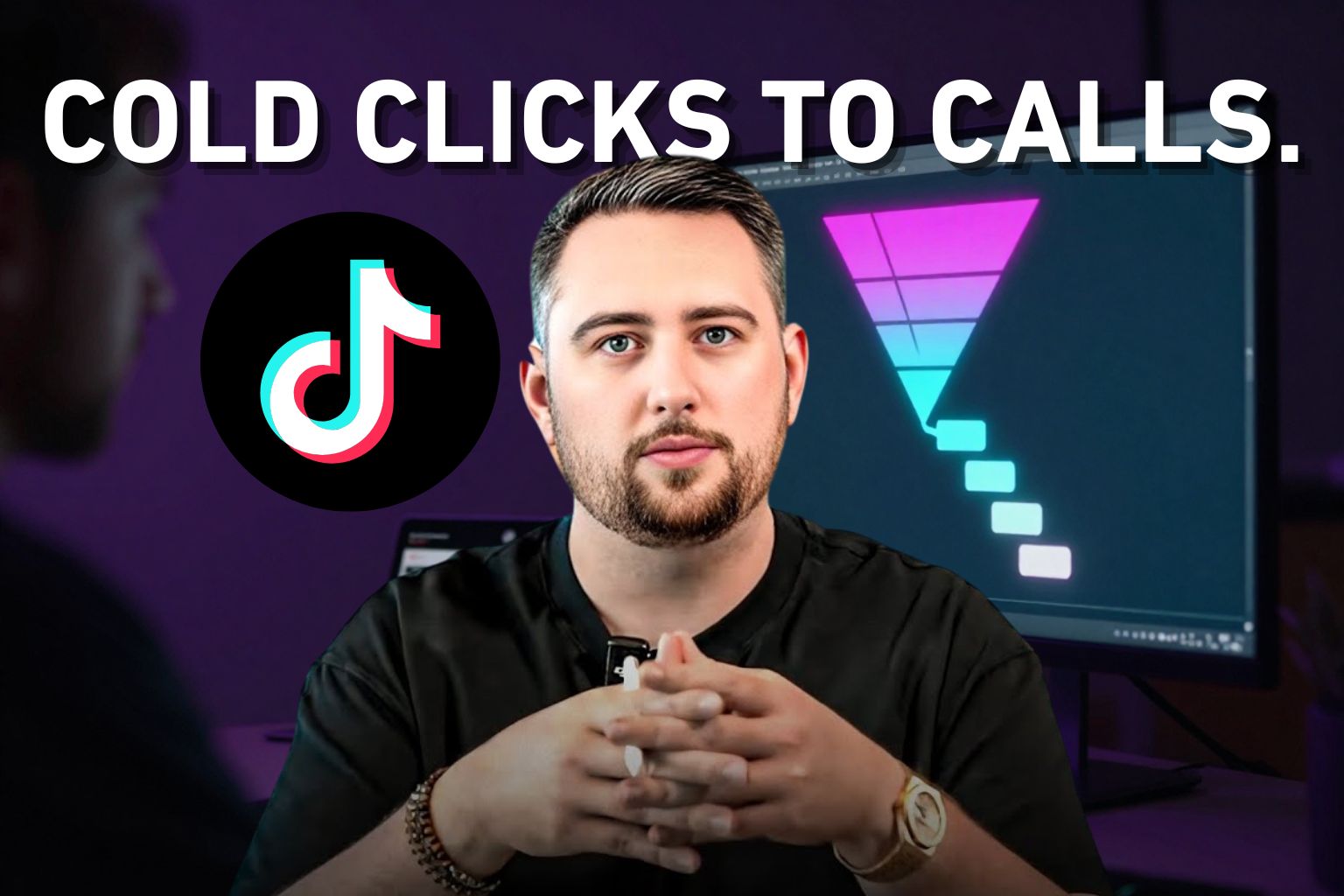
TikTok isn’t just for dance videos anymore. If you’re running a high-ticket business and you’re not looking at TikTok as an acquisition channel, you’re missing something.
I’m talking about businesses selling consulting packages, agency retainers, or masterminds. The platform has matured. The buying demographics have shifted. And when you structure the workflow correctly, TikTok creative can drive qualified calls.
But here’s what most people get wrong. They try to take their Facebook funnel, slap it onto TikTok, and wonder why it doesn’t work.
TikTok traffic is different. The creative needs to be different. The bridge between the ad and the call needs to be different.
This isn’t about going viral or building a massive following. It’s about building a systematic workflow that takes cold TikTok traffic and turns it into booked, qualified sales calls.
In my Inner Circle, we cover the complete infrastructure for paid acquisition across multiple platforms, TikTok included.
7 weeks. Real frameworks. Covering copywriting, funnels, paid ads, and conversion systems.
Results are not typical. Your results will vary and depend entirely on your individual capacity, business experience, expertise, and level of desire. There are no guarantees concerning the level of success you may experience. The testimonials and examples used are not intended to represent or guarantee that anyone will achieve the same or similar results. We don’t believe in get-rich-quick programs. We believe in hard work, adding value and serving others. As stated by law, we can not and do not make any guarantees about your own ability to get results or earn any money with our information, courses, programs, or strategies.
How TikTok Traffic Behaves Differently for High-Ticket Offers
The fundamental tension with TikTok is this: you’ve got a short-form, entertainment-first platform, and you’re trying to drive a long sales cycle, trust-dependent purchase. That gap is real. But it’s bridgeable if you know what you’re doing.
Here’s what’s changed. TikTok’s user base has aged up, and you’ve got business owners on the platform scrolling during downtime. The algorithm is interest-based, not social-graph-based like Facebook used to be, which means you can reach completely cold audiences without needing social proof or warm connections.
Hootsuite’s 2024 breakdown of social media demographics found that 39% of Americans aged 30 to 49 now use TikTok, alongside 62% of those aged 18 to 29, and the platform is currently the fastest-growing app among baby boomers. The buyer with a budget is already on the platform.
The creative format itself builds trust fast when done right. Raw, native-looking content outperforms polished ads because it doesn’t feel like an ad. When someone sees a founder breaking down their methodology in a 30-second TikTok, it feels more like advice from a peer than a sales pitch.
That’s powerful for high-ticket positioning. CPMs are often lower than Facebook, and creative fatigue happens faster, so you need more volume. But the cost to reach someone initially is typically cheaper. The real question isn’t whether TikTok can work for high ticket, it’s whether you’re willing to build the infrastructure to make it work.
What the Full Workflow Looks Like From Ad to Booked Call
Let me give you the overview before we get into the details. TikTok creative drives a click. That click goes to a bridge, usually a VSL, an advertorial, or some kind of long-form content that warms the traffic.
From there, they hit an application page with qualifying questions. Once they apply, you’ve got a follow-up sequence that confirms the call and reduces no-shows. Then they get on the call with a setter or closer.
Every step matters. Most funnels break at the bridge or the follow-up. If you send cold TikTok traffic straight to an application page, your conversion rates will be low.
If you don’t follow up fast and aggressively after someone applies, your show rates will be low. If your application doesn’t filter properly, your closers will waste time on unqualified leads.
The workflow isn’t complicated, but it has to be tight. TikTok traffic is colder and more skeptical than traffic from other platforms. They clicked because something caught their attention, but they don’t know you yet. You have to earn trust at every stage, and you have to move fast because their attention span is short.
How to Structure TikTok Creative That Drives Qualified Clicks
Let’s talk about creative because this is where most people mess up. They think they need to go viral. They optimize for views and engagement instead of conversions. That’s backwards.
Viral content and conversion content are not the same thing. Viral content is broad, entertaining, and designed to get shared. Conversion content is specific, problem-focused, and designed to attract a narrow audience that has a problem you can solve. You want the second one.
The same creative-testing discipline behind the Facebook ad creative testing strategy for budgets from $500 to $30K-plus daily applies here, just with a different native format.
The creative I use most often includes what I call disqualification hooks. Instead of trying to attract everyone, you explicitly filter out the wrong people in the first three seconds: “If you’re making under a certain amount a month, this isn’t for you.” “This only works if you already have a team.” “If you’re looking for a magic button, keep scrolling.”
This does two things. It reduces your cost per lead because unqualified people don’t click. And it increases your show rates and close rates because the people who do click are pre-qualified and pre-framed. They know this is for serious operators, not beginners.
The structure I use most often is pattern interrupt, problem agitation, mechanism reveal, CTA. The hook stops the scroll. The next 10 seconds agitate the problem they’re facing.
Then you reveal the mechanism or framework that solves it without giving away the whole thing. Then you send them to the next step.
Raw, native-looking creative beats polished production almost every time on TikTok. People expect TikTok content to look like it was shot on an iPhone. When it looks too produced, it triggers ad blindness. Founder-led content also tends to outperform UGC for high-ticket because people want to know who they’re potentially working with.
You also need volume. I’m talking about testing multiple new creatives per week. TikTok creative fatigues fast, and what works today might stop working in two weeks. You need a systematic testing process: test hooks first, then body scripts, then CTAs, isolating what’s driving performance at each layer.
Why the Bridge Between Your Ad and Application Decides Conversion
Here’s where most TikTok funnels die. You get the click, and then you send them straight to an application page. Conversion rate is low.
You blame TikTok traffic for being low quality. But the real issue is you didn’t warm them up.
TikTok traffic is cold. They don’t know you. They clicked because something caught their attention for three seconds.
That’s not enough trust to fill out an application for a high-ticket offer. You need a bridge.
The bridge is whatever sits between the ad and the application. For most high-ticket businesses, that’s a VSL built with the same structure behind call funnels that convert wealthy clients. Five to 15 minutes, founder on camera, explaining the methodology, showing proof, handling objections, and making the case for why they should book a call.
Other options include an advertorial, a blog-style page that looks like content but is really a sales page, or a webinar, longer and more educational, which works well for higher-ticket offers. Even a quiz that educates while it qualifies can work. The format matters less than the function: you need something that builds trust and makes them feel like the call is worth their time.
Skipping this step is the fastest way to waste money on TikTok ads. I’ve seen businesses cut their cost per booked call in half just by adding a solid VSL between the ad and the application.
The traffic is the same. The offer is the same. The only difference is the bridge.
How to Design an Application Page That Actually Filters Leads
Your application page is a qualification tool, not just a lead capture form. If you’re treating it like a generic “name, email, phone number” form, you’re doing it wrong. Getting this step right is closely tied to fixing the gap between paid clicks and actual clients, since a weak application page is often where that gap opens up.
The questions you ask should filter aggressively. What’s your current monthly revenue? How much have you set aside to invest in solving this problem?
When are you looking to get started, immediately, one to three months, or just researching? What’s the number one thing holding you back from the result you want?
These questions do two things. They give your setter or closer context before the call so they’re not going in blind. And they let you auto-route leads based on qualification level.
Someone who says they’re doing well and ready to start immediately gets a call booked right away. Someone who says they’re just researching gets sent to a nurture sequence or a free resource.
This protects your closer’s time. If every lead that gets on the calendar is qualified, your close rate goes up. If half the people on your calendar are tire kickers, your close rate tanks and your team burns out.
Make the application easy to fill out but hard to fake. Don’t make it so long that qualified people drop off, but don’t make it so short that unqualified people slip through. The sweet spot is usually five to eight questions with a mix of multiple choice and short answer.
Why Your Follow-Up Sequence Determines Your Show-Up Rate
Once someone submits an application, the clock is ticking. Speed to lead is everything. Harvard Business Review’s research on online sales leads found that leads contacted within five minutes are significantly more likely to convert than leads contacted after 30 minutes.
Here’s the sequence. Immediately after they submit the application, they get an automated SMS and email confirming we received it and someone will be in touch shortly. Within five minutes, a human is calling or texting them to book the call or confirm the details.
If they don’t answer, you’re following up via multiple channels: SMS, email, maybe even a DM if you have their social handle.
Before the call, you’re sending a confirmation sequence: a text 24 hours before, an email with a “what to expect on the call” video, another text two hours before, another text 15 minutes before. You’re also sending social proof, testimonials, and case studies that reinforce they made the right decision to book.
This is how you reduce no-shows. TikTok leads have higher no-show rates than Facebook or YouTube leads because they’re colder and they booked more impulsively. The confirmation sequence warms them back up and reminds them why they booked in the first place.
If someone no-shows, you’re not giving up. You’re following up again: “Hey, we missed you, here’s a link to reschedule.” A percentage of no-shows will reschedule and close if you make it easy for them.
All of this needs to be systematized in a CRM. GoHighLevel, HubSpot, Close, whatever you use, it needs to handle the automation, the reminders, the follow-up tasks, and the tracking. If you’re doing this manually, you’re leaving opportunities on the table.
How to Run Organic and Paid TikTok Content as One Flywheel
Most people think of organic and paid as separate strategies. That’s a mistake. The approach is to run them together in a flywheel.
Here’s how it works. You’re posting organic TikTok content daily, one to three times a day, sharing tactical advice, breaking down your methodology, showing behind-the-scenes. Some of those posts will pop off.
When they do, look at the engagement and the comments. Are qualified people engaging? Are they asking how to work with you? Are they saying “I need this”?
If yes, you turn that organic post into a Spark Ad. Spark Ads let you promote an organic post as a paid ad while keeping all the comments, likes, and shares. TikTok’s own internal benchmark data shows Spark Ads driving a 134% higher completion rate and a 69% higher conversion rate than standard in-feed ads, largely because the social proof is already built in before you spend a dollar.
At the same time, your paid ads are driving traffic to your profile. Some of those people will check out your organic content, see you’re posting consistently, and trust you more because of it.
The organic content makes the paid ads work better. The paid ads amplify the reach of the organic content. It’s a flywheel.
You can also use organic content to test messaging before you spend money on ads. If a certain angle or hook gets strong organic engagement, you know it’s worth testing in paid. If it flops organically, you probably don’t want to spend ad budget on it.
What Numbers to Track at Every Stage of the Funnel
You need to know your numbers at every stage of this workflow. If you don’t, you can’t diagnose where the funnel is breaking. This is the same discipline behind the 8-metric morning dashboard that runs a $1M operation: fewer numbers, watched daily, beats a spreadsheet nobody opens.
Here’s what you’re tracking: cost per click, cost per landing page view, landing page to application conversion rate, application to booked call rate, show rate (booked to attended), close rate (attended to sold), cost per acquisition, return on ad spend, and revenue per call.
In my experience, cost per lead on TikTok for high-ticket varies widely by niche and offer, and close rates on attended calls depend heavily on your offer and sales process. If you’re outside what seems normal for your business, something’s off.
If you’re getting clicks but no applications, your bridge content isn’t doing its job or your landing page is mismatched with the ad. If you’re getting applications but no one’s booking calls, your application is too long, your follow-up is too slow, or there’s no immediate booking option.
If people book but don’t show up, your confirmation sequence is weak or too much time is passing between booking and call. If people show up but don’t close, your leads are unqualified or your sales process isn’t handling TikTok-specific objections. Getting your setters and closers actually equipped to handle that gap usually comes back to having clear role scorecards and KPIs for every position on the sales team, not just the funnel itself.
Attribution is harder on TikTok than Facebook. The pixel and conversion API are improving, but they’re not as mature. This is the same reason server-side tracking matters so much, the logic behind pixel conditioning to train your ad pixel for higher-quality leads. If you’re spending serious money, invest in a third-party attribution tool like Hyros or TripleWhale so you can track which creative drove which booked call and which closed deal.
Five Mistakes That Break This Workflow
Let me walk through the most common mistakes, because if you avoid these, you’re already ahead of most people trying to run high-ticket offers on TikTok.
Sending cold traffic straight to an application with no bridge. This kills conversion rates every time. TikTok traffic needs to be warmed up before you ask for a call.
Not testing enough creative. If you’re running the same three ads for a month, you’re going to hit creative fatigue and your costs are going to go up. You need a steady flow of new creative.
Slow follow-up. If you’re waiting hours or days to contact someone after they apply, they’ve moved on. Speed to lead matters.
Weak qualification. If your application isn’t filtering properly, your closers are going to waste time on people who can’t afford your offer or aren’t ready to buy. That kills morale and revenue per call.
Trying to close TikTok leads the same way you close Facebook leads. TikTok leads are more skeptical. They need more proof, and they need to feel like they discovered you, not like you’re being sold to. Your sales process has to account for that, and not tracking attribution is what makes it impossible to know which part of the process is actually the problem.
The Tech Stack That Runs This Workflow
You don’t need a complicated tech stack, but you do need the right tools: TikTok Ads Manager for running ads, a CRM like GoHighLevel, HubSpot, or Close for managing leads and follow-up sequences, Calendly or a similar scheduling tool integrated with your CRM, and ManyChat or a DM automation tool if you’re driving people to DMs instead of a landing page.
For attribution, Hyros or TripleWhale if you’re spending enough to justify the cost. For landing pages and VSLs, whatever you’re comfortable with, ClickFunnels, Leadpages, or custom-built on WordPress, doesn’t matter as long as it loads fast and converts.
The tech is not the hard part. The hard part is the strategy, the creative, the follow-up, and the qualification. Get those right, and the tech just supports the process.
If you want the full breakdown on how we build these systems inside agencies, we cover it in our 7-week live comprehensive training at Master Internet Marketing.
Results are not typical. Your results will vary and depend entirely on your individual capacity, business experience, expertise, and level of desire. There are no guarantees concerning the level of success you may experience. The testimonials and examples used are not intended to represent or guarantee that anyone will achieve the same or similar results. We don’t believe in get-rich-quick programs. We believe in hard work, adding value and serving others. As stated by law, we can not and do not make any guarantees about your own ability to get results or earn any money with our information, courses, programs, or strategies.
Already making money? See what it takes to make a lot more.
Why TikTok Is Worth Building the Infrastructure For
TikTok to high-ticket calls is not a gimmick. It’s an acquisition channel if you’re willing to build the infrastructure around it.
The creative has to be native and conversion-focused, not viral-focused. The funnel needs a bridge to warm up cold traffic. The application needs to qualify hard.
The follow-up needs to be fast and multi-channel. And you need to track everything so you know what’s working and what’s not.
The platform is there. The buyers are there. The question is whether you’re willing to do the work to make it happen.
If you’re running a high-ticket business and you’re not testing TikTok, you might be missing something. But if you’re going to test it, do it right: build the full workflow, commit to creative volume, and track your numbers.
That’s how you turn TikTok creative into closed deals. For more on building complete acquisition systems across multiple platforms, check out our mastermind, Inner Circle, where we work through this exact infrastructure with agency operators.
Results are not typical. Your results will vary and depend entirely on your individual capacity, business experience, expertise, and level of desire. There are no guarantees concerning the level of success you may experience. The testimonials and examples used are not intended to represent or guarantee that anyone will achieve the same or similar results. We don’t believe in get-rich-quick programs. We believe in hard work, adding value and serving others. As stated by law, we can not and do not make any guarantees about your own ability to get results or earn any money with our information, courses, programs, or strategies.
Get my content first on Google
Add jeremyhaynes.com as a preferred source and Google shows my articles more prominently in your search results, including AI Overviews and AI Mode.

Jeremy Haynes
Owner and CEO of Megalodon Marketing
Jeremy Haynes is the founder of Megalodon Marketing. He is considered one of the top digital marketers and has the results to back it up.