How I Built a 48-Hour Monthly Organic Content Engine

I hope you enjoy reading this blog post. If you want my team to just do your marketing for you, click here.
Author: Jeremy Haynes | Published August 19, 2026
Earnings Disclaimer: You have a .1% probability of hitting million-dollar months according to the US Bureau of Labor Statistics. As stated by law, we can not and do not make any guarantees about your own ability to get results or earn any money with our ideas, information, programs, or strategies. We don’t know you, and besides, your results in life are up to you. We’re here to help by giving you our greatest strategies to move you forward, faster. However, nothing on this page or any of our websites or emails is a promise or guarantee of future earnings. Any financial numbers referenced here, or on any of our sites or emails, are simply estimates or projections or past results, and should not be considered exact, actual, or as a promise of potential earnings, all numbers are illustrative only.
After my education company crossed $1 million a month in recurring revenue, I looked closely at what had created the most qualified conversations behind that growth. YouTube stood out. It now accounts for roughly 95% of the impact I observe across my organic channels, even though many individual videos draw only a few thousand views. I would rather reach 2,000 people who recognize the exact business problem I am discussing than collect 200,000 views from an audience that will never need what I sell.
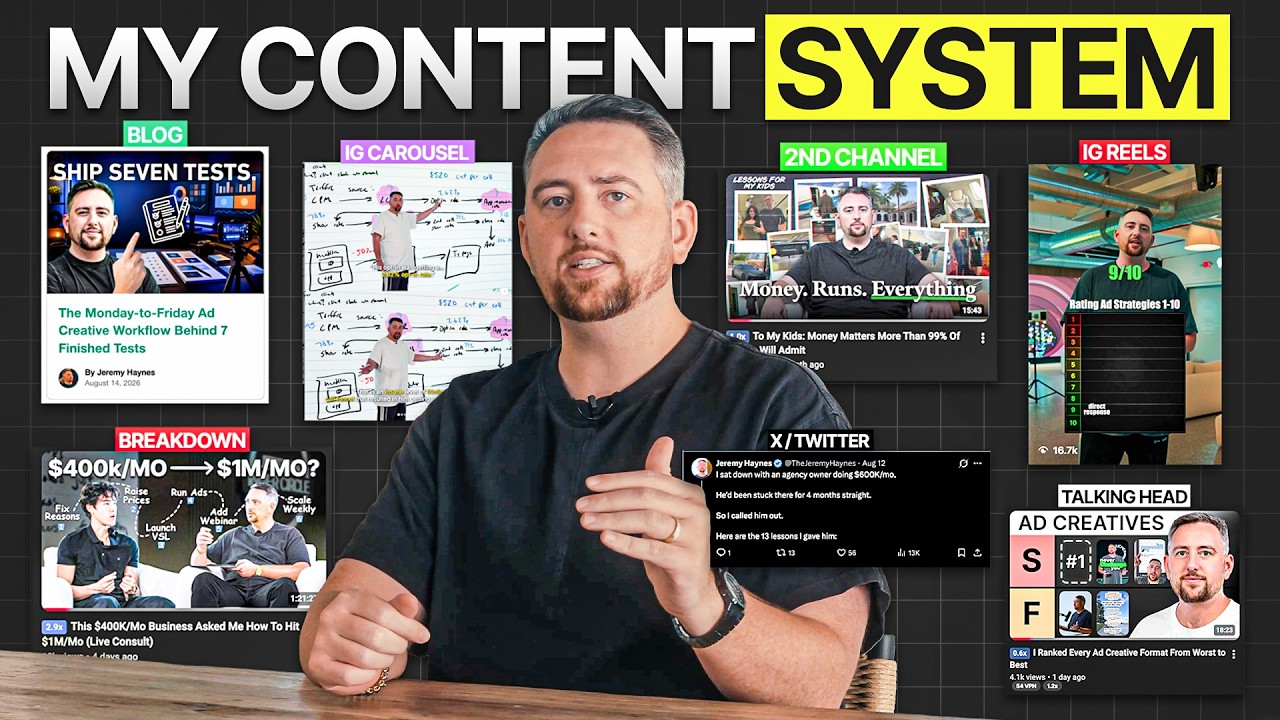
The engine began with two videos a week and about eight hours of filming a month. Today it includes four weekly YouTube videos across two long-form channels, a separate clips channel, and roughly 48 filming hours a month. The equipment and publishing volume changed. The governing idea did not. Every piece starts with a real customer conversation and gives the right person a clear reason to continue the relationship.
Already making money? See what it takes to make a lot more.
Why YouTube Became the Center of My Content Engine
YouTube is the primary action in my organic system. Instagram, X, LinkedIn, email, and my blog can introduce an idea or renew interest in it. The deeper explanation lives on YouTube, where I can spend 20 minutes, 50 minutes, or more than an hour teaching the subject with enough context to be useful.
That depth matters when the audience consists of operators making consequential decisions. A short post might identify a problem. A long-form video lets me show how I think through it, where the common diagnosis goes wrong, and what I would examine next. The viewer gets a much better sample of my judgment.
My conclusion that YouTube creates about 95% of my organic impact is a directional observation from conversations and buyer recognition, rather than a claim of perfect multi-touch attribution. People regularly approach me and reference a YouTube video. I hear that far less often about an email, blog post, or LinkedIn post. The secondary channels still help, but YouTube does most of the trust-building work.
This is also why I separate qualified reach from raw reach. YouTube Studio gives creators reports for traffic sources, search terms, click-through rate, and watch time, while its Audience reporting distinguishes new, casual, regular, and returning viewers. Those are better diagnostic inputs than one public view count when the goal is to understand who is finding the work and whether they come back. You can see the definitions in YouTube’s official guides to video reach and audience reporting.
My First Production System Was Deliberately Simple
I did not begin with a studio full of cameras. For roughly the first year and a half, I used two iPads. One recorded in 4K at 60 frames per second. The other let me draw and visualize concepts while I taught. I added a tripod, a sandbag from B&H Photo to keep it stable, and Rode microphones with the correct USB-C cable.
That setup removed excuses. I could record at my kitchen island or on my balcony without turning every session into a production event. The early habit mattered more than having the final equipment stack on day one.
A UK-based team handled the work after filming. They edited the footage, designed thumbnails, posted and scheduled each upload, wrote descriptions, added pinned comments, and created chapters. For approximately the first two years, that support cost me around $3,500 to $4,000 a month. It now costs closer to $8,500 a month because the output and production requirements are larger.
I still own the ideas. Delegating post-production makes sense because someone else can learn that process and improve it. Handing over the subject selection would separate the channel from the conversations that make it valuable.
Every Strong Topic Starts With a Real Conversation
I do not sit down with a blank page and ask what might perform. My topics come from group chats, direct messages, group calls, and twice-monthly one-on-one conversations. When the same issue appears across multiple businesses, I know the question has enough weight to deserve a full explanation.
A sudden increase in CPMs is a good example. One operator may think the issue belongs only to their account. Then I hear the same concern from several people in a short window. That pattern gives me the topic, the language the audience uses to describe it, and the wrong assumptions I need to address.
This makes the publishing system closely connected to delivery. My article on turning viewers into leads explains the broader conversion path. The topic-sourcing layer comes even earlier. It ensures the first piece of content begins with a problem qualified buyers already care about.
Members of my Inner Circle are one source of those recurring questions. Their conversations show me where established operators are getting stuck and which distinctions deserve a deeper lesson.
Results are not typical. Your results will vary and depend entirely on your individual capacity, business experience, expertise, and level of desire. There are no guarantees concerning the level of success you may experience. The testimonials and examples used are not intended to represent or guarantee that anyone will achieve the same or similar results. We don’t believe in get-rich-quick programs. We believe in hard work, adding value and serving others. As stated by law, we can not and do not make any guarantees about your own ability to get results or earn any money with our information, courses, programs, or strategies.
How Much of the Answer Belongs in Free Content
The right amount of detail depends on what the business sells. In my education business, I may publish 10% to 20% of a larger system on YouTube. The paid material contains the complete implementation, examples, and operating procedures. The free lesson still needs to stand on its own. It should help the viewer understand the problem and make a better decision.
A done-for-you business can make a different choice. If I were selling execution, I could reveal nearly the entire method. Showing the complexity would demonstrate expertise, while the offer would remove the burden of implementing it.
That distinction prevents two common errors. Some education businesses give away a disconnected teaser that teaches almost nothing. Others publish the entire paid delivery system and leave no meaningful reason for the right buyer to continue. The goal is a useful lesson with a natural boundary.
I apply the same principle inside Master Internet Marketing, my 7-week live comprehensive training. The public content explains the thinking. The training provides the organized sequence and implementation depth.
Results are not typical. Your results will vary and depend entirely on your individual capacity, business experience, expertise, and level of desire. There are no guarantees concerning the level of success you may experience. The testimonials and examples used are not intended to represent or guarantee that anyone will achieve the same or similar results. We don’t believe in get-rich-quick programs. We believe in hard work, adding value and serving others. As stated by law, we can not and do not make any guarantees about your own ability to get results or earn any money with our information, courses, programs, or strategies.
Why I Make Direct Calls to Action So Often
I place frequent calls to action inside long-form content because I believe in the offers and want qualified viewers to know the next step. A call to action should appear when the topic creates a natural bridge. It should feel like the logical continuation of the lesson, rather than an interruption pasted into the script.
Creators sometimes avoid offers because they fear hurting views. That optimizes the wrong outcome for my business. I am building a path from useful content to a relevant conversation. A viewer who is never told how to continue may enjoy the material and leave without taking another step.
The language also has to match the intended buyer. I speak as though the viewer already operates a serious business and understands the fundamentals. That makes some videos less accessible to a broad beginner audience. It also makes them more useful to the person I am trying to reach. The same principle shapes my four-stage bridge from follower to buyer.
The Four-Video Schedule Has a Job for Each Day
For my first two years, I published two videos a week on Wednesdays and Saturdays. After the channel’s two-year anniversary, I increased the main channel to three weekly uploads and added one weekly video to a secondary channel. That created a minimum of four YouTube videos each week.
Monday is the deep teaching slot. These are talking-head videos where I can work through one subject, explain the distinctions, and make relevant offers throughout the lesson.
Wednesday is demonstration day. I sit down with an operator and break down a real business. A conversation may last 60 to 90 minutes, and sometimes two hours. Instead of centering the upload on one narrow takeaway, I can demonstrate five to 12 lessons as they become relevant.
Saturday is the testing slot. These videos give me room to experiment with formats, discovery angles, and topics that may reach beyond the usual audience while remaining connected to the channel’s purpose.
Sunday belongs to my secondary channel, Lessons for My Kids. It documents mindset lessons and beliefs I want my five future children to have. It reaches a different audience and gives that material a clear home without confusing the promise of the main channel.
YouTube’s own upload schedule guidance recommends evaluating frequency, consistency, content structure, sustainability, and production cost against return. That is exactly what this calendar does. Each day has a purpose, and the total schedule can be planned as an operating system instead of a series of last-minute uploads.
Three Channels Keep Different Viewing Behaviors Separate
A creator I met at the gym taught me an important distribution lesson. He operated seven Roblox channels. The smallest had at least four million subscribers, and the largest had more than 10 million. He separated livestreams, clips, reactions, and other formats because each attracted a different viewing behavior.
I applied the same logic to my own channel architecture. The main Jeremy Haynes channel is for long-form business instruction and demonstrations. Lessons for My Kids holds mindset and legacy material. Haynes Feed carries shorts and shorter clips.
Haynes Feed publishes about six pieces a day on average and can go as high as 15. Most are shorts. Some are two-to-nine-minute clips I call mids. Those mids answer focused questions and create additional search entry points without changing the long-form promise of the main channel.
The clips may have modest view counts. I am comfortable with that because they belong to a larger catalog. A person searching for one exact problem can discover a concise answer, then move toward a fuller video. My content repurposing system covers how one recording can support a much wider asset library.
Consistency Turns the Channel Into a Familiar Show
I think about the main channel like a television schedule. People knew when shows such as Billions, Succession, or Dexter would appear. When an episode arrived unexpectedly late, the break in rhythm was noticeable. A channel can build the same familiarity when its audience understands both the subject and the release pattern.
My rule is simple. Monday, Wednesday, and Saturday belong to the main channel. Sunday belongs to the secondary channel. The upload does not depend on whether I feel inspired that week.
That consistency creates a moat because the catalog takes time to build. Early videos may receive 2,000 to 5,000 views. My typical range has often been around 3,000 to 6,000, with stronger outliers reaching 10,000 or more and the best approaching 20,000. Those figures are past observations, and none guarantee future performance. More importantly, a smaller early audience can contain people already considering the problem, the company, or the offer.
The channel becomes harder to replace with every useful upload. The viewer sees the history, the recurring point of view, and the proof that the creator will still be publishing next month.
My Filming Commitment Grew From 8 to 48 Hours
During the first two years, I filmed for about two hours each week, usually on Sundays. That was approximately eight hours a month. Today I normally film YouTube content on Tuesdays and Thursdays for a combined average of about 12 hours a week.
When I include Instagram recording, the documented filming commitment is closer to 13 or 14 hours a week. My monthly YouTube filming figure is about 48 hours. The numbers refer to related but slightly different scopes, which is why I keep both instead of pretending they are interchangeable.
Business breakdowns consume much of that time. Operators have flown in from Germany, Australia, Dubai, Miami, and other parts of the United States to record them. The conversations themselves may run 60 to 90 minutes before the team completes editing and distribution.
I increased the time because the channel earned a larger share of my attention. At the beginning, organic content produced little observable impact. Once it became a primary source of qualified conversations, spending more hours on it became rational. This is the same allocation principle I use when deciding how to balance paid and organic growth.
The 90/10 Rule Keeps Resources on the Main Driver
At one stage, I spent about $5,000 a month on blog production, $8,000 on Instagram, and $6,300 on X and LinkedIn through The Birdhouse. YouTube cost approximately $3,500 to $4,000 a month at the time. Yet the secondary channels appeared to contribute only around 10% of the overall effect, while YouTube produced the overwhelming majority of the recognition and buying impact I observed.
Those figures forced a resource-allocation decision. A business can keep every channel active, but it should know which one deserves 90% of the strategic attention. For me, that channel is YouTube. The rest of the system should extend its reach and send people back to it.
This does not mean every company should copy my percentages or publishing calendar. It means the company should identify its main trust-building asset, measure its traffic sources and buyer conversations, then support the winner. Spreading senior attention evenly across six platforms can make every channel mediocre.
Instagram Uses a Faster Action-Oriented System
I approach Instagram differently because the format, consumption pattern, and platform risk feel different to me. I would not want the entire business to depend on one Instagram account or its direct messages. With a larger recurring-revenue base and YouTube already established, I am more comfortable treating Instagram as a calculated secondary channel.
The current target is five posts per day. Three are reels. Two are images or carousels, often built from text threads, screenshots, or still frames with overlays. I film about 15 reels a week in one or two concentrated hours.
Every post asks for an action in the comments. The response might deliver access to a resource, point to a video, or introduce an offer. At least one daily post promotes Jeremy AI. Other posts can lead to a master class, a relevant program, a lead magnet, or a YouTube lesson.
The results vary widely. One post may receive a handful of comments while another receives dozens. I care about whether the right person takes the next step. That is also why my polarizing content strategy begins with a clear point of view instead of trying to appeal equally to everyone.
Every Secondary Channel Extends the Main Asset
X, LinkedIn, the blog, and email operate as redistribution channels. The Birdhouse turns source material into threads, posts, and newsletters that sound like me. The blog converts useful concepts into searchable text. Email selects material that fits the subscriber’s context and brings it back into the conversation.
This arrangement prevents every platform from requiring a separate idea factory. The hard thinking happens once in the long-form source. The team adapts the lesson to the behavior of each platform and links people back to the deeper asset when appropriate.
The blog also gives the ideas a format that search systems can parse and cite. Google’s current guidance says pages do not need special AI files or exclusive AI markup to appear in AI Overviews or AI Mode. The same fundamentals still apply, including indexability, helpful people-first content, important information in text, accurate structured data, and useful internal links. That is the standard I use for AI-search visibility.
Repurposing works best when the adaptation respects the channel. A transcript pasted everywhere is duplication. A concise LinkedIn post, a searchable article, a short clip, and a contextual email can all originate from the same lesson while performing different jobs.
7 weeks. Real frameworks. Covering copywriting, funnels, paid ads, and conversion systems.
How to Build This Engine Without Copying My Volume
Start with the qualified conversation you want the content to create. Define the operator, the problem they already recognize, and the useful next step. Then choose one platform where you can explain that problem at the required depth.
Commit to a schedule you can sustain for at least a year. Give each recurring slot a clear function, such as teaching, demonstration, or experimentation. Keep production simple until the publishing habit is stable. Add editing and distribution support when those tasks begin limiting the quality or consistency of the source material.
Build the idea pipeline from sales calls, customer delivery, direct messages, and repeated questions. Decide how much implementation belongs in public based on what you sell. Make the public lesson genuinely useful, then place a clear and relevant call to action where the viewer naturally needs the next layer.
Finally, measure more than views. Review traffic sources, search terms, returning viewers, and the actual conversations that mention the content. Put most of the resources behind the channel creating the strongest qualified response. Repurpose that source across the remaining channels instead of asking each one to carry an unrelated strategy.
If you want the organized marketing system behind this approach, explore Master Internet Marketing, my 7-week live comprehensive training. It is where I teach the wider operating principles that connect content, acquisition, and implementation.
Results are not typical. Your results will vary and depend entirely on your individual capacity, business experience, expertise, and level of desire. There are no guarantees concerning the level of success you may experience. The testimonials and examples used are not intended to represent or guarantee that anyone will achieve the same or similar results. We don’t believe in get-rich-quick programs. We believe in hard work, adding value and serving others. As stated by law, we can not and do not make any guarantees about your own ability to get results or earn any money with our information, courses, programs, or strategies.
Get my content first on Google
Add jeremyhaynes.com as a preferred source and Google shows my articles more prominently in your search results, including AI Overviews and AI Mode.


Jeremy Haynes
Owner and CEO of Megalodon Marketing
Jeremy Haynes is the founder of Megalodon Marketing. He is considered one of the top digital marketers and has the results to back it up.