
What Separates $200K/Month Businesses From $1M+/Month Businesses

I hope you enjoy reading this blog post. If you want my team to just do your marketing for you, click here.
Author: Jeremy Haynes | Published November 17, 2026
Earnings Disclaimer: You have a .1% probability of hitting million-dollar months according to the US Bureau of Labor Statistics. As stated by law, we cannot and do not make any guarantees about your own ability to get results or earn any money with our ideas, information, programs, or strategies. We don’t know you, and your results in life are up to you. We’re here to help by giving you our greatest strategies to move you forward, faster. However, nothing on this page or any of our websites or emails is a promise or guarantee of future earnings. Any financial numbers referenced here, or on any of our sites or emails, are simply estimates or projections or past results, and should not be considered exact, actual, or as a promise of potential earnings – all numbers are illustrative only.
Put a business doing around $200K a month next to one doing $1M or more and look at what happens when a webinar disappoints. One team says the funnel didn’t work. The other can tell you who registered, who stayed for the pitch, who booked, and where the cash stopped coming in. That difference tells me more about how each business operates than the extra money in its ad account does.
The revenue levels are a comparison, not a forecast. Pay attention to what the operators do with the money, time, and information they already have. You can change how you run a test or deal with a problem at the size you’re at right now.
Already making money? See what it takes to make a lot more.
What Bigger Webinar Accounts Do With Events
When you’re buying traffic for a free webinar, the action you optimize for changes what you’re asking the ad system to find. A registration and a scheduled call are different actions. Meta lists them separately, alongside purchases and other standard events. Pick the event based on what you want to learn and what you can measure cleanly.
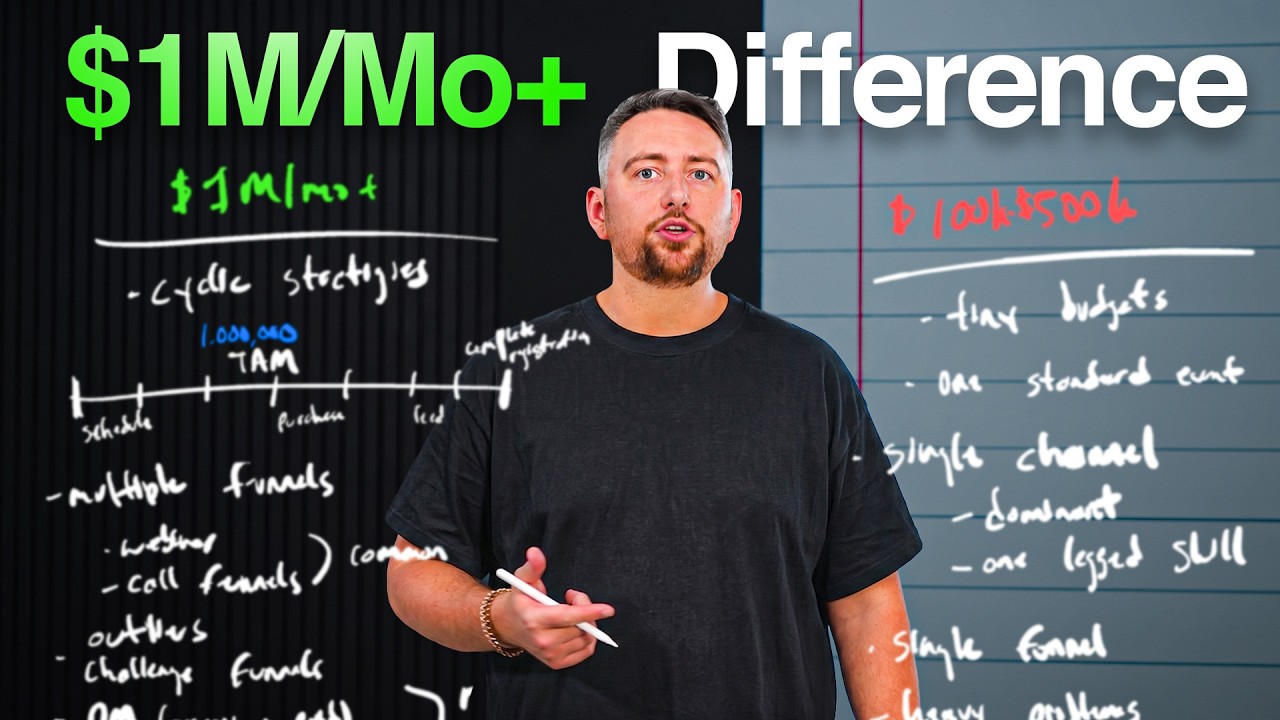
One approach I see in larger webinar accounts is what I call cyclic campaigns. An operator can keep a campaign for registrations, then test a version that optimizes for scheduling or purchases. Each campaign gives the platform a different action to look for. An account running only the deepest event can miss people who would have registered, watched the pitch, and bought later.
The tradeoff matters. A campaign for a deeper event can have a higher cost per registration and bring in fewer people, so I want to know what happened with attendance, booked calls and collected cash before I judge it. A registration campaign can bring useful volume. It can also fill a room with people you couldn’t sell to at any price.
Creative narrows the audience again. Even with the right event, you have to say something that matters to the buyer you want. Filming several versions of the same argument doesn’t give you several ways to reach them. Change the actual reason somebody should care, then check who showed up.
Where the Webinar Lost People Matters More
If you have the budget to test one event, run it well. Work out what a session can cost and what has to happen after registration before you spend. The webinar calculator can help you see which assumptions the math depends on. Your own attendance, close rate and collected cash still have to confirm them.
Look at the chain from spend to registration, attendance, offer exposure and then calls or orders. An empty room and a full room that stops paying attention before the pitch give you two completely different jobs. A funnel bottleneck analysis helps you find the stage worth fixing first. Google Analytics can show where people drop between tracked steps; reconcile those steps with your webinar and sales records before you diagnose the funnel.
I also want to know who’s putting the report together. If the sales team counts signed deals and finance counts payments that cleared, find out which number you’re looking at before you change the budget. You can take the wrong action on a perfectly accurate number if the label is wrong.
When One Funnel Has to Carry the Business
A business that depends on one funnel and one traffic source can feel great right up until either starts slowing down. Among the larger operators I’ve worked with, I see webinars and call funnels doing different jobs. One explains the offer to a room and gives interested buyers a next step. The other can give a prepared buyer a straight path to sales.
There are other ways to add revenue. A challenge may fit a launch and pull in a batch of sales, but the team has to do the work of putting the event on and handle the demand that follows. Direct messages can bring in a useful share of deals without having to carry the whole target. A low-ticket entry offer can be worth testing if you can wait for the buyers who move up. Model when the cash comes back before you commit to funding that path.
Look at what you already have before adding a funnel. If people want to talk and can get to the call informed, work out whether sales can handle more of those conversations. If closers are teaching the same basics over and over, the next useful funnel may take some of that work off the calendar.
Cold Paid Leads Need a Different Handoff
Say people watch you on YouTube, see more of you on Instagram, and then book. By the time sales meets them, they’ve had time to figure out what you do and whether they trust how you think. Send cold paid traffic straight to that same calendar and you’ve handed the closer everything the content was doing.
I’d pick a funnel the existing team can actually sell through. A webinar can do much of the explaining before the handoff. If you want a cold call funnel, look at what closers need to handle cold paid leads before you measure them against deals from organic. A buyer who knows the offer and one hearing it for the first time don’t belong in the same conversation.
The reverse works differently too. You might be used to buying traffic and getting feedback quickly, then write off an organic video because the views look low. The people watching it may be buyers already in your sales process. Make content that answers what that person is asking sales right now. Use YouTube to see how viewers found the content, and get the sales team to check which assets the buyers actually bring up.
In the businesses I’m comparing, I see YouTube and Instagram doing that organic work and Meta often supplying paid traffic. That’s where I’d look for examples of paid ads and organic content doing different jobs together. I’d still judge your channels by the buyers and cash they produce. Copying somebody else’s channel mix doesn’t tell you what your own team can handle.
Bring the Actual Numbers When You Ask for Help
In my Inner Circle, I’ve seen an operator with a working webinar show up with the numbers and ask the room what else they’d change. That’s a useful conversation. Everyone can see where the webinar is losing people and where there may be room to improve.
Results are not typical. Your results will vary and depend entirely on your individual capacity, business experience, expertise, and level of desire. There are no guarantees concerning the level of success you may experience. The testimonials and examples used are not intended to represent or guarantee that anyone will achieve the same or similar results. We don’t believe in get-rich-quick programs. We believe in hard work, adding value and serving others. As stated by law, we can not and do not make any guarantees about your own ability to get results or earn any money with our information, courses, programs, or strategies.
It’s a different conversation if all you’ve got is “the webinar didn’t work.” The person you’re asking has to spend the time figuring out what you could have brought to the conversation. Bring the campaign, the numbers through the funnel, and the issue you already suspect. Ask where your read on it could be wrong.
Then do something with the answer. Be specific about the change you’ll make and what you’ll check on the next run. I can give someone a direct opinion about a problem they asked me to call out. What matters afterward is whether the numbers or the behavior actually change.
Fix the Problem the Team Already Knows About
Look for the issue your team can name without opening a report. Maybe sales knows people arrive without understanding the offer. Maybe marketing knows the webinar brings the wrong buyers. How long has everybody known, and who is doing something about it?
The urgency I look for is in how quickly you start working on a known problem. That doesn’t mean treating every new idea as today’s emergency. If the constraint is that nobody stays for the webinar pitch, sit down with the actual presentation and the attendance report. The ad account can wait while you establish whether that’s the stage breaking the funnel.
Some of the most useful things I’ve read made no immediate difference to anything I was doing. They paid off later, when I ran into a problem they helped me think through. You can take in a good idea without making your team put down whatever was already working.
7 weeks. Real frameworks. Covering copywriting, funnels, paid ads, and conversion systems.
Keep Good Ideas From Interrupting Good Work
Before you add a project, decide what work will get less attention as a result. A new channel can sound promising and still be a bad use of the person fixing your current webinar. Write the idea down. Pick it up when you have the people, the money, and a clear reason to run it.
If a tool or a person can speed up the work, use them on a problem you understand. You can ask an AI tool to organize the funnel numbers and point out which stage is losing people. Have someone check the inputs and verify the finding before it becomes a decision about spend or the team.
That distinction matters in Master Internet Marketing, my 7-week live comprehensive training. You can learn more tactics than you could ever use at once. The useful one is the tactic that fixes the issue sitting in front of you, with a result your team can look at and a decision it knows how to make next.
Results are not typical. Your results will vary and depend entirely on your individual capacity, business experience, expertise, and level of desire. There are no guarantees concerning the level of success you may experience. The testimonials and examples used are not intended to represent or guarantee that anyone will achieve the same or similar results. We don’t believe in get-rich-quick programs. We believe in hard work, adding value and serving others. As stated by law, we can not and do not make any guarantees about your own ability to get results or earn any money with our information, courses, programs, or strategies.
Get my content first on Google
Add jeremyhaynes.com as a preferred source and Google shows my articles more prominently in your search results, including AI Overviews and AI Mode.


Jeremy Haynes
Owner and CEO of Megalodon Marketing
Jeremy Haynes is the founder of Megalodon Marketing. He is considered one of the top digital marketers and has the results to back it up.