My Webinar Training From Ad Budget to Sales Follow-Up

I hope you enjoy reading this blog post. If you want my team to just do your marketing for you, click here.
Author: Jeremy Haynes | Published October 5, 2026
Earnings Disclaimer: You have a .1% probability of hitting million-dollar months according to the US Bureau of Labor Statistics. As stated by law, we cannot and do not make any guarantees about your own ability to get results or earn any money with our ideas, information, programs, or strategies. We don’t know you, and your results in life are up to you. We’re here to help by giving you our greatest strategies to move you forward, faster. However, nothing on this page or any of our websites or emails is a promise or guarantee of future earnings. Any financial numbers referenced here, or on any of our sites or emails, are simply estimates or projections or past results, and should not be considered exact, actual, or as a promise of potential earnings – all numbers are illustrative only.
Watch The Most Valuable Webinar Training You’ll Ever Watch
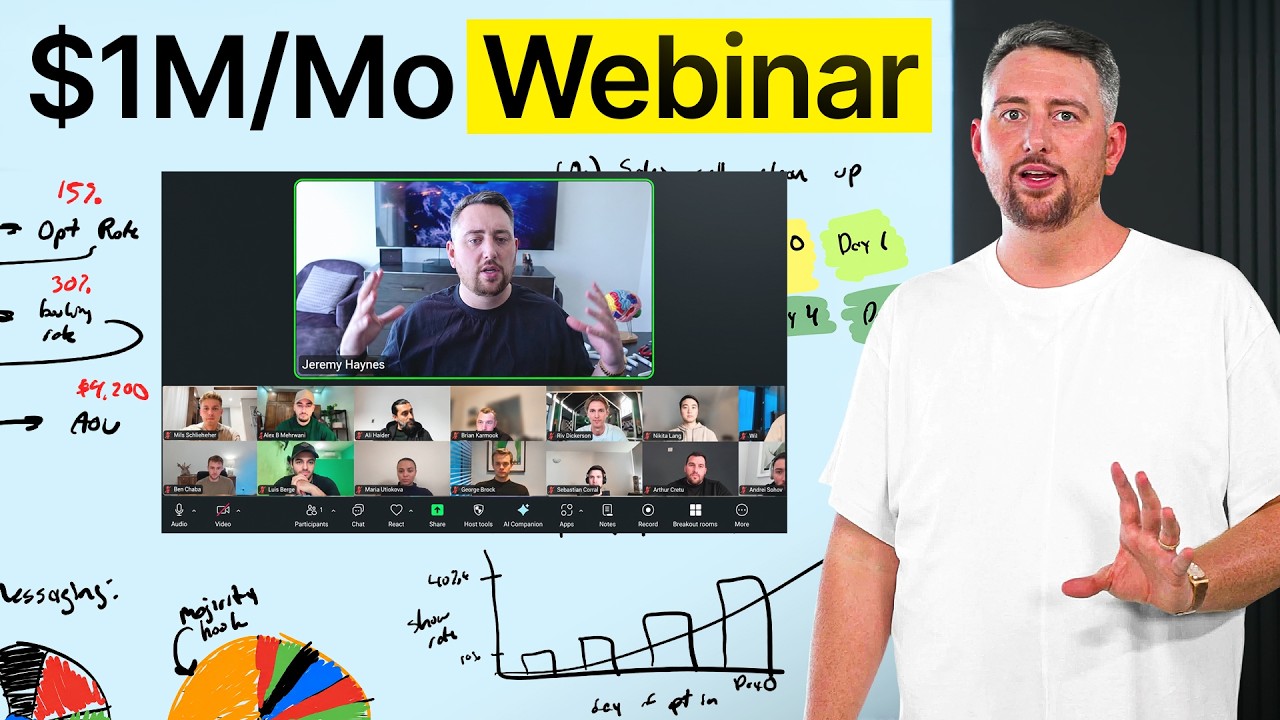
A webinar can lose the sale before the presentation starts, during the pitch, or after somebody books a call. That is why my webinar training covers the entire process, from choosing a test budget to following up with people who attended and never booked. The ads, registration page, reminders, presentation, and sales team all affect what happens to the money you spend. If you only look at registrations, you can miss the part that actually needs work.
In the video above, I walk through how those pieces fit together. Some choices change with the audience, budget, and number of events you run. The useful question is where people stop moving forward and what you can change before the next webinar.
7 weeks. Real frameworks. Covering copywriting, funnels, paid ads, and conversion systems.
Already making money? See what it takes to make a lot more.
Set a Test Budget You Can Afford to Repeat
Start with the money available for testing. A webinar launch gives you information about several different steps, and the first run may leave you with more work to do. Spending everything on that run leaves you with no room to act on what you learn.
I use a financial model before buying traffic. It connects ad spend and cost per registration to attendance, booked calls, sales-call attendance, close rate, and cash collected per customer. Each assumption affects what the same advertising budget could produce, which is why this belongs in your webinar launch planning.
The cash-collected part deserves attention. A contract value and the payment that reaches your processor are different numbers. If your model assumes the whole contract arrives immediately while customers pay over time, you are planning the next test with money you may not have yet.
You can explore those relationships with the webinar calculator. Treat the inputs as assumptions until your own results replace them. A projection helps you see what would need to happen; it does not establish that it will happen.
Pick a schedule you can support with that budget and with the time needed to review each event. In the training, I discuss different times for business and consumer audiences. Those are starting points to test against your buyers’ availability, rather than a universal best time to run a webinar.
Choose a Webinar Topic Your Buyers Already Care About
Before writing the landing page, get clear on the problem that would make somebody attend. I work through the buyer’s current situation, the result they want, and the mechanism being taught. If those do not connect, a polished webinar title will still leave the buyer wondering why it matters.
One example in the training involves a software business talking about show rates. As the conversation develops, the product’s role extends into the work between marketing and the sales call. That changes how the business can explain the problem it solves, rather than keeping the whole pitch attached to a single feature.
I also explain the DART idea as a way to think about messaging and the audience it attracts. It is my teaching analogy, not a technical specification for how an advertising platform ranks every ad. The practical point is to make the message recognizable to the part of your market you actually want to reach.
Your headline should carry that idea without needing a paragraph underneath to rescue it. Someone seeing the ad for the first time needs to understand what the session is about and why it relates to their situation. Build around a real problem you can teach, without promising an income result.
Make Registration Clear on Desktop and Mobile
The registration page needs to carry the same promise as the ad. I cover the headline, supporting video, form, and event timing in the training. They should help someone make the same decision, rather than introduce several unrelated reasons to register.
Check the mobile experience separately. A form that is easy to reach on a large screen may be buried after a long scroll on a phone. The visitor should be able to find the registration action without hunting through the page again.
Use a real event date and keep any countdown tied to that date. Collect the information your follow-up process needs through your approved consent flow. The page has to work as a registration experience before you ask ads to send more people to it.
I also discuss page-building tools and hosting in the video. The tool choice still needs to produce a working page that loads and submits correctly. If you use Cloudflare, its performance settings documentation is a technical reference for reviewing the available settings, not evidence that a particular page will convert.
Give Registrants a Reason to Come Back
After registration, the person still has to decide whether attending is worth their time. I use the confirmation page to keep answering that question. A bare thank-you message gives you very little room to explain what they will get from showing up.
The main confirmation video can help someone research the topic or understand a genuine reason to act now. Those are different jobs. If there is no real deadline or timely development, do not manufacture one to make the page sound urgent.
In the video, I describe a real-estate example where timely research supplied the reason to attend. The relevant lesson is how the information connected the event to a current concern. That example is not legal advice or a claim about what another webinar will achieve.
Additional videos can answer the questions a prospect is likely to have before attending. Keep each answer connected to their decision, and use testimonials only with appropriate context. My article on confirmation-page videos goes further into that part of the funnel.
Make Your Emails Useful Before the Webinar Starts
A reminder tells somebody when the webinar starts. A useful email can also show them why they wanted to attend. I cover emails that begin teaching the subject and answer relevant questions before the live presentation.
The reminder can still sit inside that email. You do not need to make every message a countdown with nothing else in it. The distinction is covered further in my article on value-dense webinar emails.
Retargeting and setter conversations can support the same preparation. In the training, the setter’s role includes helping the person and answering questions. That requires a relevant conversation, rather than treating every registrant as permission for unlimited outreach.
Delivery needs its own check. Google’s email sender guidelines explain authentication and other requirements for reaching Gmail recipients. Good copy cannot compensate for a broken sending setup.
I describe timed text reminders and a preference for directing people toward the join details in their email or calendar, rather than putting the Zoom join link in every text. The reason I give is the viewing experience I want to encourage. Treat that as a choice to evaluate with your own attendance and retention data, while keeping all messages within the consent you have.
Match Your Ad Schedule to the Live Event
For a live webinar, promotion has a deadline. I discuss concentrating cold promotion near the event, with more time when the budget or delivery needs it. Someone who registers late should receive communication that matches how much time is actually left.
That matters when planning the ads as well. The training uses distinct messaging angles and filming variations to create different ads. A different background can change the execution, but it does not automatically give you a different reason for the buyer to care.
I cover putting multiple ads together, separating angles, and the more segmented Thunderdome approach. Those choices affect how spend gets distributed across the creative. Understand that trade-off before copying an account structure from somebody else’s screenshot.
The budget setup also changes with the event schedule. I discuss lifetime budgets for occasional live events and daily budgets when the webinar runs more frequently or becomes automated. Set an appropriate advertising cutoff so you are not still acquiring registrations after the event they were promised is effectively over.
Choose an Event Your Campaign Can Learn From
A registration happens earlier than a booked call or a purchase. That gives you a different volume and timing of feedback depending on the event you optimize toward. The training discusses both the immediate registration signal and the later sales-related signals.
My starting preference in this setup is to optimize for registration and then inspect what happens downstream. That does not make registration quality irrelevant. It means you need to connect the advertising result to attendance and sales instead of assuming the cheapest registration is the best one.
A later event can take longer to arrive and may happen less often. Account for that before declaring the tracking broken or switching campaign settings again. Whatever event you choose, keep reporting the number it actually measures.
Keep People With You Until You Explain the Offer
The presentation needs to deliver on the reason people registered. I cover building slides, using AI as drafting support, and reviewing the structure rather than accepting a generated deck untouched. A presentation can contain useful information and still lose the audience before the offer.
Watch how many viewers remain when you reach the pitch compared with the peak concurrent audience. That helps separate a presentation-retention issue from a closing issue. Do not blame the offer before checking whether enough people were still there to hear it.
For a focused example of reviewing the presentation itself, see the webinar pitch review. Read it as a specific case, with its own circumstances, rather than a booking-rate promise for your event.
Use the reporting available in your webinar platform to examine attendance. Zoom’s webinar reporting documentation explains the reports it provides. Compare those records with your presentation timeline and your own booking data.
For operators working through the wider marketing process, Master Internet Marketing, my 7-week live comprehensive training, is another way to learn from me. Keep the presentation connected to the rest of the funnel when you review it.
Results are not typical. Your results will vary and depend entirely on your individual capacity, business experience, expertise, and level of desire. There are no guarantees concerning the level of success you may experience. The testimonials and examples used are not intended to represent or guarantee that anyone will achieve the same or similar results. We don’t believe in get-rich-quick programs. We believe in hard work, adding value and serving others. As stated by law, we can not and do not make any guarantees about your own ability to get results or earn any money with our information, courses, programs, or strategies.
Explain the Offer and What the Sales Call Is For
The move from education into the offer should make sense to someone who has been following the presentation. I explain the offer through the problems its components address and the help the buyer is considering. A list of impressive-sounding extras can leave the practical buying question unanswered.
When I discuss the price drop in the training, I mean revealing the price. I am not telling you to invent a discount. Whether you reveal pricing before the call affects the conversation and the people who choose to book, so evaluate that choice in the context of your offer.
Address objections directly and explain the actual terms of any risk reversal. Neither the presentation nor this article creates a new guarantee for your business. Keep answering questions while the audience is engaged, without stretching the session just to reach an arbitrary duration.
Then make sure the sales team understands what the prospect has already watched. The training discusses using the call to answer remaining questions, explain onboarding, and clarify the next steps. The salesperson still needs to establish fit rather than assume watching a webinar amounts to a buying decision.
Follow Up With People Who Attended but Never Booked
The webinar ending does not mean the follow-up work is finished. I separate people who attended without booking from people who registered and missed the event. They have different context, so the same message will not always make sense for both.
For someone who attended, the conversation can address what stopped them from taking the next step. For a registrant who missed it, a replay may be the useful next asset. Keep the outreach relevant, respect consent, and give the person room to decide.
This is also why judging the entire event from purchases visible at the moment you stop presenting can be premature. Booked calls and follow-up may still be in progress. Track what actually happens afterward without treating possible sales as money already collected.
Already making money? See what it takes to make a lot more.
7 weeks. Real frameworks. Covering copywriting, funnels, paid ads, and conversion systems.
Fix the Weak Step Before You Increase the Budget
At the end of the training, I return to the numbers across the funnel. Advertising costs, link clicks, registrations, attendance, retention, bookings, call attendance, closes, and order value each describe a different part of the process. Look for the step where a realistic improvement would matter, then investigate why it is weak.
Be careful about blaming the page in isolation. I describe an example from an audiobook funnel where a change in ad creative mattered to the opt-in results. The broader lesson is to check the message bringing people to the page before assuming the page itself is the whole problem.
Scaling can involve more budget, more live events, or an automated version after the economics support further testing. Each changes what you have to manage. For a closer look at an established funnel, see my article on reviewing webinar performance before scaling.
Update the financial model with the results you actually collected. When additional spend stops making sense, preserve what is working while you investigate the next message or funnel. Avoid turning a working campaign into a completely different experiment just because you want it to grow faster.
If you want to explore my Inner Circle, the program page explains the current offer. For this webinar, start by finding the step that is costing you progress and making a change you can evaluate at the next event.
Results are not typical. Your results will vary and depend entirely on your individual capacity, business experience, expertise, and level of desire. There are no guarantees concerning the level of success you may experience. The testimonials and examples used are not intended to represent or guarantee that anyone will achieve the same or similar results. We don’t believe in get-rich-quick programs. We believe in hard work, adding value and serving others. As stated by law, we can not and do not make any guarantees about your own ability to get results or earn any money with our information, courses, programs, or strategies.
Get my content first on Google
Add jeremyhaynes.com as a preferred source and Google shows my articles more prominently in your search results, including AI Overviews and AI Mode.


Jeremy Haynes
Owner and CEO of Megalodon Marketing
Jeremy Haynes is the founder of Megalodon Marketing. He is considered one of the top digital marketers and has the results to back it up.