
The ULTIMATE Funnel For Selling High Ticket Services

I hope you enjoy reading this blog post. If you want my team to just do your marketing for you, click here.
Author: Jeremy Haynes | Published May 5, 2026
Earnings Disclaimer: You have a .1% probability of hitting million-dollar months according to the US Bureau of Labor Statistics. As stated by law, we can not and do not make any guarantees about your own ability to get results or earn any money with our ideas, information, programs, or strategies. We don’t know you, and besides, your results in life are up to you. We’re here to help by giving you our greatest strategies to move you forward, faster. However, nothing on this page or any of our websites or emails is a promise or guarantee of future earnings. Any financial numbers referenced here, or on any of our sites or emails, are simply estimates or projections or past results, and should not be considered exact, actual, or as a promise of potential earnings – all numbers are illustrative only.
After running agencies for over a decade, I’ve found the call funnel to be one of the most reliable strategies for scaling high-ticket businesses. The framework is simple, predictable, and when executed properly, operates with minimal friction.
What follows is the complete operational blueprint: how these systems work, what separates functional funnels from broken ones, and the specific mechanics that drive consistent results.
Through my Inner Circle (a private, application-gated mastermind), I work with established operators who need these systems in place.
Results are not typical. Your results will vary and depend entirely on your individual capacity, business experience, expertise, and level of desire. There are no guarantees concerning the level of success you may experience. The testimonials and examples used are not intended to represent or guarantee that anyone will achieve the same or similar results. We don’t believe in get-rich-quick programs. We believe in hard work, adding value and serving others. As stated by law, we can not and do not make any guarantees about your own ability to get results or earn any money with our information, courses, programs, or strategies.
7 weeks. Real frameworks. Covering copywriting, funnels, paid ads, and conversion systems.
The Anatomy of a Call Funnel
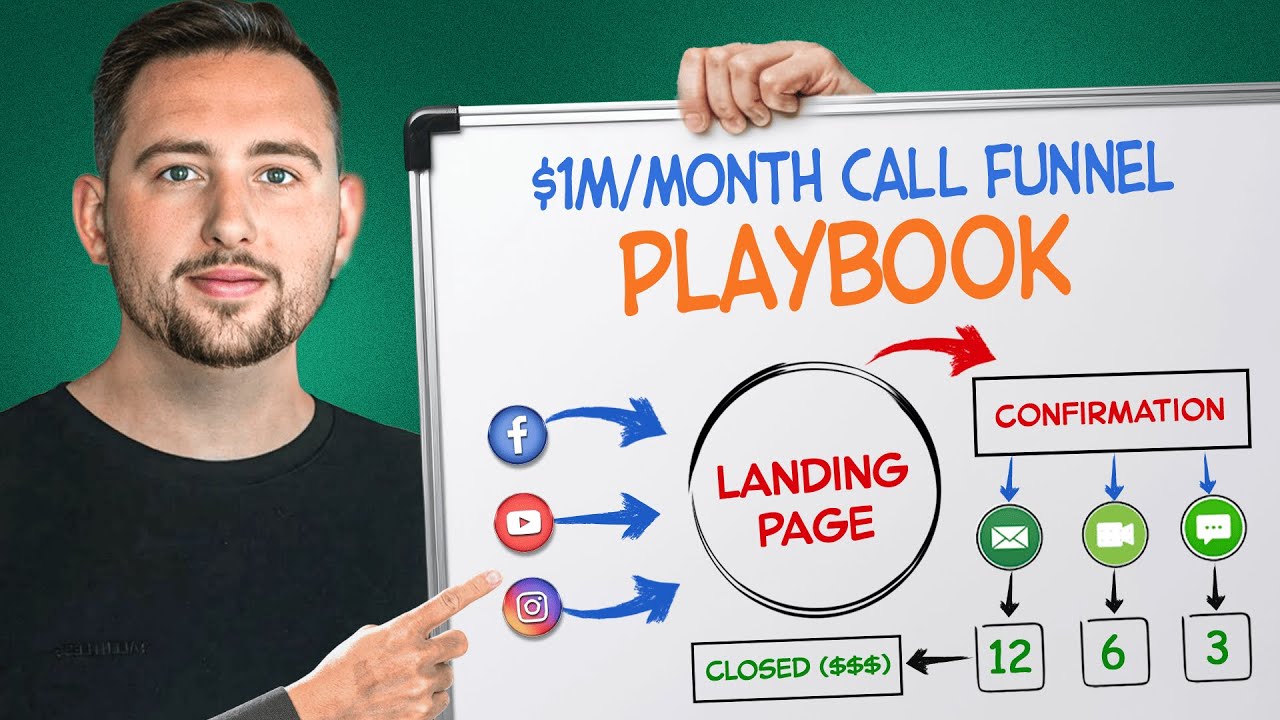
A call funnel operates through a straightforward qualification and scheduling process. Prospects fill out an application that determines whether they meet your criteria. Qualified applicants receive immediate access to schedule a call. Depending on your business model, setters may reach out to unqualified applicants or qualified prospects who haven’t yet scheduled. The qualified prospects who do schedule move directly to closers.
When paired with a solid high-ticket offer, this process becomes one of the most predictable operational frameworks available. The math is clean, the variables are trackable, and the system scales in a linear fashion.
The foundation, however, is the offer itself. Friction in your offer creates friction everywhere else. Sales teams struggle, cycles extend for weeks or months, and marketing costs reflect every point of resistance. A great offer, by contrast, makes the mechanics easier. The variables move in your favor, and the difference in how the system operates is dramatic.
The High-Ticket Pricing Threshold
High-ticket pricing fundamentally changes the framework. I define high-ticket as anything above $5,000, though $3,500 can work in certain contexts. There’s no upper limit. I’ve worked with businesses where accredited investor status and substantial minimums are required just to begin a conversation.
Once the offer and pricing structure are established, the marketing framework becomes the next critical variable. When selling to a wealthier demographic, these funnels typically combine direct response marketing with content advertising. I refer to this specific approach as the reverse fly trap (content strategies paired with direct response mechanisms) to create a complete system. The logic behind this holds up in the data: roughly 70% of the B2B buying journey happens before a prospect ever talks to a sales rep, which is exactly why the education layer has to come before the pitch.
Mapping Funnel Metrics That Actually Matter
Every call funnel requires precise metric mapping: cost per application, cost per call, show rate, and close rate. Cost per call matters more than cost per application. I optimize campaigns to send pixel data only when someone books a qualified scheduled call, not when they simply submit an application.
Cost per call varies dramatically based on business model and demographics. Show rates typically range from 50% on the low end to 70-80% on the high end. A higher show rate allows for a higher cost per call. A lower show rate requires a lower cost per call to maintain profitability. Higher average order values allow for higher costs across the board while still maintaining favorable unit economics.
All of this needs quantification in a financial model. Take ad spend, calculate how many calls will generate based on cost per call, determine how many will show based on show rate, apply your close rate, and multiply by average order value. Factor out commissions and expenses to arrive at net profit. Net profit must exceed ad spend for the math to work.
If your marketer isn’t building this kind of model, you have the wrong marketer. The framework can be financially projected by plugging in these statistics. When everyone understands the required KPIs ahead of time, accountability becomes straightforward. This is the same reasoning behind the KPI sheet I trust when pushing to $1M months — you’re worthless as an operator if you’re reacting to revenue instead of the leading numbers that predict it.
The Funnel Structure That Drives Call Generation
The funnels I build follow a simple architecture. A headline leads into what I call a mini webinar (structured template presentations ranging from 5 to 15 minutes) that deliver direct, focused messaging.
Below that sits the application. I prefer Typeform because it integrates well with Calendly, which dramatically reduces drop-off between application and scheduling. When these two elements are separated, you typically lose 50% of qualified applicants who complete the form but never schedule.
With the Typeform and Calendly integration, the scheduling step appears as just another application question. The psychology shifts: if someone invests time completing the application and reaches the scheduling step embedded within it, abandoning the process makes all that effort feel wasted. This pushes qualified applicant-to-scheduled-call conversion close to 100%.
After booking, prospects land on a confirmation page containing framing material, general information, and persuasive content designed to ensure attendance. The weakest marketers simply tell people to show up. That’s inadequate. You must persuade and sell people on showing up.
Email and Text Communication Architecture Between Booking and Call
Most operators fail at this stage. Between booking and the call, you need high-frequency communication, far higher than feels comfortable.
With 48 hours between scheduling and call time, I send as much framing and education content as possible through emails, texts, and content ads.
One client receives an email every 2 hours from 6am to 6pm: six emails in the first 12 hours, another six the second day. Within 48 hours, that’s 12 total emails.
Texts serve as reminders. Emails are not reminders. They’re framing and education content. With this 12-email sequence, I consistently see 50-80% open rates. People consume this content before their calls.
The reason this matters became clear through a personal experience. I received an ad for an opportunity to establish a company in Dubai to reduce tax burden. I scheduled a call, but it was a week away. They had seven full days to send education and framing material. They sent nothing.
So I conducted my own research: watched videos, consulted tax professionals, asked colleagues. Everything I discovered suggested it wouldn’t work and would increase audit risk. My interest level dropped from curious to zero. I didn’t show up for the call.
That company likely wonders why their show rate remains low. Prospects don’t wait passively. They research regardless of whether you provide information. Google’s own research into the “messy middle” of purchase decision-making confirms this: prospects bounce between exploration and evaluation on their own, whether or not you’re feeding them anything to work with.
Emails can’t be selfish reminders about attendance. They need to be educational framing material that helps the lead’s research process. Supplement what they would otherwise search for independently: testimonials, reviews, verifiable proof, objection handling, process walkthroughs, expectation setting. Guide their research rather than leaving it to chance.
The Content Retargeting Strategy for Lead Engagement
Beyond emails and texts, a content ad strategy is essential. I create a dynamically updating audience and deploy it across Facebook, Instagram, and sometimes TikTok. The volume of content these people see is substantial.
One client currently runs campaigns with an average frequency of 11 within 48 hours. Prospects see 11 pieces of content in that window.
I typically compile 25 pieces of content and structure them into a campaign optimized for engagement. Each ad set contains one piece of content with an exclusion audience. Once someone views a video for 3 seconds or more, they never see it again and immediately rotate to one of the other 25 videos.
The targeting is straightforward. I build a customer list of emails and phone numbers for people who scheduled calls within a rolling window. If the average show time is within 48 hours, I might create a 4-day audience. The audience needs at least 100 people for Facebook to utilize it effectively.
Marketing automation adds people to this audience when they book a call, then removes them after the defined timeline. The content addresses framing, objection handling, education, and testimonials (anything that increases interest level) before the call. This is the same underlying discipline behind a good show rate repair system — you’re not hoping people remember to show up, you’re engineering it.
Understanding Interest Levels and System Design
When someone books a call through marketing, they typically fall into one of several interest levels. The lowest is curious. Above that is general interest. Sales teams prefer not speaking with curious prospects, but most leads start somewhere between curious and general interest.
Both sales and marketing teams must work together to incrementally move people up these interest levels. The intention of direct response in a call funnel is generating a qualified scheduled call, but the work extends beyond that point.
Sales people perform best when prospects arrive at general interest or higher. If they speak with anyone below that threshold, they’ll claim the person wasn’t interested or wasn’t hot enough. The marketer’s job is sending enough content to essentially transform sales people into cashiers and order takers.
In my 7-week live comprehensive training, we map these interest levels and build content strategies around moving people through them.
Results are not typical. Your results will vary and depend entirely on your individual capacity, business experience, expertise, and level of desire. There are no guarantees concerning the level of success you may experience. The testimonials and examples used are not intended to represent or guarantee that anyone will achieve the same or similar results. We don’t believe in get-rich-quick programs. We believe in hard work, adding value and serving others. As stated by law, we can not and do not make any guarantees about your own ability to get results or earn any money with our information, courses, programs, or strategies.
The Sales Team Component
Beyond strong marketing, you need exceptional sales people. Proper structure, sales management, consistent training, and accountability are non-negotiable. Bottom performers get removed within a reasonable timeframe. The team needs high morale and appropriate compensation structure.
Sales people must understand they should exist in a perpetual state of wanting more deals. They need to update the CRM, send selfie videos introducing themselves, follow up with prospects, and execute the manual work that improves show rate.
Sometimes a setter or cleaner handles portions of this, but you need a great sales team regardless. Getting this right starts at the hire — if you’re building this team from scratch, this breakdown of how to find, vet, and hire elite closers covers exactly that. When you combine a great offer, great marketing, and a properly run sales team with talented people, the system operates smoothly.
Already making money? See what it takes to make a lot more.
Calculating Scaling Capacity Without Creating Bottlenecks
The final piece is scaling math. With a call funnel, determining how many call slots are available per day is straightforward. Marketing’s responsibility is filling the total quantity of available call slots.
When you successfully accomplish that or come close, the sales team’s job is hiring new setters and closers. This requires careful balance. As marketing pushes the total quantity of booked calls toward the limit, nothing can expand beyond that point until new closers join the team.
Recruiting and training new closers takes several weeks. Right before reaching full booking capacity, marketing needs to communicate this to the sales team so they can begin hiring and have someone trained in 3-4 weeks. This approach creates only a few days of downtime instead of weeks where scaling must pause.
The ideal scenario is perpetual scaling where you never stop because the sales team needs to hire. Sales teams naturally want to wait until they’re maxed out before hiring, but that approach creates weeks of stalled scaling. They need to feel comfortable hiring ahead of demand so when you hit the limit, you can immediately bring on another closer and maintain scaling momentum. This is the exact discipline behind good capacity planning — building in headroom before you actually need it, not scrambling once you’ve already hit the ceiling.
When all these elements align, you have a predictable framework. Businesses I’ve worked with have built consistent operations with call funnels. They’re predictable, and as long as the components continue performing, they remain one of my preferred funnel strategies.
Through Megalodon Marketing, our done-for-you agency services, we implement these exact frameworks. The structure remains consistent regardless of business model.
If you’re an established operator looking to build or refine this kind of system, my Inner Circle covers the complete framework.
Results are not typical. Your results will vary and depend entirely on your individual capacity, business experience, expertise, and level of desire. There are no guarantees concerning the level of success you may experience. The testimonials and examples used are not intended to represent or guarantee that anyone will achieve the same or similar results. We don’t believe in get-rich-quick programs. We believe in hard work, adding value and serving others. As stated by law, we can not and do not make any guarantees about your own ability to get results or earn any money with our information, courses, programs, or strategies.
Get my content first on Google
Add jeremyhaynes.com as a preferred source and Google shows my articles more prominently in your search results, including AI Overviews and AI Mode.


Jeremy Haynes
Owner and CEO of Megalodon Marketing
Jeremy Haynes is the founder of Megalodon Marketing. He is considered one of the top digital marketers and has the results to back it up.