The AI System That That Saves You Hundreds of Hours

I hope you enjoy reading this blog post. If you want my team to just do your marketing for you, click here.
Author: Jeremy Haynes | Published May 18, 2026
Earnings Disclaimer: You have a .1% probability of hitting million-dollar months according to the US Bureau of Labor Statistics. As stated by law, we cannot and do not make any guarantees about your own ability to get results or earn any money with our ideas, information, programs, or strategies. We don’t know you, and your results in life are up to you. We’re here to help by giving you our greatest strategies to move you forward, faster. However, nothing on this page or any of our websites or emails is a promise or guarantee of future earnings. Any financial numbers referenced here, or on any of our sites or emails, are simply estimates or projections or past results, and should not be considered exact, actual, or as a promise of potential earnings – all numbers are illustrative only.
The AI space moves quickly. Claude and other vendors release features constantly, and the volume of information to process is substantial.
In my organization, I do not focus on cracking AGI. I focus on use cases that apply to business operations and save time.
My business operates as a personal brand, which creates limitations in scale because many things rely on direct expertise. These constraints have shaped the business in different ways.
The most requested resource in my business is access to me. My prices have increased over the years for that access. Whether through consulting or done-for-you services, it costs more than it ever has.
I have explored different approaches to become more available and preserve time that would otherwise be spent in direct conversations.
7 weeks. Real frameworks. Covering copywriting, funnels, paid ads, and conversion systems.
Why Personal Expertise Creates Operational Bottlenecks
I wanted something that fit my business model.
My expertise is what I get compensated for. Because that expertise is finite, it has shaped my pricing over the years. The systems we’ve built for clients have also influenced that.
I wanted to create something that addressed availability constraints. AI might provide a framework for that.
I have experimented with different structures in the past but had not found the right fit until recently. This constraint mattered because it guided the architecture I needed to build, thinking in terms of software with different scale properties.
Margins matter to me. I focus on profitability and maintain specific margin profiles as we grow. Whether the system is used for client acquisition or factored into operations, I want to protect those margins.
I also prefer a smaller team. I do not enjoy managing large teams. At one point I had 27 people across three offices and was bi-coastal between LA and Miami. That was exhausting. Even with executives in place I felt like I was managing people.
Considering all these factors, the direction was clear: I needed to explore ways to make my expertise more accessible and find a framework to scale my availability.
How I Organized My Training Data for the AI System
I thought I had addressed knowledge capture before with education products and video libraries. I took information from video formats and converted it into written procedures.
Those procedures are extensive and contain detailed information, process steps, and the thinking behind them. The training videos I have range from a few minutes to about an hour each.
I needed a more efficient format for clients and students, so I started researching AI tools to create a knowledge system and found one.
The particular company I initially worked with had an annual fee of $25K. That didn’t seem unreasonable to us; it was an amount we were comfortable testing if it could address the problem.
This tool was going to create a knowledge base from my content. The first step was organizing all training materials: identifying and structuring the training data.
For example, I conduct many one-on-one calls, usually four days a week for about five hours on those days. I do one-on-one calls with people in my Inner Circle. Those calls are valuable training data.
I record all client calls from Megalodon Marketing and our consulting services. Every single consulting call up to that point became useful. I converted much of my content into procedures and have over a thousand training videos. I’ve been running an education company since 2017 and have accumulated substantial content.
Even if someone has less material, as long as they have documented expertise, that can be used. I also uploaded direct messages, texts, voice notes, entire community discussion histories, mastermind sessions I’ve led, and any events where I’ve spoken.
We included all public content like podcasts, every YouTube video I’ve done, social media posts, and any content from other people’s channels featuring me. All of that became part of the dataset.
I organized all that training data into a Google Drive folder. When I looked at the structure of what was included, I compared it to an iceberg: the public material is the small visible portion above the waterline, while most of the content (video libraries, written procedures, community discussions, one-on-one calls, consulting sessions, client meetings, texts, and direct messages) remains below the surface. Including all of that in the knowledge base made a significant difference to the quality of responses.
What the Time Allocation Data Showed
The very first thing this system did was change my time allocation. After the first version was created I immediately had time returned to me.
We implemented the first version in February 2025 as an internal support tool. It felt early to position it as a standalone service at that time. Pricing at $300/month looked high given market expectations and VC-subsidized AI pricing trends in early 2025 (see CB Insights’ State of AI 2025 Report on AI investment trends).
Today, the system is part of my business operations and the time allocation shift matters. Between February 2025 and February 2026, the system handled over 11,000 conversation threads.
The first tool I used provided analytics that tracked time per conversation as people interacted with it. The initial year was relatively light in volume, about 400,000 messages across those threads, which represents hundreds of hours I didn’t spend in back-and-forth communication.
This returned time to me and provided my clients, generally experienced operators looking to refine systems, with access they value. Clients in my Inner Circle speak positively about the AI system because it answers questions they’d normally ask me when I’m unavailable.
Results are not typical. Your results will vary and depend entirely on your individual capacity, business experience, expertise, and level of desire. There are no guarantees concerning the level of success you may experience. The testimonials and examples used are not intended to represent or guarantee that anyone will achieve the same or similar results. We do not believe in get-rich-quick programs. We believe in hard work, adding value and serving others. As stated by law, we cannot and do not make any guarantees about your own ability to get results or earn any money with our information, courses, programs, or strategies.
I film late at night sometimes. This piece was filmed at about 12:25 a.m. after a full day of calls. On call days I usually have four hours scheduled.
The AI system is available to clients in my Inner Circle, students in my 7-week live comprehensive training, and standalone system users in real time. They ask it questions and it responds immediately. There is a voice interface that sounds like me; that feature is used frequently and logs thousands of minutes per month.
In the most recent 30 days, usage increased substantially: 129,000 messages and over 2,200 unique conversation threads. That returned hundreds of hours to me that I didn’t have to spend in direct messages or calls. The AI system often provides responses faster than I can; when communicating with me directly on substantive matters, I usually respond two to three times a day if that level of access is included.
I offer access to the system, now called Jeremy AI, for $1,000 a month at jeremyhaynesai.com.
How I Structured the AI System as a Service
When I started positioning the system as a service, the approach changed.
I discussed the system and a transition we were making due to limitations with the first platform. We launched officially around mid-April and began tracking monthly recurring revenue (MRR) and annual recurring revenue (ARR). A month later the revenue levels increased proportionally and the revenue structure functioned as designed.
Why I Changed the Platform Infrastructure
The first company I used was called Delphi, which raised a $16 million Series A with participation from Anthropic’s Anthology Fund (see Fast Company’s coverage of Delphi’s funding and product). Delphi creates AI knowledge bases but provides essentially a chat interface and had practical limitations.
Starting March 28th, as I promoted the system, I began receiving limitation notifications. By April 1st there were many such notifications. Over the first days of launch we accumulated dozens of instances where the system couldn’t answer a question.
Common issues included:
- Inability to process shared links or analyze URLs.
- Character-count rejections when pasting long transcripts or high-character content (which only triggered after typing).
- File size and file type restrictions (PDFs, spreadsheets, presentation files were limited or unsupported).
These were real problems creating friction for subscribers. Delphi had no plans to add agentic functionality or address many of the file/character limitations, so I decided I couldn’t accept those constraints.
Building the Utari Eternal Platform
I moved away from Delphi and chose to use a platform I already owned: Utari. Utari had been an AI tool platform and a standalone service; I discontinued the previous version, canceled subscriptions (providing access until the end of billing periods), and repositioned the product as Utari Eternal.
If you visit utari.ai you’ll see messaging for our Eternal product where we’re now creating AI systems for others. The experience was positive in three ways:
- I was able to provide a better system to clients in my Inner Circle.
- I could provide better quality to standalone users who expected more functionality.
- I could add agentic capabilities and connectors that were not possible on Delphi.
Users expect basic things such as the ability to share a link for analysis and to input long-form content. Utari Eternal supports those capabilities and removes the file size, file type, and character-count limitations encountered previously.
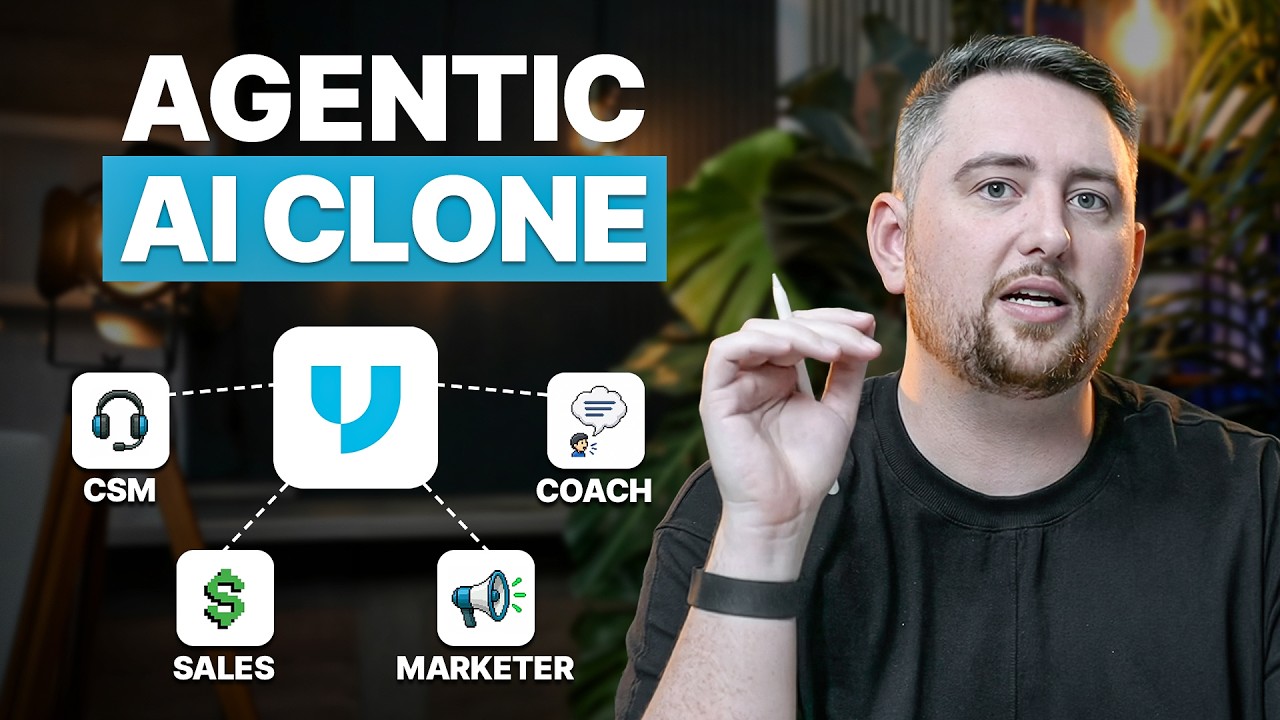
Utari Eternal has agentic capabilities. An agent can perform tasks someone might do at a computer. My system can connect to advertising accounts (Facebook, Google, and others) and analyze data, suggest adjustments, and provide scaling frameworks based on the knowledge derived from my one-on-one calls and other source material.
Delphi indicated they had no plans to add agentic functionality and wanted to remain focused on chat interfaces. I wanted to deliver a better product to people working with me. Utari Eternal still saves me substantial time and now functions as a service offering.
How AI Systems Are Changing Information Products
For people in the education space, this represents an evolution. I teach marketing frameworks, sales systems, and business operations. The traditional model (watching many videos, attending weekly group calls, participating in group discussions, or talking to customer success managers to extract value) is shifting.
People will increasingly expect an agent that guides them through implementation. They will want more than content consumption; they will expect an agent representing you.
That product structure will become normative. You will be early to something people naturally expect, and they’ll be confused when you don’t offer it.
We’ll create a system using your knowledge and voice (with your permission) so users can interact by phone. It will auto-translate into multiple languages (see Slator’s coverage of AI live speech translation adoption). It has agentic functionality and connectors.
My AI system can connect to advertising accounts, CRM systems, analytics sources, tracking dashboards, and APIs. If one of the thousands of existing connectors doesn’t apply, the platform still supports general API connectivity.
We don’t have the limitations Delphi had with file size, file types, or character counts. The system is continuously trained on my content: we autosync a Google Drive folder each day and newly documented content is incorporated. The AI system reflects content from one day prior.
Already making money? See what it takes to make a lot more.
Technical Architecture of the Utari Eternal System
Rather than simply storing knowledge in a database and letting users query it, the system recalls information from the database and references skill.md files we create from your training data.
All training data provided to Utari Eternal is analyzed and broken down into capabilities the agent can execute when prompted. These capabilities make the product more functional and valuable.
When you get started, we review your application, organize your training data (if you choose to move forward), deploy your system, and create what we call instances.
Instances are specific to different use cases. One of my instances is for internal team use: the AI system is the first resource for team members, keeping them from requiring my direct time. My marketing staff, video editors, executives, and assistants can ask the AI system first and have the agent perform tasks I would otherwise do. That saves time internally.
Time-allocation analytics from the first system demonstrate the effect:
- 440,000 messages
- 28,000 total conversation threads over 12 months
- In the most recent 30 days on the previous system: 270 users, 89,530 messages, with about four minutes per conversation on average
The time returned is measurable and the revenue structure is functioning. Delphi charges $25K annually for essentially a chat interface with limited functionality. Utari Eternal is priced at the same level and delivers agentic execution, voice, integrations, and none of those file or character limits.
Access to Jeremy AI is $1,000 a month, by application at jeremyhaynesai.com. If you want a clone of your own brain instead, Utari Eternal builds and hosts one for $25,000 a year, by application at utari.ai.
This is the most accessible offering I’ve created and it demonstrates the capabilities and technology built with a development team. We’ve already onboarded multiple clients. Dozens have moved forward and had their systems created.
Be early to this. Deliver it first. You’ll appear forward-thinking and show clients you care by providing the technological advantage that an agentic AI system creates.
If you want to explore how this applies to your business, you can learn more about my 7-week live comprehensive training where we cover systems like this, or apply for my Inner Circle where clients get direct access to these frameworks.
Results are not typical. Your results will vary and depend entirely on your individual capacity, business experience, expertise, and level of desire. There are no guarantees concerning the level of success you may experience. The testimonials and examples used are not intended to represent or guarantee that anyone will achieve the same or similar results. We don’t believe in get-rich-quick programs. We believe in hard work, adding value and serving others. As stated by law, we cannot and do not make any guarantees about your own ability to get results or earn any money with our information, courses, programs, or strategies.
Get my content first on Google
Add jeremyhaynes.com as a preferred source and Google shows my articles more prominently in your search results, including AI Overviews and AI Mode.


Jeremy Haynes
Owner and CEO of Megalodon Marketing
Jeremy Haynes is the founder of Megalodon Marketing. He is considered one of the top digital marketers and has the results to back it up.