
Cost Cap vs Bid Cap and How to Choose for Your Meta Ads

I hope you enjoy reading this blog post. If you want my team to just do your marketing for you, click here.
Author: Jeremy Haynes | Published October 22, 2026
Earnings Disclaimer: You have a .1% probability of hitting million-dollar months according to the US Bureau of Labor Statistics. As stated by law, we cannot and do not make any guarantees about your own ability to get results or earn any money with our ideas, information, programs, or strategies. We don’t know you, and your results in life are up to you. We’re here to help by giving you our greatest strategies to move you forward, faster. However, nothing on this page or any of our websites or emails is a promise or guarantee of future earnings. Any financial numbers referenced here, or on any of our sites or emails, are simply estimates or projections or past results, and should not be considered exact, actual, or as a promise of potential earnings – all numbers are illustrative only.
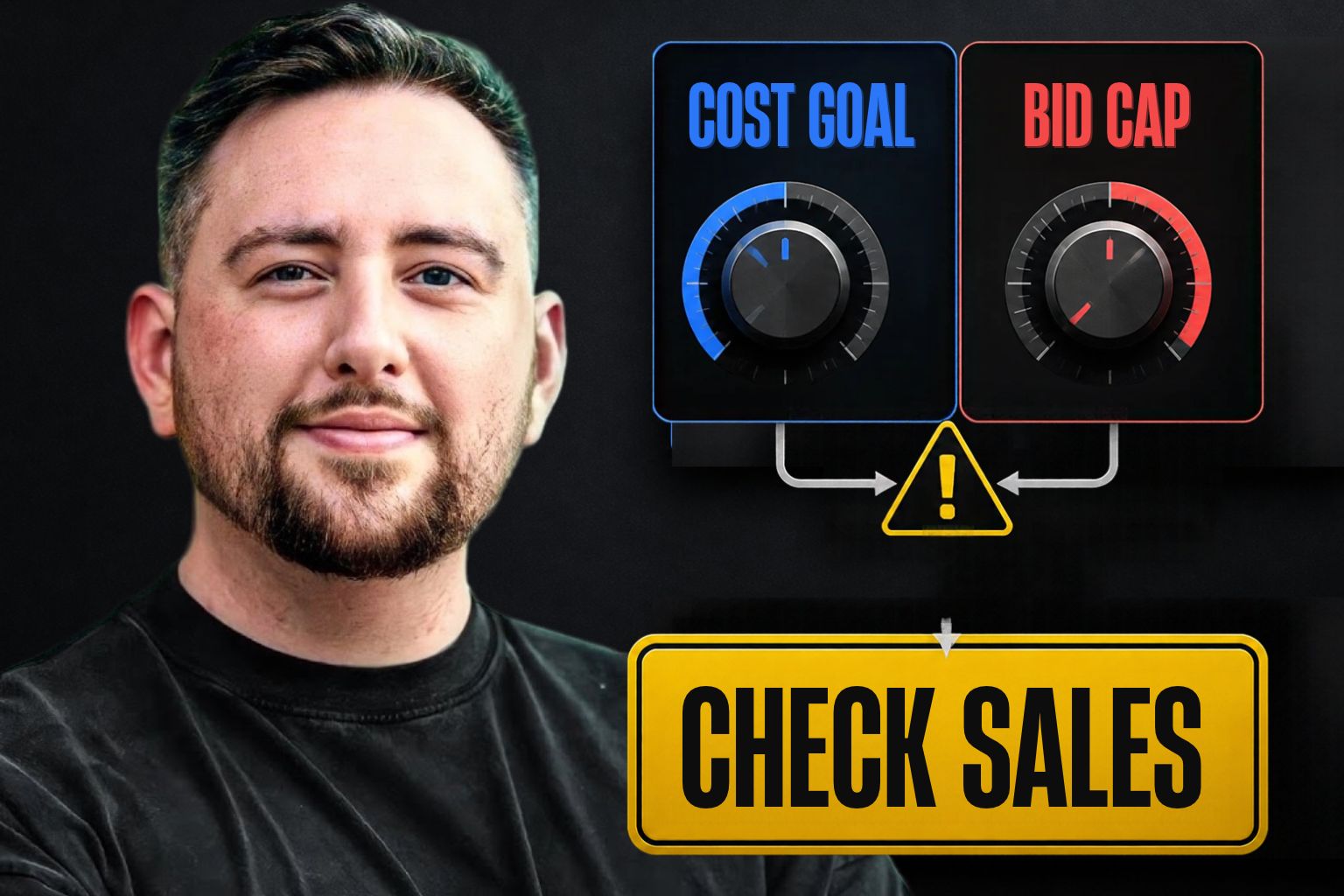
Choosing cost cap vs bid cap starts with knowing which number you want Meta to control. A cost per result goal aims at an average cost for the result you selected. A bid cap limits the bid per estimated action in the auction. If you choose a bid cap expecting a guaranteed maximum cost per sale, you are asking that setting to do a job it does not do.
I want the business math clear before the bidding discussion. What counts as a result, what is it worth, and how much room does the business have if acquisition gets more expensive? A stricter-looking setting cannot answer those questions for you.
Already making money? See what it takes to make a lot more.
How Cost Per Result Goals Guide Meta’s Bidding
A cost cap is the term I use for a cost per result goal. You set the average cost you want Meta to work toward for the selected event, such as a lead or purchase. The system adjusts its bids in pursuit of that goal.
That leaves room for variation. Individual results can cost different amounts, and the actual average can differ from the goal. Entering a number does not establish that the audience, creative, and funnel can produce results at that price.
Meta’s cost per result goal documentation describes the balance between conversion volume and an average cost target. It also distinguishes that goal from highest volume, which prioritizes using the available budget. A cost target can mean accepting less delivery.
That is why the phrase spend my whole budget while protecting my cost needs care. There may not be enough suitable opportunities for both. Decide which condition matters to the business before you judge the campaign for failing to satisfy an impossible combination.
If the campaign is generating qualified calls at an acceptable cost but leaving budget unspent, read both facts together. The cost result may be acceptable while the available volume is limited. Increasing the budget alone does not establish that more qualifying opportunities exist.
Bid Cap Controls a Bid Per Estimated Action
A bid cap controls the maximum bid per estimated action in the auction. The word estimated matters because the platform is making a prediction before the person actually takes the action.
Meta’s bid cap explanation says it is intended for advertisers who understand how their maximum bid corresponds to reported outcomes. The documentation explicitly says the setting provides no guarantee on actual outcomes.
A maximum auction bid is not a guaranteed maximum cost per customer. The campaign can comply with its bid restriction and still report a cost per result that disappoints you. Those statements describe different parts of the process.
This is where I would slow the decision down. Being able to type a bid into the field does not mean you know how it relates to the sales result you need. If the goal is simply to manage average acquisition cost, make sure the case for manual bid control goes further than wanting a hard-looking number.
Decision | Cost per result goal | Bid cap |
|---|---|---|
What you specify | The average cost per selected result you want | The maximum bid per estimated action |
What you must watch | Actual average cost and delivered volume | How the bid translates into actual cost and volume |
What it cannot promise | Every result at or below the goal | Every conversion at or below the bid |
A Cheap Lead Can Still Be an Expensive Customer
The event you optimize for decides what the cost goal describes. A lead event describes a lead. It does not establish that the person can buy, attends a call, or becomes a customer.
I connect the event back to the rest of the funnel before using it as the basis for more spend. Look at what happens after the reported result. If application quality changes or fewer people attend, the same cost per result can represent a different business outcome.
This is why marketing math has to reach beyond the ad account. Advertising spend, applications, attended calls, sales, and collected cash describe different steps. The number you are trying to control needs to match the step you actually selected.
Keep the definitions visible in the report. Cost per lead should mean advertising spend divided by recorded leads. Cost per customer needs the customer count. Avoid calling a cheaper event cheaper acquisition until the sales record supports that conclusion.
A bidding change can alter delivery without repairing the explanation on the landing page. If buyers misunderstand what they are applying for, the resulting sales problem still exists. Give the media buyer that feedback, because the message and conversion data still affect who the campaign reaches.
When Cost Per Result Goal Fits Better Than Bid Cap
Choose a cost per result goal when the decision is about the average cost of the selected event. Choose bid cap only when you have a specific reason to control the auction bid and can interpret what that control produces.
That is more useful than assigning a bidding strategy to an industry. A fixed payout or tight margin tells you that costs matter. It does not prove that a particular bid will protect that margin.
I use cost per result goals in my discussion of scaling call funnels because the acceptable cost has to stay connected to the business model. The goal gives the platform a cost condition to work with. You still have to judge what happened after the money was spent.
Highest volume also deserves an honest comparison. It prioritizes delivery rather than a specified cost target. If you need evidence about current acquisition costs, recognize what an unconstrained test can spend and set the business’s risk limits accordingly.
There is no required ladder where every account graduates from highest volume to cost cap and then to bid cap. A more manual control is not a certificate that the account has become more advanced. Use the setting whose behavior fits the question you are trying to answer.
Master Internet Marketing, my 7-week live comprehensive training, connects the broader work of advertising, copy, and funnels. The bidding choice belongs in that wider picture. It cannot replace knowing what the offer and sales process can support.
Results are not typical. Your results will vary and depend entirely on your individual capacity, business experience, expertise, and level of desire. There are no guarantees concerning the level of success you may experience. The testimonials and examples used are not intended to represent or guarantee that anyone will achieve the same or similar results. We don’t believe in get-rich-quick programs. We believe in hard work, adding value and serving others. As stated by law, we can not and do not make any guarantees about your own ability to get results or earn any money with our information, courses, programs, or strategies.
A Cap Can Hold While Actual Cost Still Runs Higher
Actual cost per result can exceed a bid cap or cost per result goal. The auction works with estimated actions, while reporting counts the actions that actually occurred. A prediction can be wrong even when the bidding restriction was followed.
Meta’s explanation of costs exceeding a cap makes that distinction explicit. It defines cost per result as spend divided by actual conversions and explains why predicted conversions can differ from realized conversions.
Read the delivery and result together before deciding the platform ignored your instruction. Check the event being counted and the period being reviewed. Then inspect whether the campaign generated the volume and buyer quality your decision depended on.
That does not mean accepting an unacceptable loss while waiting for a setting to work. Your maximum loss on an ad test is a separate business boundary. Keep it in place even when the platform is following the bid strategy correctly.
Do not put all the responsibility for protecting the company into a bid field. Keep actual spend, actual results, and the money the business can afford to risk visible to the person making the next decision.
Read Underspending Before Raising the Budget
Underspending tells you the campaign did not use the available budget. It does not, by itself, tell you that the budget needs to increase. A restrictive cost goal or bid cap can leave fewer opportunities for delivery.
Look at the restriction before adding more money above it. Does the campaign have room to bid under the conditions you selected? Is the audience appropriate, and is there useful conversion evidence? Are you looking at a delivery issue or at people reaching the funnel and declining the offer?
A low-cost target that barely produces any results also deserves a careful label. You may have a small amount of acceptable delivery. You do not yet have evidence that the campaign can produce the volume the business needs at that cost.
I make the same distinction when considering a larger budget increase. First identify whether the budget is actually what holds the campaign back. More spending capacity does not automatically resolve a constraint elsewhere.
There may be a real tradeoff to make. Accept less volume at the current goal, test another viable goal within the economics, or improve the ad and funnel. Name the tradeoff rather than lower the target until the campaign stops spending and call that better performance.
Know What Changed When You Test a Different Bid Strategy
The next bidding test needs a clear baseline. Keep a record of the strategy, selected event, actual spend, cost per result, and the downstream sales outcome. That gives you something concrete to compare with the new use.
If you change the goal, creative, destination, and offer together, the result describes that whole combination. It will be hard to explain how much the bidding change contributed. You can choose to rebuild, but be honest about what the test can establish.
Use a review period that makes sense for the outcome. A lead can arrive before its scheduled sales conversation. Looking at that advertising spend while ignoring the unfinished calls creates an incomplete read.
The VSL calculator can help connect assumptions about calls, sales, and acquisition cost in a hypothetical model. Check the assumptions against your own records. The model does not guarantee the next campaign will behave that way.
Keep the successful message and sales path in view while you examine the strategy. A cost-control test should answer something specific about bidding. It should not become an excuse to ignore a weak offer or a confused buyer.
7 weeks. Real frameworks. Covering copywriting, funnels, paid ads, and conversion systems.
Judge the Bid Strategy on the Sales It Produces
The right bid strategy earns its place through the actual cost and volume it produces for the business. Start by defining the result. Then decide whether you need an average cost goal or a specific auction-bid restriction.
For cost cap, watch what happens around the average goal and whether the volume is useful. For bid cap, understand how the auction restriction translates into reported results. Keep the spending limit separate from the performance target.
Neither setting guarantees profit or removes the need to follow the lead through sales and collection. If the campaign looks efficient while the sales record gets worse, that discrepancy belongs in the next decision.
In my Inner Circle, operators can compare these decisions with peers. Bring the event definition, the actual delivery, and the business outcome. Those details make the bidding conversation useful instead of turning it into an argument about which dropdown option sounds safest.
Results are not typical. Your results will vary and depend entirely on your individual capacity, business experience, expertise, and level of desire. There are no guarantees concerning the level of success you may experience. The testimonials and examples used are not intended to represent or guarantee that anyone will achieve the same or similar results. We don’t believe in get-rich-quick programs. We believe in hard work, adding value and serving others. As stated by law, we can not and do not make any guarantees about your own ability to get results or earn any money with our information, courses, programs, or strategies.
Get my content first on Google
Add jeremyhaynes.com as a preferred source and Google shows my articles more prominently in your search results, including AI Overviews and AI Mode.


Jeremy Haynes
Owner and CEO of Megalodon Marketing
Jeremy Haynes is the founder of Megalodon Marketing. He is considered one of the top digital marketers and has the results to back it up.