How I Decide Between an In-House Creative Team and an Agency

I hope you enjoy reading this blog post. If you want my team to just do your marketing for you, click here.
Author: Jeremy Haynes | Published September 25, 2026
Earnings Disclaimer: You have a .1% probability of hitting million-dollar months according to the US Bureau of Labor Statistics. As stated by law, we cannot and do not make any guarantees about your own ability to get results or earn any money with our ideas, information, programs, or strategies. We don’t know you, and your results in life are up to you. We’re here to help by giving you our greatest strategies to move you forward, faster. However, nothing on this page or any of our websites or emails is a promise or guarantee of future earnings. Any financial numbers referenced here, or on any of our sites or emails, are simply estimates or projections or past results, and should not be considered exact, actual, or as a promise of potential earnings – all numbers are illustrative only.
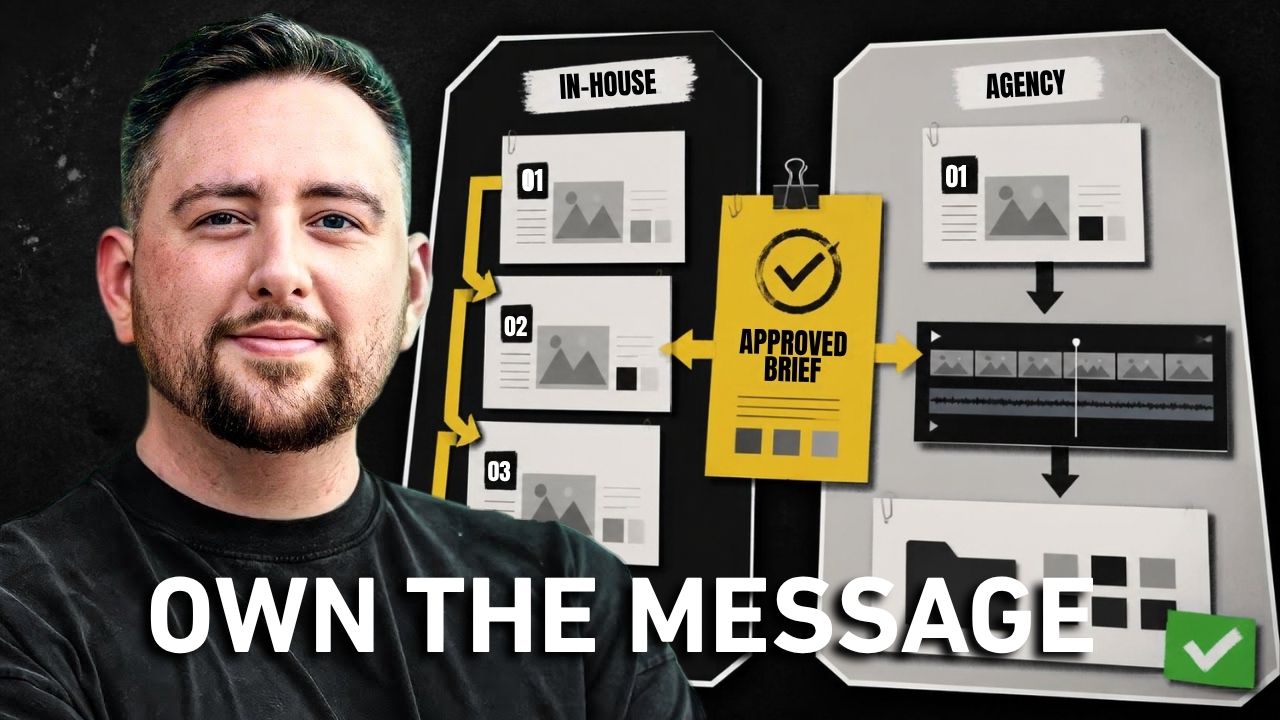
Should you hire an in-house creative team or use an agency? I would first ask who decides what the ads need to say, how often the work changes, and who can give useful feedback. A payroll hire can sit close to the business and still wait days for a clear brief. An agency can turn work quickly and still make the wrong ads if nobody inside owns the message.
The choice gets easier when you separate creative direction from production. You may need one person who knows the buyer and the offer, a steady production team, or a specialist for a format you rarely use. Those are different jobs. I would name the missing job before comparing a salary with a retainer.
Already making money? See what it takes to make a lot more.
Who Decides What the Ad Should Say
Someone has to decide which buyer problem the ad addresses, what evidence supports the claim, and what the buyer sees after the click. If those decisions are missing, hiring a designer only gives you more polished uncertainty. The same goes for giving an agency a vague request to make the ads more exciting.
I would put an owner on the message before adding more production capacity. That person may be the founder, a marketing lead, or a creative strategist. They should read sales feedback and understand the offer well enough to reject an attractive ad that promises the wrong thing.
The principle in supporting marketing claims with proof applies to the brief as much as the finished ad. A writer or editor cannot supply evidence the business never gave them. Give them the customer language, approved proof, objections, destination, and specific decision the ad should help someone make.
Keep ownership of the promise close to the business. You can move execution across teams more easily than you can recover from a message that attracts the wrong buyer.
The Workload Behind the In-House Creative Decision
Count the work you actually need, then separate repeated work from occasional specialist work. How many briefs are approved and ready to produce? Which formats recur? Which tasks sit in a queue because nobody has time to edit, design, or review them?
A business with a predictable stream of short-form edits may have enough recurring work for an editor. A business that needs a launch film now and another months later has a different problem. Hiring for the rare peak can leave that person underused between projects. Outsourcing every routine edit can create its own queue and handoff cost.
Look past the headline salary. The Bureau of Labor Statistics’ employer-cost data separates wages from benefit costs, which is a useful reminder that payroll is more than the wage alone. Your own comparison also needs recruiting, supervision, software, and the time spent bringing someone up to speed. Compare those with an agency’s scope, revision terms, and the time your team will spend managing it.
Neither side has a universal price advantage. The decision depends on the work the business can keep ready, the quality of direction, and the cost of delay when a needed asset misses its window.
What Changes When Creative Work Sits Inside the Team
An in-house person can hear the sales team discuss objections, see which offers are changing, and ask a question without a formal handoff. That proximity matters when the business needs frequent revisions to an active campaign. It also makes it easier to spot a mismatch between the ad and the landing page before a whole batch goes live.
Proximity alone does not produce good decisions. A full-time editor cannot fix an unclear buyer, an unapproved claim, or a founder who changes direction after every review. Give the person a clear owner, a usable brief, access to performance feedback, and a defined approval path. Otherwise, their day fills with revisions that teach nobody anything.
I would also avoid hiring one creative generalist to own strategy, copy, editing, design, and production. Those skills can overlap, but the job description should reflect the work you truly need done. The point of an in-house role is to remove a specific recurring bottleneck.
The role scorecard approach helps here. Give the role an outcome it can influence and enough authority to do the work. Counting finished assets is useful for workload, but it cannot tell you whether those assets helped the right prospects reach sales.
Where an Agency Can Help Without Owning the Offer
An agency can bring a production team to work that would be awkward to staff permanently. That may include a specialized format, a campaign with a defined end, or overflow when your normal queue gets full. The agency should be able to explain how it turns a brief into concepts, revisions, and usable files.
Keep the buyer, offer, approved proof, and sales feedback in your hands. Then ask the agency to show how its work will express those decisions. If it proposes an angle that changes the promise, the business owner needs to approve that change before production continues.
Meta’s update on ad creative tools describes more ways advertisers can make and adapt assets. That expands the production menu. It does not tell you which outside partner understands your buyer or whether an extra variation teaches you anything useful. I would still judge the work against the offer and the sales conversation after the click.
I also want clarity on the handoff. Ask which source files you receive, which accounts hold the work, and what the contract says about using or changing the finished assets later. The U.S. Copyright Office’s work-for-hire explanation is a reminder that commissioned work and employee work are treated differently. Get the agreement reviewed for your situation rather than assuming payment alone settles every rights question.
Why a Hybrid Team Still Needs One Creative Owner
A hybrid setup can be simple. Keep the person who knows the customer and approves the message inside the business. Use an editor, designer, freelancer, or agency for the production work that fits their skills and your actual volume. Change that mix as the queue changes.
The failure point is unclear ownership. When everyone can request an ad and nobody decides which request matters, both the employee and the agency receive conflicting direction. One owner should approve the brief, decide what to test, collect the sales feedback, and tell production what changed.
This is separate from the broader marketing team structure. You do not need to copy another company’s org chart. Identify which decisions must stay near the offer and which tasks can move to a specialist without losing context.
Inside Master Internet Marketing, my 7-week live comprehensive training, I teach operators to connect the ad, offer, and sales path before adding complexity to the team doing the work.
Results are not typical. Your results will vary and depend entirely on your individual capacity, business experience, expertise, and level of desire. There are no guarantees concerning the level of success you may experience. The testimonials and examples used are not intended to represent or guarantee that anyone will achieve the same or similar results. We don’t believe in get-rich-quick programs. We believe in hard work, adding value and serving others. As stated by law, we can not and do not make any guarantees about your own ability to get results or earn any money with our information, courses, programs, or strategies.
Give an Outside Partner a Real Brief to Work From
Before signing a large scope, I would give a prospective partner one actual business problem. Show them the current ad, the page it leads to, approved claims, and sales notes from people who responded. Ask what they would change, which part they would leave alone, and what they need from your team to do the job.
The response tells you more than a gallery of attractive work. A strong partner should be able to explain the buyer decision behind a creative choice. They should also be willing to say where the brief is missing proof or where the destination will weaken the ad.
Then define the working relationship in plain terms. Who supplies the raw material? Who approves claims? Who makes revisions? How will you discuss what the ads brought into sales? A team can make beautiful work and still be a poor fit if every useful change gets stuck in the handoff.
The production brief should leave room for testing. The creative-family approach is useful because variations share a recognizable idea. Whether your editor or an agency makes them, keep track of what changed so a result can inform the next brief.
Hire for the Creative Bottleneck That Keeps Returning
I would consider an in-house hire when the same kind of work keeps blocking the team and there is enough ready work to fill the role. The best first role depends on the bottleneck. If briefs are weak, another editor will spend time waiting. If the message is clear but footage sits untouched, editing may be the missing capacity.
Watch the approval queue too. If a founder takes too long to decide which concept is right, adding production capacity will make the pile larger. Fix the decision path first. If the business is consistently using an agency for recurring work, then compare the full cost and delivery of that arrangement with an in-house role.
Creative polish should not become the hiring goal by itself. Some high-ticket ads work with a less polished presentation when the message feels direct and believable. The team should make the format the buyer needs, not build a studio because the company can now afford one.
7 weeks. Real frameworks. Covering copywriting, funnels, paid ads, and conversion systems.
The Choice I Would Make Before Adding a Creative Salary
I would look at the last batch of briefs, the time each spent waiting, the revisions they needed, and what happened after the ads ran. If production is the repeated delay and the work is steady, an in-house role may earn its place. If the work arrives in uneven bursts or calls for skills you rarely need, an outside partner can fit better.
When the business needs both a close owner for the message and flexible specialist production, I would split the work that way. Put accountability inside and buy the execution you cannot yet justify hiring for. Recheck the arrangement when the workload changes.
Operators in my private mastermind, Inner Circle, can pressure-test this hiring choice with peers who know the cost of adding a role before the work is ready for it. The right model keeps the buyer promise clear and gets useful creative into the market without building a team around guesses.
Results are not typical. Your results will vary and depend entirely on your individual capacity, business experience, expertise, and level of desire. There are no guarantees concerning the level of success you may experience. The testimonials and examples used are not intended to represent or guarantee that anyone will achieve the same or similar results. We don’t believe in get-rich-quick programs. We believe in hard work, adding value and serving others. As stated by law, we can not and do not make any guarantees about your own ability to get results or earn any money with our information, courses, programs, or strategies.
Get my content first on Google
Add jeremyhaynes.com as a preferred source and Google shows my articles more prominently in your search results, including AI Overviews and AI Mode.


Jeremy Haynes
Owner and CEO of Megalodon Marketing
Jeremy Haynes is the founder of Megalodon Marketing. He is considered one of the top digital marketers and has the results to back it up.