Jeremy Haynes Spoke to a Room of Eight-Figure Business Owners Including a Woman Selling $100 Million in Cow Feed and Revealed Why High Friction Funnels Create 70% Show Rates While Free Webinars Get 10%
I hope you enjoy reading this blog post. If you want my team to just do your marketing for you, click here.
Author: Jeremy Haynes | Published December 31, 2025
Earnings Disclaimer: You have a .1% probability of hitting million-dollar months according to the US Bureau of Labor Statistics. As stated by law, we can not and do not make any guarantees about your own ability to get results or earn any money with our ideas, information, programs, or strategies. We don’t know you, and besides, your results in life are up to you. We’re here to help by giving you our greatest strategies to move you forward, faster. However, nothing on this page or any of our websites or emails is a promise or guarantee of future earnings. Any financial numbers referenced here, or on any of our sites or emails, are simply estimates or projections or past results, and should not be considered exact, actual, or as a promise of potential earnings – all numbers are illustrative only.
Haynes discusses why paying $70 to $90 for a virtual event drives 70%+ show rates versus 10% to 20% for free webinars, how a client spending $1 million on a challenge funnel expects $6 to $8 million back, and why call funnels at 1.4x ROAS paired with 3x to 5x webinars create the blended profitability needed to scale past stagnation.
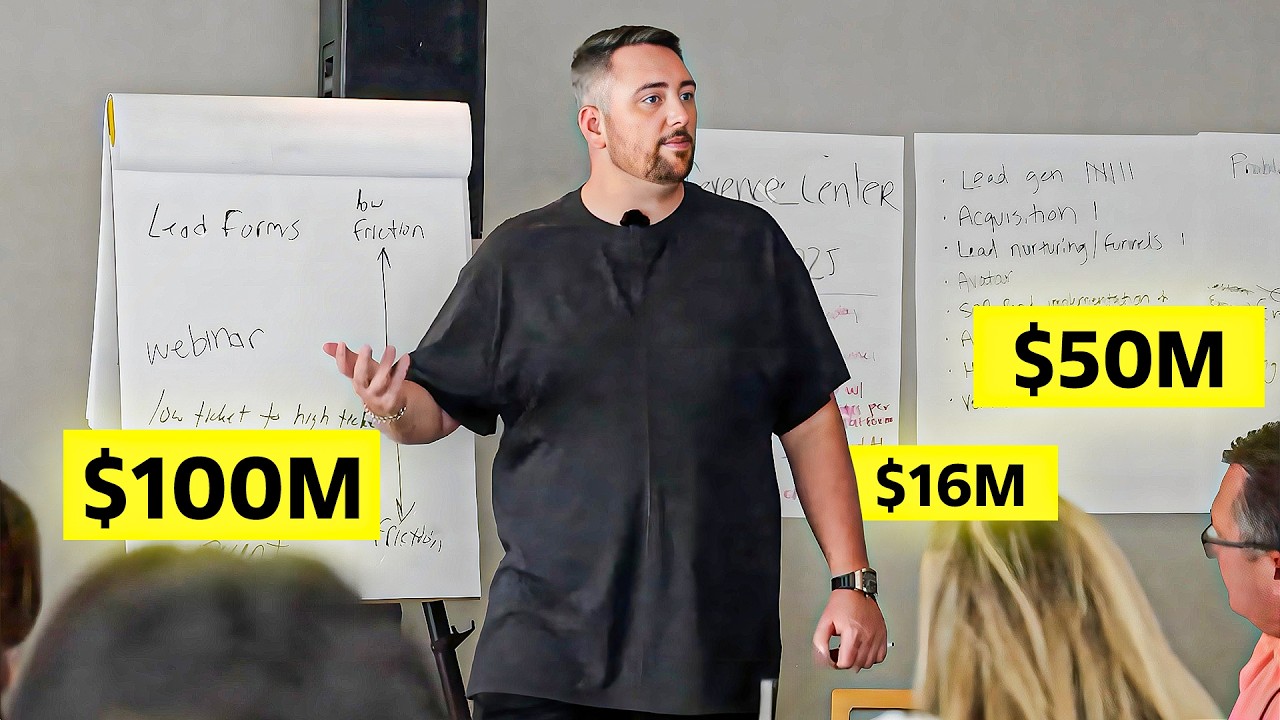
Jeremy Haynes spoke at a Cody Sanchez mastermind in Miami. The room included a woman selling $100 million-plus annually in cow feed to farmers and a guy doing over $100 million in logistics through trucking and port distribution partnerships. Haynes felt like an idiot. If someone can pedal $100 million in cow feed, he should be able to pedal $100 million in high-ticket products and services. He broke down friction versus intent across lead generation systems, why businesses stall when margins shrink, and how adding funnels with higher profit margins unlocks the cost of growth needed to scale without going broke in the process.
Why High Friction Lead Generation Brings Fewer People But They Show Up Ready to Buy
Lead forms bring high volume but low intent. Most organizations find them ineffective because their sales teams aren’t killers. Hungry, high-desire salespeople willing to do whatever it takes to close deals. Without that, lead forms fail.
Low friction means more people come through. But they show up with lower intent. Compare that to high friction funnels. Fewer people make it through. But the ones who do show up ready to buy.
Haynes gave a personal example. He walked into a Vacheron Constantin boutique in Manhattan wanting to buy a specific watch. The Overseas Perpetual Calendar in all rose gold. He knew the game. They wouldn’t sell it to him without making him buy other watches first.
“I know how the game works. Go upstairs and grab some random watches for me to buy. Preferably men’s watches,” Haynes told the sales associate.
The guy brought down three old-man watches. $40,000, $50,000, $45,000. Haynes picked one, asked for a black strap, and checked out. A week later, the boutique called. Sold him the $108,000 watch he originally wanted. Sent it in an armored truck with a security code required for drop-off.
That’s high friction. You have to buy something first before you can buy what you actually want. But once you’re in, the probability you buy the next thing skyrockets.
Why Charging Seventy to Ninety Dollars for a Virtual Event Drives Seventy Percent Show Rates Instead of Ten
Challenge funnels make people pay for access to a virtual event. Usually $70 to $90. Then there are upsells on the back end. The event typically lasts three days. During the event, you sell them on higher-ticket offers.
Why charge for the event? Information you paid for gets more attention than information you got for free. When someone pays even tens of dollars, their show rate jumps dramatically.
“Free webinars get 10% to 20% show rates. Paid challenge funnels get 70%-plus,” Haynes explained.
The fruits and vegetables analogy applies here. If you pay too little for something, like fruits and vegetables, they sit in your fridge and go bad. You throw them away without caring. But if you pay $500 for olive-fed A5 Kobe beef straight from Japan with a certificate proving it was massaged daily to ingrain fat throughout the muscle? You cook that thing within an hour of opening the box.
Charging $70 to $90 is enough for 70% of people to take it seriously. The other 30%? Fruits and vegetables. You could arguably charge more and increase the show rate even higher by eliminating that 30% who won’t consume anyway.
But if you give it away for free, only 10% to 20% consume it. The room Haynes was speaking to paid to be there. That’s why they set aside the weekend. Because they paid. And what they paid for is also a revenue-driven action.
One Inner Circle member went from a 36% show rate to a 74% show rate and made $178,000 within his first month of joining. He paid $5,000. Made it back in under two weeks. What got him that result? Only the confirmation page videos. He didn’t do anything else. He’d only been in the program for two weeks.
Where Webinars Sit on the Friction Spectrum Between Free Lead Magnets and Paid Challenge Funnels
Webinars fall right in the middle of the friction spectrum. You can do paid webinars framed as master classes, trainings, or workshops. That moves them further down the friction spectrum toward higher intent.
Or you can do free webinars. That moves them higher on the spectrum toward lower intent but higher volume.
When running cold paid advertising to people who have no idea who you are, free webinars average about 10% to 15% show rates. If you get higher than that, you’ve tapped into a market with strong demand or you’re one of the very few people communicating that problem-solution scenario to them.
Stats generally diminish over time as competition increases and consumers become more aware. Someone who went through a challenge funnel and bought a $30,000 offer? Their probability of going through the same funnel again drops dramatically. They’re fully aware. Sophisticated. The awareness changes the dynamic completely.
Webinars require about 90 minutes of time commitment. No more, no less, especially for richer demographics. People drop off by the end. That represents friction. But that additional time spent is why leads show up with higher intent when they book a call or buy.
“The higher the friction, the higher intent. The lower the friction, the lower intent,” Haynes noted.
Why Low Ticket to High Ticket Ascension Works Better Than Driving Cold Traffic to Thirty Thousand Dollar Offers
One attendee bought into Cody Sanchez’s ecosystem through a low-ticket-to-high-ticket ascension path. First, they paid $400 to be in the community. Then $5,000 for a six-week mastermind. Then $30,000 for the main program. Normally they’d never spend that much. But it spoke to the problem they were solving in that moment, and they could see a path to the solution.
Most people don’t immediately spend $30,000. They prefer to transact at a lower dollar value first before ascending. Think about med spas. Does everyone buy the highest-ticket package first? No. They start with Botox at $400 per session. Then 50% of those customers upsell to something more costly.
Would that 50% have bought the expensive thing without buying Botox first? Maybe some. But many wouldn’t have trusted the provider yet. Injecting a neurotoxin into your face requires trust. You build that trust with a lower-commitment purchase first.
Low ticket to high ticket comes in all shapes and sizes. Sometimes it’s as simple as a consult for a few dollars before committing to the grand project. People generally want that experience first.
Driving traffic straight to a sales page for a $30,000 offer? That almost never works. It’s too high friction. No chance of conversion. You can go too far on the spectrum in either direction.
On the opposite end, lead magnets where you give something away for free and it eventually leads to a sale? That doesn’t work well anymore either. There was a time when that used to work for the majority of people. That day has passed. Marketing changes.
How Blending One Point Four X Call Funnels With Three to Five X Webinars Creates the Cost of Growth Needed to Scale
Haynes has a client who runs a call funnel. Gets about 1.4x to 1.7x front-end cash collected within the first 30 days. Facebook does 1.7x. Google does 1.4x. TikTok averages 1.1x to 1.2x depending on the time of month.
The webinar does 3x to 5x profit margin. Puts a dollar in, gets three to five dollars back. When you blend the two together, total profitability comes out slightly above 2x for the month.
That client makes $1.4 million to $1.7 million per month just from the call funnel. When Haynes found him, he was at $100,000 per month. It took about a year and a half to get to $1.4 million per month. He sells a $15,000 offer, a $25,000 offer, and a $5,000 drop sale. Helps people stop drinking alcohol.
But once he hit $1.4 million to $1.7 million, it stalled. Why? No more money to sacrifice toward cost of growth. That’s it. What scaled it to that point? Higher margins. Those margins afforded sacrificing a percentage of total profit toward reinvestment into ad spend to make the number bigger.
After the number got bigger, he still netted far more than when he was at a small level. So it was worth scaling even though the margin shrank. But now the business can’t scale nearly as fast because of the margin.
He needed another offering. Another funnel. Something else to work into the system. They picked a webinar. Got to 3:1 ROAS. Blended the two together, hit about 2:1. Business took off again. Now he’s on pace to clear $2.1 million this month.
“Nobody ever does math on factoring in the cost of growth,” Haynes explained.
At 1.4x to 1.7x ROAS on call funnels, after deducting ad spend, sales commissions at 20%, and all other business expenses, you’re lucky to break even net. Some months you have to front cash. Real cash flow comes from compounding recurring revenue from payment plans.
But the webinar at 3:1 ROAS? After all expenses, you’re left with 1.5x. You can siphon off a full 0.5x toward reinvestment into ad spend. That becomes your scaling math.
When blending call funnels with webinars, the business unlocks the profit margin needed to sacrifice dollars toward growth without going broke scaling. One-legged stools are wobbly. Not secure. High risk. You can’t run a scaled business while scaling a tremendous amount of risk from being single-funneled.
From speaking to a room of eight-figure business owners selling $100 million in cow feed and logistics to breaking down why high friction drives 70% show rates versus 10% for free content. From explaining why paying $70 to $90 for a virtual event eliminates the fruits-and-vegetables buyer who never shows up to demonstrating how blending 1.4x call funnels with 3x to 5x webinars creates the cost of growth needed to scale past stagnation. Haynes made it clear that friction and intent move together.
Low friction brings volume but low intent. High friction brings fewer people but they show up ready to buy. And businesses stall when margins shrink because there’s no money left to sacrifice toward growth. The solution isn’t working harder. It’s adding funnels with higher profit margins that create the breathing room to reinvest without going broke. Because scaling without profit isn’t growth. It’s just spinning faster on a treadmill going nowhere.
Get my content first on Google
Add jeremyhaynes.com as a preferred source and Google shows my articles more prominently in your search results, including AI Overviews and AI Mode.


Jeremy Haynes
Owner and CEO of Megalodon Marketing
Jeremy Haynes is the founder of Megalodon Marketing. He is considered one of the top digital marketers and has the results to back it up.