
How to Track Agency Client ROI Beyond the Win Screenshots

I hope you enjoy reading this blog post. If you want my team to just do your marketing for you, click here.
Author: Jeremy Haynes | Published November 4, 2026
Earnings Disclaimer: You have a .1% probability of hitting million-dollar months according to the US Bureau of Labor Statistics. As stated by law, we cannot and do not make any guarantees about your own ability to get results or earn any money with our ideas, information, programs, or strategies. We don’t know you, and your results in life are up to you. We’re here to help by giving you our greatest strategies to move you forward, faster. However, nothing on this page or any of our websites or emails is a promise or guarantee of future earnings. Any financial numbers referenced here, or on any of our sites or emails, are simply estimates or projections or past results, and should not be considered exact, actual, or as a promise of potential earnings – all numbers are illustrative only.
If you only see client results when someone posts a win, you do not know your agency’s client ROI. You know what the people sharing wins chose to show you. I want the return visible across the account list, including clients with weak results and clients whose numbers nobody can confirm.
That changes the reporting conversation. Instead of opening a dashboard and defending how busy the agency has been, you can ask what the client received for the money spent, which costs are included, and how confidently you can connect the result to the work. If the answer is incomplete, the missing information becomes something to fix.
Already making money? See what it takes to make a lot more.
Why Client Wins Cannot Stand In for Client ROI
A collection of good outcomes does not describe the whole client base. It leaves you with no clear answer about the people who were quiet, struggled, or never supplied their numbers.
I have challenged an agency operator on exactly this distinction. They had a confident view of client performance based on a channel where people shared wins. When I asked how the return was tracked across the accounts, that confidence had very little organized measurement behind it.
The useful response is to get the accounts into view. Give each client a place in the report, then find out which results you can support. You may discover strong work that deserves more attention. You may discover a delivery issue. You may first discover that the tracking is too incomplete to make either judgment.
A missing result belongs in the report. Leaving the client out makes the remaining results look more complete than they are. Equally, marking missing information as a confirmed failure would give the absence a meaning you have not established.
This is one reason I want a useful reporting relationship with the client’s internal team. The agency sees the traffic and funnels it manages. People inside the business can help connect that work with the sales and financial information needed to understand what happened afterward.
What You Mean When You Report a Return
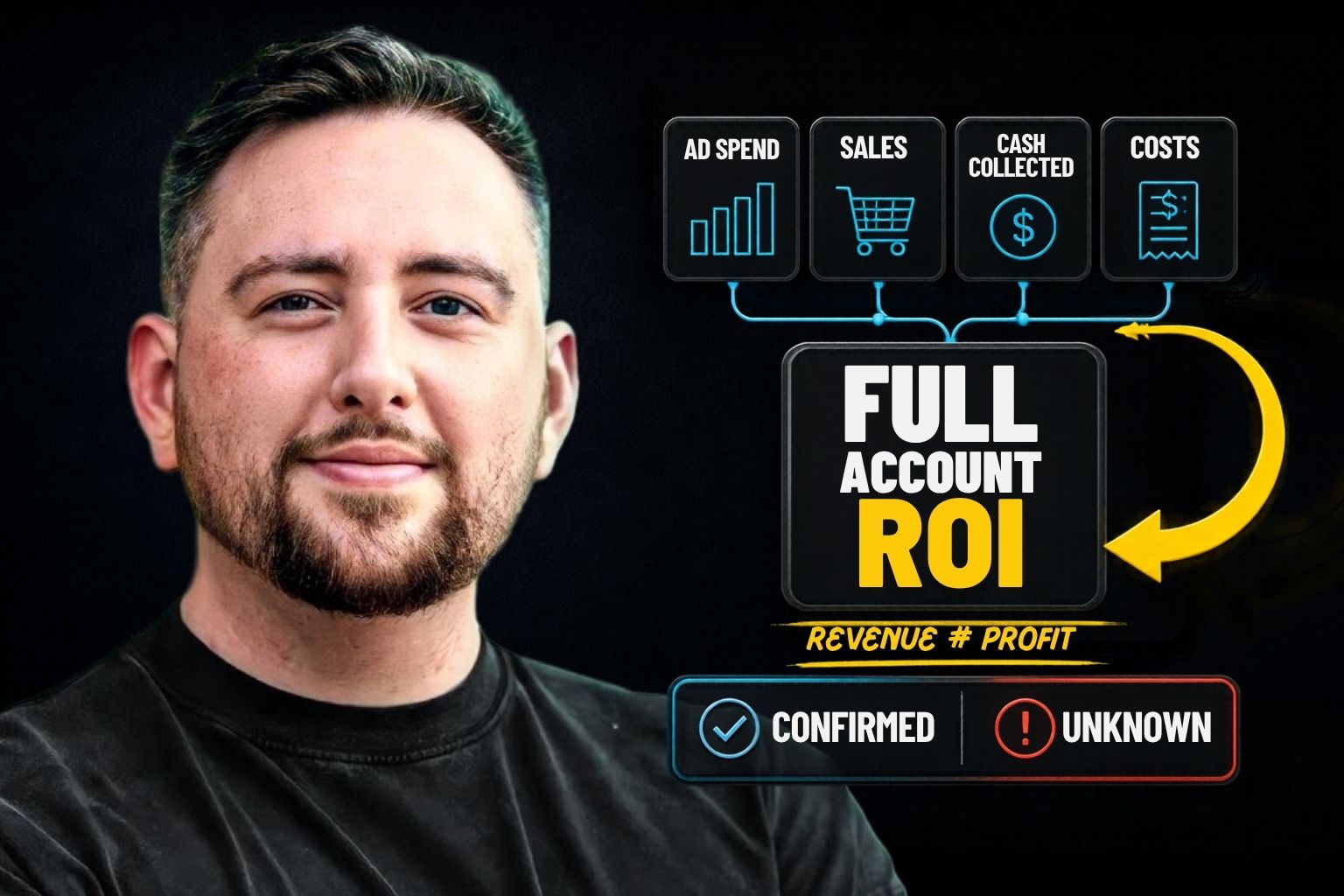
Define the return before putting a ratio beside it. Return on ad spend, collected cash, and profit answer different questions, even when they appear beside each other on the same screen.
Return on ad spend, or ROAS, compares the revenue value being reported with advertising spend. A cash-collected version uses actual collections in that calculation. Neither figure, by itself, tells you what remained after the other costs of acquiring and serving the customer.
Google’s explanation of ROI describes return on investment in terms of net profit relative to costs. That is why I would stop an account review when somebody uses ROI to describe revenue divided only by ad spend. The label changes what the client thinks they have earned.
Get clear about which costs the client includes. Advertising, the agency fee, sales commissions, and delivery costs can matter to the assessment. Have the person who understands the client’s finances confirm the calculation and the cost treatment rather than improvising a margin inside the marketing report.
You can keep the distinctions readable.
Advertising performance shows spend and the conversion events the platform records.
The sales records show what happened to the opportunities after they arrived.
Collections show the payments actually received, with refunds identified.
The agreed financial calculation shows the return after the included costs.
Give each view its own name. If you can support a revenue return but do not have the cost information for a profit calculation, show what you know and ask for what is missing. A more impressive label will not supply the missing expenses.
How a Lead Becomes Money in the Client’s Business
Follow the lead past the action your advertising platform counts. A submitted form is the beginning of a sales process in a call-based business, and the client pays the agency because something valuable is supposed to happen after that form.
Can the sales team find the inquiry? Was it suitable for the offer? Did the conversation take place? Did a sale happen, and did the payment arrive? You need enough connection between those events to understand where the opportunity went.
That is the practical side of understanding marketing math. If you count a booking as attendance, or treat a signed agreement as money in the bank, the later calculation can look precise while answering the wrong question.
I put particular weight on actual collections when judging the cash available to the business. A payment plan can have a larger contracted value than the amount received at the sale. Show both when they matter, with labels that keep the difference obvious.
You also need a person who can correct the records. The agency cannot make a closed deal appear in the client’s system if nobody updates it. An automated report will keep repeating the missing information until someone deals with the underlying handoff.
Bring that requirement into the initial agency-client handoff. Knowing who can confirm sales and collections is part of making the reporting useful. Waiting until a difficult renewal conversation makes the same missing access much harder to work around.
Why Attribution Needs the Client’s Wider View
The agency’s campaign view needs context from the rest of the client’s marketing. A buyer can encounter content, click advertising, return later, and speak to sales before paying. A platform report describes the events and credit available to that platform.
Google Analytics defines attribution as assigning credit along a person’s path to an action. The model affects that assignment. A credit label is not the same as establishing that the customer would never have purchased without the campaign.
I want the agency’s contribution visible without claiming the whole business. Show what the campaign produced, connect the available records, and explain the parts other activity may have influenced. If tracking does not establish where a sale came from, keep the uncertainty visible.
Client conversations add context too, but use them carefully. A person can remember a piece of content without remembering how it reached them. Ask about the path and compare the answer with the records rather than treating a remembered platform as the final explanation.
The useful question is what the available information supports. You can investigate the gap between systems without choosing whichever version makes your agency look better. If that changes the conclusion, the client deserves to know.
Connecting advertising to the sale is part of Master Internet Marketing, my 7-week live comprehensive training. Understanding the relationship matters more than learning to present a platform report confidently.
Results are not typical. Your results will vary and depend entirely on your individual capacity, business experience, expertise, and level of desire. There are no guarantees concerning the level of success you may experience. The testimonials and examples used are not intended to represent or guarantee that anyone will achieve the same or similar results. We don’t believe in get-rich-quick programs. We believe in hard work, adding value and serving others. As stated by law, we can not and do not make any guarantees about your own ability to get results or earn any money with our information, courses, programs, or strategies.
When the Reporting Window Changes the Answer
The reporting window changes what you can conclude because a lead, a sale, and a collection can happen at different times. Put new leads beside payments from older opportunities without explaining the timing, and you can create a misleading picture of the current campaign.
Look at the period the inquiries came in and how far those people have progressed. Then compare them with earlier groups at a comparable point in the sales process. An opportunity still awaiting a decision has a different status from one that was lost.
Google’s conversion-lag guidance explains how the delay between an ad click and a conversion can leave recent performance incomplete. Recent acquisition costs can look higher, and reported advertising returns lower, while later conversions are still arriving.
That does not give the agency permission to put weak performance permanently into the “too early” category. Ask how long comparable opportunities have taken in the client’s actual records. Use those observations to decide what is still preliminary and what needs attention.
Keep future money out of the collected total. Open opportunities can be useful to discuss, but they remain opportunities. If a payment is expected, show when and why you expect it, with enough separation that nobody reads it as money already received.
A weekly revenue scorecard can help the team see movement before collections arrive. The client ROI review then checks what that movement became. Those views work together when you preserve the difference between an early signal and a completed result.
What the Full Account List Should Tell You
The account list should tell you which client outcomes are established, which are weak, and which you still cannot measure. Start with that distinction before summarizing the agency’s performance.
An average can be useful after the records are comparable. It can also conceal a lot. An unusually strong account can make the combined result look healthy while other clients struggle. Clients with different offers, costs, and time in the engagement may need separate consideration before their outcomes belong together.
I would want to see the underlying accounts beside the summary. Which clients are included? Which are missing financial information? Are you looking at a revenue return or profit after costs? Does the summary include new clients whose sales process has barely begun?
If you describe a client success rate, explain what counted as success and who was eligible to be assessed. A defined result measured across an identified group is more useful than a confident percentage drawn from memory. Keep the unmeasured accounts visible alongside it.
The report should make an uncomfortable account easier to find. If its main effect is to make every account sound healthy, it has become a sales presentation to people who already bought.
A spreadsheet can be enough to start this conversation. The point is whether someone can trace the summary back to real client records. A more expensive reporting system cannot repair a definition nobody agreed on or a payment nobody checked.
How Client ROI Changes the Account Conversation
Verified return gives the account conversation a firmer starting point. You can discuss where the service is useful, where the client needs help, and whether the relationship makes commercial sense without relying on enthusiasm.
If advertising is creating suitable opportunities and sales follow-up is falling behind, put the relevant people together and examine that handoff. If the opportunities are a poor fit, look at the campaign and the offer. If neither team can explain the records, fix the visibility before telling the client what caused the result.
Knowing the return also matters when considering pricing. You need to understand the value the client is receiving before deciding the agency is underpaid. The same review can reveal the opposite, including work that needs improving before a higher fee would be reasonable.
A strong historical result still needs context. It does not establish what another prospect will earn or promise the same return next period. Keep the dates, costs, and measurement limits with any result you use in a commercial conversation.
In my Inner Circle, operators can examine those decisions with peers. I would bring the account-level evidence and the question it leaves you with. That is a more useful discussion than arriving with a highlight reel and asking what price to charge.
Results are not typical. Your results will vary and depend entirely on your individual capacity, business experience, expertise, and level of desire. There are no guarantees concerning the level of success you may experience. The testimonials and examples used are not intended to represent or guarantee that anyone will achieve the same or similar results. We don’t believe in get-rich-quick programs. We believe in hard work, adding value and serving others. As stated by law, we can not and do not make any guarantees about your own ability to get results or earn any money with our information, courses, programs, or strategies.
7 weeks. Real frameworks. Covering copywriting, funnels, paid ads, and conversion systems.
Bring the Missing Numbers Into the Next Review
Start the next client review with the result you can support and the information still missing. Give the person who can resolve the gap a clear question, whether that concerns sales records, payments, expenses, or the source of an opportunity.
You do not need to redesign the entire account-management process to do that. You need the agency and client to agree on what the figures mean and how to connect the work with the outcome being discussed.
Keep reviewing the quiet accounts as well as the exciting ones. A client who pays the invoice and says little still belongs in the measurement. A client who shares an impressive win still deserves the same careful calculation as everybody else.
I want reporting that makes the next decision clearer. Show the actual return where it can be established, name the costs included, and make the gaps visible. Then the account conversation can deal with the business as it is, rather than the version a collection of good screenshots suggests.
Results are not typical. Your results will vary and depend entirely on your individual capacity, business experience, expertise, and level of desire. There are no guarantees concerning the level of success you may experience. The testimonials and examples used are not intended to represent or guarantee that anyone will achieve the same or similar results. We don’t believe in get-rich-quick programs. We believe in hard work, adding value and serving others. As stated by law, we can not and do not make any guarantees about your own ability to get results or earn any money with our information, courses, programs, or strategies.
Get my content first on Google
Add jeremyhaynes.com as a preferred source and Google shows my articles more prominently in your search results, including AI Overviews and AI Mode.


Jeremy Haynes
Owner and CEO of Megalodon Marketing
Jeremy Haynes is the founder of Megalodon Marketing. He is considered one of the top digital marketers and has the results to back it up.