
What I Would Change in a $1.4M/Month Business to Scale

I hope you enjoy reading this blog post. If you want my team to just do your marketing for you, click here.
Author: Jeremy Haynes | Published September 24, 2026
Earnings Disclaimer: You have a .1% probability of hitting million-dollar months according to the US Bureau of Labor Statistics. As stated by law, we cannot and do not make any guarantees about your own ability to get results or earn any money with our ideas, information, programs, or strategies. We don’t know you, and your results in life are up to you. We’re here to help by giving you our greatest strategies to move you forward, faster. However, nothing on this page or any of our websites or emails is a promise or guarantee of future earnings. Any financial numbers referenced here, or on any of our sites or emails, are simply estimates or projections or past results, and should not be considered exact, actual, or as a promise of potential earnings – all numbers are illustrative only.
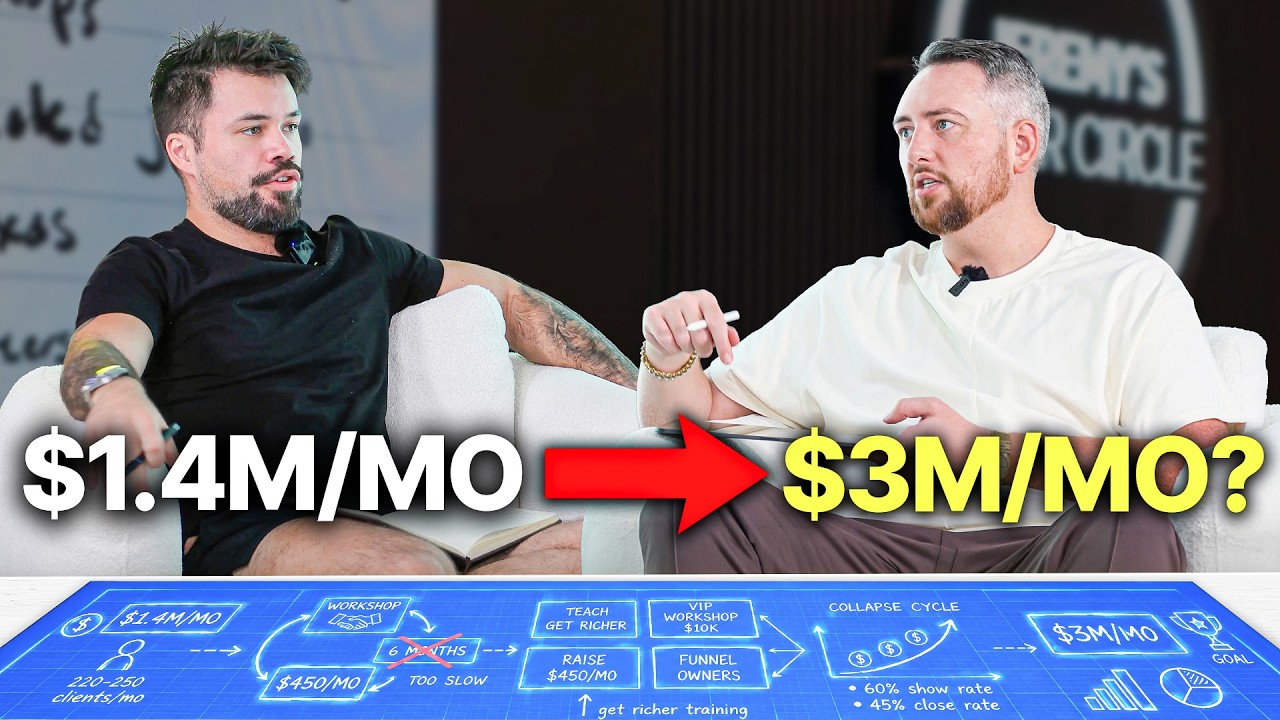
I reviewed a business presented at $1.4 million a month. The question was what should change next. The operator already had a working workshop and customers coming in, but the next stage depended on what happened after the first sale, where prospects fell out of the funnel, and who owned those problems each week. That is how I would examine a business at this size before telling it to buy more traffic.
That figure belongs to this featured case. It says nothing about what another business will achieve. The useful lesson is the order of decisions. Keep the working offer, find where value and cash collection end too early, test the funnel with the right measures, and give the next set of jobs real owners.
Already making money? See what it takes to make a lot more.
A Strong Workshop Can Still Leave Revenue Exposed
The featured business sold a live workshop alongside a self-paced option. That front-end offer had already demonstrated demand. The issue was how much of the business depended on finding another new buyer after each transaction.
I start by separating money from new customers, renewal payments, scheduled installments, and later purchases. These are different things. A payment plan creates future scheduled collections on an earlier sale. A renewal reflects someone choosing to keep paying for continuing value. An upsell is a new purchase. They should not be blended into one attractive recurring-revenue number.
That distinction changes the diagnosis. If someone says a large share of cash comes from the backend, I want to see how much is contracted installment collection, how much is true subscription revenue, and how much comes from fresh decisions by existing customers. The business can be healthy across all three, but each has different retention and delivery demands.
Stripe’s subscription lifecycle guide makes the operational distinction concrete. A subscription has recurring invoices, payment attempts, changing statuses, and cancellations. A business selling ongoing access needs to manage that lifecycle as carefully as it manages the first purchase.
Find the Next Reason a Customer Would Stay
Recurring revenue starts with a recurring reason to pay. The workshop may help a customer solve one immediate problem. After the workshop, the operator has to know which problem appears next and whether the business can help with it in a way that stays useful.
That does not mean attaching a subscription to the same material indefinitely. I would ask what customers do after completing the workshop, where they get stuck, what support they keep requesting, and which updates or peer conversations would have value even after the first lesson is over.
My breakdown of building high-ticket recurring offers makes the same point from the product side. Continued payment has to follow continued delivery. If the ongoing offer is only a name on an invoice, billing software cannot solve the retention problem.
The next product should fit the customer journey already in front of the business. It might be access to relevant new material, implementation support, a more focused room, or a service the team can reliably deliver. The answer comes from observed customer needs and delivery capacity, not from a desire to make a dashboard look steadier.
The Second Offer Should Arrive at the Right Milestone
The review raised a familiar issue. A customer receives what they bought, makes progress, and then sees no obvious next step with the same company. A later offer can be useful, but the customer should understand why it exists before that moment arrives.
I would map the path from the first purchase to the next real need. What can the customer do at the end of the workshop that they could not do before? What challenge follows if they execute? Which offer, if any, helps them with that challenge? The next sale should answer the customer’s next question.
This is why I prefer a milestone over an arbitrary waiting period when the offer depends on readiness. The right time to discuss a more advanced option is when the customer’s work shows that they can use it. A calendar date may help the team schedule a review, but it does not prove fit.
A guided ascension path works when each step has a distinct purpose. It becomes pushy when every milestone is treated as an excuse to sell the customer something else. Keep the choice anchored to their progress and the work ahead.
Protect Cash Collection Without Confusing It With Loyalty
When a business sells through installments, the cash scheduled for future months needs its own view. I would track what was sold, what has actually been collected, what remains due, and which accounts need a response after a failed payment. That protects decisions about hiring and ad spend from being made on sales figures that have not turned into cash.
Stripe’s revenue recovery documentation describes tools for failed recurring payments and collection attempts. That kind of billing control matters, but a recovered payment says little about whether the customer still values the offer. Financial collection and customer success need separate attention.
A useful review keeps scheduled installment balances, active subscriptions, renewals, new purchases, and cancellations in separate lines. Then the operator can ask whether the backend is getting stronger because more customers continue to choose the business or because older contracts are still being collected.
Inside Master Internet Marketing, my 7-week live comprehensive training, I teach operators to read traffic, offers, sales, and backend economics as parts of the same business.
Results are not typical. Your results will vary and depend entirely on your individual capacity, business experience, expertise, and level of desire. There are no guarantees concerning the level of success you may experience. The testimonials and examples used are not intended to represent or guarantee that anyone will achieve the same or similar results. We don’t believe in get-rich-quick programs. We believe in hard work, adding value and serving others. As stated by law, we can not and do not make any guarantees about your own ability to get results or earn any money with our information, courses, programs, or strategies.
Read the Call Funnel Before Buying More Traffic
The live breakdown also looked at ad spend and funnel behavior. This is where a growth conversation can become too simple. A lead can click, reach the page, start an application, abandon it, book, miss the call, or arrive without enough context to decide. More traffic magnifies whichever step is already weak.
I would pull the same period across the ad account, landing page, application, calendar, and sales records. The numbers should reconcile. If the page shows one count and the CRM shows another, fix the definition or tracking before calling a conversion rate good or bad.
Then test the point where people hesitate. The page may ask for too much too early. The application may be unclear. The call path may be the wrong buying format for part of the audience. A webinar or another way to evaluate the offer could be worth testing, but the existing path should stay in place while the test produces usable evidence.
My article on choosing a funnel that fits the offer helps separate a format problem from a traffic problem. If a video sales letter is one of the candidate paths, the VSL calculator can help model the assumptions before the test. Those inputs are scenarios, not predicted earnings.
Give Each Funnel Someone Who Owns the Outcome
One sharp moment came when the operator described a major funnel as something handled in spare time. A funnel producing meaningful revenue cannot stay on a list of work people reach only when the calendar opens up.
Ownership here is practical. Someone notices when the page and CRM disagree. Someone reads rejected leads with sales. Someone decides which test happens next and checks whether the result changed qualified conversations. Without that person, the founder keeps rediscovering the same issue during another high-level review.
That owner needs enough authority to coordinate creative, page changes, tracking, and sales feedback. Giving a person a dashboard without the ability to change the process leaves them responsible for a result they cannot influence.
It also gives the founder time to decide which offer or channel deserves attention. The lesson in building fulfillment that holds up as a business grows applies here too. Growth only helps when the team can keep delivering what was sold.
Review Retention and Funnel Work Together
Recurring revenue, upsells, and acquisition should meet in the same business review. A new customer who never reaches the first useful outcome is unlikely to care about the next offer. A great retention conversation cannot repair a front-end path that keeps bringing in the wrong people.
I would look at first-purchase quality, activation, continued use, renewal decisions, collected cash, and sales feedback together. Stripe’s subscription analytics documentation shows how subscription metrics such as recurring revenue and churn can be tracked, but those figures still need the operational story beside them. Why did someone cancel? Which part of delivery did they use? Which next step did they decline?
My article on client success after the first sale goes deeper on the delivery side. Customers need an early useful action and a reason to keep participating. That reason may have nothing to do with another funnel or another ad.
The next growth move should strengthen the relationship already paid for. That is what makes a backend offer more than an extra checkout page.
7 weeks. Real frameworks. Covering copywriting, funnels, paid ads, and conversion systems.
The Next Moves for the Featured Business
For the featured operator, I would keep the working workshop while checking how customers move from that experience into the next useful one. I would separate installment collections from genuine recurring subscriptions, build the next offer around a real customer milestone, and test an alternate funnel only where the current path shows a clear limit.
I would also put a named owner on the call funnel and make that person responsible for reading the numbers with sales. That gives the founder a way to improve the existing business while judging new opportunities with actual evidence.
Operators in my private mastermind, Inner Circle, can work through these kinds of choices with peers who understand the tradeoffs between acquisition, fulfillment, and continued customer value.
Results are not typical. Your results will vary and depend entirely on your individual capacity, business experience, expertise, and level of desire. There are no guarantees concerning the level of success you may experience. The testimonials and examples used are not intended to represent or guarantee that anyone will achieve the same or similar results. We don’t believe in get-rich-quick programs. We believe in hard work, adding value and serving others. As stated by law, we can not and do not make any guarantees about your own ability to get results or earn any money with our information, courses, programs, or strategies.
Get my content first on Google
Add jeremyhaynes.com as a preferred source and Google shows my articles more prominently in your search results, including AI Overviews and AI Mode.


Jeremy Haynes
Owner and CEO of Megalodon Marketing
Jeremy Haynes is the founder of Megalodon Marketing. He is considered one of the top digital marketers and has the results to back it up.

