Why Two Offers Scale a Business Better Than a Dozen

I hope you enjoy reading this blog post. If you want my team to just do your marketing for you, click here.
Author: Jeremy Haynes | Published July 24, 2026
Earnings Disclaimer: You have a .1% probability of hitting million-dollar months according to the US Bureau of Labor Statistics. As stated by law, we can not and do not make any guarantees about your own ability to get results or earn any money with our ideas, information, programs, or strategies. We don’t know you, and besides, your results in life are up to you. We’re here to help by giving you our greatest strategies to move you forward, faster. However, nothing on this page or any of our websites or emails is a promise or guarantee of future earnings. Any financial numbers referenced here, or on any of our sites or emails, are simply estimates or projections or past results, and should not be considered exact, actual, or as a promise of potential earnings, all numbers are illustrative only.
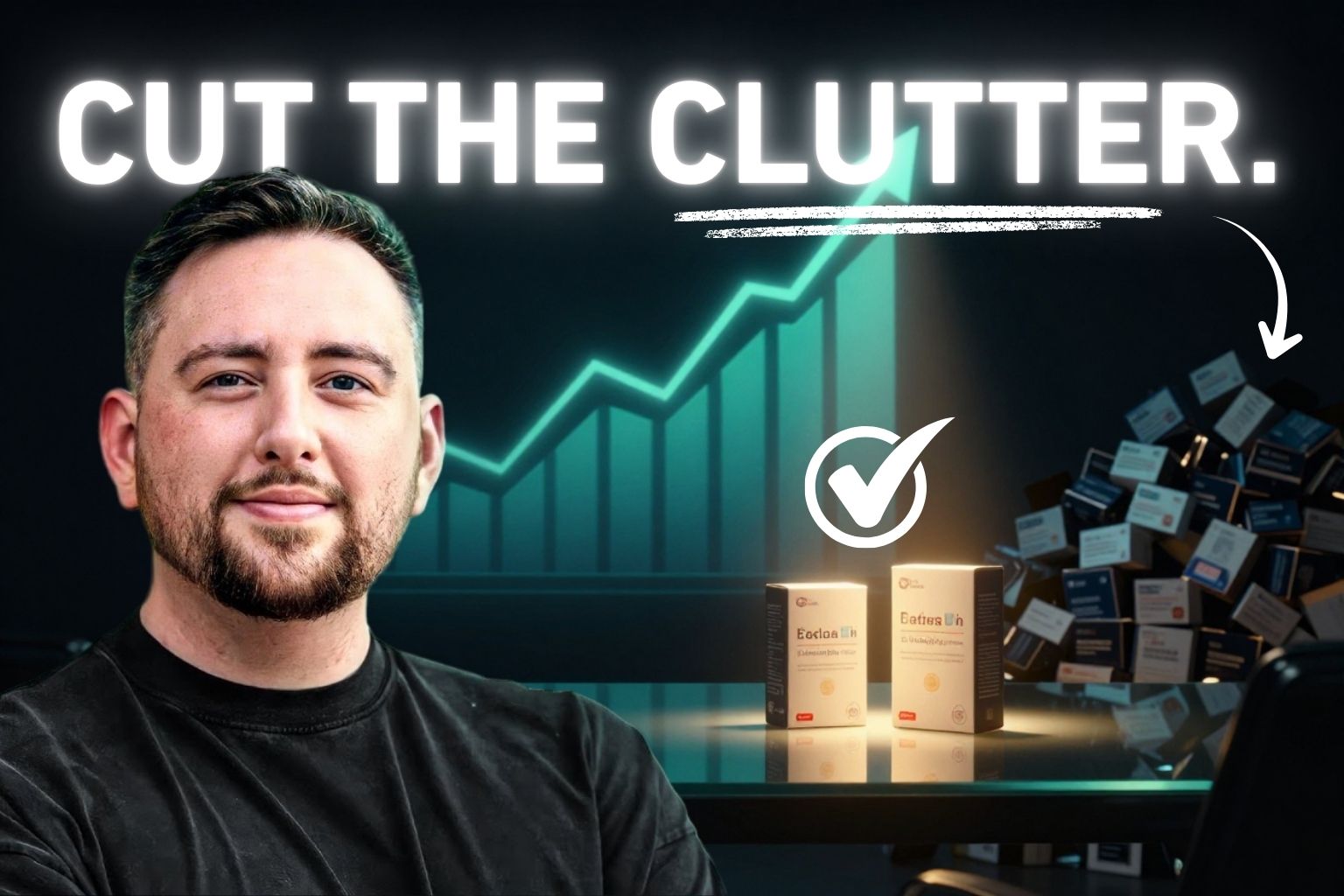
Most businesses I look at are drowning in offers they can’t properly fulfill: an entry package, a mid-tier option, a premium service, a VIP day, a group program, a retainer, and three one-off services somebody built because a client asked once. Two offers is the number that actually scales, not seven, not twelve.
Two, run well, with everything else cut or merged into them.
7 weeks. Real frameworks. Covering copywriting, funnels, paid ads, and conversion systems.
Why Running Too Many Offers Quietly Wrecks a Growing Business
The traditional value ladder sounds great in a marketing course: free lead magnet, then a tripwire, then a core offer, then a high-ticket program, then a mastermind, then a continuity product. Every new offer on that ladder creates an entirely new business underneath it. New fulfillment process, new sales conversation, new onboarding sequence, new support structure, new marketing angle, new ad creative, new email sequence.
Royal Philips learned this the expensive way. The company was a leader in product innovation, and over the first ten years of the 2000s its revenue fell 40%, wiped out a decade of profit, and dragged down its market capitalization. Harvard Business Review’s account of the collapse traces it to unmanaged proliferation across supply chain, sales, product development, and support, the exact kind of sprawl a seven-offer service business builds without ever noticing it’s happening.
Businesses I’ve worked with often carry five to ten offers and make less money than they did with two. Revenue gets spread thin, margins shrink, and the team stays confused about what they’re actually supposed to be selling. Marketing budget splits across multiple funnels, the sales team has to master different pitches for different packages, and operations juggles a different delivery system for every single one.
Bain’s research on product complexity makes the same point from the other direction: companies keep adding one offer after another hoping each new one attracts and keeps more customers, and the complexity that stacks up strangles the growth it was supposed to create. More offers doesn’t mean more revenue. It means more confusion, slower decisions, and a team that can’t tell you in one sentence what the business actually does.
What a Two-Offer Business Model Actually Looks Like
Offer one is your entry point: mid-ticket, solves one specific problem, lower commitment. This is where a prospect finds out you know what you’re doing. Offer two is your core revenue driver: high-ticket, comprehensive, a longer engagement, and where your real margin lives.
That’s the whole structure. Two offers, one clear step up between them.
The entry offer needs clear deliverables, a defined timeline, and a tangible outcome, easy to say yes to and low-risk for the buyer. The premium offer is the comprehensive transformation, the longer relationship, the high-touch engagement. The gap between the two should feel like a natural next step, not a leap the prospect has to talk themselves into.
Results are not typical. Your results will vary and depend entirely on your individual capacity, business experience, expertise, and level of desire. There are no guarantees concerning the level of success you may experience. The testimonials and examples used are not intended to represent or guarantee that anyone will achieve the same or similar results. We don’t believe in get-rich-quick programs. We believe in hard work, adding value and serving others. As stated by law, we can not and do not make any guarantees about your own ability to get results or earn any money with our information, courses, programs, or strategies.
How This Differs From Simplifying a Single Offer’s Pricing
It’s worth being precise about what this article is and isn’t solving, because it sits right next to a related question. Our piece on how to simplify your offer so prospects actually understand it covers a different layer entirely: how many pricing tiers you present for one offer inside a single sales conversation, and why collapsing those tiers down to one recommended option and one alternative reduces decision friction on the call.
This article is about a layer above that: how many distinct offers, plural, your entire business runs at the portfolio level. A business can have a perfectly simple, single-tier pricing presentation for each of seven different offers and still be drowning in the operational chaos those seven offers create behind the scenes. Fix the presentation of one offer and you solve a sales-conversation problem. Fix the count of offers your business runs and you solve a fulfillment, staffing, and cash-flow problem.
Most businesses that are struggling need both fixes, but they’re not the same fix. Confusing them is how “simplify your offer” advice gets applied to the wrong layer of the business.
Why Fewer Offers Make Fulfillment and Team Specialization Easier
Two offers means two standard operating procedures, two onboarding sequences, two delivery systems. Your team can specialize instead of acting as generalists trying to do seven things adequately instead of two things well. Quality control gets dramatically easier when you’re not maintaining consistency across five or six different service levels at once, and that specialization is exactly what a real scalable fulfillment system built for low churn depends on.
I’ve watched businesses cut their offer count from seven to two and improve profit margins even while revenue stayed flat initially, purely because they stopped bleeding money on operational complexity. When you only have two offers, your team knows exactly what they’re delivering, your clients know exactly what they’re getting, and you can build systems that actually hold up instead of constantly patching fires. That kind of consistency is also where real lifetime value gains from delivery upgrades come from, since you’re improving one system deeply instead of six systems shallowly.
In my Inner Circle, this is one of the first structural things operators fix once they’re past the first million: not their marketing, not their pricing, but the sheer number of things their business is trying to be good at simultaneously. Clear role scorecards for every position only work when each role is actually executing against two offers instead of guessing which of seven to prioritize that week.
How Two Offers Simplify Paid Traffic, Sales, and Forecasting
Paid traffic can focus on one front-end offer instead of splitting across five funnels with five landing pages and five ad angles competing for the same budget. The sales team has one primary conversation to master per offer instead of juggling the details of which package to pitch to which prospect. The upsell path is singular: deliver offer one well, let the natural need for offer two surface, and let the transition happen without a hard pitch.
Revenue forecasting becomes simple math once you’re down to two offers. If you close X clients at offer one and Y percent convert to offer two, you know roughly what next quarter’s revenue looks like. Businesses running seven offers are constantly surprised by what shows up in the bank account, because there’s no clean formula connecting activity to outcome when the paths multiply.
The constraint of two offers forces better marketing, better positioning, and better fulfillment, because you can’t hide behind “we have something for everyone.” You have to be specific about who you serve and what problem you solve, and that specificity is what actually scales a business rather than just making it feel busier.
Results are not typical. Your results will vary and depend entirely on your individual capacity, business experience, expertise, and level of desire. There are no guarantees concerning the level of success you may experience. The testimonials and examples used are not intended to represent or guarantee that anyone will achieve the same or similar results. We don’t believe in get-rich-quick programs. We believe in hard work, adding value and serving others. As stated by law, we can not and do not make any guarantees about your own ability to get results or earn any money with our information, courses, programs, or strategies.
When It’s Actually Time to Add a Third Offer
You might be thinking you need more options. You probably don’t. But if you genuinely do, here’s the rule: only add a third offer once both existing offers are at capacity and running smoothly, not when you’re bored, not when revenue plateaus, and not because a competitor launched something new. A third offer should solve a problem neither existing offer addresses, for an audience segment you’ve already proven converts.
If you’re adding offers because revenue is flat, that’s a traffic problem or a conversion problem, not an offer problem, and more offers won’t fix either one. If you’re adding offers because you’re bored with what you’re selling, that’s a mindset issue, not a product gap, businesses scale through repetition, not novelty. If you’re adding offers because everyone else in your space has more options, that’s a positioning mistake. Generic positioning that tries to cover everyone is exactly what focus is supposed to fix, and stacking on a third offer to keep up with competitors moves you further from focus, not closer.
How to Cut Your Offer Lineup Down to Two Without Losing Revenue
If you already have more than two offers, here’s how to decide what stays. List everything you currently sell, then score each offer on five criteria: revenue contribution, profit margin, fulfillment complexity, client satisfaction, and alignment with your core positioning. The two offers that score highest across all five are your keepers. Everything else gets cut or merged into one of them, the same triage that makes structuring pricing tiers so much easier once there are only two offers left to price in the first place.
That’s genuinely scary the first time. You’re worried about the revenue you’ll lose, and short-term you might see a small dip. But the focus you gain from cutting underperforming offers almost always produces higher revenue within 90 days, because your marketing gets sharper, your delivery gets better, and your sales conversations get clearer once there’s only one thing to explain instead of five.
Bain and Company’s decade-long research on business complexity, published in their book Repeatability, put it bluntly: complexity is the silent killer of growth strategies, and the enduringly successful companies they studied maintained a deliberate simplicity at the core of their model, the same discipline behind Apple running its entire product line on roughly sixty products. Two offers is that same discipline applied to a service business.
What This Looks Like for Agencies, Coaches, and Consultants
For agencies, offer one might be a 90-day sprint or a paid advertising audit, and offer two is the full-service retainer. The sprint proves competence, and the retainer becomes the natural next step. For coaches and consultants, offer one could be an intensive strategy day, and offer two is the six-month one-on-one engagement, where the strategy day reveals the gaps and the program fills them.
For education businesses, offer one might be a workshop or challenge, and offer two is the flagship training, where the workshop delivers a quick win and demonstrates teaching quality before the comprehensive program becomes the obvious next step. The structure holds across every model because the principle stays the same: one offer to build trust and prove competence, one offer to deliver the comprehensive transformation.
Already making money? See what it takes to make a lot more.
How to Build the Bridge Between Your Entry and Premium Offer
The key to making this model work is how clients move from offer one to offer two, and it shouldn’t require hard selling. If you’ve designed both offers correctly, the transition is natural rather than manufactured. Your entry offer should be structured so that fulfilling it well surfaces the need for your premium offer on its own, not through manufactured urgency or scarcity tactics.
If your entry offer is a paid advertising audit, the natural output is a roadmap that requires ongoing execution, and your premium offer is that execution. If your entry offer is a strategy day, you’ll uncover gaps in the client’s business that require deeper work, and your premium offer is that deeper work. In my experience working with operators in our mastermind, Inner Circle, the businesses converting 30% to 50% of offer-one clients into offer-two clients have designed the two offers to hand off to each other, rather than treating them as two unrelated products that happen to share a logo.
Most businesses that stall try to do too much. They add offers instead of fixing their marketing, and they build complexity instead of doubling down on what already works. Constraint breeds clarity, clarity breeds execution, and a business that can explain what it sells in one sentence is a business that’s actually ready to scale it. If you want to structure your business around this kind of focused, repeatable system, Master Internet Marketing, our 7-week live comprehensive training, walks through the exact frameworks for building offers that hand off to each other instead of competing for the same prospect’s attention.
Results are not typical. Your results will vary and depend entirely on your individual capacity, business experience, expertise, and level of desire. There are no guarantees concerning the level of success you may experience. The testimonials and examples used are not intended to represent or guarantee that anyone will achieve the same or similar results. We don’t believe in get-rich-quick programs. We believe in hard work, adding value and serving others. As stated by law, we can not and do not make any guarantees about your own ability to get results or earn any money with our information, courses, programs, or strategies.
Get my content first on Google
Add jeremyhaynes.com as a preferred source and Google shows my articles more prominently in your search results, including AI Overviews and AI Mode.


Jeremy Haynes
Owner and CEO of Megalodon Marketing
Jeremy Haynes is the founder of Megalodon Marketing. He is considered one of the top digital marketers and has the results to back it up.