How to Build an Offer That Converts Cold Traffic Like Crazy

I hope you enjoy reading this blog post. If you want my team to just do your marketing for you, click here.
Author: Jeremy Haynes | Published July 15, 2026
Earnings Disclaimer: You have a .1% probability of hitting million-dollar months according to the US Bureau of Labor Statistics. As stated by law, we can not and do not make any guarantees about your own ability to get results or earn any money with our ideas, information, programs, or strategies. We don’t know you, and besides, your results in life are up to you. We’re here to help by giving you our greatest strategies to move you forward, faster. However, nothing on this page or any of our websites or emails is a promise or guarantee of future earnings. Any financial numbers referenced here, or on any of our sites or emails, are simply estimates or projections or past results, and should not be considered exact, actual, or as a promise of potential earnings, all numbers are illustrative only.
Most operators build their offer stack around what converts a warm audience, then wonder why the same stack falls flat on cold traffic. It’s not a pricing problem or a creative problem. It’s a sequencing problem: the offer was built for someone who already trusts you, and cold traffic hasn’t earned that trust yet.
Warm audiences forgive a loose offer. Cold traffic doesn’t. If your stack isn’t built around the specific problems, circumstances, and desired outcomes of the person seeing it for the first time, it won’t convert no matter how good the creative is.
At Master Internet Marketing, our 7-week live comprehensive training walks through the offer-construction frameworks that make cold traffic convert without relying on brand trust you haven’t built yet.
7 weeks. Real frameworks. Covering copywriting, funnels, paid ads, and conversion systems.
Why Cold Traffic Needs a Tighter Offer Than Warm Traffic
Warm traffic already trusts you. They’ve watched your content, they know your name, and they’re willing to fill in gaps in your offer with goodwill. Cold traffic has none of that. They’re evaluating you and your offer in the same five seconds, with zero prior context.
That difference changes what the offer has to do. On warm traffic, a slightly generic stack still converts because the relationship is doing part of the selling. On cold traffic, the offer itself has to do all of the selling, which means every component has to map directly to something the prospect is already feeling. This tracks with a broader shift in buyer behavior: 75% of B2B buyers now say they prefer a rep-free sales experience entirely, per the same Gartner-sourced buyer journey data, which means the offer stack itself, not a follow-up call, is doing most of the convincing before a prospect ever wants to talk to a human.
Buyer research backs this up structurally. B2B buyers spend only 17% of their total purchase journey actually meeting with potential suppliers, according to Gartner’s research on the B2B buying journey. The other 83% is self-directed research, comparison, and internal deliberation happening before you ever get a conversation. If your offer can’t stand on its own during that self-directed research phase, cold traffic never reaches the point of talking to you at all.
Validate the Audience Before You Touch the Offer
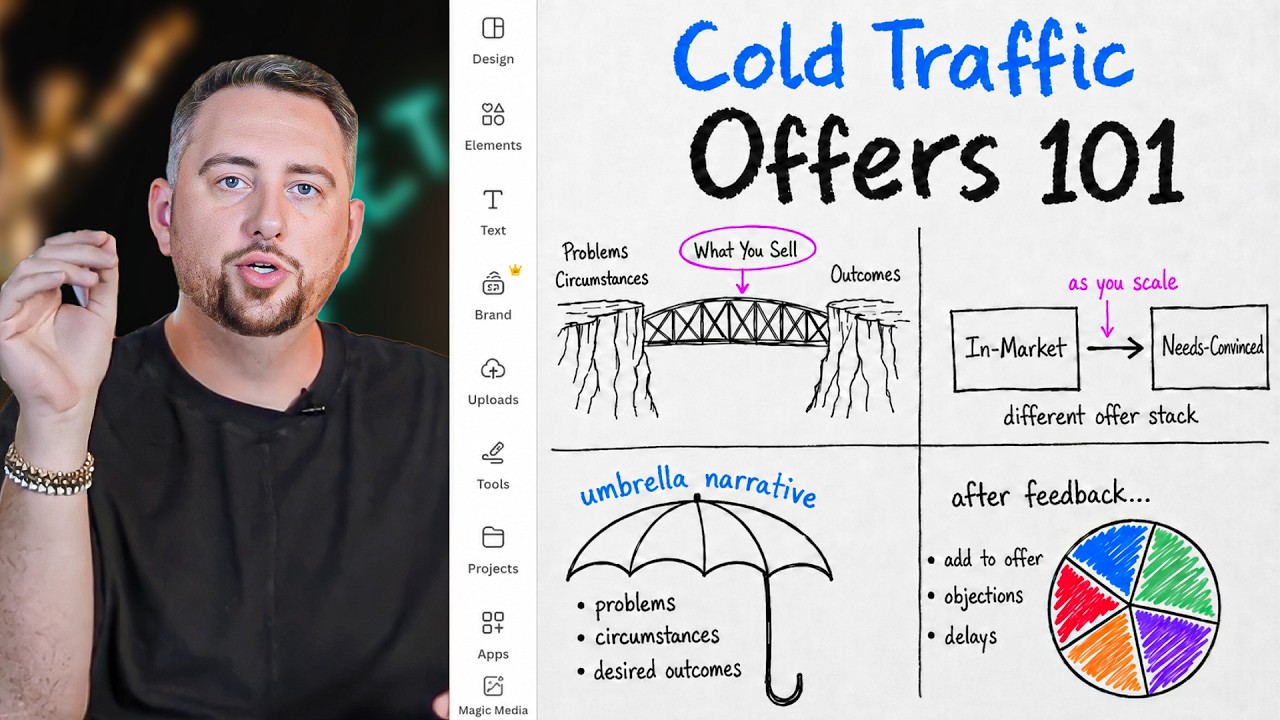
Before building anything, separate the audience into two buckets: in-market and needs-convinced. In-market prospects already know they have the problem and are actively comparing solutions. Needs-convinced prospects have the underlying problem but haven’t connected it to a felt need for a solution yet.
These two groups need different offer stacks, not different ad copy on the same offer. An in-market prospect wants proof and speed: case studies, guarantees, clear mechanism. A needs-convinced prospect wants education first, because they haven’t yet accepted that the problem is worth solving right now. Stacking your in-market proof elements in front of a needs-convinced audience wastes the spend, because they check out before the proof even lands.
Building one offer stack and running it at both segments is the single most common reason cold traffic campaigns underperform. The fix isn’t a better hook. It’s recognizing you’re running two different sales conversations through one funnel.
This is also where a lot of the sales-cycle friction described in our piece on making high-ticket offers easy to buy actually originates upstream of the offer itself. An easy-to-buy offer for an in-market buyer can still feel confusing or premature to a needs-convinced buyer, not because the offer changed, but because the audience wasn’t ready for that framing yet.
The Problems, Circumstances, Desired Outcomes Framework
Once the audience is segmented, the actual offer construction runs through three filters: problems, circumstances, and desired outcomes, or PCDO.
Problems are what the prospect is consciously aware of. Circumstances are the situational factors shaping how urgently they need a solution and what they can realistically act on. Desired outcomes are the specific end state they’re picturing, which is often more specific and more emotional than the problem itself.
Take a car breaking down as the simplest version of this. The problem is obvious: the car doesn’t run. But circumstances change everything about what offer actually lands. Someone whose transmission failed on a 15-year-old sedan they were already planning to replace has completely different circumstances than someone whose engine seized on a car they need for work tomorrow morning. Same problem, different urgency, different budget reality, different decision process.
Desired outcomes go one layer past the problem. It’s not “fix my car.” It’s “get back to work without missing a shift” or “not have to explain to my boss why I’m late again.” A prospect picturing a McLaren isn’t buying transportation, they’re buying an identity outcome the vehicle represents. Every offer stack should be built to visibly solve the actual problem, respect the real circumstances, and paint the specific desired outcome back at the prospect in language they’d use themselves.
Building the Stack Around a Real Offer Example
Here’s how this plays out with an actual stack. Inner Circle, our mastermind, isn’t built as one generic bundle. Each component in the stack exists because it maps to a specific problem-circumstance-outcome combination we’ve identified from actual sales call data, not because it sounded good to add.
Results are not typical. Individual outcomes depend on effort, market conditions, and factors outside our control.
The core coaching addresses the primary problem: not knowing which lever to pull to grow. The community layer addresses a circumstance most operators don’t say out loud, which is isolation, being the only person in their business who understands what they’re building. The templates and frameworks address the desired outcome of moving faster without reinventing every process from scratch. None of these exist because “more stuff equals more value.” Each one is there because it answers something specific we’ve heard directly from prospects on calls.
The reason this matters more on cold traffic than warm traffic is that a warm prospect will forgive one weak component in a stack because the relationship carries the rest. A cold prospect evaluating the same stack for the first time will fixate on whatever component feels tacked-on, because they have no other context to weigh it against. Every piece has to justify its own inclusion in isolation, not just as part of a larger bundle.
The Umbrella Narrative That Ties the Stack Together
A stack of individually justified components can still feel disjointed if there’s no single narrative holding it together. That’s what an umbrella narrative does: it’s the one sentence that explains why every piece of the stack exists in service of the same transformation.
Without an umbrella narrative, a cold prospect sees a list of features and has to do the work of connecting them into a coherent reason to buy. Most won’t bother. With an umbrella narrative, the stack reads as inevitable: of course there’s a community, of course there are templates, of course there’s live coaching, because the narrative already told you why those pieces have to exist together.
The Athena EA and VA offer is a clean real-world example of this. Instead of listing “you get an assistant plus a matching process plus ongoing support” as separate bullet points, the narrative is built around eliminating the specific failure points that make hiring an assistant risky: bad fit, no accountability, no backup if it doesn’t work out. Every component in that stack directly answers one of those named failure points, and the narrative sentence makes that connection explicit before the prospect has to infer it themselves.
Building the Offer Dynamically From Sales Call Objections
The PCDO framework and the umbrella narrative give you a starting stack, but the stack that actually converts gets refined from real objections surfaced on sales calls, not from guessing in a planning meeting.
When a prospect hesitates on a call, that hesitation is data. If multiple prospects raise the same hesitation, it’s a signal that the current stack has a gap, either a missing component, a missing explanation, or a mismatched circumstance the offer wasn’t built to address. The mistake most operators make is treating that feedback as anecdotal instead of systematically feeding it back into the stack.
This works the same way outside of coaching offers. Buying a home, the process forces you to surface every objection before the deal closes, financing contingencies, inspection findings, timeline conflicts, because a house is expensive enough that skipped objections become expensive mistakes. High-ticket offers deserve the same discipline. Every recurring objection on a sales call is a preview of the exact hesitation cold traffic will have reading your page, except your page doesn’t get to respond in real time. The stack has to answer it in advance.
Reading Fragmented Feedback Correctly
Not every piece of sales call feedback belongs in the core stack. Some of it is a genuine gap in what you’re offering. Some of it is a request for a premium add-on that most buyers don’t actually need. Confusing the two leads to bloated offers that raise price without raising conversion.
A restaurant menu makes this distinction naturally. The base combo meal covers what nearly everyone wants. Extra toppings, upgraded sides, and premium substitutions exist as optional add-ons precisely because most customers don’t need them, but the customers who do need them are happy to pay for the option. Car customization works the same way: the base trim covers the core use case, and features like upgraded audio or premium interior are optional precisely because they’re not universal needs.
The test is simple: if 80% of prospects raise the same objection, it belongs in the core stack. If it’s a specific ask from a smaller segment willing to pay more for it, it belongs as a post-commitment upsell, not a core inclusion that raises the price for everyone.
Misreading this distinction is expensive in a specific way: it inflates the offer for every buyer to satisfy a preference only some of them have, which raises price resistance across the entire funnel instead of just capturing incremental revenue from the segment that actually wanted the upgrade. The fix isn’t complicated once you separate the two categories, but most operators never build the habit of tagging feedback by “core gap” versus “premium preference” as it comes in, so the stack just grows unchecked call over call.
Using AI and Social Research to Inform the Narrative
None of this framework works without accurate input on what your specific audience is actually saying, and that research has gotten dramatically faster with AI tools layered on top of social platforms. Pulling comment threads, reviews, and forum discussions into an AI tool to identify recurring language patterns gets you to the same PCDO insights that used to take months of manual call review.
This matters more now because of how buyers actually behave before they ever talk to you. Buyers today are nearly 70% through their own purchase decision before contacting a company directly, according to research from LeadG2 on the modern B2B buyer’s journey. That means the language in your offer stack has to match the language your prospect is already using in their own head, not the language you’d use internally to describe your own product. AI-assisted research pulling directly from where your audience actually talks, whether that’s Reddit threads, review sections, or comment sections on competitor content, is the fastest way to close that gap.
The mechanics of why a well-stacked offer justifies a premium price, once the PCDO alignment is right, come down to the psychology covered in our breakdown of offer stacking versus bundling and the psychology that makes stacks work, and the buyer-side confidence mechanics that make a premium offer feel like an easy yes are covered in how to make high-ticket offers easy to buy. Both of those matter, but neither works if the underlying stack wasn’t built around the right problems, circumstances, and desired outcomes in the first place.
Results are not typical. Individual outcomes depend on effort, market conditions, and factors outside our control.
Already making money? See what it takes to make a lot more.
Cold traffic doesn’t give you the benefit of the doubt a warm audience does, so the offer has to arrive already aligned to the specific problem, circumstance, and desired outcome sitting in front of it, built from real objection data instead of assumptions, which is exactly the discipline we walk through inside Master Internet Marketing and Inner Circle.
Get my content first on Google
Add jeremyhaynes.com as a preferred source and Google shows my articles more prominently in your search results, including AI Overviews and AI Mode.


Jeremy Haynes
Owner and CEO of Megalodon Marketing
Jeremy Haynes is the founder of Megalodon Marketing. He is considered one of the top digital marketers and has the results to back it up.