
How to Build an Offer Stack That Lets You Charge More and Sell More

I hope you enjoy reading this blog post. If you want my team to just do your marketing for you, click here.
Author: Jeremy Haynes | Published June 29, 2026
Earnings Disclaimer: You have a .1% probability of hitting million-dollar months according to the US Bureau of Labor Statistics. As stated by law, we cannot and do not make any guarantees about your own ability to get results or earn any money with our ideas, information, programs, or strategies. We don’t know you, and besides, your results in life are up to you. We’re here to help by giving you our greatest strategies to move you forward, faster. However, nothing on this page or any of our websites or emails is a promise or guarantee of future earnings. Any financial numbers referenced here, or on any of our sites or emails, are simply estimates or projections or past results, and should not be considered exact, actual, or as a promise of potential earnings – all numbers are illustrative only.
Most businesses think they have to choose between raising prices or increasing volume. That’s completely backward.
In my experience, the right offer stack lets you do both simultaneously. I’ve structured offers where businesses adjusted their pricing while the perceived value made the higher price point feel justified. This is the framework that separates different approaches to packaging and positioning. If you want a comprehensive approach to building these systems, Master Internet Marketing, our 7-week live comprehensive training, covers offer architecture from the ground up.
Results are not typical. Your results will vary and depend entirely on your individual capacity, business experience, expertise, and level of desire. There are no guarantees concerning the level of success you may experience. The testimonials and examples used are not intended to represent or guarantee that anyone will achieve the same or similar results. We don’t believe in get-rich-quick programs. We believe in hard work, adding value and serving others. As stated by law, we cannot and do not make any guarantees about your own ability to get results or earn any money with our information, courses, programs, or strategies.
7 weeks. Real frameworks. Covering copywriting, funnels, paid ads, and conversion systems.
Why Competing on Price Alone Destroys Your Positioning
When you compete on price, you become a commodity. You’re fighting with everyone else in your market who’s racing to the bottom. Every competitor who drops their price creates pressure for you to do the same. Eventually, you’re working harder with thinner margins and more price-sensitive clients.
Dan Kennedy said it perfectly: “Price is only an issue in the absence of value.”
When you’re selling a deliverable instead of an outcome, price becomes the only differentiator. A service at one price point looks expensive when that’s all you’re offering. But when that same service is packaged with additional components like creative production, strategy sessions, analysis tools, and support structures, the perception shifts entirely.
The businesses I’ve worked with that moved to higher pricing all made the same shift. They stopped selling what they DO and started selling what their clients GET.
Harvard Business Review has documented that competing on price keeps businesses locked in a perpetual race they can’t win. Value-based positioning is what creates pricing power.
What Offer Stacking Is and the Psychology Behind Why It Works
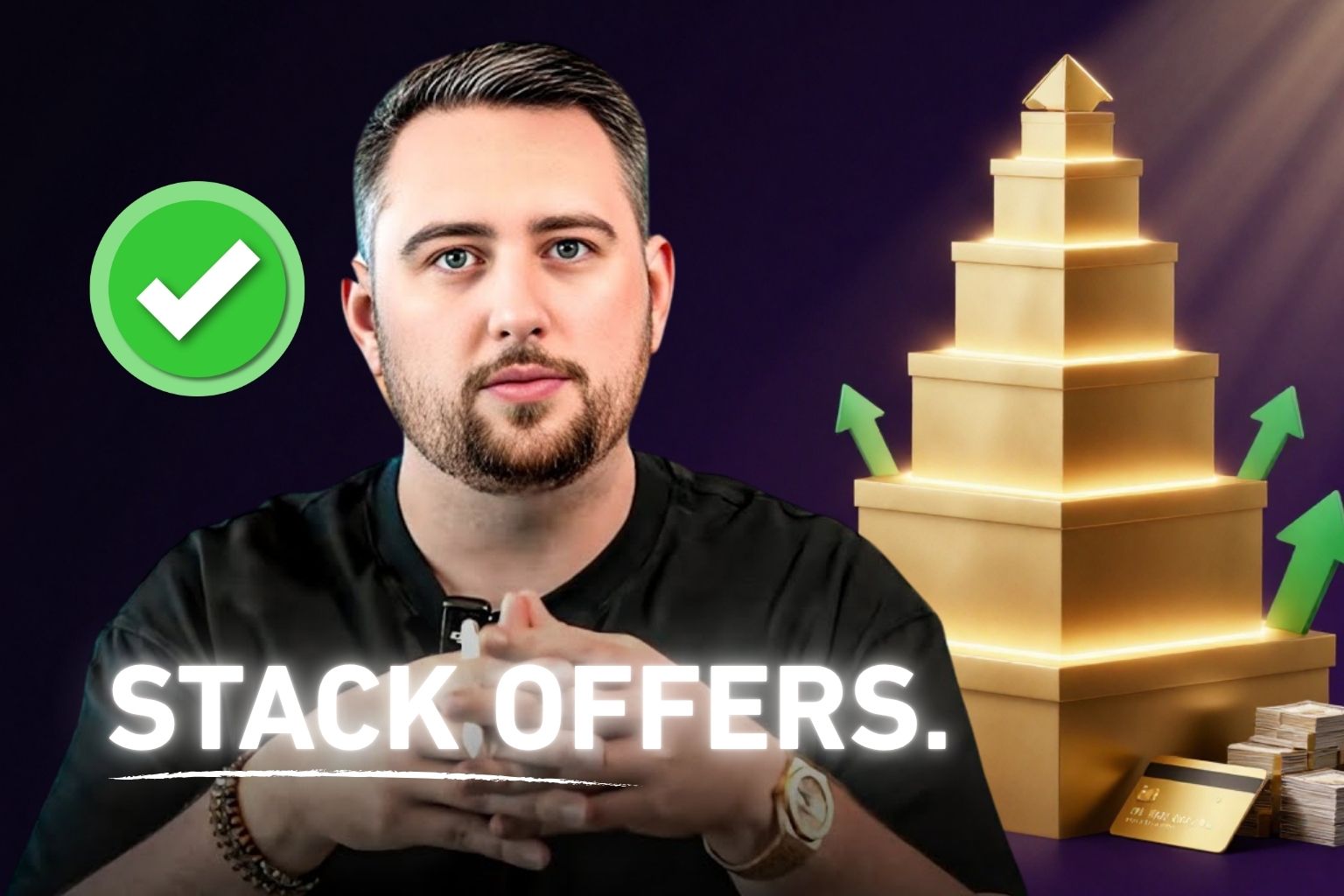
An offer stack isn’t just throwing random bonuses at people hoping something sticks. It’s the strategic architecture of value perception. Every element serves a specific psychological and practical purpose.
Your core offer solves the main problem. Each additional layer in your stack removes a specific objection, accelerates implementation, or eliminates friction between where your client is now and where they want to be. The goal is creating a value-to-price gap so large that buying feels like the only logical decision.
This is different from bundling, which is just grouping products together. Stacking is about creating an ecosystem that supports the transformation.
There are four psychological principles that make offer stacking effective.
- Anchoring effect. When you present the total itemized value first, you anchor someone’s brain to that high number. Everything else gets measured against that anchor. A price tag feels completely different when it’s positioned against total value versus being presented in isolation.
- Loss aversion. People fear losing access to bonuses, community, or exclusive elements more than they fear spending money. Kahneman and Tversky’s prospect theory demonstrated this: losses loom larger than equivalent gains in the human mind.
- Objection elimination. Every friction point becomes a stack element. “I don’t have time” gets answered with done-for-you templates. “I don’t know how to implement” gets answered with step-by-step checklists. “What if it doesn’t work” gets answered with a guarantee structure.
- Decision simplification. Instead of forcing prospects to decide whether they need multiple separate items, you give them one decision. One yes gets them everything they need.
How a Better Offer Stack Raises Prices and Volume at the Same Time
When you’re no longer selling a single deliverable, you’re selling a transformation ecosystem.
Alex Hormozi’s value equation frames this precisely: value equals dream outcome times perceived likelihood of achievement, divided by time delay and effort required. Every element in your stack should improve one of these variables. Bonuses that accelerate implementation reduce time delay. Guarantees increase perceived likelihood. Templates and done-for-you components reduce effort. The core offer delivers the dream outcome.
In my experience, businesses that restructure from single deliverables to comprehensive stacks often see their conversion metrics hold steady or improve. Higher prices signal higher quality, especially when the value justification is clear. This creates a cycle: higher prices attract more committed buyers, committed buyers get better outcomes, better outcomes create better testimonials, better testimonials support more sales conversations.
The counterintuitive part: better offers generate more word-of-mouth. When someone feels like they got substantial value, they tell people. Higher prices also give you more room in your acquisition budget. If you’re working with thin margins, you can’t afford significant ad spend per acquisition. If you’re working with healthy margins, investing more in acquisition becomes viable and scalable. The relationship between unit volume and unit price isn’t always inverse when you’re improving the actual offer.
How to Build Each Layer of Your Stack Without Making Common Mistakes
Your core offer should solve one clear, specific, painful problem. It needs to be articulated as an outcome, not a deliverable. “Generate qualified leads consistently” hits different than “Get access to our lead generation training.” One is a result. The other is a thing.
Bonuses are where most people mess this up. Each bonus needs standalone value and its own name. Branded frameworks feel more valuable than generic add-ons. Three to five bonuses is the sweet spot. More than that creates overwhelm and dilutes perceived quality. Each one should address a secondary objection or accelerate a specific part of the transformation. The best bonus types are tools and templates, case study breakdowns, implementation checklists, workshop recordings, resource libraries, and community access. Each one should make the buyer think “I’d pay for this separately.”
Guarantees deserve their own attention. Strong guarantees affect conversion more than they affect refund rates. In my experience, businesses that add clear guarantees see meaningful improvements in close rates without proportional increases in refunds. Your options include unconditional money-back guarantees, conditional guarantees, performance guarantees, and “better than money back” structures where clients keep everything plus get a refund. The guarantee becomes a selling point in your stack.
The most important mistake to avoid: the presenter’s paradox. Research by Kimberlee Weaver, Stephen Garcia, and Norbert Schwarz showed that adding weak items to a bundle actually lowers the overall perceived value of the entire offer. Consumers average value rather than add it. A $1,750 scholarship felt more generous than a $1,750 scholarship plus a $15 textbook voucher. The cheap addition dragged down the perception of everything. Every element in your stack must have genuine, defensible standalone value. Stuffing instead of stacking will cost you sales.
Other common mistakes: not articulating value clearly, adding bonuses that compete with the core offer, not presenting the stack visually, and underpricing despite a strong stack out of fear. And the framework adapts across every business model:
- Coaching and consulting: Core program plus templates, implementation calls, community access, and a guarantee.
- Agency and done-for-you services: Core service with strategy audits, reporting dashboards, creative libraries, and performance guarantees.
- SaaS: Core software with onboarding, training, priority support, and integration setup.
- Info products: Core training with workbooks, live Q&A sessions, bonus modules, and certifications.
The principles stay the same regardless of model. Our flagship program covers how to architect these stacks for different business models in detail.
Results are not typical. Your results will vary and depend entirely on your individual capacity, business experience, expertise, and level of desire. There are no guarantees concerning the level of success you may experience. The testimonials and examples used are not intended to represent or guarantee that anyone will achieve the same or similar results. We don’t believe in get-rich-quick programs. We believe in hard work, adding value and serving others. As stated by law, we cannot and do not make any guarantees about your own ability to get results or earn any money with our information, courses, programs, or strategies.
The Step-by-Step Method for Building and Presenting Your Stack
Start with an objection audit. List every objection, fear, and friction point your prospect has before buying. Design one stack element to neutralize each objection. If the objection is “I don’t have time to implement,” your bonus is done-for-you templates plus a short implementation sprint call. If the objection is “What if I can’t get it to work,” your answer is a guarantee plus direct support access.
Reverse-engineer the dream outcome. Start with the transformation your buyer wants. Work backward to identify every gap, obstacle, and friction point between where they are now and that outcome. Each stack element fills a gap.
Apply the value multiple rule. Total perceived value of your stack should be substantially higher than your asking price. Assign a defensible value to each element based on what it would cost to buy separately or what comparable alternatives cost in the market.
Use the name-and-frame technique. Give every element a branded name, a specific value, and a one-sentence explanation of why it matters. “The Seven-Figure Funnel Blueprint” hits different than “a funnel template.”
Consider tiered options. Two to three tiers of the same core offer with progressively richer stacks. The middle tier typically gets the most consideration because of the decoy effect. The top tier makes the middle tier feel like better positioning.
Sequencing matters more than most people realize for presentation. Present the core offer and its value first. Then layer bonuses one at a time, each with its own mini-pitch. Let the running total of value build with each addition. Reveal the actual price only after the full stack and total value are established. On sales pages, use a visual stack with each element clearly called out. On webinars, dedicate meaningful time solely to building and presenting the stack. On sales calls, walk through each element and confirm understanding before moving to the next. The presentation is as important as the stack itself.
Already making money? See what it takes to make a lot more.
What Happens When You Get Offer Architecture Right
Better offers attract better clients. Better clients do the work and get outcomes. Those outcomes become case studies and testimonials. That social proof supports more sales conversations.
Meanwhile, your cost per acquisition stays stable or improves because your conversion rates improve. Your lifetime value per client increases because they’re paying more upfront and getting better outcomes, which leads to more referrals and repeat business. The gap between you and competitors who are still competing on price gets wider over time. They’re stuck in a race to the bottom while you’re building a category of one.
This isn’t about tricking people into paying more for less. The best stacks genuinely help buyers succeed faster and more completely. You’re probably already delivering substantial value. You’re just packaging and presenting it in a way that doesn’t communicate that value effectively. The mechanics of offer stacking give you the vehicle to charge what you’re actually worth while making it feel like a clear decision to your buyers.
That’s how you raise prices and increase volume at the same time.
If you want to build this system in your business, Master Internet Marketing, our 7-week live comprehensive training, walks through the entire offer architecture process.
Results are not typical. Your results will vary and depend entirely on your individual capacity, business experience, expertise, and level of desire. There are no guarantees concerning the level of success you may experience. The testimonials and examples used are not intended to represent or guarantee that anyone will achieve the same or similar results. We don’t believe in get-rich-quick programs. We believe in hard work, adding value and serving others. As stated by law, we cannot and do not make any guarantees about your own ability to get results or earn any money with our information, courses, programs, or strategies.
Get my content first on Google
Add jeremyhaynes.com as a preferred source and Google shows my articles more prominently in your search results, including AI Overviews and AI Mode.


Jeremy Haynes
Owner and CEO of Megalodon Marketing
Jeremy Haynes is the founder of Megalodon Marketing. He is considered one of the top digital marketers and has the results to back it up.

