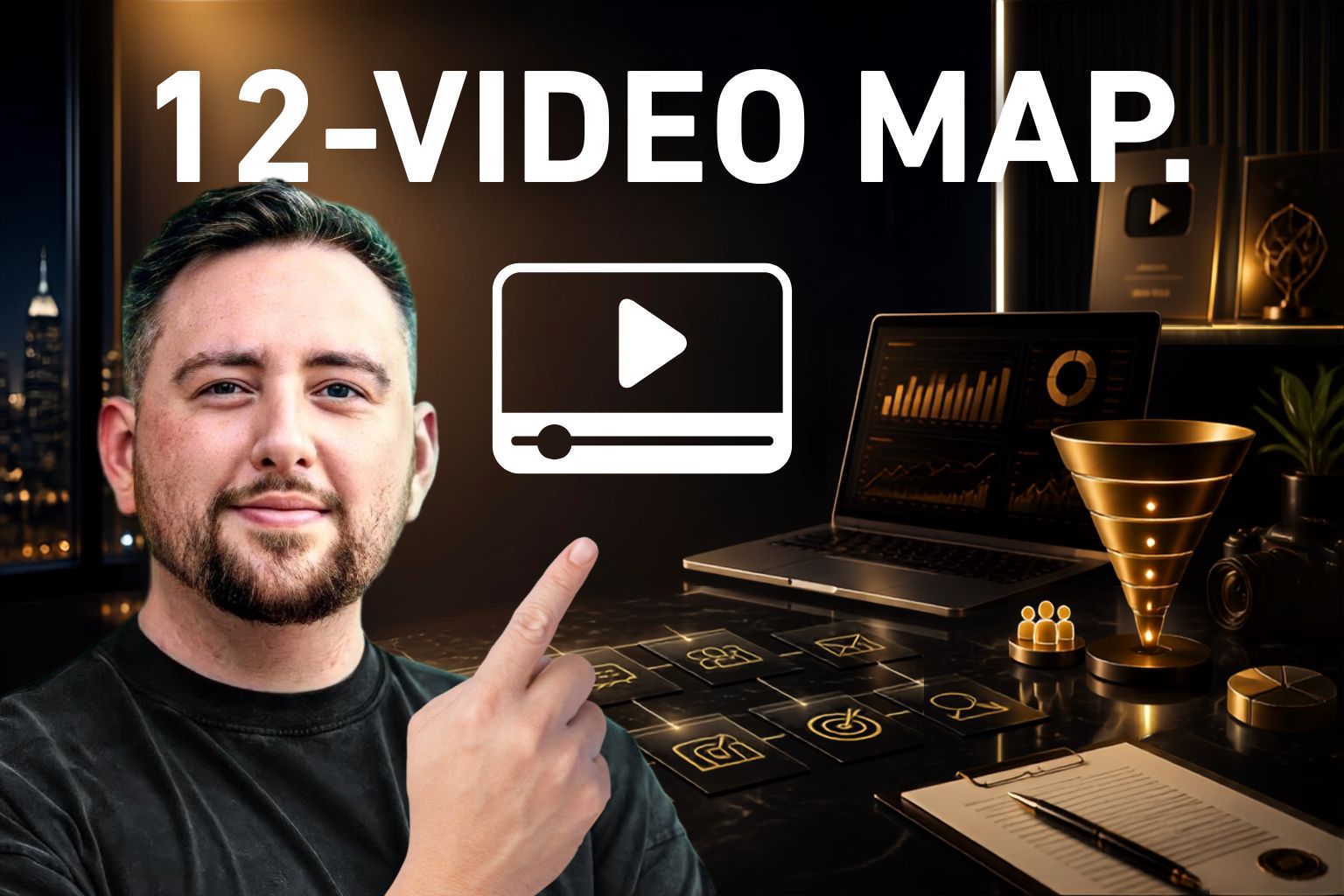
My 12-Video YouTube Content Map for High-Ticket Offers
I hope you enjoy reading this blog post. If you want my team to just do your marketing for you, click here.
Author: Jeremy Haynes | Published August 18, 2026
Earnings Disclaimer: You have a .1% probability of hitting million-dollar months according to the US Bureau of Labor Statistics. As stated by law, we can not and do not make any guarantees about your own ability to get results or earn any money with our ideas, information, programs, or strategies. We don’t know you, and besides, your results in life are up to you. We’re here to help by giving you our greatest strategies to move you forward, faster. However, nothing on this page or any of our websites or emails is a promise or guarantee of future earnings. Any financial numbers referenced here, or on any of our sites or emails, are simply estimates or projections or past results, and should not be considered exact, actual, or as a promise of potential earnings, all numbers are illustrative only.
I would rather build 12 YouTube videos around one high-ticket offer than publish 100 disconnected videos and hope the right buyer finds a path through them. A high-ticket YouTube channel works when each video answers one decision-stage question and deliberately sends the viewer to the next useful answer. The offer defines the content library, the playlists organize it, and the routing between videos creates a clear research path. That is the channel architecture I use when sales quality matters more than raw reach.
This is a narrower job than general content marketing. My broader breakdown of turning content views into high-ticket sales covers the full content-to-revenue system. Here, I’m staying with the channel itself and showing how I map one offer into a useful 12-video starting library.
Already making money? See what it takes to make a lot more.
Why I Build the Channel Backward From the Offer
The offer tells me which buyer the channel needs to help, which problem that buyer already recognizes, and which decisions stand between interest and an application. I write those decisions down before brainstorming titles. Otherwise, the topic list drifts toward whatever sounds interesting that week.
I start with four questions. Who is the offer genuinely for? What has that person already tried? What do they need to believe before the offer makes sense? What would make them hesitate even if they trust the person selling it?
Those answers create the edges of the channel. A video belongs when it helps the intended buyer diagnose the problem, understand the mechanism, evaluate proof, or make a fit decision. A topic can be popular and still fail that test.
The offer is the editorial filter. It prevents a channel from becoming a collection of unrelated expertise. The viewer should be able to watch three videos and understand who the work is for, how the operator thinks, and which problem the offer is built to solve.
How I Turn Buyer Questions Into a Content Map
I build the first topic list from real sales material. Call notes, application answers, lost-deal reasons, email replies, direct messages, and questions from current buyers give me better inputs than a generic keyword export. Search demand still matters, but it comes after the buyer language is clear.
I sort every useful question into a simple decision map:
Problem: What is going wrong, and why does it keep happening?
Cost: What does waiting or using the current approach continue to consume?
Mechanism: What process would change the situation?
Proof: What evidence would make the process credible?
Fit: Who should use the offer, and who should choose another route?
The map also exposes gaps in the offer. If I cannot explain the mechanism without vague language, the video problem is downstream of an offer problem. If every proof idea depends on one dramatic result, the evidence base needs more variety before the channel can carry the sales conversation.
This work is closely related to building trust assets for high-ticket sales. The difference is placement. Trust assets can appear throughout a funnel, while this map decides which trust questions deserve full videos and how those videos connect.
The 12 Videos I Use for the Starting Library
The first library contains three videos in each of four groups. Twelve is enough to create multiple viewing paths while keeping the initial build manageable. It is a starting structure, not a promise that every offer needs the same permanent video count.
Three diagnosis videos: Each names a costly symptom, explains the likely cause, and shows how to tell whether that cause is present.
Three mechanism videos: Each explains one part of the process behind the offer without turning the video into a feature tour.
Three proof videos: Each examines evidence, a case pattern, or a before-and-after decision with enough context to be useful.
Three decision videos: Each answers a fit, timing, implementation, or expectation question a serious buyer asks near the end.
I do not publish all 12 as interchangeable educational videos. Diagnosis content should help a newer viewer name what is happening. Mechanism content should give an informed viewer a model. Proof and decision content should help a warm viewer evaluate risk and fit.
That sequence gives every upload a job. It also makes the gaps obvious. If the library has six diagnosis videos and no decision content, the channel may attract attention while leaving serious buyers to answer their hardest questions somewhere else.
How Each Video Owns One Buyer Decision
One video should resolve one meaningful question. Trying to cover the problem, full methodology, every objection, three case studies, and the offer in one upload usually produces a long video with no clear center. I pick the decision first and write the title around it.
For a high-ticket service, a decision might be whether the current lead problem comes from volume or qualification. For an education offer, it might be whether the buyer lacks information or lacks a repeatable implementation process. The video earns attention by making that distinction useful.
I use a four-part outline:
State the decision: Name the question and give the direct answer early.
Show the diagnosis: Explain the signs that tell the viewer which situation they have.
Demonstrate the reasoning: Walk through the process, tradeoffs, or evidence.
Route the next step: Send the viewer to the next question that naturally follows.
The last point keeps the video from ending with a generic subscription request. A viewer who just diagnosed a qualification problem needs a video about fixing qualification. They do not need whichever upload happens to be newest.
How Playlists Create the Buyer Research Path
I organize the 12 videos into playlists based on the questions a buyer is trying to answer. The playlist names should describe a useful outcome or decision, such as “Diagnose Your Lead Quality Problem” or “Evaluate a High-Ticket Sales System.” Internal team labels like “Authority Content” mean little to a viewer.
YouTube’s official guidance confirms that creators can arrange videos inside playlists. Its series playlist documentation also explains that an official series marks videos as a set that should be viewed together, and YouTube may use that information when presenting or discovering the videos. A video can appear in only one official series playlist, so I reserve that setting for a sequence with a real order.
My basic path looks like this:
A diagnosis video identifies the viewer’s specific problem.
A mechanism video explains how I think about solving it.
A proof video shows the reasoning applied in context.
A decision video explains fit, expectations, or the next step.
The order should survive without the viewer seeing every video. Each upload still needs to stand on its own. The playlist simply makes deeper research easier for someone who wants it.
Where End Screens and Links Should Send Viewers
I decide the destination while outlining the video. The spoken transition, description link, pinned comment, and end screen should support the same next step. Competing destinations force the viewer to choose between actions that the channel owner should have prioritized.
For early-stage videos, I usually route to another video. For proof or decision videos, the next step may be an application page or a resource that helps the viewer evaluate fit. The destination depends on what the viewer is ready to do after the question has been answered.
YouTube’s end screen guidance says creators can use the final 5 to 20 seconds to feature a specific video or playlist, and eligible channels can also feature an external link. The same guidance recommends relevant elements and provides an end-screen click-rate report. That makes routing measurable rather than decorative.
I connect this channel architecture to the larger authority journey inside Master Internet Marketing, my 7-week live comprehensive training. The useful question is always the same: after someone consumes this piece, what do they need next to make a better decision?
Results are not typical. Your results will vary and depend entirely on your individual capacity, business experience, expertise, and level of desire. There are no guarantees concerning the level of success you may experience. The testimonials and examples used are not intended to represent or guarantee that anyone will achieve the same or similar results. We don’t believe in get-rich-quick programs. We believe in hard work, adding value and serving others. As stated by law, we can not and do not make any guarantees about your own ability to get results or earn any money with our information, courses, programs, or strategies.
How I Build Proof Videos Without Making Them Ads
A useful proof video explains what happened, what decision changed, and which conditions mattered. A highlight reel may look impressive, but it gives a serious buyer little to evaluate. Context is what turns a result into credible evidence.
I structure proof videos around the initial state, the constraint, the decision, the implementation, and the observed outcome. I also explain what would make the same approach unsuitable elsewhere. That boundary makes the analysis more trustworthy and keeps the video from implying universal results.
Proof does not require exposing a member or client. Patterns can be anonymized, sensitive details can be removed, and claims can be limited to what is documented. My testimonial and social proof system covers the broader workflow for capturing and deploying evidence.
Inside my Inner Circle, the same standard matters when members discuss what happened in their businesses. The room is a private mastermind, so a public video should never trade confidentiality for a stronger hook.
Results are not typical. Your results will vary and depend entirely on your individual capacity, business experience, expertise, and level of desire. There are no guarantees concerning the level of success you may experience. The testimonials and examples used are not intended to represent or guarantee that anyone will achieve the same or similar results. We don’t believe in get-rich-quick programs. We believe in hard work, adding value and serving others. As stated by law, we can not and do not make any guarantees about your own ability to get results or earn any money with our information, courses, programs, or strategies.
What I Measure Across the 12-Video Library
I still watch impressions, click-through rate, retention, and returning viewers because those numbers tell me whether people discover and consume the videos. I do not treat them as proof that the offer architecture works. The sales-side questions are whether qualified viewers continue through the library and whether the right videos influence applications.
YouTube Analytics supports this review at several levels. The platform’s Advanced Mode guidance explains how to group videos by content pillar, compare groups or playlists, filter traffic sources, and compare similar videos. I can group the diagnosis, mechanism, proof, and decision videos instead of judging the entire channel as one pile.
I pair platform data with business data:
Use a distinct tracked link for each video’s primary destination.
Ask applicants which videos they watched or found most useful.
Record first-touch and self-reported influence separately.
Compare lead quality across the four content groups.
Review which next-video routes earn clicks and continued viewing.
Self-reported attribution will never be perfectly complete. It still reveals language and viewing patterns that a last-click report misses. The goal is to understand which videos help a qualified buyer move forward, then improve those paths.
This measurement belongs beside the rest of the sales process. My breakdown of how top businesses follow up by sales stage shows why every lead needs a next action after the content has done its part.
How I Expand the Library After the First 12 Videos
I expand from evidence rather than filling a publishing calendar. A strong search query can become a deeper diagnosis video. A retention drop can reveal where an explanation lost clarity. A repeated sales objection can become a decision video that the library currently lacks.
The four groups do not need to grow evenly. If buyers understand the problem but repeatedly misunderstand the implementation, I add mechanism content. If applications arrive with unresolved fit questions, I add decision content. The channel should respond to the offer’s real sales conversations.
Long-form videos can also feed other channels once their main job is complete. My content repurposing system explains how one recording can supply shorter assets. I keep the original YouTube video’s buyer decision intact instead of letting the clipping plan dictate the long-form topic.
A mature library gets denser, not merely larger. New videos should fill a decision gap, update an outdated answer, add evidence, or create a better route between existing questions. Publishing volume alone does not improve the architecture.
7 weeks. Real frameworks. Covering copywriting, funnels, paid ads, and conversion systems.
Build the First Research Path Before Scaling Output
Start with one offer and map the five buyer-question categories. Choose three diagnosis videos, three mechanism videos, three proof videos, and three decision videos. Give each upload one question to resolve and one logical destination for the viewer who wants to continue.
That 12-video library will not answer every possible question. It will create a coherent first path that you can measure and improve. Once applications and sales conversations reveal the missing decisions, add videos with a clear reason for existing.
If you want the broader system around that library, Master Internet Marketing, my 7-week live comprehensive training covers content, funnels, qualification, and follow-up as connected parts of acquisition. The channel becomes more useful when every video has a defined buyer, decision, and next step.
Results are not typical. Your results will vary and depend entirely on your individual capacity, business experience, expertise, and level of desire. There are no guarantees concerning the level of success you may experience. The testimonials and examples used are not intended to represent or guarantee that anyone will achieve the same or similar results. We don’t believe in get-rich-quick programs. We believe in hard work, adding value and serving others. As stated by law, we can not and do not make any guarantees about your own ability to get results or earn any money with our information, courses, programs, or strategies.
Get my content first on Google
Add jeremyhaynes.com as a preferred source and Google shows my articles more prominently in your search results, including AI Overviews and AI Mode.


Jeremy Haynes
Owner and CEO of Megalodon Marketing
Jeremy Haynes is the founder of Megalodon Marketing. He is considered one of the top digital marketers and has the results to back it up.