I hope you enjoy reading this blog post. If you want my team to just do your marketing for you, click here.


I hope you enjoy reading this blog post. If you want my team to just do your marketing for you, click here.
Author: Jeremy Haynes | founder of Megalodon Marketing.
Earnings Disclaimer: You have a .1% probability of hitting million-dollar months according to the US Bureau of Labor Statistics. As stated by law, we can not and do not make any guarantees about your own ability to get results or earn any money with our ideas, information, programs, or strategies. We don’t know you, and besides, your results in life are up to you. We’re here to help by giving you our greatest strategies to move you forward, faster. However, nothing on this page or any of our websites or emails is a promise or guarantee of future earnings. Any financial numbers referenced here, or on any of our sites or emails, are simply estimates or projections or past results, and should not be considered exact, actual, or as a promise of potential earnings – all numbers are illustrative only.
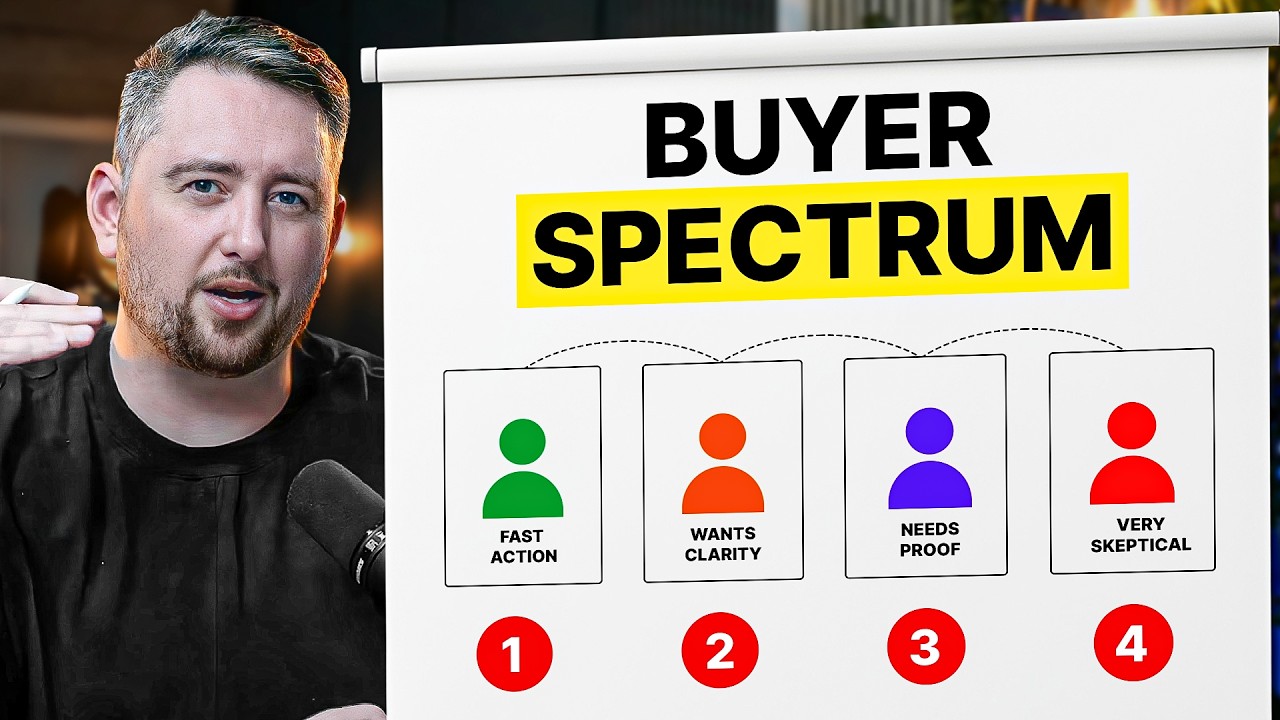
Let me introduce you to the buyer spectrum. The buyer spectrum in my world makes a significant difference for helping me adapt messaging at specific stages of market sophistication and market awareness.
There’s a great book that we’ve talked about a tremendous amount of times on this site. It’s called Breakthrough Advertising and Eugene Schwartz written in the 1950s introduces this concept of market awareness and market sophistication and ties it into how you need to communicate and how you need to adapt what types of funnels you potentially run at later stages of the market.
The main lesson that he consistently talks about is that as you get to more sophisticated levels of market sophistication and higher levels of awareness, you have to change what you do.
You have to, as an example, start introducing unique mechanisms, talk about processes much more in order to get people who are probable to buy to actually buy.
When you very first enter into a market, you can generally get away with just making a simple claim. And as a result of making that claim, you have a really high probability of getting people to respond.
If your business is already generating $100k+ per month, My Inner Circle is where you break through to the next level. Inside, I’ll help you identify and solve the bottlenecks holding you back so you can scale faster and with more clarity.
I want to be clear when I say this though. Over the years, although I found a tremendous benefit from that thinking that Eugene introduced in that book, Breakthrough Advertising, I have added a handful of frameworks on top of it.
And the buyer spectrum is one of those foundational frameworks that helps me and my clients convert at scale.
So if you’re new to the site, all we talk about around here is hitting million-dollar months. We take the lessons of people who have been there, done that, and hand them down to you right here in little bite-size formats just like this one here.
Today, we’re going to go through an absolute banger. This is one of my favorite things to talk about, but it’s a little more advanced.
You have to find specific scenarios in which it’s most applicable to use and deploy. I’ll help tie in these concepts to how you can actually take action on it based on circumstances you might presently be in.
So if you’re already a subscriber, welcome back. It’s always a pleasure to have you here.
Per usual, we don’t make any income claims on this site. All we’re doing is handing down lessons. No income claims, no implied earnings potential.
All we’re saying is, hey, if you want to learn some lessons from people that have cracked these million-dollar months, that are looking to crack their next million-dollar month, I would encourage that you pay close attention because this is how they think.
So without further ado, let’s dive in.
Now, I want to introduce you to a car. It’s called the Apollo. I have no idea if that’s the manufacturer of the car or if that’s the specific model of the car, but the Apollo is likely something that you haven’t heard of before.
And for those of you that are into cars, maybe you have.
All I really know about the Apollo is it has a giant X on the back of it for its tail lights. It looks sick. Has a massive carbon fiber diffuser, a crazy spoiler.
The car looks super cool. I’ve only seen it at car shows. I have no idea what country makes it. I have no general idea of the price. I know it’s priced somewhere between 2 and 5 million bucks.
I know it’s an independent car manufacturer. And other than that, that’s really all I know.
Couldn’t tell you the horsepower. Couldn’t tell you whatever else there is to know about cars. All I know is it looks pretty sick.
And if you got 2 to 5 million bucks, they’ll put you on a wait list and probably get you one in about a year after manufacturing it.
I’m under the impression it’s that specific company’s first vehicle. I also think this car came out in the last 2 to 3 years.
After you hear that, who do you think is most probable to buy that type of car?
I like to have you open up with this example when you consider the buying spectrum because it immediately puts in to clear perspective the first type of buyer that we’re going to talk about.
The first type of buyer is a very high risk profile buyer.
This type of individual will just see that type of car, say, “That thing looks sick.” They probably don’t ask all the other questions that are very sensible questions that honestly make a lot – they’re great and likely need answered.
As an example, where the heck are you going to get that car mechanically fixed? Like if something goes wrong with it, are they going to fly somebody to the car and fix it?
Do they have parts from other vehicle manufacturers where you can send it to their dealerships or service providers? Is it a highly specialized mechanic? Like they’re going to cost an insane amount.
What is the service schedule? You know, some of these supercars and hypercars, I think that one’s a hypercar respectively, are so insane for the amount of maintenance that they have and the cost associated with that maintenance.
But it’s like, again, really think about that. Do you even think buyer type number one’s going to ask those types of questions?
To be fair to buyer type number one, generally they’ll ask maybe one of those types of questions there. That’s the thing with buyer type number one.
They generally have one key question and that’s really it. That’s all that really holds them back.
Most of these people operate on immediate action. Like they see something that aligns to a desire or a problem solution scenario that they have and due to the fact that they have such a strong appetite for risk in their life.
Even buying that type of car, they likely don’t think of for more than a couple seconds or couple minutes and then they’re pulling the trigger on it.
This is really important you understand this first buyer type. They don’t require testimonials. They don’t require a lot of questions being asked.
They generally don’t even necessarily require anything other than, “Hey, where do I send the money to?”
This type of buyer generally shows up already sold or just with the most minor key questions that they want answered and they’re willing to purchase.
They don’t need a risk reversal. They don’t require a lot to actually purchase, which is the complete opposite of the end of this spectrum.
The exact opposite end of this spectrum we’ll talk about here towards the tail end of this piece, but it’s a wildly skeptical individual that requires a tremendous amount of friction in order for them to eventually purchase.
Longer buying cycles and again the exact opposite. Strong testimonials, risk reversals, guarantees, every question under the sun being answered.
And even then, they’re going to take their sweet time to make sense of the purchase decision. And they might not even be in the financial position to truly take action on it.
They’re likely going to have to have some help making sense of the money, too.
So to be clear, this whole buying spectrum and what you’ll learn throughout this whole thing is it’s essentially a risk spectrum.
So the people who are willing to take more risk are at the highest end of the spectrum. And then the people who are willing to take the absolute lowest amount of risk in their lives, they’re at the complete opposite end of the spectrum, way over here.
And again, we’ll talk more deeply into the other end of the spectrum here shortly as we move through these middle stages.
So to be clear, when you initially launch something, whether you’re aware of it or not, you’re generally by default selling to the highest risk demographics.
You got a brand new offer, nobody’s purchased from you, you got no testimonials, you got nobody out there that’s going to help you from a referral network perspective.
Maybe if you’re lucky, you’ve got your reputation on your side, and some people out there from that perspective might purchase because of that.
But generally what gets these high risk profile individuals to purchase which in most instances are your first buyers – these are the people that you need to align to most when you very first launch something and have no credibility around selling that thing yet.
This type of buyer is going to be your saving grace. This specific person is the buyer that you need to look for and optimize around first.
But imagine if you attempted to stay optimized around that type of buyer at later stages of your market. It would have a very high failure rate.
You wouldn’t convert the second, third, or fourth type of buyers ever. You’d only have a business for the first type.
And this is actually quite interesting to see. Give or take the size of the market that you participate in – wildly dictates your revenue potential right off the bat just based on size.
In addition to that, the quantity of people that are in this specific demographic shrinks and increases relative to the size of the market.
So think about it like this. Real estate offers, stock or trading offers, sales offers nowadays, AI offers, very common household goods, things that almost everybody purchases like shoes, clothes, toothbrushes, toothpaste, you know, like common things like that, deodorants.
My point being is the larger the market, the higher the quantity of this type of buyer that there is.
And so when you very first launch something, it’s very important to note there’s truly not much you have to do to get this type of buyer because they’re going to be the only ones that are most probable to purchase anyway. Research shows that innovators, who represent the first 2.5% of buyers, are risk-takers who are willing to try new products at some risk and typically have higher incomes than later adopters.
All you necessarily have to do here is just make the offer really good.
So back to that first example I provided with the Apollo car. Again, if you look at that car, it’s sick. And if you’re in market for a hyper car and you wanted something that’s more unique comparatively to everything else that’s out there, that’s right up your alley.
You have a very high probability to purchase it.
But let me tie in buyer type number two to that same exact analogy. Let’s talk about Koenigsegg, Pagani, right?
These types of cars, they already have a tremendous amount of buyers for them. By tremendous to be fair, realistically only a low couple hundred just due to the pricing of these specific cars.
But that’s more than the buyers of the Apollo. The buyers of the Apollo are still all buyer type number one. And that’s what’s really important to understand.
Buyer type number one is always going to be first. Buyer type number two.
So if you go to buy a Koenigsegg or you go to buy a Pagani as an example, same kind of logic. You’re in the market for a hypercar. You realistically want something in that range, but you know, you want the safety measures answered.
Like you want to understand what the maintenance schedule is. You want to understand who’s going to service it, how they’re going to service it.
You’re going to do little things like look on a map where you’re located versus where you actually have to go service it at.
You’re going to ask those questions like if the service center’s far away, is Koenigsegg or Pagani going to send a specialist to you? Like how’s all that work?
You’re going to ask all kinds of questions about value retention, and whether the car stays relatively the same or, you know, how much mileage you can realistically put on it or whether you can track it or not.
There’s going to be a lot of questions that buyer type number two has.
However, they still have relatively high risk profiles and it’s important you understand this.
So I’ll give you a great example with my Inner Circle offer so I can tie it to something that’s likely more real for what you and I sell.
So to be clear, in the high ticket product and service world, in this case, I’ve got this Inner Circle program, and the very first people that ever joined into it are buyer type number one through and through.
They are buying because of my reputation. They know that I’m going to help them, but nobody else has bought the offer before when it very first came out.
They don’t necessarily know what to expect, but they have a good expectation in general, but it’s reasonable. It’s manageable. It’s easy to fulfill on and you know again they’re more than happy to pull the trigger.
Now we’re currently in the second phase. The second phase is quite different than the first phase.
So the second type of buyer that we currently generate, sure we still get a lot of buyer type number ones, but I’ll give you a great example.
Like I just recently did an interview with a guy his name was Ryan. And when I was on Ryan’s podcast or show or just his YouTube channel in general, you know, we got the opportunity to talk about the Inner Circle a little bit throughout it.
Ryan’s done over $70 million with his specific offer. Respectfully to him, I think he just cracked 75 million to be more specific.
Now throughout that specific episode, we had talked at length about how he wanted to join into the Inner Circle.
Now, why is a guy who’s done 70 plus million not just immediately and instantly pull the trigger on it?
That’s a great question. And that question can be easily answered by looking at the buying spectrum.
Buyer type number two has to make sense of many things.
So for Ryan, respectfully to him, he definitely is a risk taker. That’s not necessarily the question here. There’s other variables at play with buyer type number two that are factored in.
So for him specifically – more of a timing based question. So he needed to get into it after about another month or so went by and the main reason being that extra month is the amount of time that he wanted to give his head of marketing that he just hired in.
And he wanted to reward the guy but he wanted the guy to hit a specific revenue spectrum – a revenue target – prior to buying.
So buyer type number two, this is really important you understand this. Like they can still make sense of the offer. They can still make sense of taking the risk. They just have a lot more questions.
So like literally if you go watch that interview with Ryan and I, you’ll see some of the questions that he asked, you’ll hear him talk about like, “Oh what comes with it? Like you know what are the expectations?” Things like that.
Those are all buyer type number two questions.
Here’s the good news. There’s obviously a smaller quantity of people at both ends of these spectrums, which is both good and bad.
And there’s a far larger quantity of people that are in these second and third spectrums.
Buyer type number two and buyer type number three are the most common people that you’re going to come across. According to adoption curve research, early adopters represent approximately 13.5% of the market, while the early majority accounts for about 34% of buyers.
Typically, sales organizations struggle with this the most, and they’re the people who need to know it more than near everybody else.
When you have a sales team that only looks for the people that are inside of buyer type number one or buyer type number two, you fail to ever sell buyer type number three and buyer type number four.
Sometimes you even struggle to sell buyer type number two.
Your sales people will commonly say things like, “Ah, you know, this lead showed up with a whole bunch of questions. I don’t think that they were ready to purchase yet. You know, as a result of that, like I deemed them unqualified.”
When in reality, what you have to do is you have to adapt.
It’s like, I’m never frustrated when we get a buyer type number two through the door that needs to make sense of the offer that has more questions than buyer type number one that has a little bit more time in the buying cycle compared to buyer type number one.
I’m never shocked when I see that type of person come through the funnel. Neither is my sales team. Neither for the most part are my clients sales teams because they know that there’s just that type of buyer out there that exists and they know that there’s a far larger quantity of that type of buyer that exists.
And here’s the crazier part. You’re going to get far more of buyer type number two once you do start to have a positive reputation about whatever your product is and the word starts to get around.
So back to the Inner Circle example, that’s exactly what’s happening with that offer right now. Our stock values way up.
People are realizing, “Man, you could pay this guy what he’s asking for that offer, have a very high probability to make it back, not only fast, but like pretty much in the first couple months, if not the literal first month from some of these stories that you see.”
And it’s not even like we have to be the ones to tell you that word gets around about it because it’s a relatively small world of people. It’s a small market that we’re likely selling that offer to.
And so as a result of positive reputation both online and offline in real conversations, you have to understand you’re naturally going to get more people that are less risk-averse that need more group think and word of mouth in order to take an action.
Here’s a crazy stat for you. Right after we went and did that Ryan interview – and since a guy at that level, you know, again, 75 plus million dollars generated on his specific offer, you know, how many people right after that specific interview and a guy like that having willingness to buy pulled the trigger on the Inner Circle as a result of that specific interview?
It was more than 10. I’ll tell you that it was more than 10.
Now, why did those people have to have that specific set of data – a random high authority third party vouch for it – in order to pull the trigger?
It’s all in the risk spectrum. That’s all it is.
Like I said, you can’t be frustrated by this type of stuff. If anything, you have to play into it.
So when you very first come out with an offer, like if you again look at the Inner Circle specifically or you look at the Apollo versus you look at the Koenigsegg models or the Pagani models, that’s what they do.
It’s like they’re always going to attract buyer types. Number one, we always get people through the Inner Circle.
We had a guy just joined in the other day. He’s like, “Oh, I’m already at a mill a month. I want to get to 2 mill a month. Love the way Jeremy talks. Like, I’m ready to go.”
I asked the guy, I go, “Do you know anybody a part of the group?” He goes, “I’m sure I do, but yeah, I mean, I don’t care about that. Like, you know, I just like this guy. I think that he can help.”
It’s like, dude, that’s a buyer type number one. He bought literally immediately after coming through the funnel.
But buyer types number two, we got a lot of those from that interview as an example. These are people have a tremendous amount of additional questions.
These are people who have a tremendous amount of things that need understood, but again, just a little more time, a lot more questions, and they’re going to purchase too.
Now, when you get into buyer type number three – buyer type number three is very different.
When you go through this specific part of the spectrum, this is also a very large swath of the market.
These people have a much harder time purchasing because they’re much less tolerable of risk. They have a much smaller risk appetite comparatively to buyer types number one or buyer types number two.
However, they’re also a large swath of people.
These are the people who benefit most from a lot of my backend selling systems and my content ad strategies that I consistently talk about on this site. Studies show that testimonials can increase conversions on sales pages by 34%, which is particularly effective for buyers who need more proof before purchasing.
These are people who are going to consume a lot of your confirmation page videos. These are people who are going to read and consume almost all of those six plus value dense email sequences that you’re going to be sending out.
These are the people that are going to put a relatively long duration of time in the buying cycle.
These are people that are going to ask for potentially talking to a testimonial. Listening and watching a testimonial is not enough for them. They likely need to actually talk to somebody.
Their timing is likely going to be something along the lines of, “Oh yeah, I’m paying for some other stuff right now. I’m gonna afford this and buy in in, you know, the next quarter or the next month.”
They simply put, they have a lot more friction.
And that’s the other really important thing to understand about this whole buying spectrum – there is less friction when you look at this versus there is a lot more friction at these later stages of the market.
And as a result of that, you have to understand this. You’re going to end up having a blend of people as you scale.
So back to the Inner Circle offer is another perfect example of this. We deny everybody that’s from here over.
Like we don’t sell to anybody in the third part of the spectrum, in the fourth part of the spectrum. We don’t believe in those people.
We actually for our offers specifically think that those people are gonna hurt us from a reputation perspective because if we allow one of those turds to come through, they’re not going to do stuff that we talk about in an offer like mine.
Like my offers require you to take risk. They require you to put your nuts on the table here and there and take a financial bet in order to see some cash returned.
Not everything that I teach requires you to put money on the line. There’s a tremendous amount of stuff that I teach that’s more of an optimization tactic that doesn’t cost money that can still lead to revenue, but I don’t care.
I’m not just going to teach those people that specific stuff. I’m going to teach them all kinds of things.
And in that specific offer, like my Inner Circle program, buyer type number one and buyer type number two, they are the people who see the most result.
They are not just our preferential buyer because they buy in a tighter time frame, they buy at a higher rate. They are our preferential buyer because of the success that they can see with our types of offer.
And this is what’s most important to understand. A lot of the times, especially for the people that already cracked a mill a month and are trying to crack the next mill a month or in smaller markets got to a couple hundred grand and are now trying to crack their first mill a month.
What ends up happening is you’re kind of thinking to yourself like “I’m forced to sell to more of this higher skepticism, longer sales cycle, way more questions, a lot more handholding, much much more trust is required for them to pull the trigger and just make sense of buying type buyers.”
And as a result of that willingness to sell to them at all, you end up loading up one of the largest time bombs in your business’s history that will eventually go off.
Because these types of people, I know this might sound a little ridiculous, but this is really important you understand this.
These people over here are typically very happy and satisfied with life.
And I know this might sound a little silly, but you know, bear with me.
These people at the other end of the spectrum, these are typically very cynical, high skeptical people. They have a lot of unhappiness.
They are typically in a position where they have really bad results in life because they just don’t take risks.
As you know, as a rich person sitting here reading this, trying to get a ton richer – really think about it. Like what’s generally what’s led you to get a lot richer? Risk.
And every time you get richer, you generally, for the most part, get a ton happier. You get more fulfillment. You get more purpose. Your life speeds up. You get to materialize what you want faster and sooner.
Get to help a bunch of people around you. Get to make way more impact. Scaled impact at that.
It’s like everything changes when you make a ton more money. And it generally leads to a lot of life satisfaction and happiness.
Dude, when things aren’t going your way and things aren’t going your way for a long duration of time, like you just naturally start to develop a cynicism towards life and people around you.
Your skepticism starts going through the roof.
Sometimes it’s not even the fact that you’re just not getting a tremendous amount of results. There’s a lot of younger people who are just entering into life that still have a lot of skepticism and cynicism.
However, generally those people fall victim to negative propaganda more than anything else that leads to that negative worldview.
And so this is really important you understand this – as a result of people coming in with a natural bias of this unhappiness, lack of satisfaction, high cynicism, high skepticism type perspective, everything that in my world, in my case, since I sell information in this specific example I’m providing to you with the Inner Circle offer, the Master Internet Marketing offer, which by the way, you can find links for if you want to check out.
Can’t stress this enough. If I sold to that type of person, buyer type number three or buyer type number four, it’s a time bomb because of how their lives are.
It doesn’t matter what I teach them. It doesn’t matter how effective the information that’s been given to those individuals are. Doesn’t matter how effective your service or your product is.
Those people due to their world view have a dramatically higher failure rate comparatively to the people that are buyer types number one and buyer types number two.
And so the whole premise of this lesson – why I’m presenting this to you and trying to give you as much context around this as I can – is people rarely ever talk about this. I haven’t seen anybody talk about this stuff.
That’s why I’m trying to put you on game to it.
If you sell to a buyer type number three or a buyer type number four and you want to continue maintaining a solid reputation, you have to understand the people who are buyer types number one and two, they’ll help carry your brand.
Like they will constantly have a much higher success rate, a much higher satisfaction rate, a much higher referral, word of mouth, network effect.
Buyer types number three and buyer types number four – it’s like even if you feel like you can eventually persuade them and change their worldviews and help aid them in that regard because they need it for sure, it’s going to be a long drawn out cycle because that’s what’s most important to understand.
There’s more time involved with these people.
If they take a long time to buy, they’re going to take a long time to get a result.
If they take a long drawn out period of time with a ton of questions and excuses, what do you think’s going to happen once they buy the product? You think their questions are just going to go away? You think their excuses are just going to go away?
No. No. If anything, it goes up because that’s where all the real work is. You understand?
Buying’s easy. Buying is the easiest part. The part that’s tough is the part where it comes down to actually getting a result relative to what you sell and what you’re offering people.
So I can’t stress this enough time and time again, what we’ve consistently seen as a best practice is to maintain trying to communicate and sell and deter anybody other than buyer types one and two.
We don’t want buyer types three and four.
And just to be articulate about buyer type number four, buyer type number four sucks. These people are the devil.
They’re highly skeptical. They are some of the most cynical people on earth. They don’t believe in next to anything.
Not only will they have such a tremendous amount of questions, even after all those questions get answered, that doesn’t increase the odds they’re actually going to buy.
They go into it trying to ask questions, more so trying to prove that their skepticism and cynicism is accurate. And that’s the craziest part.
Like you could tell them the things that buyer types number one, two, and maybe even three can make sense of when they hear, not buyer type number four.
Buyer type number four because they don’t believe in stuff.
Again, they’re not asking questions from the perspective of trying to figure it out for their own benefit to buy. Literally, it’s the opposite.
They are time vampires. These people hurt you and your sales team’s time as they go through your funnels and your sales process.
So what you want to attempt to do is you want to attempt to try to start considering how to actively deter buyer types number three and four and how to exclusively attract buyer types number one and two.
So in my world, again, just to give you some examples from my Inner Circle specifically, we frame the funnel to have very obvious questions.
So for us, our very first question, you got to make 100K a month. You got to make 100K a month be a part of the Inner Circle at a bare minimum.
Most guys join in – like out of the most recent 10 people as an example we’ve had join in, they’ve been high hundreds of thousands a month. There’s been three of those people that joined in that were already above a mill a month.
The lowest people that are allowed to join into that group are the 100K people. And there’s a wild difference between the people that are in the 100 to 200K a month range and the people that are at the high 100,000 plus range.
Can’t stress that enough. We immediately ask that question. It’s the first question in our application.
The second set of questions that we use as qualifiers, we just say the price. So we say, “Hey, currently cost this. Are you going to be able to swing that?” They say yes, they get to continue.
From there, we ask another question. So we want people to commit for a year. A year is a proper amount of time when you’re attempting to hit the goals that almost everybody comes through that specific offer trying to hit.
We need a year. We got to have a year.
Do people get phenomenal results well before a year? Yeah, that’s very common. However, we need a year to ensure that we can get a high level of results because that’s what we’re trying to turn out with that program.
We only want people who have a really high probability to get a huge result because that’s the reputation that we want.
We don’t want a bunch of people like if I make 10% for a guy that makes 100K a month, he makes a measly 10K a month. That still pays for the offer easily.
However, if I help make a guy who’s already at a million a month, an extra 10% in that month, he makes an extra 100 grand a month. And again, he’s obviously super capable of paying for the entire year’s cost in that one month of additional earnings.
But it’s like, all right, I’m not just trying to make people that extra 10%. That in most instances is nobody’s goal who joins in. That’d be considered a very small goal.
Most of these people have pretty significant goals and target. And although we don’t make any guarantees, we do agree with most of these people that their potential is possible, but we have to believe in them.
We don’t believe in person type number four. We barely believe in person type number three.
So we don’t let them buy those offers. That’s not an offer for those people.
And as soon as they see those specific questions as an example, they’re deterred immediately. All right, that’s really important you understand that they’re immediately deterred.
Here’s what’s also important to note. The people who are most probable to talk trash about you on the internet – like, these are the Reddit users where you have some Reddit thread of people who have literally never even bought your product just actively talking trash about you for selling whatever you’re selling.
These are the people who are again just from their skepticism and their worldview. They don’t believe in anything that you do. They don’t believe that you’re legit. They don’t believe that you’re real.
They don’t believe that you’re helping anybody no matter how many people you’ve helped and no matter how much success you’ve had.
These are the types of people that have a dramatically higher probability to go out there and be the ones that have reputational damage to you.
And so here’s the other thing that’s really important to understand. As you enter higher levels of the market, you’re spending more money. You’re generating more awareness. You have far more customers than you ever did prior.
What’s going to end up happening is you’re just naturally going to get more exposure to all these folks.
People generate opinions really quick. And they generate most of their opinions based on which one of these buckets they fall into in life on the buying spectrum.
Because again, you have all these specific characteristics that correlate clear as day to where they fall into in these specific four buckets.
Now, what’s going to happen is as you continuously scale up, as you get more and more awareness, you accumulate more and more of all of these buckets at once.
That’s kind of the craziest part. When you very first get started, you generally only have buyer type number one that’s actually going to purchase. But you get attention from all four buckets at once.
That’s what’s most interesting about this whole spectrum. It doesn’t move in phases where you fill up the first bucket and then the second bucket and then the third and then the fourth. No, no.
You just instantaneously have exposure to all four of these types of demographics at once.
So what happens is like we just had an Inner Circle member, they cracked $3 million this past month. And in the most recent month, they’re attempting to crack 5 to 6 million bucks.
And one of the things that they started having occur right after they cleared 3 million bucks, they had all these random people who had never even bought from them start to just talk trash about them online.
Like there were people that have whole YouTube channels dedicated to hating. And again, Reddit threads from non-buyers just sitting there just openly communicating with each other about their skepticism and cynicism towards life and saying, “Oh, there’s no way it can be true.”
That happens online more than ever because it’s very easy to find echo chambers that echo back to you the exact same beliefs that you want to see out of the world.
So if I’m a skeptic and I want to go find a bunch of other people who also think that you’re full of it, I can just make a post about it.
And the higher you scale, the more attention there is, the more probability there is for a lot of those other skeptics at the same time to go and find you.
And just to be able to go and find those other people that are also skeptical, and they create a little hive of people who just actively will, again, try to attack you and tear you down.
Now, here’s the crazy part about that. That will impact buyer types number two and three more than anybody else.
Buyer type number one, they won’t care about that, to be honest. They probably won’t even Google you. They don’t care about that kind of stuff.
Some of them might have one specific question, but again, they have a much lower probability, buyer type number one, to ever even find that kind of stuff.
This will impact buyer type number two a lot. Buyer type number three, as soon as they see that kind of stuff they’re not going to buy anyway.
Buyer type number three, they’re looking for “where there’s smoke, there’s fire,” that kind of stuff.
So if you sell, think about this. If you built a business where you’ve successfully sold to buyer types 1, two, and three, and maybe even a little bit of four, although very rarely will you ever actually sell anything to four, mainly one, two, and three – and you have skepticism introduced to your market, you’ll immediately lose one of the larger chunks of people that had willingness to purchase.
Buyer type number three has next to no willingness to purchase when skepticism gets introduced from multiple people.
Buyer type number three, more than anything else, they think with group think. They don’t make decisions in an isolated way. They move in a pack.
So this is a very important thing to understand in terms of marketing. It’s like when I do want to successfully convert buyer type number three, I have to have group think tactics deployed at scale in order to successfully convert these folks.
Buyer types number one and two, they don’t require that.
You will get a little shakiness from buyer type number two when skepticism gets introduced, but it’s easily overcome by just you addressing it head-on yourself through things like confirmation page videos and just trying to make them aware.
Like, listen, mainly the people who are in those buckets, like they’re not even customers, they’re just skeptics, you know?
So anyway, there’s a tremendous amount of ways that we deploy this and that we use this well beyond what I’ve just discussed here.
Per usual on this site, I try to put you guys on enough game to be able to go out there, get a result with it, see some success, make enough money, and then buy some of my stuff.
So you can check out the links. We got a Master Internet Marketing cohort coming up, a new live class. It’s our fifth iteration of it in late summer here.
Very excited for that. Pumped to go through that class again. It’s always an honor to be able to remake it, add all the modern best marketing practices, and then help all those people try to get rich.
But more importantly, what I constantly love to do here is preach about my Inner Circle program.
Twice a month, one-on-one calls, weekly group calls, quarterly in-person masterminds. We also have our group chat full of rich people trying to get a ton richer, very active, very, very valuable.
And in addition to that, we got AI Jeremy with unlimited usage in the Inner Circle as well. Trained on over 4.4 million data points now because we update it.
Everything I do today gets uploaded into that bad boy which includes messages, recorded calls, conversations, everything. And it gets put into AI Jeremy the following morning.
So AI Jeremy’s always one day behind Real Jeremy and current awareness and knowledge. Very valuable and it gives you real time answers and insights when you need it.
Check out both of those links and at the very least subscribe to the site. Check out some of my other pieces.
What I can teach you isn’t theory. It’s the exact playbook my team has used to build multi-million-dollar businesses. With Master Internet Marketing, you get lifetime access to live cohorts, dozens of SOPs, and an 80+ question certification exam to prove you know your stuff.
Go out there and get richer. Talk soon.

Jeremy Haynes is the founder of Megalodon Marketing. He is considered one of the top digital marketers and has the results to back it up. Jeremy has consistently demonstrated his expertise whether it be through his content advertising “propaganda” strategies that are originated by him, as well as his funnel and direct response marketing strategies. He’s trusted by the biggest names in the industries his agency works in and by over 4,000+ paid students that learn how to become better digital marketers and agency owners through his education products.

Jeremy Haynes is the founder of Megalodon Marketing. He is considered one of the top digital marketers and has the results to back it up. Jeremy has consistently demonstrated his expertise whether it be through his content advertising “propaganda” strategies that are originated by him, as well as his funnel and direct response marketing strategies. He’s trusted by the biggest names in the industries his agency works in and by over 4,000+ paid students that learn how to become better digital marketers and agency owners through his education products.


This site is not a part of the Facebook website or Facebook Inc.
This site is NOT /endorsed by Facebook in any way. FACEBOOK is a trademark of FACEBOOK, Inc.
We don’t believe in get-rich-quick programs or short cuts. We believe in hard work, adding value and serving others. And that’s what our programs and information we share are designed to help you do. As stated by law, we can not and do not make any guarantees about your own ability to get results or earn any money with our ideas, information, programs or strategies. We don’t know you and, besides, your results in life are up to you. Agreed? We’re here to help by giving you our greatest strategies to move you forward, faster. However, nothing on this page or any of our websites or emails is a promise or guarantee of future earnings. Any financial numbers referenced here, or on any of our sites or emails, are simply estimates or projections or past results, and should not be considered exact, actual or as a promise of potential earnings – all numbers are illustrative only.
Results may vary and testimonials are not claimed to represent typical results. All testimonials are real. These results are meant as a showcase of what the best, most motivated and driven clients have done and should not be taken as average or typical results.
You should perform your own due diligence and use your own best judgment prior to making any investment decision pertaining to your business. By virtue of visiting this site or interacting with any portion of this site, you agree that you’re fully responsible for the investments you make and any outcomes that may result.
Do you have questions? Please email [email protected]
Call or Text (305) 704-0094