I hope you enjoy reading this blog post. If you want my team to just do your marketing for you, click here.


I hope you enjoy reading this blog post. If you want my team to just do your marketing for you, click here.
Author: Jeremy Haynes | founder of Megalodon Marketing.

Earnings Disclaimer: You have a .1% probability of hitting million-dollar months according to the US Bureau of Labor Statistics. As stated by law, we can not and do not make any guarantees about your own ability to get results or earn any money with our ideas, information, programs, or strategies. We don’t know you, and besides, your results in life are up to you. We’re here to help by giving you our greatest strategies to move you forward, faster. However, nothing on this page or any of our websites or emails is a promise or guarantee of future earnings. Any financial numbers referenced here, or on any of our sites or emails, are simply estimates or projections or past results, and should not be considered exact, actual, or as a promise of potential earnings – all numbers are illustrative only.
If you’re selling something at a high price point, whether that’s tens of thousands, hundreds of thousands, or even a million-plus dollars per person, you already know there’s going to be resistance in the sales process.
That’s just the nature of high-ticket offers.
But here’s what a lot of business owners miss. There are specific moments throughout the sales process where you can either create a massive amount of trust and close the deal faster, or you miss that window entirely and your sales cycle drags out for months longer than it needs to.
The way you capitalize on those moments is through what I call sales assets and trust assets.
These are the modern techniques that high-ticket businesses need to be deploying right now. Times have changed. The old playbook of just driving a lead to a sales call and hoping your closer can handle everything doesn’t cut it anymore.
I’m going to break down exactly what these assets are, how businesses I’ve worked with have deployed them, and why they’ve been so effective at shortening sales cycles and converting more of those on-the-fence leads.
If your business is already generating $100k+ per month, My Inner Circle is where you break through to the next level. Inside, I’ll help you identify and solve the bottlenecks holding you back so you can scale faster and with more clarity.
Let me define these clearly.
A sales asset is any piece of content or material that moves a lead closer to a buying decision. A trust asset is a specific type of sales asset that builds credibility and alleviates skepticism.
I use the terms hand-in-hand but keep them separate because they serve slightly different functions in the sales process.
In the sales process, there are key moments that come and go where you can either create a monumental amount of trust to close a transaction faster, or you miss the opportunity and dramatically lengthen your sales cycle.
When you’re selling something cheap, you generally don’t need a lot of these tactics. But the higher the price point, the more critical these become. And the businesses I’ve worked with across multiple industries, from capital raising to high-ticket e-commerce to information products, have all seen the same thing. When you deploy the right trust assets at the right time, sales cycles shorten dramatically.
This is where it all starts.
Before a real conversation even occurs with a lead, the goal is to overwhelm them with what I call high trust consumables. These are the pieces of proof, data, and third-party validation that start chipping away at skepticism before your sales team even picks up the phone.
Now here’s an important distinction. Not everything that used to be a trust signal still carries weight.
I was in a private group recently, high-level marketers only, and one of the members posted asking if anyone had a connection to scrub negative Trustpilot and Google reviews. That tells you everything you need to know about the current state of those platforms.
There are literally services you can pay to fake reviews or remove negative ones — regulators have recently moved to ban the trafficking of fake reviews and the sale of fabricated social proof because the practice deceives consumers and distorts purchase decisions.
Consumers know this. They’re aware that a five-star Trustpilot profile can be completely manufactured.
So you can’t just kick off an email sequence with “Hey, go check out our Trustpilot page” and expect that to move the needle. The consumer is aware that those platforms can be completely unreliable. That’s no longer considered a high trust consumable.
What does work? Third-party data.
The information coming from you as the company will always sound biased. The information coming from a third party will always carry more weight.
For one high-ticket e-commerce business I’ve worked with that sells red light therapy products, the third-party data that moves the needle is scientific studies. Universities, independent labs, and researchers conducting studies on how red light impacts various health conditions.
These weren’t studies the company funded. They were studies that already existed, conducted by independent scientists and institutions. The company found them, vetted them, and then used them as initial data to share with leads who were on the fence.
That’s a powerful high trust consumable because it removes the company’s bias from the equation entirely.
For information product businesses, the modern equivalent of third-party trust is Reddit.
More and more people now search for a company name followed by ‘Reddit’ when they’re doing their research — brands and marketing studies show consumers increasingly consult Reddit for candid peer reviews and product discussions that influence purchasing decisions.
They’re not going to Trustpilot. They’re not checking the BBB. They’re looking for real human beings having authentic conversations about their experience with your product or service, in a place that doesn’t appear to be influenced by the company.
Your leads are looking to trust you. They’re searching for reasons to buy or reasons not to buy. The whole point of trust and sales assets is to provide them with the research so they don’t have to go find it on their own.
Here’s what happens when you don’t proactively create these trust assets.
One business in our flagship program was based in Dubai, offering a high-ticket service at around $25,000. For a long time, all their KPIs were rock solid. Cost per call, show rates, close rates, everything was consistent. They were a freight train.
Then out of nowhere, their show rate and close rate started tanking. It wasn’t a seasonal dip. It wasn’t some macro event. There was no change in demand for their service. It was just a random, unexplained drop.
For almost two months, they tried every best practice in the book and nothing worked.
Results are not typical. Your results will vary and depend entirely on your individual capacity, business experience, expertise, and level of desire. There are no guarantees concerning the level of success you may experience. The testimonials and examples used are not intended to represent or guarantee that anyone will achieve the same or similar results. We don’t believe in get-rich-quick programs. We believe in hard work, adding value and serving others. As stated by law, we can not and do not make any guarantees about your own ability to get results or earn any money with our information, courses, programs, or strategies.
I had a hunch. I asked them if they had a Reddit thread where their actual customers openly talked about their experience. They said no, they used Trustpilot.
So we looked up their business name plus “Reddit.” Two threads ranked at the top, and both were filled with people who had never even bought the product. These were just people who despised the idea that any educational program could ever create success for someone.
And here’s the thing. The timing of when those Reddit threads started ranking in Google correlated almost perfectly with when their show rate and close rate started declining — research and industry surveys consistently show negative or prominent third-party commentary in search results can materially reduce conversions and discourage buyers.
It was too precise of a correlation to ignore.
The fix was straightforward. They sent those Reddit threads out to their hundreds of existing customers and simply asked them to share their experience, good or bad. No pressure, no bias. Just asked them to articulate what their experience was like.
Over 200 people responded and shared authentic feedback. About two and a half weeks later, their show rate and close rate not only recovered but actually exceeded their previous benchmarks.
That’s the power of proactively controlling the third-party research that leads are going to find anyway.
If you really want to take trust assets to the next level, fund your own third-party study.
One business I worked with, part information product, part service, funded a university study on the effects of their program. They wanted to know their actual success rate over a specific duration of time and whether the claims they were making about outcomes were substantiated.
The study lasted over a year. The results showed that their program was effective in the high 90th percentile and that almost all of their claims were proven accurate and substantiated.
Now they have a third-party, university-conducted study that they can leverage as one of the very first things they send to leads. They’re fully transparent about the fact that they funded it, and they share the entire process, how many people were followed, how the researchers checked in, how they arrived at the conclusions.
That one trust asset alone helps get the majority of analytical buyers over the fence. Sometimes all it takes is one incredibly strong trust asset to dramatically shift your conversion rate.
Obviously, funding a study isn’t something every business can do overnight. But the principle applies universally. The more you can take your claims and back them up with proof that doesn’t come directly from your company’s mouth, the more effective your sales process becomes.
Another principle that’s been incredibly effective, especially in capital raising, is visualizing your data in a way that’s easy to consume and impossible to dismiss.
One business I’ve worked with in the raising capital space had a strong track record of investors consistently reinvesting into new projects. Out of 157 total investors, 156 had reinvested into every subsequent project.
That’s an incredible reinvestment rate. But just saying that number means nothing. The words alone, especially coming from the company, are meaningless. You have to have hard proof. Literal data.
Results are not typical. Your results will vary and depend entirely on your individual capacity, business experience, expertise, and level of desire. There are no guarantees concerning the level of success you may experience. The testimonials and examples used are not intended to represent or guarantee that anyone will achieve the same or similar results. We don’t believe in get-rich-quick programs. We believe in hard work, adding value and serving others. As stated by law, we can not and do not make any guarantees about your own ability to get results or earn any money with our information, courses, programs, or strategies.
What they did was take that data, put it into a spreadsheet, and visualize it. They showed investor by investor, project by project, the individual capital returns with anonymized data. How much was invested, the timeline to get the money back, what the returns looked like, and then how those same investors moved into the next project.
They then addressed the obvious follow-up question, which was “If your reinvestment rate is so strong, why are you raising outside capital?” They handled that with a vision video from the founders explaining their growth strategy and why they needed to expand.
Each time a new question came up in the sales process, they created another trust asset to address it. That’s the framework.
This is the part most businesses get wrong.
It’s not enough to just create a bunch of trust assets and dump them on a lead all at once. That’s like carpet bombing someone with information and hoping something sticks.
The magic is in the sequencing.
You want to show leads what’s likely top of mind for them in that exact moment of the sales process. Not what you think is impressive. Not a random assortment of proof. The specific piece of information that addresses whatever is holding them back at that particular step.
The best marketers can replicate the sales process that would happen on a phone call in a content sequence that happens before the call. By the time the actual call happens, the salesperson is doing layup deals because all the heavy lifting has already been done.
In my experience working with high-ticket businesses, the process looks like this. First, you define every step a lead goes through from initial contact to close. Then you identify what question or objection is top of mind at each step. Finally, you create a trust asset that directly addresses that specific concern and deploy it at the right time.
You take those high trust consumables and turn them into different formats. Emails, long-form content, short-form content, direct messages. Different formats work better at different stages, and different leads prefer consuming information in different ways.
But the order matters. The sequence matters. Showing someone a deep financial analysis before they even understand what you do is a waste. Sending a basic overview to someone who’s already had three calls with your team is equally useless.
Match the asset to the moment, and the sales cycle compresses.
Here’s the bottom line. Your leads are going to research you whether you like it or not. The question is whether you’re going to control that research or leave it to chance.
If you don’t proactively create and deploy trust assets, your leads will go find their own information. And as that Dubai example showed, what they find might be a Reddit thread full of people who never even bought your product trashing you from the sidelines.
The businesses that win in high-ticket sales are the ones that provide the research for their leads. They create high trust consumables backed by third-party data. They visualize their proof in ways that are impossible to dismiss. And they sequence all of it in a strategic order that mirrors the natural progression of the sales process.
If you’re running a high-ticket business and you haven’t built out your trust asset library yet, that should be priority number one. Start by identifying what your leads are searching for when they research you, and then make sure what they find moves them closer to buying rather than further away.
If you want hands-on help building this exact system for your business, our flagship program includes twice-monthly one-on-one calls, weekly group calls where you can request specific topics like this, quarterly in-person masterminds in Miami, and a private community of high-level business operators scaling aggressively.
Most business owners waste years figuring out what actually works. In my Master Internet Marketing training, I compress that learning curve into 7 weeks, covering copywriting, funnels, ads, and more. If you’re ready to invest $5k and get serious about your skills, apply here.
Watch the video:

Jeremy Haynes is the founder of Megalodon Marketing. He is considered one of the top digital marketers and has the results to back it up. Jeremy has consistently demonstrated his expertise whether it be through his content advertising “propaganda” strategies that are originated by him, as well as his funnel and direct response marketing strategies. He’s trusted by the biggest names in the industries his agency works in and by over 4,000+ paid students that learn how to become better digital marketers and agency owners through his education products.
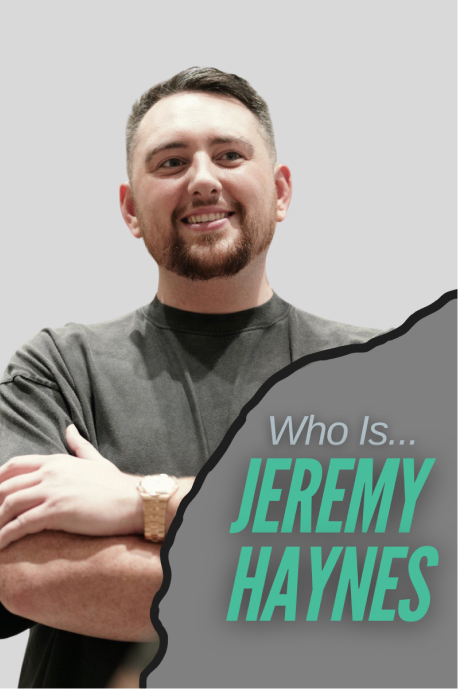
Jeremy Haynes is the founder of Megalodon Marketing. He is considered one of the top digital marketers and has the results to back it up. Jeremy has consistently demonstrated his expertise whether it be through his content advertising “propaganda” strategies that are originated by him, as well as his funnel and direct response marketing strategies. He’s trusted by the biggest names in the industries his agency works in and by over 4,000+ paid students that learn how to become better digital marketers and agency owners through his education products.


This site is not a part of the Facebook website or Facebook Inc.
This site is NOT /endorsed by Facebook in any way. FACEBOOK is a trademark of FACEBOOK, Inc.
We don’t believe in get-rich-quick programs or short cuts. We believe in hard work, adding value and serving others. And that’s what our programs and information we share are designed to help you do. As stated by law, we can not and do not make any guarantees about your own ability to get results or earn any money with our ideas, information, programs or strategies. We don’t know you and, besides, your results in life are up to you. Agreed? We’re here to help by giving you our greatest strategies to move you forward, faster. However, nothing on this page or any of our websites or emails is a promise or guarantee of future earnings. Any financial numbers referenced here, or on any of our sites or emails, are simply estimates or projections or past results, and should not be considered exact, actual or as a promise of potential earnings – all numbers are illustrative only.
Results may vary and testimonials are not claimed to represent typical results. All testimonials are real. These results are meant as a showcase of what the best, most motivated and driven clients have done and should not be taken as average or typical results.
You should perform your own due diligence and use your own best judgment prior to making any investment decision pertaining to your business. By virtue of visiting this site or interacting with any portion of this site, you agree that you’re fully responsible for the investments you make and any outcomes that may result.
Do you have questions? Please email [email protected]
Call or Text (305) 704-0094