
I Run My Hiring Process Like a Sales Funnel. Here’s the Exact System.

I hope you enjoy reading this blog post. If you want my team to just do your marketing for you, click here.
Author: Jeremy Haynes | Published June 30, 2026
Earnings Disclaimer: You have a .1% probability of hitting million-dollar months according to the US Bureau of Labor Statistics. As stated by law, we can not and do not make any guarantees about your own ability to get results or earn any money with our ideas, information, programs, or strategies. We don’t know you, and besides, your results in life are up to you. We’re here to help by giving you our greatest strategies to move you forward, faster. However, nothing on this page or any of our websites or emails is a promise or guarantee of future earnings. Any financial numbers referenced here, or on any of our sites or emails, are simply estimates or projections or past results, and should not be considered exact, actual, or as a promise of potential earnings – all numbers are illustrative only.
Your hiring process has a CAC problem. You just don’t think about it that way.
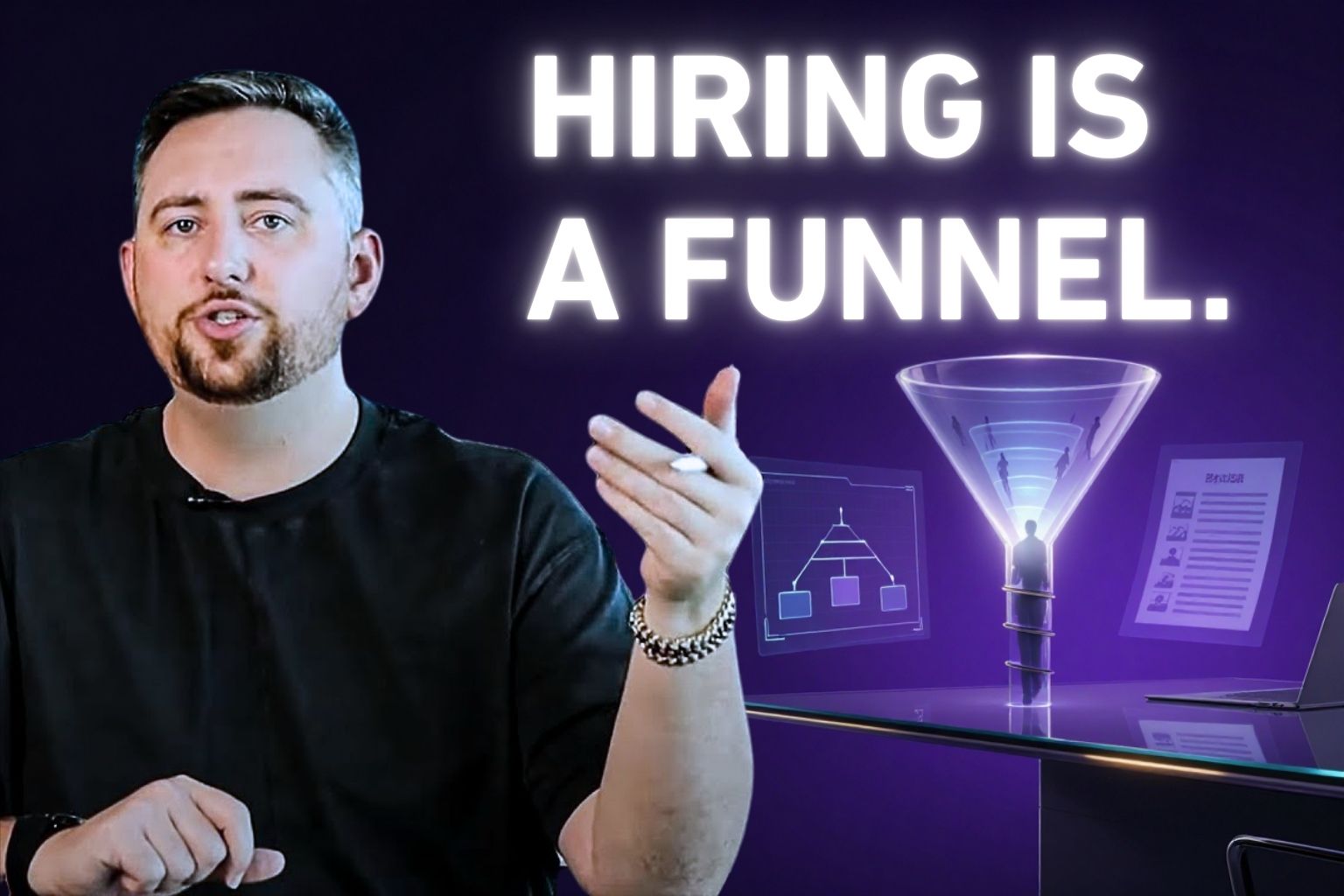
Every job post is an ad. Every application is a lead. Every interview is a sales call. And right now, most businesses are running that funnel worse than they’d ever let their media buyer run a paid campaign. No tracking, no conversion data, no qualification logic, no urgency. Just hope.
If you ran your ad funnel the way you run your hiring funnel, you’d fire yourself.
A bad hire typically costs between half and two times their annual salary once you factor in lost revenue, training time, and the opportunity cost of the deals that didn’t close while they figured it out. That’s your customer acquisition cost on a candidate who never converts into a producing closer.
I’ve built this exact funnel, and it consistently finds A-player closers inside two weeks. Not by working harder. By treating every stage like a marketing campaign instead of an HR formality. This is the same framework we use inside my Inner Circle, where we work with agency operators on building systems that scale.
Results are not typical. Your results will vary and depend entirely on your individual capacity, business experience, expertise, and level of desire. There are no guarantees concerning the level of success you may experience. The testimonials and examples used are not intended to represent or guarantee that anyone will achieve the same or similar results. We don’t believe in get-rich-quick programs. We believe in hard work, adding value, and serving others. As stated by law, we can not and do not make any guarantees about your own ability to get results or earn any money with our information, courses, programs, or strategies.
7 weeks. Real frameworks. Covering copywriting, funnels, paid ads, and conversion systems.
Top of Funnel: Why Job Boards Are the Worst Traffic Source You Can Run
If you were running a paid campaign and someone told you your best traffic source was “people actively looking, many of whom just got fired,” you’d cut that channel immediately.
That’s job boards. 70% of the workforce is passive talent (employed, performing well, not browsing job listings). The A-players you actually want aren’t checking Indeed at 2 PM on a Tuesday. They’re closing deals. Job boards filter for exactly the wrong audience: people with the most free time to apply, which often correlates with the least demand for their skills elsewhere.
Treat sourcing like top-of-funnel paid acquisition instead. Facebook and Instagram ads targeting sales professionals, built the same way you’d target buyers. LinkedIn outbound messaging high performers at competitor companies directly. That’s cold outreach, the same muscle you already use for sales. Referral bonuses from your current team function exactly like an affiliate program: your best closer knows other closers, and they’re your highest-trust traffic source.
Run paid ads for hiring. Treat recruitment like a marketing campaign, because that’s exactly what it is. You’re not posting and praying. You’re running traffic to a landing page with a video sales letter explaining the role, the culture, and the comp structure, then capturing leads through an application form designed to qualify, not just collect.
This is the same architecture we teach in Master Internet Marketing, our 7-week live comprehensive training, just pointed at candidates instead of customers.
Results are not typical. Your results will vary and depend entirely on your individual capacity, business experience, expertise, and level of desire. There are no guarantees concerning the level of success you may experience. The testimonials and examples used are not intended to represent or guarantee that anyone will achieve the same or similar results. We don’t believe in get-rich-quick programs. We believe in hard work, adding value, and serving others. As stated by law, we can not and do not make any guarantees about your own ability to get results or earn any money with our information, courses, programs, or strategies.
Lead Capture and Scoring: Your Application Is a Landing Page, Not a Form
“Upload your resume and we’ll get back to you” is a landing page with no offer, no copy, and no CTA. Of course it converts poorly.
Your job ad is your headline. Lead with income potential and performance culture, not benefits and PTO. Use polarizing language on purpose. “This role is not for everyone” filters exactly the way a sharp ad headline filters cold traffic from buyer-intent traffic. Disqualifiers belong in the copy, not buried in a job description nobody reads: “if you need hand-holding, don’t apply.”
The application itself is your lead capture form, and it needs scoring logic the same way a sales funnel scores leads by intent. Ask “what’s the most you’ve ever earned in a single month and how did you do it?” That’s a qualifying question, not small talk. It tells you immediately if they’ve ever performed at a high level. Ask “describe a deal you lost and what you learned.” You’re scoring for ownership versus blame, the same way you’d score a lead for buying intent versus tire-kicking.
Then the highest-leverage qualifier in the whole funnel: “record a two-minute video explaining why you’re an A-player.” A video application is a lead-scoring mechanism that filters faster than any resume ever could. If someone won’t record a short video for you, they’re not going to do the uncomfortable work of cold-calling a prospect who doesn’t want to talk to them. Build an automated scoring rubric (yes, maybe, no) and weight speed of response the same way you’d weight a lead’s speed-to-engage. Fast responders convert at higher rates in both funnels for the same reason: urgency signals intent.
The Nurture Sequence: Homework as Your Qualification Gate
In a sales funnel, the nurture sequence separates window shoppers from buyers. In a hiring funnel, that’s the homework assignment.
Give qualified applicants 24 to 48 hours to complete something real: “Here’s a case study. A prospect raised this exact objection. Record a three-minute response handling it and closing for the next step.” You’re testing sales methodology, tonality, and confidence under a deadline, and you’re testing whether they actually follow through, which is its own qualification signal. If someone can’t turn around a simple assignment in 48 hours, they won’t survive a fast-paced sales environment where deadlines are constant.
This stage is where most companies skip steps because it feels like extra friction. It is extra friction, on purpose. The same way a checkout flow with a few extra qualifying questions filters out tire-kickers before they waste your sales team’s time, the homework assignment filters out candidates who interview well but won’t put in the work. Track this stage the way you’d track any funnel metric (completion rate, turnaround time, quality score) because the data tells you where your funnel is leaking talent, not just where it’s converting them.
The Sales Call: What the Live Audition Actually Tests
This is the close-equivalent stage of the funnel, and it’s the one stage that can’t be faked.
Resumes can be embellished. Interview answers can be rehearsed. References can be coached. A live role-play under real pressure cannot be faked. They either have it or they don’t, the same way a live sales call either converts or it doesn’t regardless of how polished the deck looked beforehand.
Run structured scenarios: discovery call simulation, objection handling across price and timing objections, a full closing scenario with a resistant prospect. You’re evaluating exactly what you’d evaluate watching a real call recording: do they ask questions or just pitch, can they hold frame under pressure, do they listen or talk over the prospect, can they pivot when the script breaks.
Run group auditions (five to 10 candidates back to back on Zoom) the same way you’d batch-test ad creative instead of running one variant at a time. It creates competitive pressure that mirrors a real sales floor, and it’s dramatically more time-efficient than 10 separate one-hour interviews.
Score them one to 10 across five to seven criteria: discovery questions, objection handling, tonality, confidence, close attempt, coachability. Only candidates above your threshold move forward, exactly like only leads above a certain score get passed to a closer.
The Close: Reverse Closes, Fast Offers, and Your Refund Window
The final interview isn’t a repeat of what you’ve already seen. You’ve watched them close. Now you’re confirming culture fit, comp alignment, and 90-day expectations.
Use the reverse close. Give the candidate 10 minutes to close you on why you should hire them over every other candidate. This reveals confidence, preparation, and persuasion ability in real time. If they can’t close you on hiring them, they’re not going to close your prospects either.
Then move fast. Dr. John Sullivan’s recruiting research found that top candidates are typically off the market within 10 days of becoming available. If your decision process takes longer than that, you’ve already lost the candidate to a faster competitor. The recruiting equivalent of a slow follow-up sequence losing a hot lead to whoever responds first. Make the offer within 24 to 48 hours of the final interview.
Comp structure matters here too. Heavily performance-based compensation attracts people who want to eat what they kill. A fat salary with thin variable pay attracts people who want security, not performance. Wrong buyer for this offer entirely.
Already making money? See what it takes to make a lot more.
One more piece most funnels skip: the refund window. Build in a two to four week paid trial with clear performance benchmarks (X calls, X demos booked, X closes within the first 30 days). This is just a scorecard applied to a new hire instead of an existing employee. If they don’t hit it, you cut fast, no hard feelings. This protects you against the rare candidate who’s an A-player interviewer but a C-player performer. People can fake a role-play if they’ve done enough sales training, but they can’t fake real calls with real objections and real money on the line.
The framework in simple terms: you’re running paid traffic to a landing page, capturing applications, scoring leads with strategic questions and video, nurturing with homework, converting on a live audition, and closing fast with a trial period as your safety net. That’s not a metaphor stretched too far. It’s the same funnel logic you already use to sell, pointed at the most important purchase decision you’ll make this quarter: who’s going to be selling for you.
If you want help implementing systems like this in your business, we cover hiring, sales processes, and operational frameworks inside my Inner Circle and Master Internet Marketing, our 7-week live comprehensive training.
Results are not typical. Your results will vary and depend entirely on your individual capacity, business experience, expertise, and level of desire. There are no guarantees concerning the level of success you may experience. The testimonials and examples used are not intended to represent or guarantee that anyone will achieve the same or similar results. We don’t believe in get-rich-quick programs. We believe in hard work, adding value, and serving others. As stated by law, we can not and do not make any guarantees about your own ability to get results or earn any money with our information, courses, programs, or strategies.
Get my content first on Google
Add jeremyhaynes.com as a preferred source and Google shows my articles more prominently in your search results, including AI Overviews and AI Mode.


Jeremy Haynes
Owner and CEO of Megalodon Marketing
Jeremy Haynes is the founder of Megalodon Marketing. He is considered one of the top digital marketers and has the results to back it up.