I hope you enjoy reading this blog post. If you want my team to just do your marketing for you, click here.


I hope you enjoy reading this blog post. If you want my team to just do your marketing for you, click here.
Author: Jeremy Haynes | founder of Megalodon Marketing.
Earnings Disclaimer: You have a .1% probability of hitting million-dollar months according to the US Bureau of Labor Statistics. As stated by law, we can not and do not make any guarantees about your own ability to get results or earn any money with our ideas, information, programs, or strategies. We don’t know you, and besides, your results in life are up to you. We’re here to help by giving you our greatest strategies to move you forward, faster. However, nothing on this page or any of our websites or emails is a promise or guarantee of future earnings. Any financial numbers referenced here, or on any of our sites or emails, are simply estimates or projections or past results, and should not be considered exact, actual, or as a promise of potential earnings – all numbers are illustrative only.
The old playbook of making bold promises and hoping people believe you? That’s dead. AI is fact-checking everything. Your prospects are smarter. And honestly, they’re tired of the hype.
What I’ve been building and refining is what I call the Offer Proof Flywheel. It’s a self-reinforcing system where real customer wins create proof that strengthens your offers, which generates more wins, which creates more proof.
No tricks. No exaggeration. Just a repeatable system that compounds over time.
Here’s what most people don’t understand about the current landscape.
The platforms have evolved. AI overviews are surfacing content based on credibility and proof, not just whoever screams the loudest. When someone searches for a solution, they’re seeing summaries that pull from sources with demonstrated results.
If your marketing is built on hype and big promises without substance, you’re invisible in these AI-driven environments. Research from SparkToro shows that zero-click searches now dominate how people find information, meaning AI summaries often replace the need to visit your site at all.
Traditional sales funnels that relied on pressure tactics and exaggerated testimonials are getting filtered out. The businesses winning right now are the ones with documented wins, real data, and authentic customer stories.
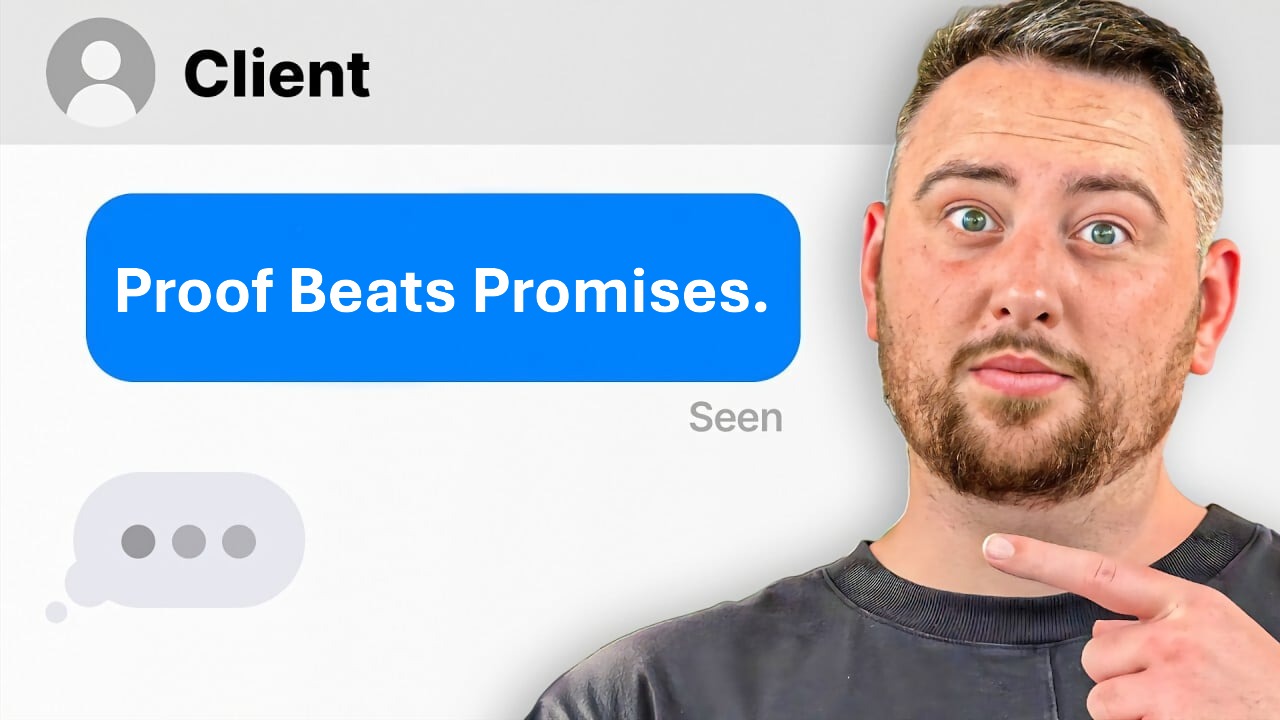
The shift is simple: proof beats promises every single time.
Let me break down how this actually works.
The flywheel has four core stages that feed into each other. First, you create an offer that’s designed to generate wins. Not just sales, but actual results your customers can measure and talk about.
Second, you systematically capture those wins. This means having processes in place to document results, collect feedback, and turn customer success into usable proof assets.
Third, you showcase that proof strategically across every channel where your prospects are making decisions. This includes your website, social platforms, email sequences, and especially the places AI is pulling information from.
Fourth, you iterate your offers based on what the proof tells you. You’re not guessing what works. You’re looking at real data from real wins and refining your approach.
Then the cycle repeats, but stronger each time because you have more proof, which makes your offers more compelling, which generates better wins.
If you want to go deeper on building systematic proof collection and offer development frameworks, check out my 7-week live comprehensive training where we cover these concepts in detail.
The biggest question I get is: “What if I don’t have wins yet?”
Start with low-friction offers that are designed specifically to generate documented results. This could be a pilot program, a free diagnostic, or a limited engagement where the entire goal is proving your methodology works.
The key is making it easy to say yes and structured to produce measurable outcomes. You’re not trying to maximize revenue on this first rotation. You’re trying to create proof assets.
Document everything. Set up simple surveys that capture before-and-after metrics. Record video testimonials. Take screenshots of results. Collect specific data points that demonstrate change.
Categorize these wins by customer type. A testimonial from a SaaS company hits differently than one from an e-commerce brand. When you can show proof that’s relevant to the specific prospect you’re talking to, the conversation changes completely.
This initial phase is all about building your proof inventory. Once you have a handful of solid wins with documentation, you’re ready to amplify.
Here’s where most people mess this up.
They collect testimonials and then just throw them on a testimonials page that nobody visits. That’s not amplification. That’s storage.
Real amplification means integrating proof into every touchpoint of your customer journey. Your homepage should lead with customer wins, not your company history. Your email sequences should include relevant case studies based on the prospect’s industry or pain point.
For the current environment specifically, you need to optimize for AI visibility. That means using structured data markup on your case studies so AI can easily parse and reference them. Google’s documentation on structured data explains how this helps search engines understand your content.
Embed proof in your organic social content. Not as promotional posts, but as storytelling. Share the journey of how a customer went from problem to solution. Raw, authentic, human-to-human content that shows real transformation.
The platforms are prioritizing this kind of authentic proof over polished corporate content. Stackla’s consumer research found that the vast majority of consumers value authenticity when deciding what brands they like and support. Your proof should reflect that.
This is where the flywheel starts accelerating.
Once you have proof coming in consistently, you analyze it to refine your offers. Look at which customer segments are getting the best results. Which specific outcomes are they achieving? What patterns emerge in their success stories?
Use this data to sharpen your positioning. If you notice that e-commerce companies consistently see results in a specific area, you can create an offer specifically designed around that outcome with proof to back it up.
Test variations of your offers based on what the wins tell you. If customers are raving about a specific deliverable you didn’t even emphasize, make that a core part of your next offer.
This isn’t guesswork. You’re building a feedback loop where customer success directly informs your product and marketing evolution.
Each iteration makes your offers stronger because they’re increasingly aligned with what actually produces results.
You need to know if this thing is actually working.
Traditional metrics still matter. Conversion rates, customer acquisition cost, lifetime value. But for a proof flywheel specifically, you’re looking at compounding indicators.
Track how many referrals you’re getting. A functioning flywheel naturally generates word-of-mouth because satisfied customers with real wins become advocates. If referrals aren’t increasing over time, something’s broken.
Monitor repeat purchase rates and expansion revenue. Customers who experience wins buy again and buy bigger. Your flywheel should be increasing both frequency and value of customer relationships.
Look at engagement metrics on your proof content. Are people sharing your case studies? Commenting on customer success stories? Spending time with your testimonials? High engagement means your proof resonates.
Add new metrics around AI visibility. Are you appearing in AI-generated summaries? Are your proof assets being referenced in chatbot responses? Tools are emerging that track your brand’s presence in AI ecosystems.
If you’re seeing growth in these areas, your flywheel is spinning. If not, you need to diagnose where the cycle is breaking down.
The proof flywheel isn’t a tactic. It’s a fundamental shift in how you approach building and refining offers. In my experience, once you get it spinning, it creates momentum that hype-based marketing could never achieve.
The framework covers systematic win capture, proof distribution across channels, and iteration based on real customer data. What this looks like in practice is a compounding system that gets stronger over time, as long as you keep feeding it with real wins.
If you want to work through implementing these systems with direct feedback and support, my Inner Circle is where we go deep on this with established operators.
Results are not typical. Your results will vary and depend entirely on your individual capacity, business experience, expertise, and level of desire. There are no guarantees concerning the level of success you may experience. The testimonials and examples used are not intended to represent or guarantee that anyone will achieve the same or similar results. We don’t believe in get-rich-quick programs. We believe in hard work, adding value and serving others. As stated by law, we can not and do not make any guarantees about your own ability to get results or earn any money with our information, courses, programs, or strategies.

Jeremy Haynes is the founder of Megalodon Marketing. He is considered one of the top digital marketers and has the results to back it up. Jeremy has consistently demonstrated his expertise whether it be through his content advertising “propaganda” strategies that are originated by him, as well as his funnel and direct response marketing strategies. He’s trusted by the biggest names in the industries his agency works in and by over 4,000+ paid students that learn how to become better digital marketers and agency owners through his education products.
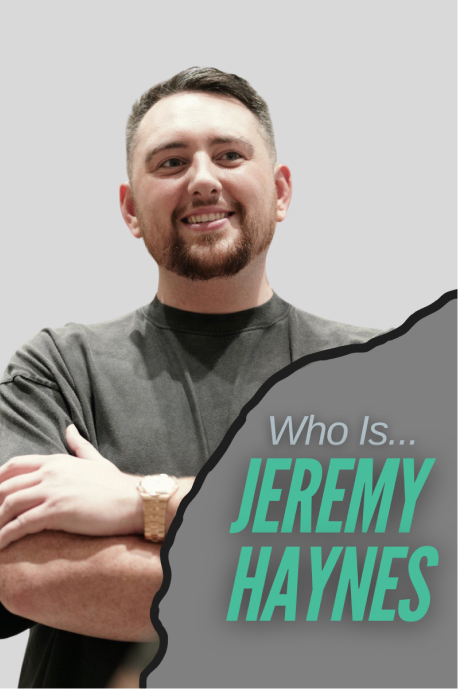
Jeremy Haynes is the founder of Megalodon Marketing. He is considered one of the top digital marketers and has the results to back it up. Jeremy has consistently demonstrated his expertise whether it be through his content advertising “propaganda” strategies that are originated by him, as well as his funnel and direct response marketing strategies. He’s trusted by the biggest names in the industries his agency works in and by over 4,000+ paid students that learn how to become better digital marketers and agency owners through his education products.


This site is not a part of the Facebook website or Facebook Inc.
This site is NOT /endorsed by Facebook in any way. FACEBOOK is a trademark of FACEBOOK, Inc.
We don’t believe in get-rich-quick programs or short cuts. We believe in hard work, adding value and serving others. And that’s what our programs and information we share are designed to help you do. As stated by law, we can not and do not make any guarantees about your own ability to get results or earn any money with our ideas, information, programs or strategies. We don’t know you and, besides, your results in life are up to you. Agreed? We’re here to help by giving you our greatest strategies to move you forward, faster. However, nothing on this page or any of our websites or emails is a promise or guarantee of future earnings. Any financial numbers referenced here, or on any of our sites or emails, are simply estimates or projections or past results, and should not be considered exact, actual or as a promise of potential earnings – all numbers are illustrative only.
Results may vary and testimonials are not claimed to represent typical results. All testimonials are real. These results are meant as a showcase of what the best, most motivated and driven clients have done and should not be taken as average or typical results.
You should perform your own due diligence and use your own best judgment prior to making any investment decision pertaining to your business. By virtue of visiting this site or interacting with any portion of this site, you agree that you’re fully responsible for the investments you make and any outcomes that may result.
Do you have questions? Please email [email protected]
Call or Text (305) 704-0094