The Leak Keeping This Business Stuck at $150K a Month

I hope you enjoy reading this blog post. If you want my team to just do your marketing for you, click here.
Author: Jeremy Haynes | Published July 31, 2026
Earnings Disclaimer: You have a .1% probability of hitting million-dollar months according to the US Bureau of Labor Statistics. As stated by law, we can not and do not make any guarantees about your own ability to get results or earn any money with our ideas, information, programs, or strategies. We don’t know you, and besides, your results in life are up to you. We’re here to help by giving you our greatest strategies to move you forward, faster. However, nothing on this page or any of our websites or emails is a promise or guarantee of future earnings. Any financial numbers referenced here, or on any of our sites or emails, are simply estimates or projections or past results, and should not be considered exact, actual, or as a promise of potential earnings – all numbers are illustrative only.
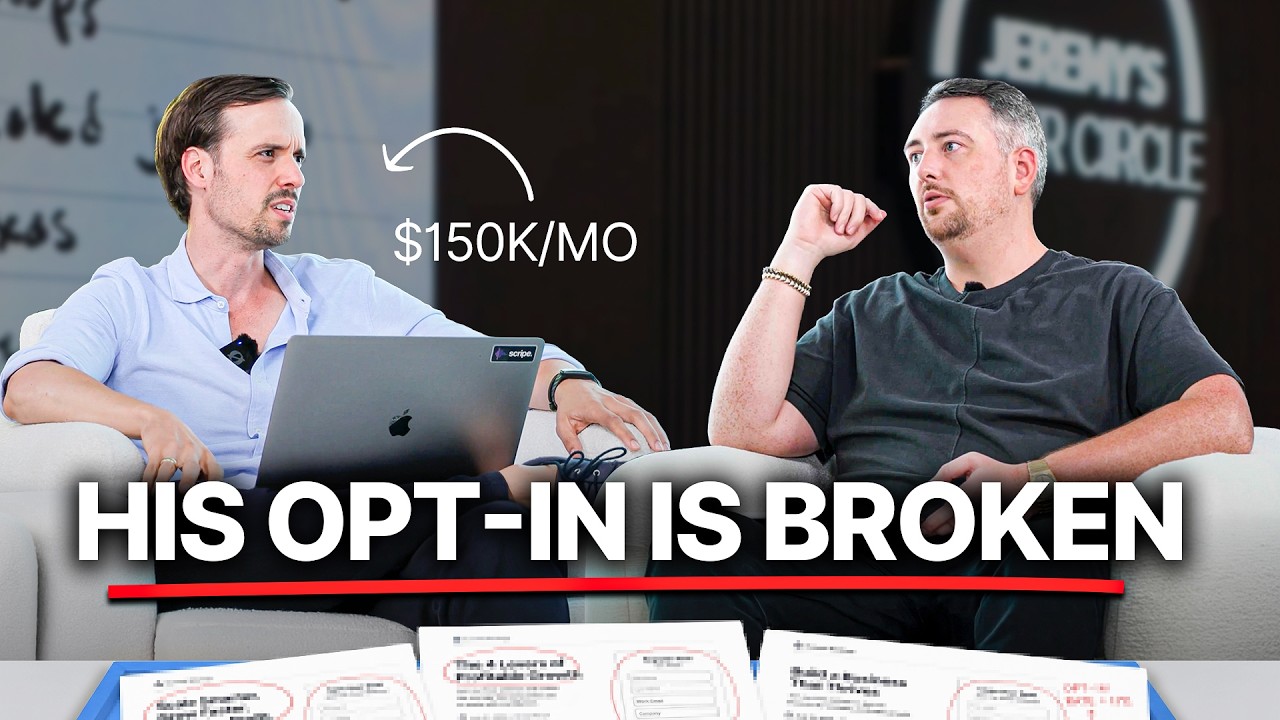
I got on a call this month with a B2B founder in my Inner Circle who’s built something most people would call a real business. His agency runs out of Germany, sells $2,000 to $2,500 monthly retainers to other B2B founders, and pulled in $180,000 in his best month this year. He’s on track for $200,000 this July.
By any normal measure, this guy is winning.
But when I pulled apart his numbers on that call, I found the exact leak keeping him stuck at $150K a month instead of pushing past it. The problem sat in a fragile, single-funnel operation built for a market that doesn’t behave like the market he was optimizing for.
If you’ve been stuck at the same revenue number for what feels like too long, this breakdown is for you.
7 weeks. Real frameworks. Covering copywriting, funnels, paid ads, and conversion systems.
Why $150K a Month Can Still Be One Bad Week From Collapse
Here’s the part that should scare every operator reading this: this business has been sitting between $120,000 and $180,000 a month for roughly two years. Not because the founder wasn’t working. He was running exactly one webinar a month for most of that stretch. Eight weeks ago he switched to running one every week, and revenue moved fast.
But the number that matters more than the revenue line is this: his return on ad spend sits at roughly 1.5. He’s spending around $30,000 to $32,000 a month on ads, about $8,000 a week, to generate around 300 opt-ins weekly. That spend produces roughly $10,000 back on $8,000 out, week over week.
I told him directly on the call: if one single number in that chain, cost per lead, opt-in rate, show rate, booking rate, close rate, drifts even slightly worse, that 1.5 ROAS is what takes the hit. He’s running his entire business off the edge of one funnel with almost no room for a bad week.
That’s the real leak: a structural fragility that a $150K-a-month business should have outgrown a long time ago. The customer acquisition cost math only works because every stage of the funnel has to perform at exactly the level it’s currently performing at, and there’s no cushion built in anywhere.
The Four Buyer Types and Why Skeptics Break Funnels Built for Everyone Else
I’ve written before about the four types of buyers you run into as you scale, and this case is the clearest example I’ve seen of type four showing up and quietly wrecking a funnel’s numbers. If you haven’t read my breakdown on how skeptical buyers behave at scale, the short version is this: type one takes risks without proof, type two needs some social proof, type three needs a mountain of it, and type four doesn’t want to buy at all. They’re there to confirm their suspicion that you’re full of it.
This founder is selling almost exclusively to German B2B buyers, and Germany has a specific skepticism problem baked into the market. There’s real consumer-protection legislation there that lets people work with lawyers to get refunds on “info products,” and predatory law firms advertise this aggressively. Add general economic anxiety tied to the automotive sector, and you get a buyer pool that treats every offer like it’s probably a scam until proven otherwise.
His real mistake was building a funnel with the same structure you’d use on a warm, trusting U.S. audience, then pointing it at a cold, defensive, skeptical one. You cannot optimize a skeptic-heavy funnel the same way you optimize for buyer types one and two. The mechanics have to change.
The Real Diagnostic: Where This Funnel Was Actually Leaking
This is the full stat line we walked through on the call:
CPM around $47. Link click-through rate of 1.5%. Opt-in rate around 11%, putting cost per lead around $28. Webinar show rate around 32%, but retention through the pitch is strong at 90%, meaning 72 of every 80 people who show up stick around to hear the offer. Booking rate off the webinar sits at only 15%. First-call show rate is 90%. Second-call booking rate is 50%. Second-call show rate is 95-100%. Close rate off that second call is roughly 50%.
Two numbers jumped out immediately: the 11% opt-in rate and the 15% booking rate. Both are what I call the skeptic tax showing up in the math. People are clicking, watching, even sitting through the entire pitch, and then bailing at the exact moment they’d have to commit to a next step with a stranger they don’t trust yet.
Everything downstream of those two numbers, the calls, the closes, the retention, is actually performing fine. The conversion rate problem sits at the two points where trust gets tested hardest: the opt-in page and the ask to book a call.
Results are not typical. Your results will vary and depend entirely on your individual capacity, business experience, expertise, and level of desire. There are no guarantees concerning the level of success you may experience. The testimonials and examples used are not intended to represent or guarantee that anyone will achieve the same or similar results. We don’t believe in get-rich-quick programs. We believe in hard work, adding value and serving others. As stated by law, we can not and do not make any guarantees about your own ability to get results or earn any money with our information, courses, programs, or strategies.
Fixing the Opt-In Page With Verifiable Proof, Not Screenshots
The opt-in page was leaning entirely on income screenshots. To a skeptical German B2B buyer who’s already been burned or knows someone who has, a screenshot proves nothing. It’s the easiest thing in the world to fake.
The fix: add a section that speaks directly to the skepticism instead of ignoring it. Something close to “look, I get it, you’ve probably been burned before, here’s why this is different,” followed by social proof people can actually verify. Real names, real people they could theoretically look up or message directly, not anonymous dashboard screenshots. This mirrors what I’ve seen with another Inner Circle member running an information business: adding a section to her opt-in page that directly addressed buyer hesitation, using verifiable proof instead of vague claims, lifted her opt-in rate without changing a single thing about the offer itself. Research on social proof backs this up directly: reviews with verifiable, specific detail convert dramatically better than generic claims, and products with credible reviews see purchase likelihood jump by as much as 270% compared to offers with none.
The second half of the fix is explaining the mechanism, not just making the claim. Skeptics don’t trust outcomes they can’t picture. Walking through exactly how the process works step by step, rather than saying “this gets you X result,” gives them something concrete to evaluate instead of something to simply believe or reject.
Why the Webinar Close Needed to Triple in Length
The webinar itself was only pitching for 30 minutes. For a skeptic-heavy audience, that’s nowhere near enough runway. I told him to stretch that close to a full hour, minimum, and to stop pitching once and hoping it lands.
Instead, re-pitch multiple times from different angles, each one addressing a different flavor of skeptic in the room. Some people on that webinar are thinking “I need one more piece of information before I’d ever consider this.” Others are thinking “I’ve been burned before and I’m not doing that again.” Those are two completely different objections, and one generic pitch can’t answer both. Address the largest group first, then work down through the smaller ones.
I’ve seen the opposite mistake play out with a different consulting client who ran a webinar that pitched for barely 30 minutes and went straight to checkout. That funnel converted at only 3%. Compressing the close doesn’t save time, it just cuts off the exact audience segment that needed the extra runway to get comfortable.
Restructuring the Payment Plan to Make the Skeptic Feel Safe
His previous attempt at a $10,000 to $15,000 pay-in-full offer closed poorly, which isn’t surprising for this buyer type. Skeptics don’t want to hand over a large sum upfront to someone they just met. The fix was restructuring the payment plan to front-load a specific, higher first payment, then step down to a lower recurring amount after that.
Framed correctly, this actually increases perceived safety rather than decreasing it. It says: pay a meaningful amount to start, and if this isn’t working, you’re not locked into the full commitment. Backing that framing with real retention data matters here. Roughly 75% of his clients stay past the three-month exit point where they could leave, and showing real testimonials from people who stayed satisfied gives skeptics the exact kind of evidence they’re looking for before they’ll commit. Billing structure genuinely shapes how committed a buyer feels once they’re in: businesses that get pricing structure right see meaningfully stronger retention than businesses that don’t think about it at all.
Results are not typical. Your results will vary and depend entirely on your individual capacity, business experience, expertise, and level of desire. There are no guarantees concerning the level of success you may experience. The testimonials and examples used are not intended to represent or guarantee that anyone will achieve the same or similar results. We don’t believe in get-rich-quick programs. We believe in hard work, adding value and serving others. As stated by law, we can not and do not make any guarantees about your own ability to get results or earn any money with our information, courses, programs, or strategies.
Building Low-Ticket Trust Assets Before the High-Ticket Ask
One of the strongest moves for a skeptic-heavy funnel is giving people a low-risk way to experience your process before asking for the full commitment. We mapped out a set of $750 master-class-style products covering specific pieces of his process: call funnels, webinar structure, show-rate optimization, messaging, sales team execution. Each one is small enough to feel low-risk, and each one builds trust in the larger offer by proving the process actually works at a small scale first.
Bundled together with a couple months of AI-assisted support, that stack becomes a genuine value ladder rather than a discount gimmick, and buyers who start with one small purchase and later upgrade get credit toward the larger commitment. It gives buyer type four a way in that doesn’t require them to trust a stranger with $10,000 on day one.
Organic content plays a supporting role here too, and it’s worth being precise about what “supporting” means. For a skeptic-heavy market, content’s job is verifying legitimacy after buyers have already opted in, well after the point where they first found you. That means showing up consistently across platforms, not just the one you’re running ads on, so that when a skeptical prospect goes looking for reasons to trust you, they find them.
Already making money? See what it takes to make a lot more.
The $250,000 Trigger and What Comes After the Leak Is Fixed
This founder has a specific number in mind: $250,000 a month. That’s his self-defined trigger point for expanding beyond Germany into international markets he hasn’t touched yet. Setting a hard trigger number like that matters because it turns a vague someday-goal into a concrete decision point tied to actual performance.
But hitting $250K on the back of the same fragile, single-funnel setup that’s currently running at a 1.5 ROAS would just mean scaling the fragility along with the revenue. Fixing the actual leak, the skeptic-shaped gaps at opt-in and booking, the underpowered webinar close, the payment structure that scared off buyers who would’ve stayed, matters more right now than pushing more ad spend into the same broken math.
This is the exact kind of bottleneck work I go through with operators inside my Inner Circle: not “spend more,” but “find the specific point in your funnel where your buyers are actually skeptical, and fix that before you scale anything.” If you’re stuck at the same revenue number month after month, there’s a real chance it’s not your offer either. It’s a leak exactly like this one, quietly capping everything above it.
Results are not typical. Your results will vary and depend entirely on your individual capacity, business experience, expertise, and level of desire. There are no guarantees concerning the level of success you may experience. The testimonials and examples used are not intended to represent or guarantee that anyone will achieve the same or similar results. We don’t believe in get-rich-quick programs. We believe in hard work, adding value and serving others. As stated by law, we can not and do not make any guarantees about your own ability to get results or earn any money with our information, courses, programs, or strategies.
Get my content first on Google
Add jeremyhaynes.com as a preferred source and Google shows my articles more prominently in your search results, including AI Overviews and AI Mode.


Jeremy Haynes
Owner and CEO of Megalodon Marketing
Jeremy Haynes is the founder of Megalodon Marketing. He is considered one of the top digital marketers and has the results to back it up.