How to Structure Your Agency for Growth Using a Five Phase Operational Roadmap

I hope you enjoy reading this blog post. If you want my team to just do your marketing for you, click here.
Author: Jeremy Haynes | Published March 20, 2026
Earnings Disclaimer: You have a .1% probability of hitting million-dollar months according to the US Bureau of Labor Statistics. As stated by law, we can not and do not make any guarantees about your own ability to get results or earn any money with our ideas, information, programs, or strategies. We don’t know you, and besides, your results in life are up to you. We’re here to help by giving you our greatest strategies to move you forward, faster. However, nothing on this page or any of our websites or emails is a promise or guarantee of future earnings. Any financial numbers referenced here, or on any of our sites or emails, are simply estimates or projections or past results, and should not be considered exact, actual, or as a promise of potential earnings – all numbers are illustrative only.
Most agency operators who reach a certain revenue threshold think the path forward is just doing more of what got them there. In my experience, that’s the fastest way to plateau or burn out.
The reality is that moving through different revenue phases isn’t about working harder. It’s about completely restructuring how your business operates at each threshold.
I’ve worked with businesses at various revenue levels. Some were one bad month away from collapse. Others built systems so solid they could step away for weeks without operations breaking down.
The difference isn’t luck or market timing. It’s following a methodical roadmap that addresses the specific bottlenecks at each phase of growth.
This isn’t theory. These are the exact phases I’ve observed and worked through with agency operators. Each phase has specific objectives, common failure points, and systems that need to be in place before moving to the next level.
Here’s exactly what this looks like in practice.
If you’re looking for structured frameworks to approach agency growth, I cover this extensively in my 7-week live comprehensive training where we work through operational systems in real-time.
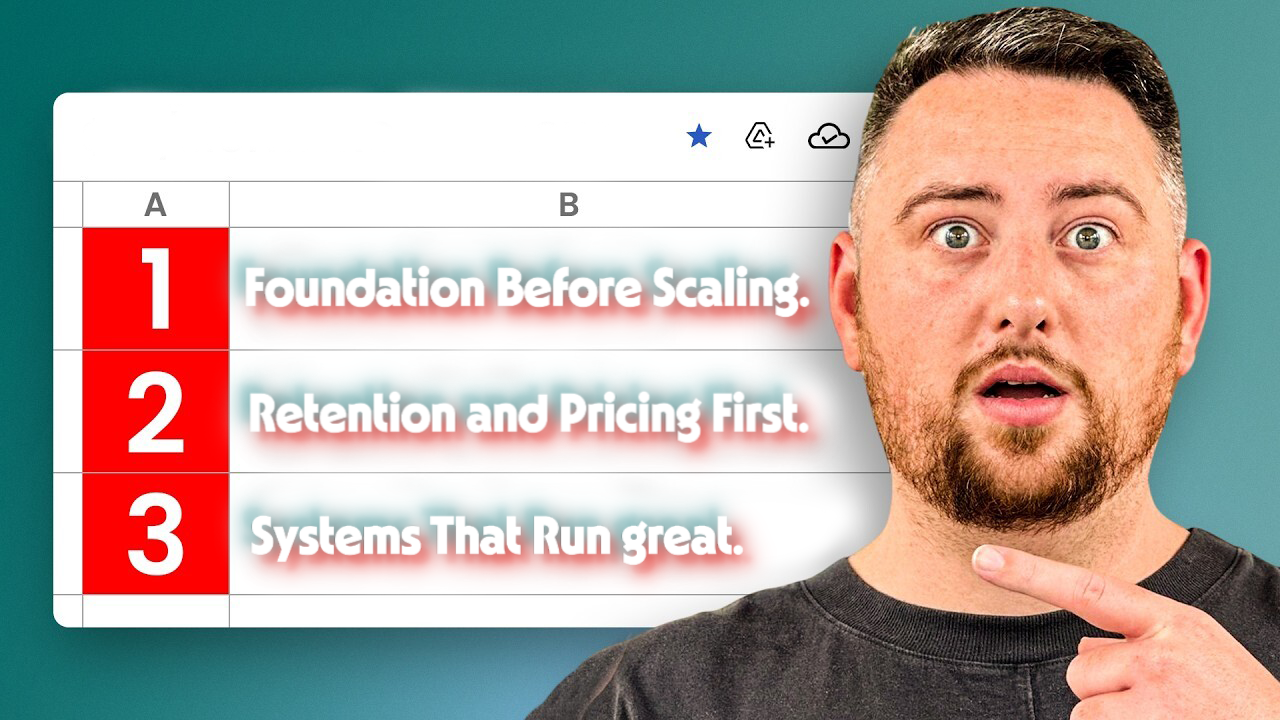
Phase 1: How to Audit and Stabilize Your Agency Foundation Before Scaling
Before you even think about scaling, you need to know exactly where your money is coming from and where it’s leaking out.
Most businesses at a certain threshold have multiple revenue streams but no clear picture of which ones actually matter. They’re running five different offers when two of them generate the majority of the profit.
Start with a complete revenue audit. Map every income source, calculate the actual customer lifetime value for each segment, and run the numbers on your customer acquisition cost. According to Harvard Business Review research on customer acquisition, understanding your LTV to CAC ratio is foundational to sustainable growth decisions.
I’ve seen businesses spending heavily on ads for a product that barely breaks even. On paper it looks profitable until you factor in fulfillment costs, support overhead, and the time sink it creates for the team.
Cut the underperformers. This isn’t about having more offers. It’s about having profitable ones that can actually scale without breaking your operations.
Next, identify your bottlenecks. Is it lead flow? Conversion rates? Fulfillment capacity? Team bandwidth? You can’t fix everything at once, so figure out what’s actually constraining growth.
Cash flow is usually the silent killer at this stage. You might be doing solid revenue but if your payment terms are net 60 and your expenses hit net 15, you’re constantly scrambling. Get your cash conversion cycle under control before you try to expand.
Your team efficiency matters more than team size. I’ve watched businesses hire their way into problems instead of systematizing their way out of them. Document your core processes, identify where things break down, and fix those gaps before adding headcount.
The goal of Phase 1 isn’t growth. It’s building a foundation that won’t crack under pressure when you start scaling hard.
Phase 2: Why Customer Retention and Pricing Optimization Come Before New Acquisition
Once your foundation is stable, Phase 2 is about squeezing every possible dollar out of your existing systems before building new ones.
This is where most businesses leave money on the table. They’re so focused on acquiring new customers that they ignore the gold mine sitting in their existing customer base.
Customer retention is cheaper and more profitable than acquisition. If you’re losing customers monthly at a high rate, you’re trying to fill a leaky bucket. Fix the leak first.
Implement a proper retention system. Email sequences that actually provide value, not just pitch after pitch. Regular check-ins with high-value clients. A feedback loop that catches problems before customers churn.
Businesses have added significant monthly revenue just by reducing churn. That’s pure profit with minimal additional work.
Pricing is another area where money gets left behind. Most businesses undercharge because they’re afraid of losing customers. But if you’ve proven your value and you’re delivering results, strategic price increases won’t kill your business.
Test pricing adjustments on new customers first. Grandfather existing clients if you want, but stop leaving money on the table because you’re scared. A reasonable price increase with minimal churn still nets you more revenue.
Your unit economics need to be dialed in at this phase. Know exactly what it costs to deliver your product or service. Know your gross margin down to the decimal. Know which customer segments are most profitable and which ones drain resources.
Process automation becomes critical here. Not everything needs a human touch. Customer support, scheduling, basic fulfillment tasks, reporting: these can all be systematized or automated.
The businesses that scale smoothly are the ones that build repeatable processes for everything. If it happens more than twice, it needs a documented process. If it happens daily, it probably needs automation.
This phase is about operational excellence. Getting really good at what you already do before trying to do more things.
Phase 3: How to Scale Acquisition Channels When Search Traffic Alone Isn’t Enough
Phase 3 is where things get interesting. You’ve got a stable foundation and optimized operations. Now it’s time to pour fuel on the fire.
But here’s where most businesses screw up. They try to scale the same channels they’ve always used without adapting to how the game has changed.
Search traffic isn’t dead, but relying on it exclusively is a mistake. The rise of AI overviews and zero-click searches means you need to show up where people are actually consuming information. SparkToro’s research on zero-click searches shows this trend has been accelerating for years.
Businesses that restructured their content for AI visibility and saw their inbound lead flow increase noticeably without spending an extra dollar on ads. They weren’t gaming the system. They were just showing up in ChatGPT results, Claude responses, and Perplexity searches.
Structure your content with clear headings, direct answers, and multi-media elements. Video transcripts, infographics, data tables: these all signal quality to AI systems and make your content more likely to get referenced.
Video is non-negotiable at this stage. According to Wyzowl’s State of Video Marketing report, the vast majority of buyers prefer video content when researching solutions. If you’re not creating video content, you’re invisible to a massive segment of your market.
Short-form video on social platforms, long-form educational content on YouTube, video sales letters, demo videos: all of it matters. The businesses winning right now are the ones treating video as a core acquisition channel, not an afterthought.
Diversification is your friend here. Allocate your acquisition budget across multiple channels. Email and social should be getting significant attention because search dependency is declining. Multi-media video should get another chunk. Owned channels like your email list and community round out the rest.
Partnership strategies become powerful at this phase. Strategic alliances with complementary businesses, affiliate programs with the right partners, co-marketing initiatives: these can open up entirely new customer segments without massive ad spend.
Your goal in Phase 3 is strategic acquisition expansion. Not reckless spending, but strategic expansion into channels that compound over time.
Phase 4: When to Diversify Revenue Streams and Add Premium Tiers to Your Agency
Phase 4 is about reducing risk and increasing average customer value. You’ve scaled acquisition, now it’s time to maximize what each customer is worth.
Product diversification doesn’t mean launching random offers. It means strategically expanding what you provide to existing customers who already trust you.
Look at your customer journey. Where are the natural upsell points? What additional problems do your customers have that you could solve? What premium tiers or add-on services would a segment of your base happily pay for?
Businesses have added significant monthly revenue by introducing a premium tier that only a portion of customers opt into. The offer was there for those who wanted more, but it didn’t complicate the core business.
Upselling frameworks matter here. Not aggressive sales tactics, but genuine value ladders that help customers get better results. Your best customers want to give you more money if you can deliver more value.
New audience segments open up once you’ve mastered your initial market. Adjacent industries, different company sizes, geographic expansion: there are multiple paths to growth beyond your current customer base.
But don’t spread yourself too thin. Each new segment needs its own acquisition strategy, messaging, and often product adjustments. Test small before going all-in.
This is also where strategic partnerships really pay off. Joint ventures with established players in adjacent markets, white-label arrangements, licensing deals: these can open up revenue streams that don’t require building new infrastructure.
The goal of Phase 4 is reaching higher revenue thresholds with revenue coming from multiple sources. If one channel has a bad month, it doesn’t sink the entire business.
Phase 5: How to Build Systems That Run Without You as the Bottleneck
Phase 5 is about building a business that can sustain higher revenue levels without you being the bottleneck.
Most entrepreneurs are the ceiling of their own business. Every decision runs through them, every problem lands on their desk, every client relationship depends on them. That doesn’t scale.
Leadership delegation is critical here. You need people who can think strategically, make decisions independently, and own outcomes. Not just task executors, but actual leaders who can run parts of the business.
This usually means upgrading your team. The people who got you to one revenue level might not be the ones who can handle the next level. That’s not a judgment on them; it’s just reality. Different phases need different skill sets.
AI integration becomes a competitive advantage at this level. Not just using AI tools, but actually building AI into your workflows as a force multiplier. McKinsey’s research on AI adoption shows businesses integrating AI into operations are seeing meaningful efficiency gains.
Customer support can be handled by AI for tier-one issues. Ad creative can be generated and tested faster with AI assistance. Data analysis and forecasting can be automated. First-party data collection can be systematized.
The businesses winning now and going forward are treating AI as a collaborator, not just a tool. They’re finding ways to use it that create actual competitive moats.
Data-driven forecasting replaces gut-feel decisions. You should know your numbers well enough to predict revenue with reasonable accuracy. You should see problems coming before they hit.
Implement proper OKR frameworks. Everyone on the team should know exactly what they’re responsible for and how it ties to company objectives. Clarity eliminates confusion and wasted effort.
Systems documentation becomes essential. Every process should be documented well enough that someone new could follow it. This isn’t just for delegation; it’s for identifying inefficiencies and continuously improving.
Exit-proofing your business matters even if you never plan to sell. A business that could run without you is a business that’s actually valuable. It’s also a business that won’t burn you out.
The goal of Phase 5 is sustainability. Hitting higher revenue levels is one thing. Doing it month after month while maintaining profitability and sanity is entirely different.
What to Do Next to Apply This Roadmap to Your Agency
This roadmap isn’t theoretical. These are the actual phases businesses go through when scaling through different revenue levels.
But here’s the reality: most businesses skip phases or try to do everything at once. They want Phase 3 results with Phase 1 systems. It doesn’t work.
You can’t scale acquisition before you fix retention. You can’t diversify revenue before you optimize your core offer. You can’t build sustainable systems before you have the revenue to support them.
Each phase builds on the previous one. Skipping steps just means you’ll hit a ceiling and have to come back and fix the foundation anyway.
The other mistake I see constantly is trying to do this alone. The businesses that scale fastest are the ones that bring in expertise at each phase. Whether that’s consultants, agencies, or strategic hires, trying to figure everything out yourself is the slow path.
Your job as the business owner is to understand the roadmap and make sure you’re executing the right phase at the right time. Not to become an expert in every single tactic within each phase.
Focus on building systems that compound. Every improvement you make should make the next improvement easier. Every process you document should make delegation simpler. Every channel you master should make diversification less risky.
The path through these revenue phases isn’t a straight line. There will be plateaus, setbacks, and months where nothing seems to work. But if you’re following a methodical roadmap and executing consistently, you’ll make progress.
The businesses that make it are the ones that treat scaling like a system, not a sprint. They’re patient with the process but aggressive with execution. They know which phase they’re in and what needs to happen before moving to the next one.
That’s how you build a business that doesn’t just hit higher revenue levels once, but sustains them month after month while actually improving your quality of life instead of destroying it.
If you want to work through these frameworks with direct guidance, my 7-week live comprehensive training covers each phase in detail with implementation support.
Results are not typical. Your results will vary and depend entirely on your individual capacity, business experience, expertise, and level of desire. There are no guarantees concerning the level of success you may experience. The testimonials and examples used are not intended to represent or guarantee that anyone will achieve the same or similar results. We don’t believe in get-rich-quick programs. We believe in hard work, adding value and serving others. As stated by law, we can not and do not make any guarantees about your own ability to get results or earn any money with our information, courses, programs, or strategies.
Get my content first on Google
Add jeremyhaynes.com as a preferred source and Google shows my articles more prominently in your search results, including AI Overviews and AI Mode.


Jeremy Haynes
Owner and CEO of Megalodon Marketing
Jeremy Haynes is the founder of Megalodon Marketing. He is considered one of the top digital marketers and has the results to back it up.