
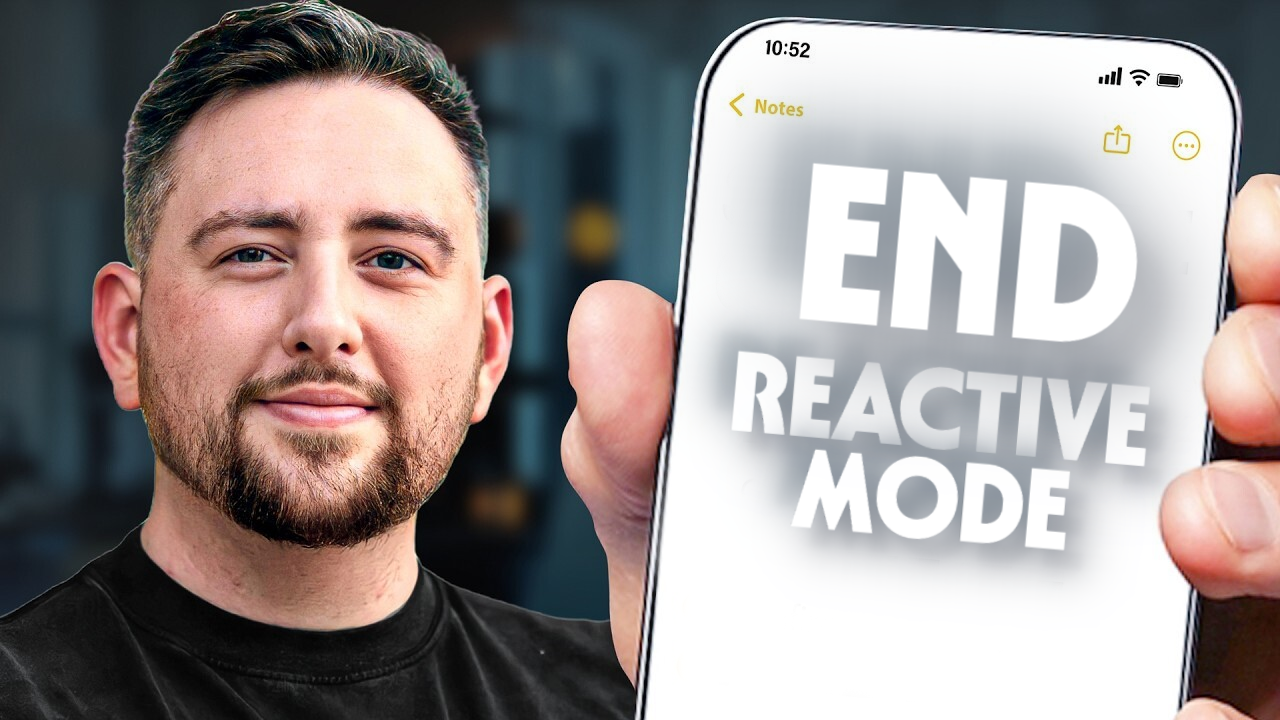
The Daily Routine That Gets Founders Out of Reactive Mode and Into Consistent Performance

I hope you enjoy reading this blog post. If you want my team to just do your marketing for you, click here.
Author: Jeremy Haynes | Published June 23, 2026
Earnings Disclaimer: You have a .1% probability of hitting million-dollar months according to the US Bureau of Labor Statistics. As stated by law, we can not and do not make any guarantees about your own ability to get results or earn any money with our ideas, information, programs, or strategies. We don’t know you, and besides, your results in life are up to you. We’re here to help by giving you our greatest strategies to move you forward, faster. However, nothing on this page or any of our websites or emails is a promise or guarantee of future earnings. Any financial numbers referenced here, or on any of our sites or emails, are simply estimates or projections or past results, and should not be considered exact, actual, or as a promise of potential earnings – all numbers are illustrative only.
Most founders who plateau aren’t dealing with a strategy problem. They’re dealing with a rhythm problem.
You’ve got the offer dialed in. The team is capable. The market is there. But somehow, you’re stuck in this reactive loop where you’re constantly firefighting instead of actually leading.
What’s actually happening: you’re letting your day get hijacked by inputs: Slack messages, email, team questions, client emergencies. By 10 AM, you’ve already spent three hours responding to other people’s priorities instead of executing on yours.
When the founder operates this way, the entire company’s velocity gets capped. Your team can only move as fast as you can respond. You become the bottleneck.
The fix isn’t working more hours. It’s building a daily routine that creates space for the work that actually moves the business forward. The kind of routine that lets you walk into each day knowing exactly what needs to happen and having the structure to make sure it does.
In my experience working with agency operators through Master Internet Marketing, our 7-week live comprehensive training, the founders who maintain consistent performance have daily routines that protect their cognitive capacity and create predictable execution rhythms.
Results are not typical. Your results will vary and depend entirely on your individual capacity, business experience, expertise, and level of desire. There are no guarantees concerning the level of success you may experience. The testimonials and examples used are not intended to represent or guarantee that anyone will achieve the same or similar results. We don’t believe in get-rich-quick programs. We believe in hard work, adding value and serving others. As stated by law, we can not and do not make any guarantees about your own ability to get results or earn any money with our information, courses, programs, or strategies.
7 weeks. Real frameworks. Covering copywriting, funnels, paid ads, and conversion systems.
Why Daily Structure Actually Matters for Founders
According to Psychology Today’s reporting on executive decision-making, the average adult makes roughly 35,000 decisions every day. As a founder, you’re making disproportionately high-stakes decisions on top of that baseline.
Every decision you make drains cognitive capacity. When you don’t have a routine, you’re burning mental energy on low-value choices all day long. What should I work on first? Should I check Slack now or later? When should I review yesterday’s numbers?
That decision fatigue compounds. By the time you get to the decisions that actually matter, you’re already running on fumes.
A structured daily routine removes the cognitive load from those low-value decisions. You’re not deciding what to do first every morning. You already know. You’re not wondering when to check in with the team. It’s already scheduled.
This creates consistency. When you do the same high-leverage activities every single day, they compound. Reviewing your KPIs daily means you catch problems when they’re small instead of waiting until the weekly meeting when it’s too late. Clearing blockers every morning means your team maintains velocity instead of getting stuck waiting on you.
There’s another piece most founders miss: your daily rhythm becomes your company’s rhythm. If you’re chaotic, your team is chaotic. If you’re disciplined and proactive, that cascades through the entire organization.
The way you structure your day sets the culture.
How to Protect Your First 90 Minutes for Strategic Work
The first 60 to 90 minutes of your day should be completely protected. No Slack. No email. No calls. No inputs from the outside world.
This is your CEO hour. This is when you do the thinking and reviewing that keeps you ahead of the business instead of buried in it.
Start with a KPI review. Spend 15 to 30 minutes looking at yesterday’s numbers before anyone else needs anything from you: revenue, ad spend, ROAS, booked calls, close rate, cash collected, churn (whatever your core metrics are).
You need to walk into the day informed, not guessing. When you know the numbers before the team asks questions, you’re leading from a position of clarity instead of reacting to whatever gets surfaced in meetings.
After the KPI review, identify your one priority for the day. Not a to-do list with fifteen things on it, one thing. The thing that, if you accomplish it, makes the day worthwhile regardless of what else happens.
This is the essentialism framework. What is the one thing that makes everything else easier or unnecessary? That’s your priority.
Then spend 10 to 15 minutes doing strategic thinking. No distractions. Just you and a notebook or a blank document. Ask yourself: What’s working right now? What’s breaking? What’s the next bottleneck we’re going to hit? What do I need to start delegating? What decision have I been avoiding?
This is where you do the thinking that prevents fires instead of spending all day fighting them.
Gloria Mark’s research at UC Irvine, documented in a Gallup interview, found it takes an average of 23 minutes and 15 seconds to fully refocus after a single interruption. If you’re checking Slack and email first thing in the morning, you’re destroying your ability to do deep strategic work before the day even starts.
Protect the morning block. Your capacity to think clearly determines everything else.
What a Daily Team Standup Should Actually Cover
After your morning block, you need a daily standup with your team. This should be short and focused: 10 to 15 minutes max.
This is not a meeting to discuss strategy or brainstorm ideas. It’s a tactical sync to create accountability and clear blockers.
Three questions per person:
- What did you accomplish yesterday?
- What are you doing today?
- What’s blocking you?
That’s it. No long explanations. No deep dives into problems. Just quick updates that give everyone visibility into what’s happening across the team.
Your role as the founder in this standup is to clear blockers in real time or assign someone to clear them within the hour. This is how you keep the team moving at full velocity.
When someone says they’re blocked waiting on a decision from you, make that decision right there. When someone’s blocked on a resource, tool, or access to something, assign someone to handle it immediately. This is how you remove friction before it compounds into delays.
There’s also an accountability component here. When your team knows they’re going to report what they accomplished yesterday and what they’re committing to today, performance increases. People perform better when they know they’re being measured.
For remote teams, you can run this async using Loom videos or Slack threads. But live standups create more urgency and connection. If you can do it live, do it live.
The key is consistency: same time every day, same format, no exceptions unless there’s an actual emergency.
How to Time Block Your Mid-Day for High-Value Work
After your standup, you move into execution mode. This is where you do the work that only you can do.
Time-blocking is non-negotiable here. You need two to three hour blocks scheduled for the work that only you can do: sales calls, content creation, partnership deals, product decisions, strategic planning.
If you’re not time-blocking, you’re letting your day get fragmented by whatever comes up. And fragmented time produces fragmented results.
Here’s the filter you need to constantly run: Am I doing something only I can do? If the answer is no, it needs to be delegated or systematized.
Most founders are still doing low-value tasks because they haven’t built the discipline to hand them off. Every hour you spend on low-value work is an hour you’re not spending on work that actually scales the business.
Batch your communication into two or three windows per day instead of constantly checking Slack and email. Set specific times where you process messages and respond to everything at once. This dramatically reduces context-switching. Every time you switch from deep work to check a message and then try to get back into deep work, you’re losing momentum and cognitive capacity.
Your mid-day should be ruthlessly protected for execution. This is when you’re building the business, not managing it.
Why You Need to Review Pipeline Every Single Day
The afternoon is when you shift into review mode and real-time coaching.
Start with a pipeline review. Not a weekly pipeline review, a daily one. You need to know the status of every deal in motion every single day.
Waiting until a weekly meeting to discover a deal went cold is too late. By the time you find out, you’ve lost a week of momentum. Daily pipeline reviews keep deals moving and keep your sales team accountable.
This doesn’t need to be a formal meeting. It can be a quick Slack check-in or a five-minute call with your sales lead. The point is visibility and speed.
After pipeline, look for coaching moments. These are quick 10 to 15 minute conversations with team members when something needs correction or reinforcement.
Don’t wait for scheduled weekly meetings to give feedback. Speed of feedback equals speed of improvement. If you see something that needs to be addressed, address it that day.
This is also when you review what’s happening with content and marketing: what went live today, what’s performing, what needs adjustment. Especially if you’re the face of the brand, you need daily visibility into what’s being put out and how it’s landing. Waiting until the end of the week to discover something isn’t working means you’ve wasted an entire week of content.
The afternoon review keeps you ahead of problems and keeps the team moving in the right direction with constant micro-adjustments.
What Your End of Day Shutdown Process Should Include
At the end of the day, you need a shutdown ritual. This is how you close the loop on today and set yourself up to win tomorrow.
First, review the day against your number one priority. Did the most important thing get done? If yes, the day was worthwhile. If no, why not? What got in the way?
This isn’t about beating yourself up. It’s about identifying patterns. If you’re consistently not hitting your priority, something in your routine or your delegation needs to change.
Next, set tomorrow’s priority tonight. Don’t wait until tomorrow morning to figure out what matters most. Decide tonight so you can go to bed knowing exactly what you’re waking up to do.
Baylor University researchers found that writing down tomorrow’s to-do list before bed helps people fall asleep an average of nine minutes faster by offloading open cognitive loops instead of letting them cycle through your head.
Speaking of open loops, anything unfinished needs to get captured somewhere: a task manager, a notebook, or wherever you track work. The point is to get it out of your head so it’s not rattling around while you’re trying to disconnect.
Finally, have a hard stop time. Founders who work fourteen hour days without boundaries burn out and make worse decisions. There’s a principle called Parkinson’s Law: work expands to fill the time available. When you have a hard stop, you create urgency. You’re forced to prioritize. You can’t just keep working until everything’s done because everything is never done.
A hard stop also protects your capacity to show up sharp the next day. You won’t maintain consistent performance if you’re consistently exhausted.
Already making money? See what it takes to make a lot more.
How Weekly Planning Supports Your Daily Routine
The daily routine is the foundation, but it needs to be supported by a weekly cadence.
Once a week, review your team scorecard (the five to eight numbers that define whether you had a good week: revenue, pipeline, conversion rates, customer acquisition cost, churn, whatever your key metrics are). This is different from the daily KPI check. The daily check is about spotting problems early. The weekly review is about identifying trends and making strategic adjustments.
You also need a weekly planning session. This is just you: 30 to 60 minutes where you look at the week ahead and decide on your three big priorities. What needs to change from last week? What are the biggest opportunities right now? What’s the next bottleneck we need to address?
This planning session is what keeps you proactive instead of reactive. You’re deciding what matters instead of letting the week decide for you.
Finally, run weekly one-on-ones with your direct reports. These are deeper than the daily standups. This is where you talk about career development, bigger-picture strategy, and address any tensions or misalignments. Here’s the weekly executive meeting structure that keeps the whole operation scaling.
In my experience with operators in Inner Circle (a private, application-gated mastermind), the weekly planning session is what separates founders who maintain consistent execution from those who get pulled into reactive mode every Monday morning.
Results are not typical. Your results will vary and depend entirely on your individual capacity, business experience, expertise, and level of desire. There are no guarantees concerning the level of success you may experience. The testimonials and examples used are not intended to represent or guarantee that anyone will achieve the same or similar results. We don’t believe in get-rich-quick programs. We believe in hard work, adding value and serving others. As stated by law, we can not and do not make any guarantees about your own ability to get results or earn any money with our information, courses, programs, or strategies.
When you implement this kind of structure, things start shifting. In the first 30 days, you’re less reactive. You’re not spending your entire day responding to whatever’s loudest. Your team starts moving faster because they’re not waiting on you for decisions.
By 90 days, you’ll see it in the numbers: more consistency, fewer dips, the kind of steady performance that comes from doing the right things every single day instead of hoping for big wins to save the month. At six months, the compound effect becomes obvious. Your team is operating with less direct involvement from you. The business is less dependent on you being in every conversation and every decision.
The founders who scale past seven figures aren’t the ones with the flashiest tactics. They’re the ones with the most disciplined routines. They know their numbers before anyone asks. They clear blockers daily instead of letting them pile up. They review pipeline daily instead of hoping deals close themselves.
Build the routine. Protect the routine. Let the routine compound.
If you want to see how we implement these daily and weekly operating rhythms inside actual agencies, Master Internet Marketing, our 7-week live comprehensive training, walks through the complete framework over seven weeks of live training.
Results are not typical. Your results will vary and depend entirely on your individual capacity, business experience, expertise, and level of desire. There are no guarantees concerning the level of success you may experience. The testimonials and examples used are not intended to represent or guarantee that anyone will achieve the same or similar results. We don’t believe in get-rich-quick programs. We believe in hard work, adding value and serving others. As stated by law, we can not and do not make any guarantees about your own ability to get results or earn any money with our information, courses, programs, or strategies.
Get my content first on Google
Add jeremyhaynes.com as a preferred source and Google shows my articles more prominently in your search results, including AI Overviews and AI Mode.


Jeremy Haynes
Owner and CEO of Megalodon Marketing
Jeremy Haynes is the founder of Megalodon Marketing. He is considered one of the top digital marketers and has the results to back it up.