I hope you enjoy reading this blog post. If you want my team to just do your marketing for you, click here.


I hope you enjoy reading this blog post. If you want my team to just do your marketing for you, click here.
Author: Jeremy Haynes | founder of Megalodon Marketing.
Earnings Disclaimer: You have a .1% probability of hitting million-dollar months according to the US Bureau of Labor Statistics. As stated by law, we can not and do not make any guarantees about your own ability to get results or earn any money with our ideas, information, programs, or strategies. We don’t know you, and besides, your results in life are up to you. We’re here to help by giving you our greatest strategies to move you forward, faster. However, nothing on this page or any of our websites or emails is a promise or guarantee of future earnings. Any financial numbers referenced here, or on any of our sites or emails, are simply estimates or projections or past results, and should not be considered exact, actual, or as a promise of potential earnings – all numbers are illustrative only.
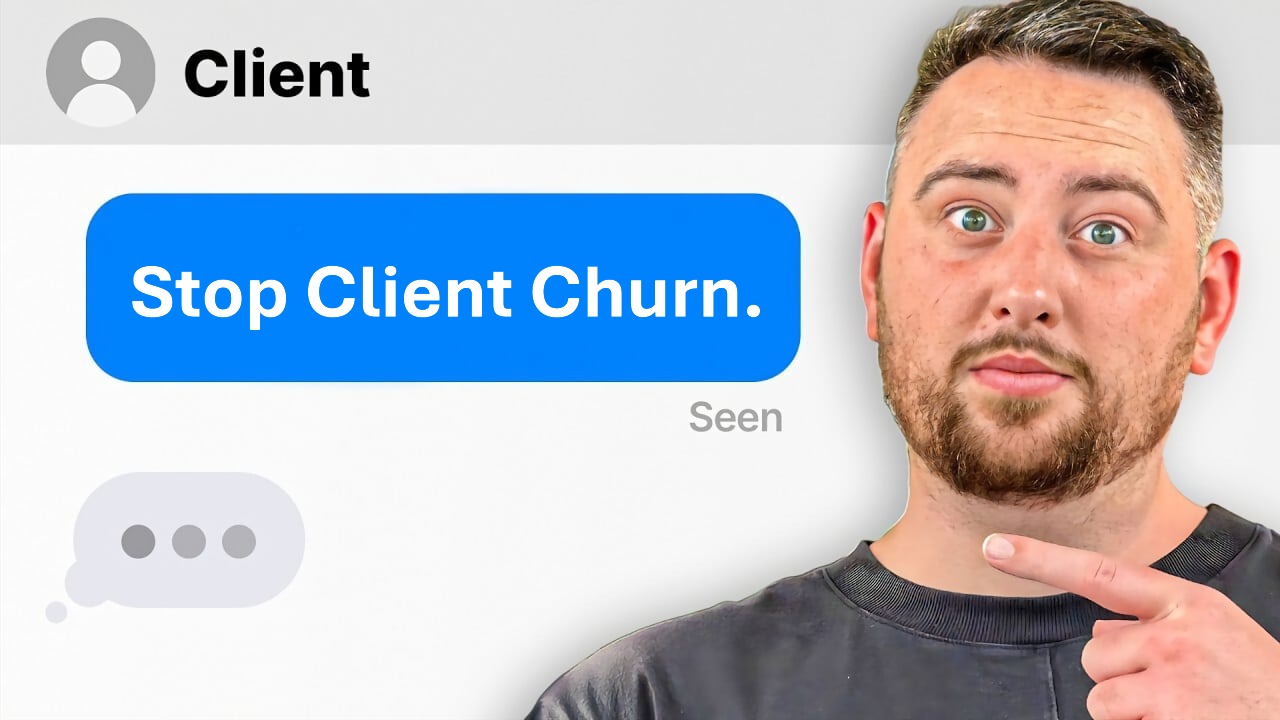
Most businesses don’t lose clients because their service is bad.
They lose them because they went silent at the wrong time.
I’ve seen this pattern repeat across hundreds of agencies, SaaS companies, and service businesses. You deliver great work, solve real problems, and genuinely care about results. But somewhere between month two and month four, communication drops off. No major issues. No complaints. Just quiet.
Then the cancellation email comes.
The client was “going in a different direction” or “pausing to reassess priorities.” Translation: you stopped being present in their world, and someone else filled that space.
This isn’t about sending more emails or being annoying. It’s about building a communication cadence that keeps you relevant, valuable, and top-of-mind without becoming noise.
If you’re looking to build these kinds of operational systems inside your agency, the 7-week live comprehensive training covers client retention frameworks in depth.
Results are not typical. Your results will vary and depend entirely on your individual capacity, business experience, expertise, and level of desire. There are no guarantees concerning the level of success you may experience. The testimonials and examples used are not intended to represent or guarantee that anyone will achieve the same or similar results. We don’t believe in get-rich-quick programs. We believe in hard work, adding value and serving others. As stated by law, we can not and do not make any guarantees about your own ability to get results or earn any money with our information, courses, programs, or strategies.
Let me walk you through exactly how I approach this.
Here’s what most people get wrong about client retention.
They think it’s about delivering results. And yes, results matter. But perception of value matters more. In my experience, a client who gets great work but feels ignored will leave faster than a client getting mediocre results who feels supported and heard.
Research from Bain & Company has shown that customer retention economics make acquisition costs look painful by comparison. The cost of replacing a client versus keeping one is substantial across every industry.
When you dig into why clients actually leave, the reasons rarely have to do with product quality or service delivery. It’s perceived neglect. Mismatched expectations. A sense that they’re not a priority.
All of these come down to communication cadence.
Your clients need to feel like you’re actively managing their success. Not just doing the work, but guiding them through the process, celebrating wins, and staying ahead of problems before they become reasons to leave.
That’s what a proper communication cadence does. It creates a rhythm of touchpoints that builds trust, reinforces value, and makes leaving feel like a bigger decision than staying.
Quiet churn is the most dangerous type.
It’s not the client who complains, argues, or makes demands. Those clients are actually easier to save because they’re engaged. They care enough to fight.
Quiet churn is the client who just fades. They stop responding to emails. They skip check-in calls. Their usage drops. By the time you notice, they’ve already mentally checked out.
The warning signs are subtle: slower response times, less engagement in meetings, fewer questions. They’re not angry. They’re just not invested anymore.
And the root cause is almost always the same: you stopped showing up consistently.
Maybe you got busy with other clients. Maybe you assumed everything was fine because they weren’t complaining. Maybe you didn’t have a system in place to maintain regular contact.
Whatever the reason, the gap in communication created space for doubt. They started wondering if they still needed you, if the investment was worth it, or if someone else might do it better.
That’s the cost of inconsistent communication: not immediate cancellations, but slow erosion of trust and perceived value.
The fix isn’t complicated, but it does require intentionality.
Let me give you the actual structure I’ve seen work across different business models.
The foundation is simple. You need three types of communication happening on a predictable schedule.
Value delivery. Share insights, updates, wins, or useful information that reinforce why they hired you. This should be your most frequent touchpoint—usually weekly or bi-weekly.
Strategic check-ins. Deeper conversations about progress, goals, and alignment. These happen less frequently—monthly or quarterly depending on your business model and client tier.
Milestone celebrations. Triggered by specific events or achievements (product launches, revenue goals, anniversaries). These aren’t scheduled, but they should be systematized so you never miss them.
The specific frequency and channels will vary based on your business. But the pattern stays the same: regular value delivery, periodic strategic alignment, and event-triggered celebration.
Here’s what that looks like in practice:
For high-touch enterprise clients: weekly email updates, bi-weekly calls, and quarterly business reviews.
For mid-market clients: bi-weekly emails and monthly calls.
For lower-touch clients: weekly automated emails with monthly personal check-ins.
The key is consistency. Your clients should know when to expect to hear from you. That predictability builds trust.
Not all communication channels work the same way.
Email is your workhorse. It’s scalable, trackable, and doesn’t require real-time availability. Use it for regular updates, value delivery, and anything that needs documentation.
Calls are for strategic conversations. Use them when you need to read tone, handle complex topics, or build deeper relationships. Don’t use them for simple updates that could be an email.
Slack or Teams are great for clients who want quick access and ongoing collaboration, but they can create expectations of instant response. Set boundaries early about response times.
Video messages are underrated. A quick Loom or personalized video can feel more personal than email without scheduling overhead. These work well for check-ins and celebrations.
The mistake most businesses make is picking one channel and using it for everything, or using whatever channel is most convenient for them rather than what works for the client.
Ask early in the relationship how they prefer to communicate, then build your cadence around that.
Your communication cadence shouldn’t be static.
During onboarding, be present. The first 72 hours after they sign should include a welcome message, clear next steps, and confirmation that you’re on it. The first month should have weekly touchpoints minimum. This reinforces their decision and delivers quick wins.
After the first 30–60 days, shift to your standard cadence—regular value delivery, periodic check-ins, and milestone celebrations.
For long-term clients, avoid complacency. The client who’s been with you for a year won’t leave because of one missed email, but they will leave if you take them for granted. Keep the cadence consistent and consider shifting some touchpoints to strategic topics rather than tactical ones.
For at-risk clients, implement a re-engagement sequence immediately when you see warning signs.
Harvard Business Review research documents how the early stages of a customer relationship set the tone for long-term retention.
Most businesses use client communication as a sales channel: every email is an upsell, every call ends with a pitch, and every message has an ask.
Clients can smell this from a mile away, and it destroys trust faster than almost anything else.
The better approach is simple: make the majority of your communication pure value delivery—insights they can use, updates on progress, industry trends that matter to them, and celebrations of their wins. No ask. No pitch. Just value.
Reserve a smaller portion of your communication for asks: feedback requests, upsell conversations, and referral requests. That ratio keeps communication from feeling transactional and positions you as a partner invested in their success, not just extracting revenue.
When you do make an ask, it carries weight because you’ve earned the right to make it.
Scheduled cadence is your foundation. The magic happens in triggered communication—messages that fire based on specific client behaviors or milestones.
Low engagement is your biggest red flag. If a client’s usage drops, they stop responding to emails, or they cancel two calls in a row, trigger a specific sequence that’s not aggressive or salesy but is a genuine check-in.
Example: “Hey, noticed we haven’t connected in a bit. Everything good on your end? Anything we should be adjusting?”
Wins should trigger communication. When a client hits a goal, launches something, or gets featured, celebrate with a quick video message or personal note.
Usage milestones matter: acknowledge significant product actions or campaign benchmarks.
The key is having these sequences built and ready to go. You need systems that flag these moments and either automate the outreach or put them on your radar for personalization.
Gartner’s research on customer experience shows that proactive communication is one of the strongest drivers of customer loyalty.
You can’t improve what you don’t measure. For communication cadence, focus on a few useful metrics:
Open rates tell you if your subject lines work and if clients are paying attention. Don’t obsess, but monitor them.
Response rates matter more. Are clients engaging when you reach out? Are they showing up to calls?
Net Promoter Score (NPS) is a good leading indicator of churn. Low scores should trigger a conversation.
Customer Effort Score (CES) is underrated. Ask clients how easy it is to work with you—high effort is a churn risk even if results are good.
Churn rate, broken down by lifecycle stage: onboarding (first 90 days) vs. long-term (6–12 months) to identify where problems arise.
The goal isn’t perfection—it’s improvement. Reducing churn by even a few percentage points has significant revenue impact.
The at-risk client needs a different approach. Your standard cadence isn’t working, so doing more of the same won’t fix it.
A re-engagement sequence that works is three touches over two weeks:
Empathetic acknowledgment. “I noticed we haven’t connected much lately. I want to make sure we’re still aligned on your goals and that we’re delivering value. Can we schedule 15 minutes to sync up?”
Value delivery with no ask. Send something genuinely useful: a resource, an insight, or an introduction.
Direct conversation. A call to ask hard questions: What’s working? What’s not? What would make this partnership more valuable? Are we still the right fit?
That last question is important. Sometimes the answer is no—and that’s okay. But often, just asking and being willing to adjust re-engages the client.
Don’t wait until you receive a cancellation. Trigger the re-engagement sequence the moment you see warning signs.
This can feel like a lot if you try to build everything at once. Don’t.
Start with your foundation: pick one communication type and one frequency you can maintain consistently. For most businesses, that’s a weekly value email. Get that dialed in first.
Add strategic check-ins next: monthly or quarterly, depending on your model. Get those on the calendar and stick to them.
Then layer in triggered sequences. Start with one (onboarding or at-risk re-engagement), build it, test it, and refine it.
Tools don’t have to be complicated. A CRM, an email platform, and a calendar are enough to run a solid cadence. HubSpot, ActiveCampaign, or even a well-organized spreadsheet and Gmail can work.
As you scale, add automation: drip sequences for onboarding and triggered emails based on usage data. But you don’t need automation to start—you need consistency and intentionality.
There’s no one-size-fits-all cadence. An enterprise SaaS company with large annual contracts needs a different rhythm than a smaller monthly agency retainer. A done-for-you service requires different touchpoints than a DIY software product.
The framework stays the same: value delivery, strategic check-ins, and milestone celebrations. But specifics must match your business model, client expectations, and capacity.
Be honest about what you can sustain: a cadence you maintain at 80% is better than a perfect cadence you execute at 30%.
Build the system that works for your business, then commit to it.
Because client retention isn’t about having the best product or the lowest price—it’s about being present, consistent, and valuable in your clients’ world.
That’s what prevents quiet churn, keeps clients around long enough to see real results, and turns one-time buyers into long-term partners who refer, renew, and grow with you.
The communication cadence isn’t a nice-to-have. It’s the difference between a business that constantly replaces churned revenue and one that compounds growth through retention.
Build the system. Stick to it.
If you want to go deeper on client retention systems and the operational frameworks that make agencies run, check out the Inner Circle where we work through these implementations together.
Results are not typical. Your results will vary and depend entirely on your individual capacity, business experience, expertise, and level of desire. There are no guarantees concerning the level of success you may experience. The testimonials and examples used are not intended to represent or guarantee that anyone will achieve the same or similar results. We don’t believe in get-rich-quick programs. We believe in hard work, adding value and serving others. As stated by law, we can not and do not make any guarantees about your own ability to get results or earn any money with our information, courses, programs, or strategies.

Jeremy Haynes is the founder of Megalodon Marketing. He is considered one of the top digital marketers and has the results to back it up. Jeremy has consistently demonstrated his expertise whether it be through his content advertising “propaganda” strategies that are originated by him, as well as his funnel and direct response marketing strategies. He’s trusted by the biggest names in the industries his agency works in and by over 4,000+ paid students that learn how to become better digital marketers and agency owners through his education products.

Jeremy Haynes is the founder of Megalodon Marketing. He is considered one of the top digital marketers and has the results to back it up. Jeremy has consistently demonstrated his expertise whether it be through his content advertising “propaganda” strategies that are originated by him, as well as his funnel and direct response marketing strategies. He’s trusted by the biggest names in the industries his agency works in and by over 4,000+ paid students that learn how to become better digital marketers and agency owners through his education products.


This site is not a part of the Facebook website or Facebook Inc.
This site is NOT /endorsed by Facebook in any way. FACEBOOK is a trademark of FACEBOOK, Inc.
We don’t believe in get-rich-quick programs or short cuts. We believe in hard work, adding value and serving others. And that’s what our programs and information we share are designed to help you do. As stated by law, we can not and do not make any guarantees about your own ability to get results or earn any money with our ideas, information, programs or strategies. We don’t know you and, besides, your results in life are up to you. Agreed? We’re here to help by giving you our greatest strategies to move you forward, faster. However, nothing on this page or any of our websites or emails is a promise or guarantee of future earnings. Any financial numbers referenced here, or on any of our sites or emails, are simply estimates or projections or past results, and should not be considered exact, actual or as a promise of potential earnings – all numbers are illustrative only.
Results may vary and testimonials are not claimed to represent typical results. All testimonials are real. These results are meant as a showcase of what the best, most motivated and driven clients have done and should not be taken as average or typical results.
You should perform your own due diligence and use your own best judgment prior to making any investment decision pertaining to your business. By virtue of visiting this site or interacting with any portion of this site, you agree that you’re fully responsible for the investments you make and any outcomes that may result.
Do you have questions? Please email [email protected]
Call or Text (305) 704-0094