I hope you enjoy reading this blog post. If you want my team to just do your marketing for you, click here.


I hope you enjoy reading this blog post. If you want my team to just do your marketing for you, click here.
Author: Jeremy Haynes | founder of Megalodon Marketing.
Earnings Disclaimer: You have a .1% probability of hitting million-dollar months according to the US Bureau of Labor Statistics. As stated by law, we can not and do not make any guarantees about your own ability to get results or earn any money with our ideas, information, programs, or strategies. We don’t know you, and besides, your results in life are up to you. We’re here to help by giving you our greatest strategies to move you forward, faster. However, nothing on this page or any of our websites or emails is a promise or guarantee of future earnings. Any financial numbers referenced here, or on any of our sites or emails, are simply estimates or projections or past results, and should not be considered exact, actual, or as a promise of potential earnings – all numbers are illustrative only.
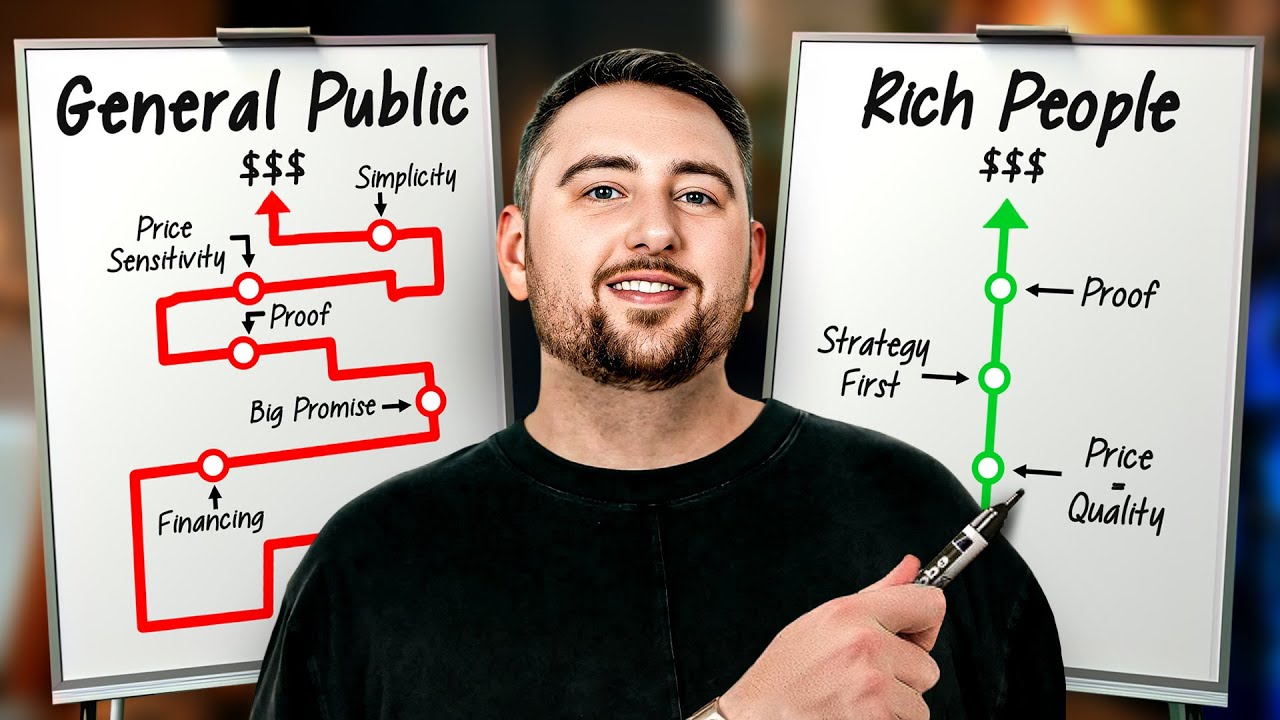
There comes a key decision in every man’s life and the 1% of women who follow along where you must decide – are you going to sell to the rich or are you going to sell to the general public?
And that key decision, that fork in the road that you all face is what defines and shapes everything that you do from that point forward as a brand.
It’s what defines the strategy. It’s what defines the offer. It’s what defines the conversion mechanisms that you do and do not use. It’s what defines the content.
That single decision of just choosing to sell to the rich or choosing to sell to the general population is everything.
And we’re going to go through all the details, pros and cons to both, the sacrifices you make one way or the other, the revenue potential on both sides of the equation.
And listen, as an agency over the years who has currently helped 41 different businesses hit million-dollar months, and that number continues to grow, we’re working on 42 and 43 currently – we’ve had clients that have done both.
We’ve had clients that have sold to one or the other, and we’ve had clients that have kind of oscillated between the two.
We’re going to go through all the top lessons here today.
If you’re new, welcome in. My name is Jeremy Haynes. All we do is talk about hitting million-dollar months around here.
We don’t make any income claims. We just hand down all the top lessons from the different businesses that we’ve helped get there, that have been there, done that, and we pass them down to you.
If you’re already following along, welcome back. It’s a pleasure to have you. Make sure you pay attention to this one. This one’s really important.
If your business is already generating $100k+ per month, My Inner Circle is where you break through to the next level. Inside, I’ll help you identify and solve the bottlenecks holding you back so you can scale faster and with more clarity.
So I was sitting down at lunch with a new friend of mine, and he was in the process of deciding, you know, which niche do I want to cater to? What offer do I want to cater to? How am I going to crack $3 to $5 million months, Jeremy?
That was the key question of this conversation.
Now, this isn’t somebody that’s a complete novice to the game. They had already done about $700,000 with some offers that they’ve created. They’re already creating a ton of content and they have a rather strong presence.
I believe he said the number about 23-ish million people his account is reaching per month currently in terms of his overall distribution.
So by no means is this an entry-level player as I assume most of you are in the same position. You’re already playing the game. You just might need to make some key decisions and some changes that are going to make all the difference for you to actually make some real money for once.
So it all started with this very simple thing that I’m going to present you with here.
Now, there’s a fork in the road that every man and like I said before, the 1% of women who follow along all face.
And it all starts off with a very simple decision. Are we going to sell to the rich or are we going to sell to the general public?
They are very different in terms of the implications for what you must do after that key decision is made.
Most people they kind of mix up the order of when they decide what and they end up lost and not really making like substantial progress. Like I said, just like this guy got to $700K a month, but he’s not making millions of dollars a month yet.
There’s some indecision that occurs and you kind of feel like from the outside looking in, you could see the pull between one side of things and the other.
So let’s talk about this guy specifically. He had a $10,000 offer and this offer specifically was, you know, kind of sold to both. Like you could argue it could be sold to the general public, but it could also be sold to rich people.
He had content that was mainly for the general public.
When I say mainly for the general public, like think of general public content like lessons that are for beginners, you know, content that’s framed at like an elementary level. You’re using simpler words. You’re not trying to talk in excessive tactics.
If you do talk in tactics, they’re appreciated by the general public. Rich people prefer big strategies, you know, big ideas comparatively. They’re happy to hear the tactics, but they’ve got to be a part of a big idea, a big strategy.
This guy’s content was not that. This guy’s content recently has been a lot of just really drilling into just mindset lessons, like really base level mindset lessons at that. A lot of beginner framing stuff.
And anyway, long story short, point is with a $10,000 offer, content that’s really for beginners, but the person themselves that we’re talking about here, the actual personal brand in this case, this guy was a big dog.
He sold a company for tens of millions of dollars straight cash wired into his account.
And big respect to this guy, he managed to double it from what I’ve heard, just through some money moves he’s made after getting that initial wire. Made a complete character reform and just, you know, kind of became like what looks to be a very free man.
This is really important. You understand how many discrepancies this creates and how it’s perceived to the people that it looks like on the front end he’s trying to sell to.
Kind of turns off both demographics at the same time with this random set of variables.
A $10,000 offer is generally a little too much for the general public. If they do buy it, they’re probably going to have to go into debt to buy.
And as we know, if you’ve seen my content on compliance and some of the FTC best practices, if you put people into debt, you might as well lay out a welcome mat on your front door that just says FTC, the door’s unlocked. Just come right in.
If you do not have a literal 100% probability of putting people into the debt to buy whatever it is that they’re buying from you and getting them out of the debt by helping them get the result that they’re buying, you’re going to have a bad time, my friend.
You’re going to have a real bad time.
So anyway, I digress. Back to the point at hand.
There was again a price point that’s a little too out of reach for the general population. But yet all the guy’s content is built for the general population.
Yet at the same time, the guy is a big dog. And generally what the general populace thinks about big dogs helping them out get richer – they just think that you’re a scam right away.
There’s nothing in their mind that can make it make sense for why somebody who sold a company for tens of millions of dollars would reach out a helping hand to pull them up to that next level.
To them, it’s just a bunch of red flags. Skepticism peaks through the roof, and you don’t really get a lot of traction as a result from this random set of convoluted variables combined together.
Now, at the same time, how do the rich people perceive these variables?
Well, $10,000 for a rich person is, you know, nothing. They’re happy to afford that. But the thing is, rich people equate price to quality and outcome potential that they’re likely to receive on the other side of that price.
So the $10,000 price point’s too little to have a serious result. On the other side of it, a rich person would look at that price for what this kind of guy’s offer is and think to themselves, there’s no way I’m actually going to make any kind of serious money or have some kind of serious result.
Consumer psychology research confirms that people often associate higher prices with superior quality through the price-quality heuristic, a mental shortcut where consumers automatically assume higher-priced products deliver better results, making premium pricing essential for signaling value to wealthy buyers who equate price with outcome potential.
There’s no way this guy’s really going to care at that current price. You know, there’s no way that this guy’s going to have the involvement that I’d like him to have in getting me the outcome.
So right away to a rich person, the price alone is something that is below the level they’d otherwise like to see to be thinking to themselves, “This guy’s going to take this serious and really going to punch me up and help me get results.”
At the same time, all the content the guy makes is really built for the general public. Those super base level mindset lessons, they’re not interpreted well at all by the rich people.
The rich people see that, they get a couple seconds in, they just move right past it. They don’t care about it. They already know those lessons. They learned those, you know, a year ago, decades ago. You know what I’m saying? A long time ago.
They aren’t consuming that stuff. So then the guy gets ignored by the rich population.
And then the final thing – well, at the same time though, the rich people know that the guy’s a big dog. That’s what attracted them to this guy in the first place was the guy sold a company for tens of millions of dollars liquid.
So you end up in this very problematic position, if you can see where I’m going with this.
The general public has nothing but skepticism and interprets everything you’re doing as a red flag. Whereas the rich people that you’re potentially reaching are thinking to themselves, “This really isn’t for me. I mean, I don’t know why it would be. All the content the guy makes is clearly for the general population. The offer doesn’t seem like it’s that serious in terms of the price. So I don’t think I’m going to get a serious result, but I respect the guy. You know, maybe he’s just selling to the general public.”
But in reality, and this is what’s most interesting about this, like just from the outside looking in, this is what I was seeing.
And I sat down at lunch with this guy and I said, like, is this the case? Like, are you kind of at the fork in the road and you’re not really committed to one or the other?
And, you know, spot-on per usual.
The guy was at the fork in the road.
So I laid it out for him. I started to make it clear what he has to do next. I started to make the sacrifices of one side or the other really clear to him.
So when you commit to the general population, first things first, there’s usually a lot of like mindset work and framing that has to be done in order to increase the probability that you actually get results for that population.
This goes for anything, any kind of high ticket product or service. It’s not just info products. It’s like physical goods as an example that can have specific outcomes. Specific high ticket services, you know, any kind of service or product in general.
There’s generally some kind of – especially at a $10,000 price or any kind of multi-thousand dollar price when you’re selling high ticket to them – some framing and some kind of like mental stuff that has to happen.
It’s the foundation to them having a much higher probability of having success with it.
Because at the end of the day, let’s be honest, right? That’s a lot of the reasons that these people are inside of the general population in the first place is their mindset.
They’d be richer if they knew better, but they don’t know better, and that’s why they’re in the general population, right?
Something to consider.
So when you sell something, you have to really start with that idea of I’m going to have to help these people a lot more than I would somebody who’s already much farther along, like a rich person.
Second thing – price.
So when it comes to price, you can sell things for tens of thousands of dollars to the general public, right? People in the general public buy cars all the time. They buy houses all the time. They buy jewelry. They buy plenty of things.
But, and there’s a big but to that – in almost all instances, they’re financing those things.
So very rarely are they coming out of pocket cash for those things. And if they are, it’s going to be one of the biggest purchases of their life if they buy something from you for thousands or let alone tens of thousands of dollars.
Again, I’m not trying to make it sound like they don’t have the means to do it. They have a high probability, give or take the demographic and the general population that you’re targeting, to be able to purchase what you sell.
But again – but they’re going to be doing it with financing.
So you’re going to need a lot of funding options, which if you’re aware of how funding options work as a business owner, you’re right away aware that that’s going to eat into your overall profit and technically your gross that you’re going to make.
Almost all funding companies will take anywhere from about 5% all the way up to 15% to get you the funding to that consumer that you’re selling to.
Now, you can obviously offset that onto the consumer and just raise your price by that same percentage or a little bit greater than that technically. So you actually gross and then therefore net what you’re attempting to in the first place.
However, you’re putting them in even more debt by doing so by raising that price point.
Again, something to consider with the funding options at play.
I want to be super clear on this. When you sell some type of high ticket product or service and you do not have a nearly 100% success rate with getting whatever the outcome is that your high ticket product or service does, you’re going to have a bad time.
You’re going to have a lot of refund requests. You’re going to have chargebacks. You’re going to have FTC complaints and you are dramatically increasing your liability exposure when you choose to take that path.
It’s just what comes with it. It’s a part of the game.
So as long as you’re willing to refund, as long as you’re willing to eat some chargebacks, and this is the main thing here – if those things occur and you actually do right by those people who have those requests, you likely are going to mitigate a lot of the additional liability that comes beyond that.
If you’re not willing to play that game, but you’re technically playing it, and you do not refund people when they ask, and you get a lot of chargebacks and you get a lot of people that go complain to these government organizations, you are toast.
You are burnt straight away. You are cooked, my friend.
Very important to consider when you choose that path.
Now, this price can be dynamic. It can go all the way up to tens of thousands of dollars. Just treat it like you have a higher liability on the spectrum when you choose to do so.
The lower the price, the less debt you’re going to have to put people in and therefore the less liability that you incur when you’re selling whatever it is that you’re going to choose to sell to these people.
Something to consider.
Now, one thing that’s very interesting over the years – every single large multi-7-figure a month business we’ve worked with that sells something to the general population, they incur a substantial like the largest quantity of hate that exists.
They are breaking down walls of skepticism, scams, like you know just those types of comments every single day of their life in mass, especially as they scale.
There is no higher level of skepticism than from the general population, especially as the price increases.
So as the price goes up, the skepticism and people thinking that you’re a scam by default go up, the trust goes down.
So you also have to consider that resistance.
It’s far easier to sell to rich people comparatively to how hard it can be and how much resistance you’re going to face when you sell to the general population.
Also something to consider because at the end of the day, we teach a lot of strategies like the hammer them strategy, all these most recent trust, modern due diligence best practices, sales assets, confirmation page best practices, email best practices.
There’s so much we talk about that by all means for both demographics can help increase trust, shorten sales cycles, and get you a lot more revenue.
However, you’re going to face a lot more of that when you choose to sell to the general population.
So simply put, trust is exceptionally lower and skepticism is exceptionally higher.
Here’s the other very interesting thing that I’ve noticed over the years from working with people who choose to sell to the general public. And this is something that you might not consider.
You hear about burnout a lot.
And the most interesting thing with the general public is just due to the level of resistance and like skepticism that you face as a business inside of that space – it will wear you down.
It can just drive you into the ground in terms of how you’re going to feel mentally. It’s exhausting to a degree.
And if you don’t have a lot of resilience as like a natural characteristic of self – and you also have to adapt like the style of how you do things. Like your communication changes a lot.
I know exceptionally smart people that really have to like dumb themselves down and just simply put like simplify how they communicate and they have to do strategies and like content and ads and just their messaging overall – it’s very different than how they actually are as a person, you know.
So that disconnect can cause a lot of friction in your endurance and your ability to long-term commit to that specific vertical and niche.
Again, these are just observations I’ve made over the years.
Now, I do want to be fair in saying just in terms of numbers, there’s obviously a far larger quantity of people that exist inside of the general population comparatively to the much smaller quantity of people that exist in what’s considered like a rich demographic.
That being said, there’s obviously huge businesses that exist on Earth that their entire strategy, you know, and their entire business and their revenues dwarf what you and I are ever going to accomplish whether we sell to rich people or whether we sell to the general public.
But I do want to be fair in saying there’s definitely a lot more like large publicly traded companies, huge revenue driver businesses out there where their entire model is built on the general population.
But I want to be clear when I say this – there’s a very clear model that’s geared towards selling to that demographic.
Comparatively, if you think about the opposite, sure there’s a lot smaller businesses that exist. They sell to far fewer people. So typically they come off as smaller businesses. They have smaller operations. They have smaller teams. They have, you know, smaller like physical presence on Earth in terms of their store square footage presence and things like this.
However, that by no means negates the amount of revenue that they make.
As an example, LVMH group, who runs Louis Vuitton and every other big business that exists inside of that vertical of selling designer – in almost all instances, they’re selling to rich people.
The global luxury goods market reached $362 billion in 2023 and is projected to hit $464.10 billion in 2025, demonstrating that targeting wealthy consumers who spend significantly more per transaction creates massive revenue opportunities even with far fewer total customers compared to mass market businesses.
There’s general population that aspires to buy those things, but they buy like belts and wallets and like occasional shoes and stuff. It’s not a common purchase versus there’s people who go in there.
Imagine you have hundreds of customers that are willing to spend $20K to $50K a month as an example, you know, and then you multiply that times way more than hundreds.
There’s a reason that Arnault is one of the richest people in terms of like top – I’m pretty sure at any given time he’s one of the top five richest people on earth.
And that’s all backed by rich people spending money with him. Far fewer people are spending money, but they’re spending far more dollars per person.
Here’s the other very interesting thing before we just bounce over to the rich demographic. I want to talk about views.
One thing that some businesses struggle with is viewership and reach. And in a degree, the word would be fame.
With the general population, you are going to have a lot more views. And that really just comes down to the fact that as I just described, there’s far more people in the general population comparatively to the quantity of people that are in the rich demographic.
My channel is a perfect example of this. I’m not sitting here making content for the general population. I’m making content for you, a rich guy that wants to get a ton richer than you are right now.
And respectfully to the ladies that follow along, for the 1% of you, you too ladies. But mainly all you dudes.
Point I’m trying to make is very simple. I don’t get a lot of views, but I do quite well financially from the few views that I do get.
And that’s my point. I don’t really care if I’m famous. You know, I don’t care if I walk down the road and have 10 people in a couple block radius like some of my clients have had – just walk up and approach them and like know who they are straight away.
And it’s very important that you understand this because in some instances, just like this guy that I had lunch with as an example, he was already at 23 million people that his account was reaching per month, but that was because he was making general population content.
If he transitioned to fully committing to the rich path, the views are a lot less to say the least.
You know, that account is going to appear like it’s dying from a statistical perspective, but it’s not. It’s just reaching the right people that have a much higher probability to buy.
And I want to be very fair in saying, and I’m going to talk about this more at the end in detail – you do have the opportunity to kind of oscillate between both of these demographics.
You do have the ability at any given time to sell to rich and then eventually sell to the general population and vice versa and kind of move in waves.
And I’ll give you some examples of that towards the end of this. But let’s get to the rich people side of things.
So views are going to be at a much lower quantity. Dollars spent per person are much higher.
And this is really important to understand – you are going to have, just like I gave in the example of LVMH, a lot more money spent per user.
There’s going to be a lot more revenue flowing your way for each person that chooses to do business with you.
And that’s something to consider.
It’s also going to be a lot easier to sell people.
When you talk about the skepticism, there is a lot less of it. When you talk about trust, doesn’t always mean that there’s more trust. However, there’s just a lot less skepticism.
Generally, the rich population is much more willing to take risks. So therefore, there’s a much higher probability they’re going to be willing to buy from you without too much consideration.
A few green flags grease the wheel to the point where they’re doing a deal.
Very important to understand this though. There’s a different content strategy that also plays into getting those types of outcomes.
The communication is different, the messaging is different, how you are going to make content, what conversion mechanisms you’re going to use, like the funnels as an example – they’re all different.
It’s not just as simple as like you do a difference in targeting. Everything changes.
As I described, if you took this exact piece and you handed it to somebody that’s in the general population, they’re probably not going to read it because there’s not a lot of relatability to where they currently are.
This is for the people that are like levels into the game already that are trying to advance to the point of hitting million-dollar months.
You see, this doesn’t really have a lot of applicability to the people that are just getting started. And it’s intended to be that way.
I don’t make content for people that are just getting started. I don’t make content for people that are trying to hit $100K a month, you know.
I make content for people that are at a couple hundred K a month trying to hit a million a month or at a million a month trying to get their next million a month.
You see? So again, that has a lot less appeal, but there’s a very key and strong intentional effort that you have to deploy to appeal to the rich demographic in the first place and vice versa for the general population.
Just totally different games. That’s the point I’m attempting to make. I’m trying to make it clear with all these individual points – totally different games that you are playing when you do one or the other.
See what I’m saying?
Generally, give or take the price, you have a much higher probability to sell for a higher price point. And you should.
There’s a lot of value perception related to price.
Right away when a rich person looks at the cost of something, they think, why is it worth that? And they attempt to find the justifications to sell themselves why it’s worth that.
Research on premium pricing psychology shows that luxury consumers view high prices as social signaling tools that communicate wealth, taste, and achievement, with studies confirming that consumers willingly pay premiums when they believe higher prices equate to better experiences and status symbols, making price itself a critical part of the value proposition.
Where when the general population sees the price of something and they see it as high, they think, “Why in the world is that priced like that? It doesn’t make any sense.”
And they’re almost trying to sell against its value. Whereas rich people look at the price of something that’s high and they sell why it is that value.
You see what I’m saying?
So if something is priced too cheap, it’s like, “Oh, that’s not going to be a good deal.”
I used the example at this lunch of, you know, one of my cars as an example. I talked about the Rolls-Royce.
In my past have bought an absolute beater rat of a Rolls-Royce. I had bought like a 2012 or 2013 – this in like 2020 – Rolls-Royce. It was a Ghost and it was like hundred and something thousand like low hundred something thousand and it shows up and like you know honestly at first it was pretty cool.
It was a series 1 Ghost. I go out and I drive it. I take it over to the design district. I’m feeling good.
And on the drive home, the car starts to rattle and shake as I break.
And every time I would try to accelerate, it would like feel like it was slipping. I got a drive shaft error notification.
And so naturally, I get home, load it up onto a tow truck, and I send it off to Rolls-Royce to quote me on a maintenance. How much is it going to cost me?
Anybody want to take a guess? How much do you think it cost?
So they hit me back and they said, “Mr. Haynes, it’s going to cost $85,000 for the maintenance that you need on this car.”
I mean, you know, my goodness, it was like almost 70-something percent of the car’s value.
So I instead just immediately go sell it. I take a $37,000 hit on that piece of junk. And, you know, it was a hard lesson learned.
So then I don’t know, maybe like a month or two later, I buy a proper Rolls-Royce. I bought a Ghost Series 2 at the time. And this was, you know, a year behind whatever the current year was when I had bought it.
Beautiful car. Still have it today. White on white, big old white rims, interior’s red, you know, great Miami spec and a beautiful car at that.
And you know, this car was almost $300,000 and it still had the new car warranty on it, which, you know, for all those who don’t know, and I’m sure most of you do, you’re going to have free maintenance on an annual basis.
Anything and everything that goes wrong with the car, you’re not paying any money. They’re paying the money.
That’s why these cars when they come out of the dealer are, you know, $500K, $600K. You’re still technically paying for the maintenance, but you’re not paying for it when you actually need to pay the maintenance. You know, you’re paying for it in the cost of what you buy the car for instead.
So, you know, whichever one you prefer is up to you, but I prefer buying it new and I prefer buying it with the warranty. Now, I’ll tell you that.
So anyway, I get to the point where, you know, I start judging all the cars that I’d later buy, you know, and I’d bought several cars just this year as an example.
Another one – I bought a McLaren 750S Spider and this is a $460,000 car that I purchased.
Now, right away when I see the price, I by default I’m assuming this is going to have a new car warranty. All the maintenance and all the service is going to be covered in addition to all those great things, the car is obviously going to be awesome for $400,000.
And guess what? It was. And it is.
It’s insane that vehicle. I love it so much. And it exceeded the price point.
So when I look at the price, I’m not thinking to myself, “Wow, that’s expensive.” I’m thinking, “Well, yeah, it’s some serious money, but I bet it’s going to exceed every expectation that I could possibly have for it.”
And I had some pretty high expectations, and it blew through.
My point being – it’s an amazing car, and the price of it is what made me initially think it’s got to be amazing.
Same thing with the difference between my piece of junk Rolls-Royce Ghost and my amazing, extremely high quality, feel like the man Rolls-Royce Ghost.
The price immediately should signal that’s got to be a piece of junk, right?
If I ever see a Rolls-Royce that’s like a $600,000 car going for $200,000 or $100,000, I’m going to think to myself, that’s got to be a rat. That’s got to be a piece of junk. There’s no way that it’s going to be good.
Even though it’s a Rolls-Royce – versus if I see a Rolls-Royce that’s $300 plus thousand, and it’s within a couple recent years of the current year I’m in, I’m thinking to myself, makes a lot of sense why it costs what it costs. It’s under warranty. That car’s got to be awesome. I bet the spec is sick. Let’s check that out. I bet the suspension is flawless. I bet there’s nothing wrong with it.
You see, price in the eyes of rich people immediately dictates and sets the bar of the perceived value and the expectations.
So when you’re pricing something when it comes to an offer for rich folks, the higher the price, the better off you are because the expectation, the standard that they think it’s at, the quality that they’re going to perceive it to be align with what you actually likely have to sell them.
So one of the biggest things that people that are transitioning from selling to the general population to selling to rich folks struggle with – they don’t understand that the price should not even be remotely close to whatever you likely think it should be.
It should be far greater than that.
And as a result of making it far greater than that, you, my friend, are going to get very well-off customers through your funnel who have realistic expectations and you’re going to be able to blow through those expectations once you have a good product.
So here’s the following steps that you must take because it really all starts with do you want to sell to rich people or do you want to sell to the general population?
Once you’ve picked that part of the path, you’ve officially identified the initial fork in the road, which is general population versus rich folks.
From there, you want to decide price.
So the next step is very simple and it’s the same for both sides. What should the price of the offer be? How much you going to charge? What’s the bar you want to set for the perceived expectation, the perceptual quality?
It’s the standard you’re going to set because you set it right away with price.
After you’ve determined the price, that’s when you determine what you are going to sell.
And this is where a lot of people get it wrong. And this is why I’m writing this piece.
A lot of people start with the what you’re going to sell. I think that’s backwards. I don’t think that makes much sense.
If you start with the what you’re going to sell, you’re going to have a bad time.
It all starts with the demographic and then you go to the price and then you decide what you’re going to sell.
There’s a very important differentiator here that I also want to pepper in give or take what you’re selling.
So a lot of the people from what I’ve seen that follow along, you guys love to sell some type of like high ticket service, something – could be info, could be something you’re going to do for people after they buy.
You also want to start to consider outcomes at this particular stage. And I want to be fair in saying this can kind of change a little bit for where you choose to place it.
You can place outcomes here at this level or you can also place outcomes a little bit above it at this level here. It’s up to you when you decide what you’re going to sell.
Sometimes that can be dictated by outcomes. Sometimes you could think what you’re going to sell first and then you think what are the outcomes this is going to produce.
It can technically be either or. So you get to choose. Is it here or is it up here?
Up to you in terms of again the placement in this ladder here of offer creation.
But from what I’ve seen time and time again, every single big dog that we’ve ever worked with uses this specific flow to back into what they’re going to sell, what they’re going to price it at, who they’re going to sell it to.
This is how they’re thinking.
And it all wraps up with one specific thing. And this is actually pretty interesting. What comes with it?
And this is not to be confused with what you’re going to sell.
What you’re going to sell could be like, is it a product? Is it a service? Is it an event? Is it an info thing? Is it a done for you thing?
That’s what I mean by what you’re going to sell. Think with like done on your own, done with you, or done for you.
For the what comes with it – these are the specific things, the stuff that you’re actually going to include in the thing, in the offer itself.
So again, it all starts general population or rich people. You then move into price. Right away, you want to be thinking with price. And remember, price sets the standard.
From there, you can think with outcomes or you can start thinking with done on your own, done with you, or done for you.
From there, as I mentioned, if you didn’t already think with outcomes, now you’re going to be thinking with what am I actually going to help people produce? What are the results? What are those outcomes I’m going to be able to get for people?
And you close it all out with the what comes with it.
Now, before we continue on to how you can kind of oscillate between these two of selling to rich people versus the general public, I just want to make it really clear.
I cover stuff just like this in extreme detail in my Inner Circle offer which is built for rich people just like you trying to get a whole lot richer than you are right now.
It’s a done with you offer that we have. It includes one-on-one coaching where twice a month we jump on a 30-minute call together. You can book them. You don’t need to book them. Up to you.
We do weekly group calls. They’re all recorded. We have a giant library full of all the ones that we’ve already done. Extremely helpful on topics just like this. Super in-depth. Obviously all intended to help you make far more than what you’re going to invest with us to be a part of it in the first place.
We have a group chat. The group chat’s extremely active. We talk in there every single day, multiple times a day, and we actually all try to help each other.
It’s a place that you’ve never been a part of, unlike all the other communities that you’ve likely been with. This community actually has real value to it. It’s awesome.
We’ve gotten consistently great feedback from all the members from it, and everybody that joins in is generally very impressed by it.
In addition to that, we do our quarterly in-person masterminds. We do those every quarter. Top of every quarter – January, April, July, and October. We do them here in person in Miami, Florida.
We record every one of them. We stream it live as well, just in case you can’t join us.
Lastly, we include unlimited access to Jeremy AI. Jeremy AI you could do video calls with, voice calls with, you can message it.
And unlike most little software out there that are just currently using the word AI, this is extremely valuable. We consider it cutting edge tech.
We’re starting to see that courses – which you get nearly a thousand of when you join into this – and even to a degree like the group calls and things like this, these are where you get exposure to the things you don’t know, the things that you don’t know you need to know or some things that you do need to know you’re going to learn in extreme depth because you might not know what questions to ask about what you need to know.
Jeremy AI becomes extremely efficient. It’s an efficiency tool to be able to cut through the noise. You don’t have to go search through the course library. You don’t have to go and consume something.
You could just immediately talk to Jeremy AI about it and it will be trained on every single piece of possible material that we could have uploaded into that thing for you to converse back and forth with it.
So for the things that you do know you need to know – it’s the greatest tool that we’ve provided to our student base and our Inner Circle members to be able to have real-time access to my brain to think through together to be able to help you execute tasks to be able to help you put into practice what you’re learning and have it hold your hand too.
It’s very effective and it’s very efficient and it’s been very well received by the group both in the Master Internet Marketing community where we do our standalone course – our done on your own offer.
And then for those of you that have everything already in place, you’re already scaling, you don’t need new things built out, we don’t need to put you through an offer where you have to get those things in place – we have an agency application below.
Although, I will say there are very, very few of you who we will be willing to take on as an agency client. And that’s not a marketing tactic. It’s me being honest and genuine with you.
We have a very small stable of clients that we’re willing to take on. And I just attempt to be transparent with you in that regard.
It’s a much higher probability that the Inner Circle is going to be the best place for us to work together and for me to try to help you get richer on your journey of scaling up.
So anyway, back to the content.
One interesting thing that we concluded to at this lunch together was first of all, is there anybody that can do both at the same time?
Have you found any businesses and brands out there that have truly mastered the art of selling both to the general public and to rich folks at the same time?
And we could think of very few and far between, especially in the high ticket services niche.
There wasn’t a tremendous quantity of people out there that we could readily point our finger at that were making serious money in doing both.
In almost all instances, there were people that had offers for rich people and when the general public would come through those funnels, they would have drop sales.
And vice versa. There were people that were selling to the general public and when they’d have an occasional rich person that came through that wanted a heightened experience or a bigger outcome or a bigger result, they had upsells to push those people through the proper offers.
But very rarely was there a business that we could think through that was trying and actively doing it well with selling to both the general population and to rich folks at the same time.
However, what we did conclude to which is very important to understand – there’s people who are able to successfully oscillate between the two, meaning they can go back and forth.
And this is really important to understand because you ultimately might be in the position where you do this.
You might start with the general public and then work your way over to rich and then work your way back over to the general public and then work your way back over to rich and vice versa.
And the span of time that goes by in between you selling to one or the other – that is a self-determined amount of time.
But from what we’ve seen out there in the market can generally be up to about a year to two years where you’re between one and the other.
And usually there’s a little bit of buildup time and some momentum creation that’s necessary. You have to adapt all your assets, your content, your funnels, all the messaging across everything to be geared towards the other demographic.
And usually there’s like a detachment period where you’re moving away from one and going into the other.
There’s again a lot more examples of this. Let me give you a perfect one. Somebody that you likely all know.
Talk about Mr. Tai Lopez. I think Tai does this extremely well.
So Tai’s had instances where I’d consider him selling more to the general population, helping people get rich, selling info offers at scale to literally hundreds of thousands of people.
Think of Tai’s original offer as a good example of this, like 67 Steps or his SMMA offer as another example. This is a great general public offer. You’re not getting a lot of people that are already extremely rich that are going through that.
To be fair, they definitely work, but again, it’s not built for that. It’s more built for the general population.
Now, Tai sells that to hundreds of thousands of people and then kind of takes what appears to be almost like a few month break, you know, but in reality, what’s happening behind the scenes is a transition from recreating new assets, new messaging, new conversion mechanisms.
And then what most people don’t see – because remember about the views, the quantity of people that see general population offers is exceptionally greater comparatively to the far lower quantity of people that see the rich person offer.
As an example, think about Tai when he was buying businesses.
Now, successful or unsuccessful at doing that. During that period of time, I’ve known people who Tai was working with that were literally giving him a million dollars in lump sums to come in and be like a marketing partner and to help scale these people up.
I’ve known people during that same duration of time where Tai was having masterminds that were tens of thousands of dollars each.
And again, my point is these are things that you don’t really see because they’re not even remotely close to the scale of the general population offers and rightfully so because there’s far fewer people that are financially qualified for the rich person offers and there’s a far smaller demographic.
They’re also sold differently. They’re marketed differently.
So my point being you then see Tai move back. He’ll go from selling to rich people just as described to as an example right now he’s teaching people how to start AI digital marketing agencies.
You know, and there’s a few other offers that he’s had throughout the years that are other good examples of this.
But my point being, it’s a perfect example of oscillation from moving between one demographic and the other.
And there’s plenty of other examples just like this, but I give you one by name in this case, a surprise, of a guy who’s done it extremely well for a very long duration of time and still consistently does it well today.
This topic that we’ve covered today is extremely important to not only grasp but to master because staying at the fork in the road causes a tremendous amount of issues for you.
It becomes very problematic because just as I described the guy who I sat down at lunch with – to the front-facing public it’s confusing.
You know, they can’t really tell if the offer is for one demographic or the other. So you don’t get nearly as many buyers versus when you completely lean in to one or the other.
You build everything around one or the other. You make a lot more money as a result.
And after all, that’s what we’re all here to do, huh?
Hope this was valuable to you. Make sure you subscribe if you’re not already. Go check out some of my other content. I’m sure you missed a few. And as you know, they’re all great.
So go ahead and dive in and catch up.
And check out those links down below. There’s plenty of great offers down there for you.
Shame on you if you’re not checking those out, but you’re getting a lot of value here. Imagine how much richer I could help you get if you actually spent some money with me.
What I can teach you isn’t theory. It’s the exact playbook my team has used to build multi-million-dollar businesses. With Master Internet Marketing, you get lifetime access to live cohorts, dozens of SOPs, and an 80+ question certification exam to prove you know your stuff.
All right, go get richer.
Watch the video:

Jeremy Haynes is the founder of Megalodon Marketing. He is considered one of the top digital marketers and has the results to back it up. Jeremy has consistently demonstrated his expertise whether it be through his content advertising “propaganda” strategies that are originated by him, as well as his funnel and direct response marketing strategies. He’s trusted by the biggest names in the industries his agency works in and by over 4,000+ paid students that learn how to become better digital marketers and agency owners through his education products.

Jeremy Haynes is the founder of Megalodon Marketing. He is considered one of the top digital marketers and has the results to back it up. Jeremy has consistently demonstrated his expertise whether it be through his content advertising “propaganda” strategies that are originated by him, as well as his funnel and direct response marketing strategies. He’s trusted by the biggest names in the industries his agency works in and by over 4,000+ paid students that learn how to become better digital marketers and agency owners through his education products.


This site is not a part of the Facebook website or Facebook Inc.
This site is NOT /endorsed by Facebook in any way. FACEBOOK is a trademark of FACEBOOK, Inc.
We don’t believe in get-rich-quick programs or short cuts. We believe in hard work, adding value and serving others. And that’s what our programs and information we share are designed to help you do. As stated by law, we can not and do not make any guarantees about your own ability to get results or earn any money with our ideas, information, programs or strategies. We don’t know you and, besides, your results in life are up to you. Agreed? We’re here to help by giving you our greatest strategies to move you forward, faster. However, nothing on this page or any of our websites or emails is a promise or guarantee of future earnings. Any financial numbers referenced here, or on any of our sites or emails, are simply estimates or projections or past results, and should not be considered exact, actual or as a promise of potential earnings – all numbers are illustrative only.
Results may vary and testimonials are not claimed to represent typical results. All testimonials are real. These results are meant as a showcase of what the best, most motivated and driven clients have done and should not be taken as average or typical results.
You should perform your own due diligence and use your own best judgment prior to making any investment decision pertaining to your business. By virtue of visiting this site or interacting with any portion of this site, you agree that you’re fully responsible for the investments you make and any outcomes that may result.
Do you have questions? Please email [email protected]
Call or Text (305) 704-0094