
How to Scale a High-Ticket Physical Product Business Using Meta Ads

I hope you enjoy reading this blog post. If you want my team to just do your marketing for you, click here.
Author: Jeremy Haynes | Published July 16, 2026
Earnings Disclaimer: You have a .1% probability of hitting million-dollar months according to the US Bureau of Labor Statistics. As stated by law, we can not and do not make any guarantees about your own ability to get results or earn any money with our ideas, information, programs, or strategies. We don’t know you, and besides, your results in life are up to you. We’re here to help by giving you our greatest strategies to move you forward, faster. However, nothing on this page or any of our websites or emails is a promise or guarantee of future earnings. Any financial numbers referenced here, or on any of our sites or emails, are simply estimates or projections or past results, and should not be considered exact, actual, or as a promise of potential earnings, all numbers are illustrative only.
If you’re running a high-ticket physical product business and stuck at the same revenue level month after month, the problem usually isn’t the offer. It’s how the ad spend gets scaled and how fast problems get solved once they show up.
The speed you solve problems is the speed you grow. Most high-ticket physical product businesses plateau for the same reason: they treat reinvestment, scaling, and digital trust as afterthoughts instead of systems.
I recently worked with a business owner selling premium steam rooms, saunas, and cold plunges. What follows is exactly what’s holding most businesses like his back, and how to fix it.
At Master Internet Marketing, our 7-week live comprehensive training, we cover these exact scaling frameworks in detail.
7 weeks. Real frameworks. Covering copywriting, funnels, paid ads, and conversion systems.
Why Most High-Ticket Businesses Don’t Have a Reinvestment Trigger
Most businesses don’t have a defined reinvestment trigger. Revenue comes in, overhead gets paid, and whatever’s left just sits in the account. There’s no predetermined formula for what goes back into ad spend.
Growth research backs up why this matters. Harvard Business Review’s study of over 2,000 public companies found that the businesses with the most consistent growth, what the researchers call “growth champions,” treat reinvestment rate as one of the most important numbers to track, not an afterthought decided after the fact. According to Harvard Business Review’s research on building consistent growth systems, companies that measure and predetermine how much of their profit gets reinvested outperform companies that make that decision reactively.
The fix is simple to state and hard to actually do: predetermine what percentage of revenue gets reinvested into ad spend before that revenue ever hits the account. Set the trigger first. Let the number, not the mood of the month, decide how aggressively you scale.
How to Scale Meta Ad Spend Without Wrecking Cost Per Lead
When operators try to scale, the most common mistake is doubling the daily budget overnight. Cost per lead spikes immediately, panic sets in, and the budget gets cut two weeks later before the account ever had a chance to settle.
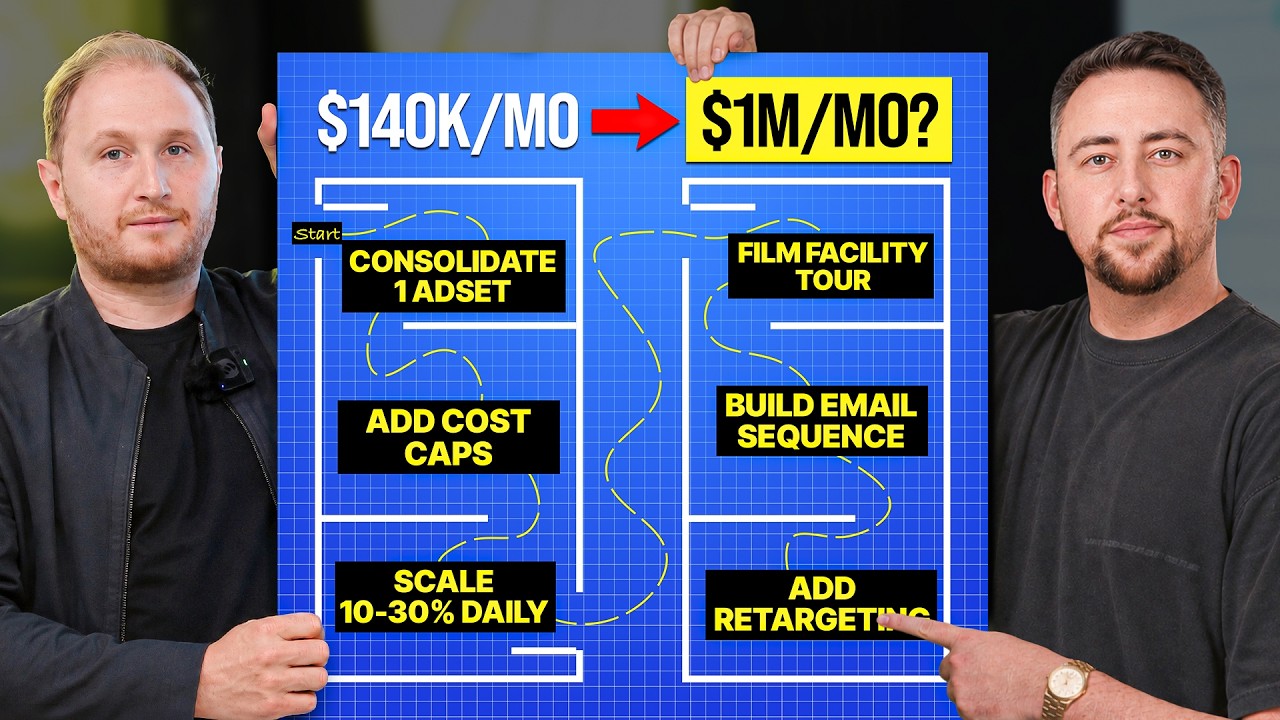
The safer approach is scaling daily budget by 10 to 30% at a time, then letting it settle before scaling again. The more spent per day, the faster that settling window closes. At lower daily budgets, it takes longer to stabilize. We’ve broken down the full mechanics of this, along with more aggressive scaling methods for when the situation calls for them, in three aggressive Facebook ad scaling strategies for million dollar months and how to scale Facebook ads to $1 million monthly revenue without cost spikes.
A cost cap, technically a cost per result goal inside Meta, limits which auction ranges an ad even competes in. Set it based on the maximum cost per lead the business can tolerate and still hit its minimum acceptable return, and the account stops bidding into auctions that would blow past profitability. Research on cost cap bidding from Triple Whale confirms this: cost caps trade some delivery volume for meaningfully more predictable acquisition costs, which is exactly the tradeoff a physical product business needs when margins are already tighter than a typical digital offer.
How to Build a Financial Model for True Profitability
Most businesses operating in the six-figure monthly range never track cost per application, connection rate, close rate, and average order value as one connected system. That’s a real gap once the offer is high-ticket, because a single missing number can hide exactly where the money is actually being lost.
Build a simple spreadsheet. Plug in ad spend, cost per application, how many people actually get talked to, how many close, and AOV. That gives a true return, not a surface-level cost per lead number that looks scary without context.
When cost per lead jumps during a scaling push, the real question isn’t whether the cost went up. It’s what the actual return was at that new cost. Track every step from impression to closed sale, and the bottleneck becomes obvious instead of guessed at.
Pocket Audiences and the Thunderdome Testing Framework
Every ad has a performance ceiling. Some scale to five-figure daily budgets without issue. Others max out at a few hundred dollars a day, and there’s no way to know which one you’re looking at until you hit it.
Meta shows ads to the people most likely to convert first, the pocket audience. Scaling further moves into outer layers of people who are less interested and more expensive to convert. That’s why a creative testing framework called Thunderdome works well specifically for finding which ads have real scale potential before committing budget to them.
The structure: individual ad sets, one ad each, force spend using ABO, and exclude 3-second video viewers from each ad set so people only ever see each ad once. This exposes which ads convert on the first impression, the ones with the highest scale ceiling, and prevents weaker ads from quietly eating budget the way they would in a traditional CBO setup. At lower budgets, a single consolidated ad set running broad targeting is enough. Once daily spend hits a few thousand dollars, switching to Thunderdome for aggressive creative testing is what separates accounts that find their ceiling from accounts that guess at it.
How to Build Digital Trust Selling High-Ticket Products
Some businesses have a huge local advantage. People can visit the showroom, see the manufacturing facility, meet the team, and close in person. Nationally, that same business struggles, because people don’t trust buying a high-ticket item sight unseen from a website.
The fix is replicating the in-person experience digitally. Film a facility tour. Show the manufacturing line. Introduce the team. Highlight the trucks, the insurance, the inventory, anything that makes it obvious this is a real business that can actually deliver.
Trust research supports why this specific tactic works. Checkout abandonment research shows that roughly a quarter of shoppers walk away specifically because they don’t trust a site with their information or their money, and that distrust is highest before any proof of legitimacy has been shown. Research on e-commerce trust signals found that trust elements work by removing a specific doubt at the moment it’s highest, not by adding generic positivity to the page. For a high-ticket physical product, that doubt shows up hardest right after someone applies but before they’ve scheduled a call.
Put the facility tour video on the confirmation page right after someone books a call. Send it in the email sequence to people who apply but don’t schedule. People don’t need to physically meet the team. They need the same trust-building moments that happen in person to happen digitally instead, at the exact point the doubt is loudest. Listing every completed project with documentation and proof works the same way, building instant trust before anyone ever gets on a call.
Why Problem-Solving Speed Determines Growth Rate
Some businesses stay stuck at roughly the same ad spend for years. That’s rarely a product problem or a market problem. It’s a problem-solving speed problem.
The wellness trend backing this specific niche is still expanding, not fading. The global cold plunge tub market was valued at roughly $354.6 million in 2025 and is projected to grow at an 8.1% annual rate through 2033, according to Grand View Research’s cold plunge tub market report, driven by rising consumer focus on recovery, wellness, and at-home health investment.
But trends don’t last forever. When the narrative eventually shifts and people start questioning the category, cost per acquisition goes up and conversion rates go down. There’s a finite window to exploit an opportunity like this one, and the speed problems get solved is quite literally the speed the business grows to the next level.
Results are not typical. Your results will vary and depend entirely on your individual capacity, business experience, expertise, and level of desire. There are no guarantees concerning the level of success you may experience. The testimonials and examples used are not intended to represent or guarantee that anyone will achieve the same or similar results. We don’t believe in get-rich-quick programs. We believe in hard work, adding value and serving others. As stated by law, we can not and do not make any guarantees about your own ability to get results or earn any money with our information, courses, programs, or strategies.
Already making money? See what it takes to make a lot more.
What to Do Next to Scale This Without Wrecking CPL
None of this requires solving everything at once. Start with the reinvestment trigger: pick a percentage of revenue that goes back into ad spend before that money ever gets treated as profit, and write it down as a rule instead of a feeling. From there, set a cost cap based on the maximum cost per lead the business can tolerate, and scale the daily budget by 10 to 30% at a time instead of doubling it overnight.
Once the account is stable at that pace, build the connected financial model, ad spend, cost per application, connection rate, close rate, and AOV, so a rising cost per lead never gets judged in isolation again. Film the facility tour and put it in front of applicants right after they book, at the exact moment their trust is lowest. And once daily spend justifies it, move creative testing into the Thunderdome structure so the account finds its real ceiling instead of guessing at it.
In our Inner Circle mastermind, we focus heavily on this exact execution framework. It’s not about having every answer upfront. It’s having a system to identify the bottleneck, concentrate on it, solve it aggressively, and move back into action, because that cycle of action, problem, solution, action is what actually compounds into faster scaling. If you want the complete framework for implementing these systems, Master Internet Marketing walks through the entire process over 7 weeks of live training.
Results are not typical. Your results will vary and depend entirely on your individual capacity, business experience, expertise, and level of desire. There are no guarantees concerning the level of success you may experience. The testimonials and examples used are not intended to represent or guarantee that anyone will achieve the same or similar results. We don’t believe in get-rich-quick programs. We believe in hard work, adding value and serving others. As stated by law, we can not and do not make any guarantees about your own ability to get results or earn any money with our information, courses, programs, or strategies.
Get my content first on Google
Add jeremyhaynes.com as a preferred source and Google shows my articles more prominently in your search results, including AI Overviews and AI Mode.


Jeremy Haynes
Owner and CEO of Megalodon Marketing
Jeremy Haynes is the founder of Megalodon Marketing. He is considered one of the top digital marketers and has the results to back it up.