
The Responsibility Matrix and Why Growth Makes You Pull Back

I hope you enjoy reading this blog post. If you want my team to just do your marketing for you, click here.
Author: Jeremy Haynes | Published September 29, 2026
Earnings Disclaimer: You have a .1% probability of hitting million-dollar months according to the US Bureau of Labor Statistics. As stated by law, we cannot and do not make any guarantees about your own ability to get results or earn any money with our ideas, information, programs, or strategies. We don’t know you, and your results in life are up to you. We’re here to help by giving you our greatest strategies to move you forward, faster. However, nothing on this page or any of our websites or emails is a promise or guarantee of future earnings. Any financial numbers referenced here, or on any of our sites or emails, are simply estimates or projections or past results, and should not be considered exact, actual, or as a promise of potential earnings – all numbers are illustrative only.
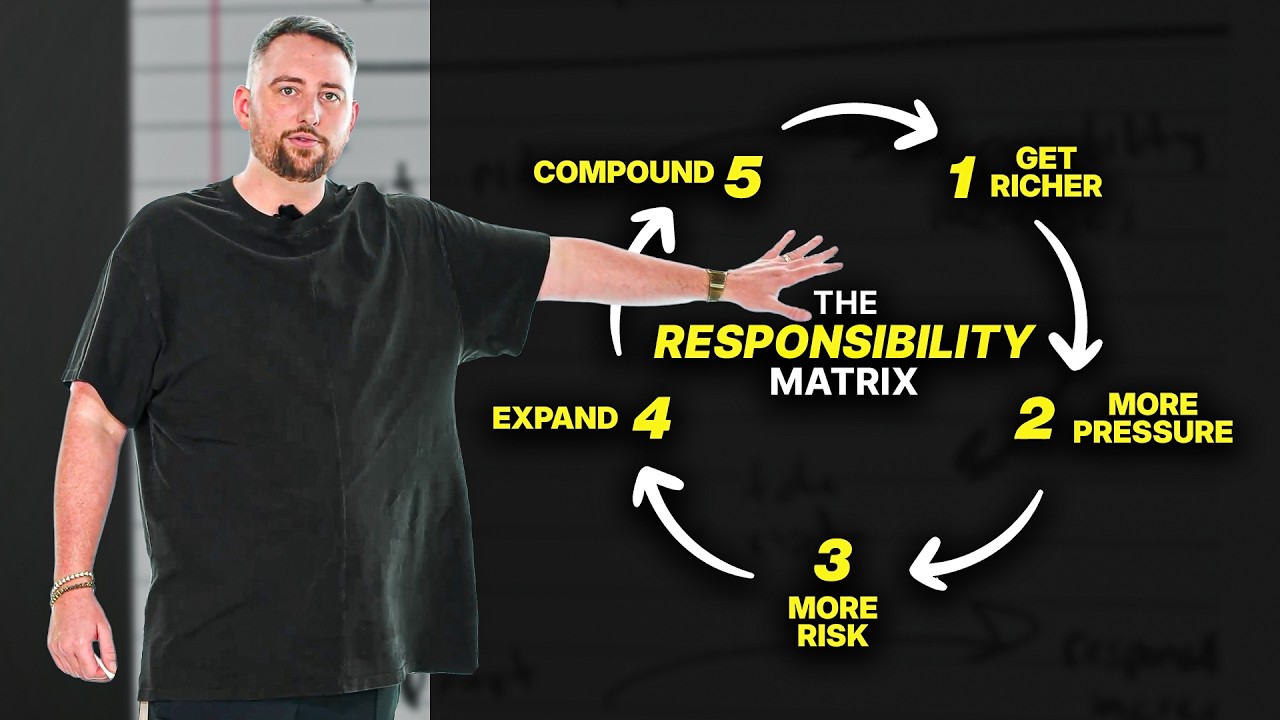
Growing the business can make you more afraid to invest in it. You have more people depending on you, more customers to deliver for, and more money you could lose. My responsibility matrix describes the decision that follows that pressure. Do you address what the bigger business needs, or start pulling back because running it feels heavier?
I want you to catch that decision before it turns into a crisis. A hire you keep postponing, a working acquisition channel you stop feeding, or a responsibility you keep handing back can all sit behind the same excuse. You tell yourself you will deal with it when things settle down. Meanwhile, the work is still there.
Already making money? See what it takes to make a lot more.
Why a Better Month Can Make the Next Decision Harder
Success adds obligations. More customers need delivery, and more staff need direction. The business you wanted now asks you to do things the earlier version never required.
That’s the starting point of the responsibility matrix. Something works, the business grows, and your responsibility increases. The next move is to identify what needs more support and decide whether to commit to it.
That commitment might be more investment in an acquisition channel. It might be a person who can take work you can no longer carry alone. Sometimes it is a system or professional support that should have been in place already.
The uncomfortable part is that you make the commitment before you know exactly how it will work out. Hiring creates payroll. Increasing production creates work for the rest of the team. Even a sensible decision can feel very different once you are the person responsible for paying for it.
Feeling the weight of a decision does not tell you whether it is the wrong decision. You still need to examine the work, the cost, and what happens if you leave it unresolved. Discomfort deserves attention, but it cannot do that assessment for you.
When I talk about how operators approach growth, this is part of what I mean. A bigger goal comes with decisions that your old routine may not accommodate. The responsibility matrix helps name the moment when that becomes apparent.
What My Recurring Revenue Example Actually Shows
In the example I shared, my combined monthly recurring revenue had moved to just shy of $1.3 million. I described the increase as almost $300,000 over roughly four to five weeks. Those were reported results from that period, not current figures or an outcome another business should expect.
At that point, my private mastermind, Inner Circle, had crossed $1 million in monthly recurring revenue on its own. Jeremy AI was at about $215,000 a month. More members needed my attention, and more software users meant more feedback and support work.
Results are not typical. Your results will vary and depend entirely on your individual capacity, business experience, expertise, and level of desire. There are no guarantees concerning the level of success you may experience. The testimonials and examples used are not intended to represent or guarantee that anyone will achieve the same or similar results. We don’t believe in get-rich-quick programs. We believe in hard work, adding value and serving others. As stated by law, we can not and do not make any guarantees about your own ability to get results or earn any money with our information, courses, programs, or strategies.
The response involved both acquisition and delivery. I described increasing Instagram output from three posts a day to five, then eight. YouTube output increased from two videos a week to four, alongside a separate clipping channel.
I also reported hiring two staff members, including a technical customer success manager. That role needed someone who understood the software and could explain it to customers in ordinary language. Growth had created work that needed an owner.
The lesson is the connection between the added responsibility and the next commitment. More users created a reason to strengthen support. Content that was already helping bring attention to the business gave me a reason to produce more of it.
Copying my posting schedule would miss that connection. Your business may need a different investment entirely. The example shows the decisions I made alongside a particular result; it does not isolate what caused the revenue change or establish a repeatable earnings formula.
How Pulling Back Can Create the Pressure You Fear
The contraction cycle starts when the added responsibility makes you retreat from work the business still needs. You reduce the activity because you want relief. The obligations already attached to the business may remain.
Think about pausing a hire while the support queue keeps growing. You avoid a new payroll commitment, but the unanswered requests still need someone to handle them. If they keep coming back to you, the decision has preserved the very workload you wanted to escape.
The same tension can show up in acquisition. You feel stretched by fulfillment and stop feeding a channel that was working. Later, you need more business and restart the work under pressure. The responsibility matrix is a way to examine that sequence before repeating it.
There are legitimate reasons to slow down. A business that cannot fulfill its promises needs to address that problem. An expense the business cannot support needs scrutiny. Treating every pause as weakness would make this framework far less useful.
I want the reason for the pause to be specific. What is broken? What would make the decision affordable or workable? If the answer stays at “it feels like too much,” you have described your reaction without deciding what to do about the actual workload.
Keep the numbers in that conversation. The SBA’s business-management guidance covers tracking available cash, expenses, and payroll responsibilities. That supports the practical check here. Look at what the commitment requires before either rejecting it or assuming that more spending will solve the problem.
The Trap Door Is More Than a Temporary Slowdown
I use the phrase trap door for a worse version of the contraction cycle. The business shrinks, the available opportunities narrow, and the operator starts treating that decline as proof that taking action is pointless. Pulling back becomes a habit.
In the repeating cycle, pressure eventually pushes the owner into action again. The trap door describes what happens when that response never arrives. Every disappointment supplies another reason to withdraw.
That is a warning about a pattern, not a diagnosis of every struggling business. A lost customer, a market change, or a delivery failure needs its own explanation. Calling everything a mindset problem would let you skip the investigation.
Look for the decision you still control. Perhaps a role remains unfilled or a known delivery problem keeps getting postponed. Name it plainly and look at the evidence around it. You can take responsibility for that decision without pretending you control the entire market.
My discussion of beliefs that distort business decisions makes the same distinction between a story and what is actually happening. A conclusion needs something behind it. Otherwise, “this cannot work” can become an excuse to stop checking.
Why Growth Can Ask You to Become a Different Leader
A new responsibility can require behavior you have never had to practice. Becoming an employer means other people rely on your decisions. You may still think of yourself as the person who does the work, while the team needs you to make the work possible.
I have felt that through different roles in my own life. Becoming a husband and a father changed what I needed to prepare for. I took baby classes and started recording lessons for my children because those responsibilities mattered to me.
The label alone did not do the work. I had to learn things, make preparations, and act differently. That’s the part of identity I am talking about in business too.
I also described having had a team of 27 people that felt difficult to manage. That experience shaped what I wanted from later hires. I wanted people who could take ownership of the agreed work, with clear standards and help when they needed it.
The Center for Creative Leadership describes the shift to managing others as a change in how you achieve results. Being good at your own tasks does not automatically prepare you to lead someone else’s work. That distinction matters when you hire to free yourself and then keep taking every decision back.
The question becomes concrete. Can you explain the outcome, provide what the person needs, and let them own it? That is a more useful way to examine your changing role as the business grows than deciding whether you feel like a different person yet.
What the Technical Customer Success Hire Brought Up
The technical customer success manager example puts the identity issue into an actual work conversation. I had hired someone with a development background who could also communicate with nontechnical customers. We agreed on three outcomes for the role.
Within the first three days, he proposed setting one outcome aside while he finished the other two. I pushed back because that changed what we had agreed the role would own. The unresolved work would come back to the business.
My point in that conversation was that the role would stretch him. I had also told him to involve me if he needed help. Accepting responsibility means addressing what prevents the work from getting done, including asking for the support required.
There is a distinction worth keeping here. A person abandoning an agreed outcome and a person raising a genuine capacity problem need different responses. You cannot learn which one is happening by refusing to hear the concern.
The HSE’s guidance on job demands calls for achievable workloads and a way to respond to employee concerns. Holding a standard still leaves room to check whether the person has the skills, time, and support the job requires. The story is about ownership; it should not become permission to ignore those questions.
That is also part of accountability inside a growing team. If the work has a real obstacle, deal with it. If the expectations changed, discuss the change. Letting an outcome disappear without resolving who owns it leaves everyone guessing.
7 weeks. Real frameworks. Covering copywriting, funnels, paid ads, and conversion systems.
The Next Risk Needs a Job to Do in the Business
When responsibility increases, name what now needs attention. More demand might require delivery capacity. More support requests might require a different hire. A working source of customers might need continued investment while you repair the bottleneck behind it.
I am asking you to connect the risk to the work. “Spend more” is incomplete advice when nobody can say what the money is supposed to change. “Wait until I feel ready” is also incomplete when the business has already outgrown what you are doing.
Look at the commitment you have been postponing. Decide what problem it addresses, whether the business can support it, and what information would change your mind. Sometimes that review supports moving ahead; sometimes it shows that the plan needs work first.
The responsibility matrix is useful at that point. It gives you a way to notice when fear of the next obligation is making the decision for you. Then you can return to the actual business and choose what to do.
For the marketing and sales work behind those decisions, Master Internet Marketing, my 7-week live comprehensive training, covers the methods I use. The larger point remains yours to apply. When the business asks more of you, examine the next responsibility before automatically stepping away from it.
Results are not typical. Your results will vary and depend entirely on your individual capacity, business experience, expertise, and level of desire. There are no guarantees concerning the level of success you may experience. The testimonials and examples used are not intended to represent or guarantee that anyone will achieve the same or similar results. We don’t believe in get-rich-quick programs. We believe in hard work, adding value and serving others. As stated by law, we can not and do not make any guarantees about your own ability to get results or earn any money with our information, courses, programs, or strategies.
Get my content first on Google
Add jeremyhaynes.com as a preferred source and Google shows my articles more prominently in your search results, including AI Overviews and AI Mode.


Jeremy Haynes
Owner and CEO of Megalodon Marketing
Jeremy Haynes is the founder of Megalodon Marketing. He is considered one of the top digital marketers and has the results to back it up.