
How to Raise Agency Fees Without Neglecting Existing Clients

I hope you enjoy reading this blog post. If you want my team to just do your marketing for you, click here.
Author: Jeremy Haynes | Published October 30, 2026
Earnings Disclaimer: You have a .1% probability of hitting million-dollar months according to the US Bureau of Labor Statistics. As stated by law, we cannot and do not make any guarantees about your own ability to get results or earn any money with our ideas, information, programs, or strategies. We don’t know you, and your results in life are up to you. We’re here to help by giving you our greatest strategies to move you forward, faster. However, nothing on this page or any of our websites or emails is a promise or guarantee of future earnings. Any financial numbers referenced here, or on any of our sites or emails, are simply estimates or projections or past results, and should not be considered exact, actual, or as a promise of potential earnings – all numbers are illustrative only.
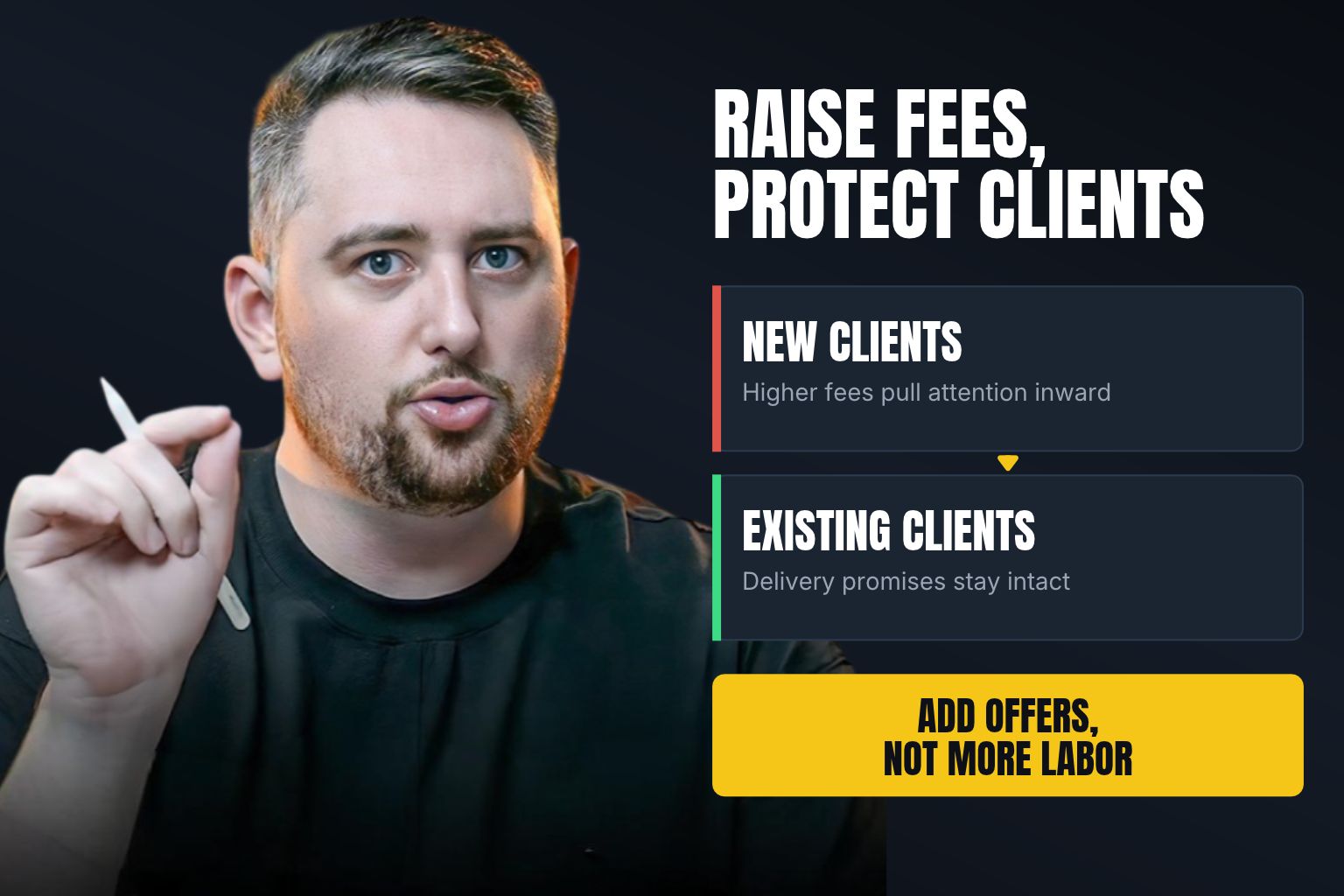
When you raise agency prices for new clients, watch what happens to the clients already paying you. A new account can suddenly look much more attractive than an older one that still needs delivery. If your team is already at capacity, that difference can start deciding who gets your attention. The old agreement has not changed just because the new deal pays better.
I want the higher price to make sense, but I also want a plan for the existing roster. Otherwise, the agency can improve its new-client economics while creating a service problem in the relationships that helped build the business.
Already making money? See what it takes to make a lot more.
Why Better New Deals Can Change How You See Old Ones
A higher-paying new client changes the comparison in your head. Work you previously accepted can start feeling less worthwhile when another account pays more for your attention.
I raised this concern with agency operators while discussing stronger upfront collection and an additional offer for their existing accounts. I wanted them to think ahead. If the new relationships became more valuable to them, what would stop the old relationships from receiving less attention?
You can see why that becomes a problem when the same people serve both. The new client’s launch needs help. The older client’s campaign also needs work. If the team is fully committed, enthusiasm about the new fee does not create another person to handle the old account.
A better new-client price leaves the existing delivery promise in place. Keep that promise visible while deciding how the agency will change. The client who signed earlier should not have to discover that your attention moved elsewhere.
For the initial price decision, what the agency actually collects per sale still matters. Once that decision starts producing different account economics, you also have to look at the work sitting behind the money.
What the Current Client Is Still Paying You to Do
Start with the service you have already agreed to provide. An older price can deserve a review while the work attached to the current agreement still deserves to be completed.
Look at the client’s active campaigns and outstanding work. Ask who is responsible for them and whether anything has begun waiting behind new-client activity. A service issue should be addressed directly instead of being hidden inside frustration about the price.
I would pay particular attention to work that keeps getting pushed to later. Has a reporting question remained unanswered? Is an approved change still waiting? Does somebody understand why it is delayed?
Atlassian’s capacity-planning guidance ties planned work to the people and skills available to do it. Use the actual workload when deciding whether both the new accounts and the current commitments can be supported.
That does not require inventing a complicated review system. You need an honest answer about the work, the people available, and the next commitment you intend to accept. If the same person is promised to everybody, a higher fee has not resolved the conflict.
Why Another Upsell Can Make a Full Team Busier
An upsell only helps this situation if the agency can deliver it sensibly. Adding a labor-heavy service to increase what an existing client pays can create another demand on the team you already have.
In the agency review, the operators had introduced video shoots. That meant physical travel and production, with editing work building up internally. I challenged that choice because they were selling more time-intensive delivery while trying to improve the business.
The issue was the work attached to the extra money. A larger invoice can look appealing until you follow it through the actual production requirements. Who does it, what must happen before it can start, and what existing work shares those people?
Keep the core service and additional services clear. If the new service needs its own delivery capability, treat that as a real requirement. Selling it as a convenient addition does not make it convenient to fulfill.
I would also look at corrections and repeated work. ASQ includes rework in the cost of quality. The time spent fixing something belongs in the cost of delivering the offer, even if it never appears as a new line on the customer’s invoice.
How an Existing Client Could Buy Something Genuinely Useful
Look for an additional problem you are equipped to solve, with delivery that makes sense for the agency. The buyer needs a reason to want it beyond helping you bring an old account closer to a new price.
For those operators, I suggested testing a different kind of offer around the client’s existing database and follow-up. The contrast with the filming service mattered. We were considering a different way to create useful work for the client without repeating the same physical production burden.
That suggestion was something to test. It was not proof that the agency already had a working service ready to sell across its roster. The setup, the client’s situation, and the ability to demonstrate what happened still mattered.
I told them to find a suitable current account, put the idea into action, and establish what it did before rolling it out further. An existing relationship can give you a place to test an offer; it does not remove the need to prove delivery.
I teach how the offer connects to acquisition and selling in Master Internet Marketing, my 7-week live comprehensive training. Keep the delivery side in that same conversation. A service that sounds good in the pitch still needs to work after the purchase.
Results are not typical. Your results will vary and depend entirely on your individual capacity, business experience, expertise, and level of desire. There are no guarantees concerning the level of success you may experience. The testimonials and examples used are not intended to represent or guarantee that anyone will achieve the same or similar results. We don’t believe in get-rich-quick programs. We believe in hard work, adding value and serving others. As stated by law, we can not and do not make any guarantees about your own ability to get results or earn any money with our information, courses, programs, or strategies.
What Changes When the Client Agrees to More Work
If the client wants an additional service, make the additional work clear. Do not leave the account team to discover which promises were included during the sales conversation.
Explain what the new purchase adds, what stays in the existing agreement, and who needs to participate. If the new service uses a client system or depends on somebody inside their business, resolve that before presenting it as ready.
PMI’s scope-change guidance calls for examining the impact of a proposed change, getting approval, and updating the plan. That is a useful discipline when a current account adds work. Extra revenue and extra obligations arrive together.
There is also a separate choice about changing the price of the existing service. An upsell and a price change are different conversations. A client may be suitable for one and have no need for the other.
Use the actual agreement when deciding how to discuss any change. Do not treat a new-client price as permission to rewrite an old commitment. Give the client a clear explanation of the proposed terms and let the appropriate people review them.
7 weeks. Real frameworks. Covering copywriting, funnels, paid ads, and conversion systems.
Why the Old Roster Still Needs Your Attention
The point of improving the economics is to build a business you can keep delivering. If the new price makes you resent every older account, that is something to resolve before it changes your behavior toward them.
A useful additional offer may fit some existing clients. Others may stay on the current service. You still need to know what the agency owes each relationship and whether the people assigned can do that work.
When the team is stretched, avoid solving the discomfort by quietly prioritizing whoever signed most recently. Look at the commitments already made. If more work would exceed what you can support, address that before accepting it.
Your agency pricing and delivery decisions need to work together. Better upfront collection can improve the next sale while a suitable additional service gives an existing client a reason to buy more. Both decisions still need people capable of supporting the work.
Bring the existing roster into the decision about the next stage of the agency. What must continue, what genuinely needs to change, and what additional service would help the client without burying your team? Those are useful questions for operators to work through together in my Inner Circle. A higher new-client fee should be part of a business you can stand behind across the whole roster.
Results are not typical. Your results will vary and depend entirely on your individual capacity, business experience, expertise, and level of desire. There are no guarantees concerning the level of success you may experience. The testimonials and examples used are not intended to represent or guarantee that anyone will achieve the same or similar results. We don’t believe in get-rich-quick programs. We believe in hard work, adding value and serving others. As stated by law, we can not and do not make any guarantees about your own ability to get results or earn any money with our information, courses, programs, or strategies.
Get my content first on Google
Add jeremyhaynes.com as a preferred source and Google shows my articles more prominently in your search results, including AI Overviews and AI Mode.


Jeremy Haynes
Owner and CEO of Megalodon Marketing
Jeremy Haynes is the founder of Megalodon Marketing. He is considered one of the top digital marketers and has the results to back it up.